
The fourth task: launching higher
by Gordon Buckland [email protected]
Daryl Perkins once said that the fourth task in F3B contests was the winch launch. His ability to launch higher than nearly everyone else played an important part in his winning five World Championships.
Every Thermal Duration flight begins with the launch. The higher you start your search for lift, the better chance you have of successfully completing the task and the greater your advantage is over nearly everyone else.
There are many misconceptions about launch setup and many approaches are followed, but the first step to a good launch for your modern F3J model is understanding three basic launch goals:
- Tension: Get the model to the greatest altitude on tow while winding in the least amount of line before diving for the zoom.
- Speed: Accelerate the model to the maximum speed during the dive part of the zoom while sacrificing the least amount of altitude.
- Final climb: Convert the stored kinetic energy of zoom speed to maximum height gain with a steep final climb.
If you achieve each of these goals, your model will attain the maximum altitude in the given conditions and you will have the greatest chance of successfully seeking thermals.
Trimming
Before optimizing your launch setup, make sure that your model is correctly trimmed. Set your desired CG position and trim your elevator for each flight mode.
There is no one right CG position—merely the one that suits your flying style best. Most pilots prefer a moderately rearward CG position so the model provides more feedback while hunting for lift. This makes the model slightly less stable in pitch but much more responsive.
Consider the following steps when trimming your airplane:
- Thermal camber (positive TE camber of 2-4mm at the root): I suggest that you set the elevator trim so your model is flying as slowly as possible, but not quite at the point of stall.
- Cruise camber (TE neutral): I like enough down-trim set in cruise where my model is clearly flying faster, so I can move around and penetrate upwind.
- Reflex (negative TE camber of 3-5mm): I prefer enough down-trim that the model gets moving on step. I select reflex when the model is a long way downwind; I want to be sure it comes home.
Tension
The first step in launch optimization requires your model to be set up for maximum tension against the towline. If your model pulls hard all the way up, the winch will wind in the least amount of line before the zoom and your model will be at the greatest altitude possible before initiating the zoom.
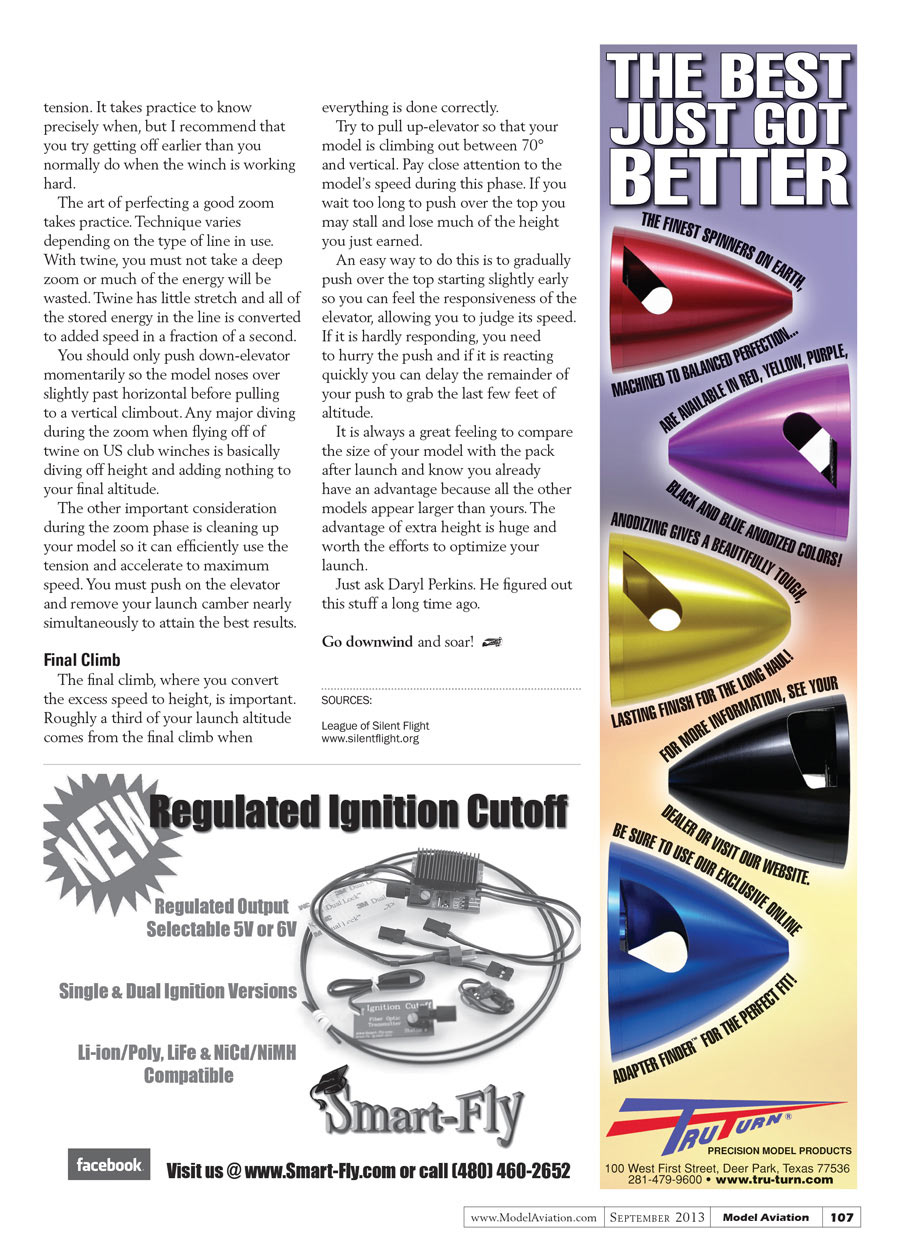
In order to pull hard, your model’s wing needs to produce maximum lift for the relatively slow speed at which it climbs out, and the towhook must be positioned close to the theoretical center of lift. This requires a significant amount of positive camber (combined flap and aileron).
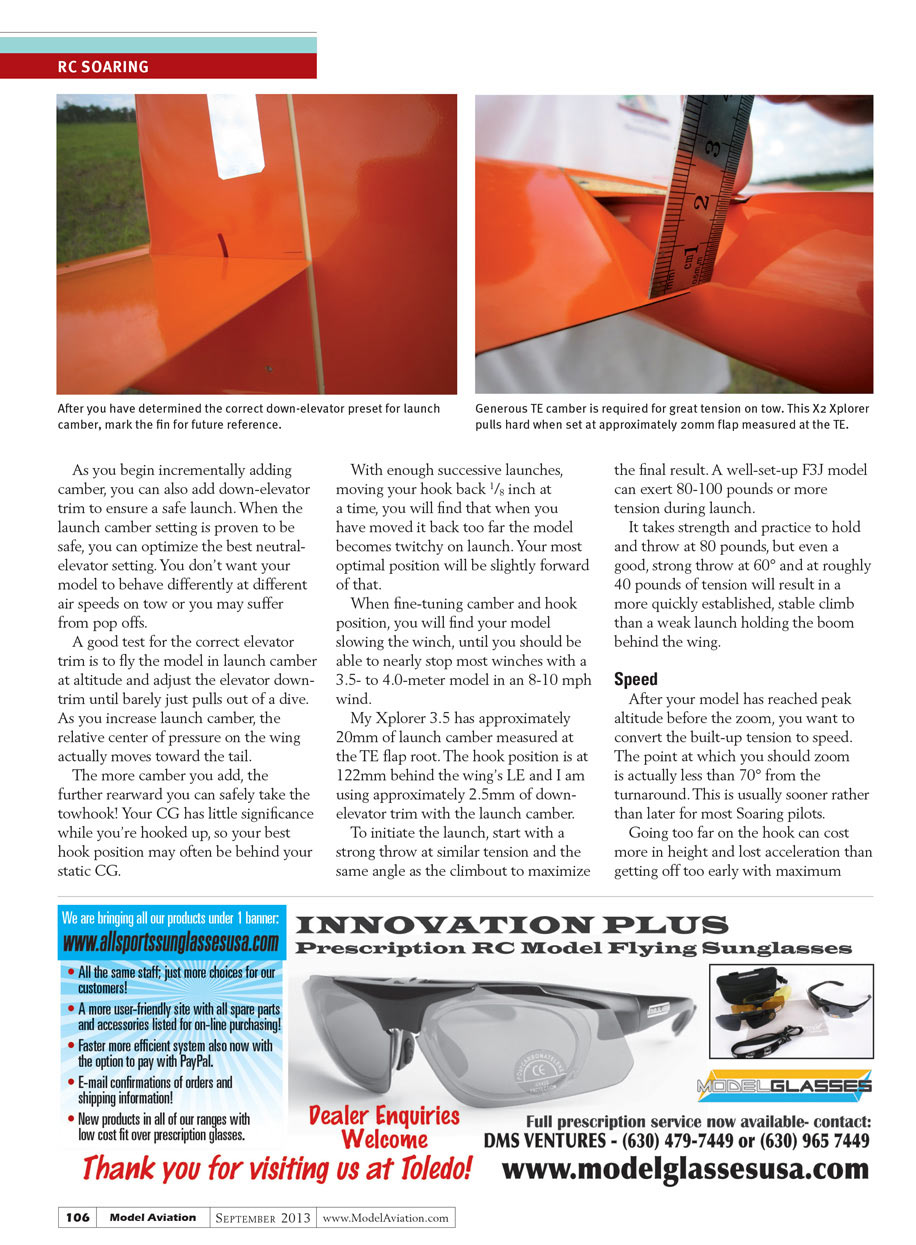
The amount of camber will vary on different models, but you can gradually increase camber throughout successive launches. As you begin incrementally adding camber, you can also add down-elevator trim to ensure a safe launch. When the launch camber setting is proven to be safe, you can optimize the best neutral-elevator setting. You don't want your model to behave differently at different air speeds on tow or you may suffer from pop offs.
A good test for the correct elevator trim is to fly the model in launch camber at altitude and adjust the elevator downtrim until barely just pulls out of a dive. As you increase launch camber, the relative center of pressure on the wing actually moves toward the tail.
The more camber you add, the further rearward you can safely take the towhook! Your CG has little significance while you're hooked up, so your best hook position may often be behind your static CG.
With enough successive launches, moving your hook back 1/8 inch at a time you will find that when you have moved it back too far the model becomes twitchy on launch. Your most optimal position will be slightly forward of that.
When fine-tuning camber and hook position, you will find your model slowing the winch, until you should be able to nearly stop most winches with a 3.5- to 4.0-meter model in an 8-10 mph wind.
My Xplorer 3.5 has approximately 20mm of launch camber measured at the TE flap root. The hook position is at 122mm behind the wing's LE and I am using approximately 2.5mm of down-elevator trim with the launch camber.
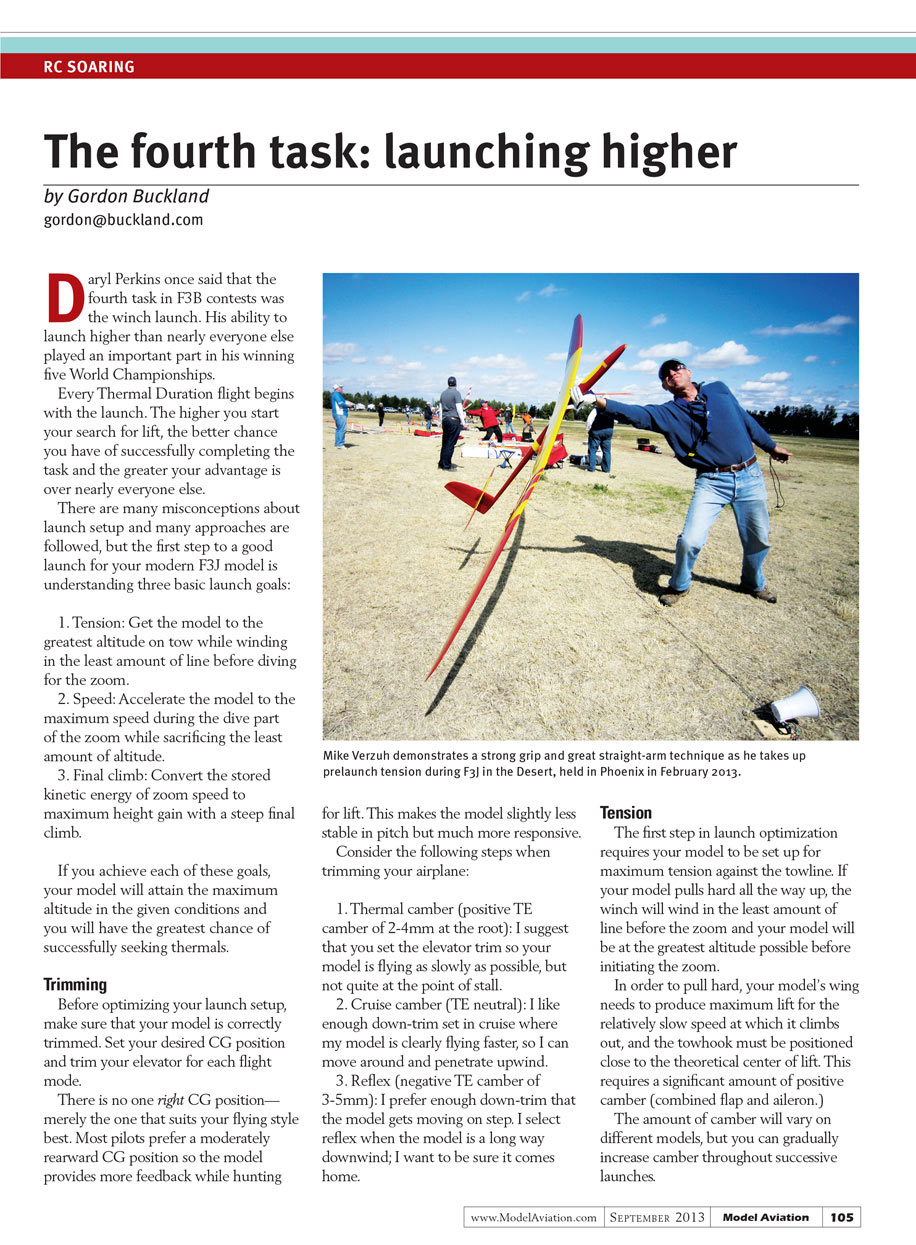
To initiate the launch, start with a strong throw at similar tension and the same angle as the climbout to maximize the final result. A well-set-up F3J model can exert 80-100 pounds or more tension during launch.
It takes strength and practice to hold and throw at 80 pounds, but even a good, strong throw at 60° and at roughly 40 pounds of tension will result in a more quickly established, stable climb than a weak launch holding the boom behind the wing.
Speed
After your model has reached peak altitude before the zoom, you want to convert the built-up tension to speed. The point at which you should zoom is actually less than 70° from the turnaround. This is usually sooner rather than later for most Soaring pilots.
Going too far on the hook can cost more in height and lost acceleration than getting off too early with maximum speed. You must push on the elevator and remove your launch camber nearly simultaneously to attain the best results.
Final Climb
The final climb, where you convert the excess speed to height, is important. Roughly a third of your launch altitude comes from the final climb when everything is done correctly.
Try to pull up-elevator so that your model is climbing out between 70° and vertical. Pay close attention to the model's speed during this phase. If you wait too long to push over the top you may stall and lose much of the height you just earned.
An easy way to do this is to gradually push over the top starting slightly early so you can feel the responsiveness of the elevator, allowing you to judge its speed. If it is hardly responding, you need to hurry the push and if it is reacting quickly you can delay the remainder of your push to grab the last few feet of altitude.
It is always a great feeling to compare the size of your model with the pack after launch and know you already have an advantage because all the other models appear larger than yours. The advantage of extra height is huge and worth the efforts to optimize your launch.
Just ask Daryl Perkins. He figured out this stuff a long time ago.
Go downwind and soar!
SOURCES:
League of Silent Flight www.silentflight.org
Transcribed from original scans by AI. Minor OCR errors may remain.

