
Team USA F3B did well in Germany
by Gordon Buckland <REDACTED>
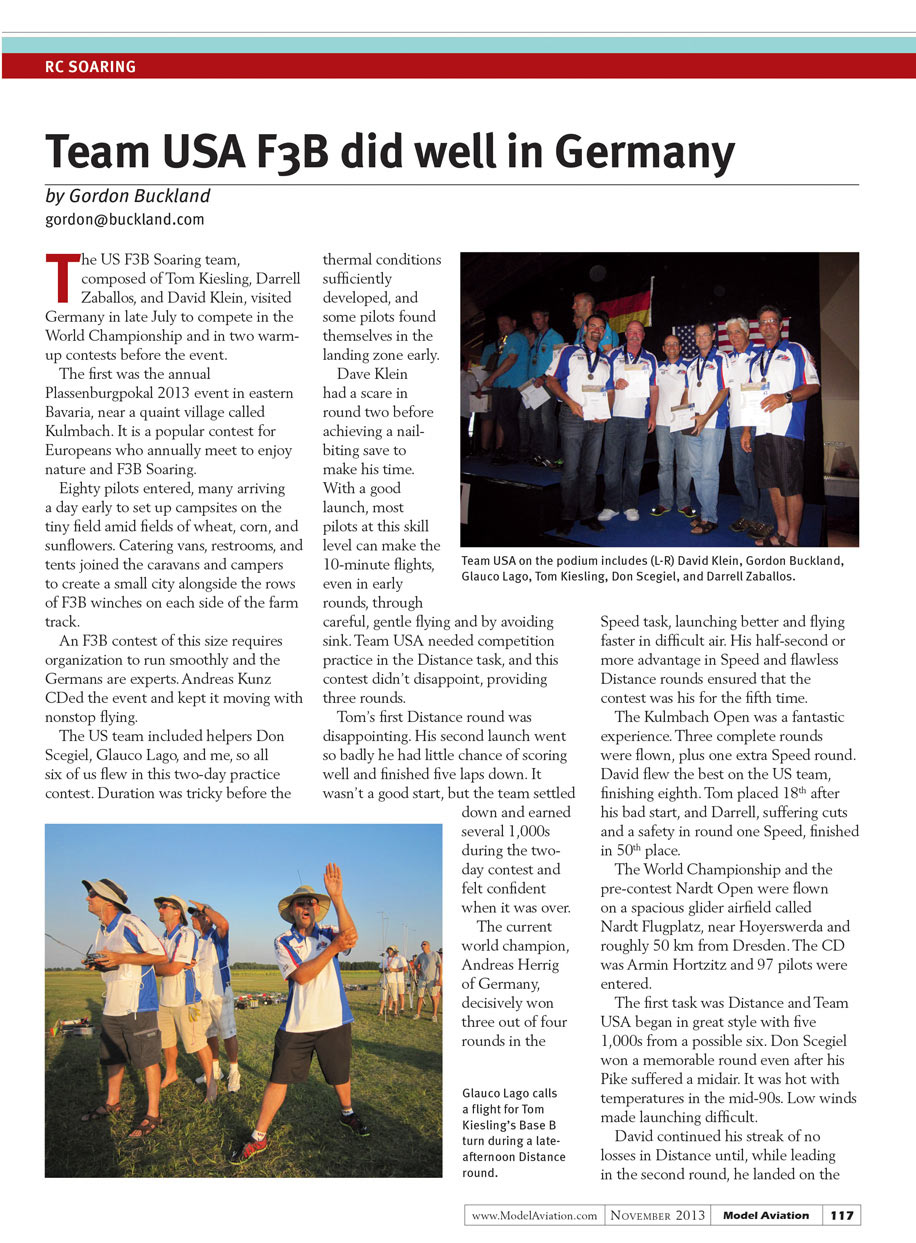
The US F3B Soaring team, composed of Tom Kiesling, Darrell Zaballos, and David Klein, visited Germany in late July to compete in the World Championship and in two warm-up contests before the event.
The first was the annual Plassenburgpokal 2013 event in eastern Bavaria, near a quaint village called Kulmbach. It is a popular contest for Europeans who annually meet to enjoy nature and F3B Soaring.
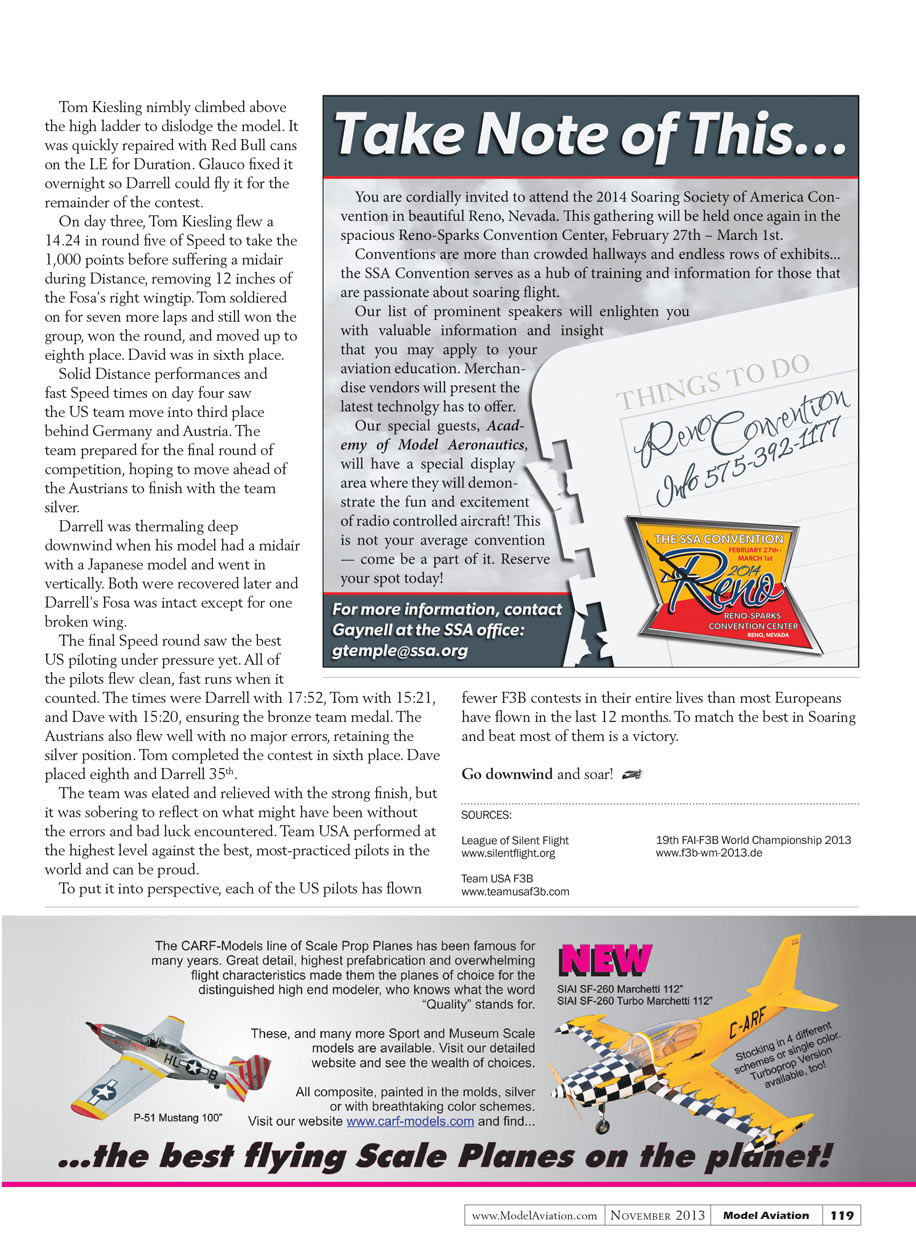
Eighty pilots entered, many arriving a day early to set up campsites on the tiny field amid fields of wheat, corn, and sunflowers. Catering vans, restrooms, and tents joined the caravans and campers to create a small city alongside the rows of F3B winches on each side of the farm track.
An F3B contest of this size requires organization to run smoothly and the Germans are experts. Andreas Kunz CDed the event and kept it moving with nonstop flying.
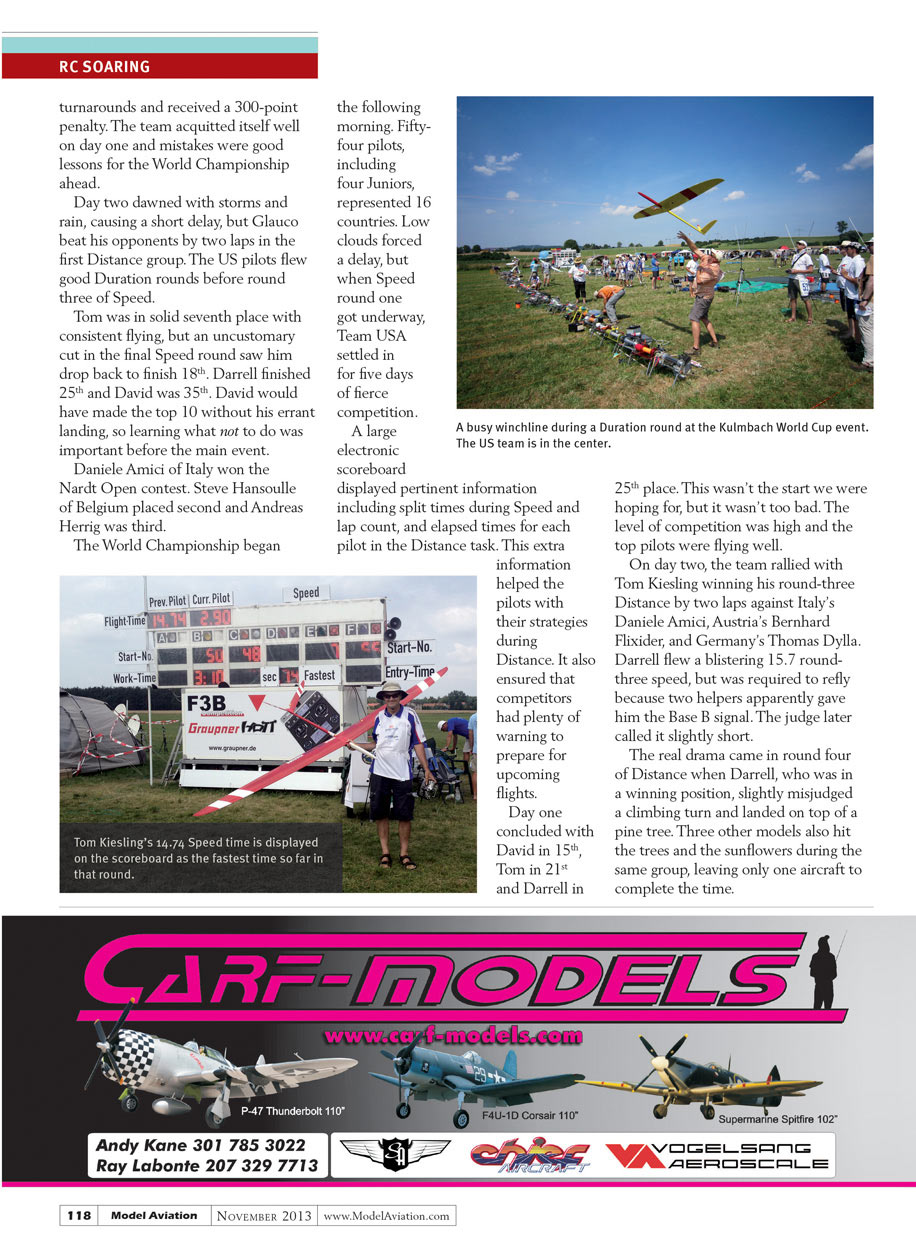
The US team included helpers Don Sciegiel, Glauco Lago, and me, so all six of us flew in this two-day practice contest. Duration was tricky before the thermal conditions sufficiently developed, and some pilots found themselves in the landing zone early.
Dave Klein had a scare in round two before achieving a nail-biting save to make his time. With a good launch, most pilots at this skill level can make the 10-minute flights, even in early rounds, through careful, gentle flying and by avoiding sink. Team USA needed competition practice in the Distance task, and this contest didn't disappoint, providing three rounds.
Tom's first Distance round was disappointing. His second launch went so badly he had little chance of scoring well and finished five laps down. It wasn't a good start, but the team settled down and earned several 1,000s during the two-day contest and felt confident when it was over.
The current world champion, Andreas Herrig of Germany, decisively won three out of four rounds in the thermal task, launching better and flying faster in difficult air. His half-second or more advantage in Speed and flawless Distance rounds ensured that the contest was his for the fifth time.
The Kulmbach Open was a fantastic experience. Three completed rounds were flown, plus one extra Speed round. David flew the best on the US team, finishing eighth. Tom placed 18th after his bad start, and Darrell, suffering cuts and a safety in round one Speed, finished in 50th place.
The World Championship and the pre-contest Nardt Open were flown on a spacious glider airfield called Nardt Flugplatz, near Hoyerswerda and roughly 50 km from Dresden. The CD was Armin Hortzitz and 97 pilots were entered.
The first task was Distance and Team USA began in great style with five 1,000s from a possible six. Don Sciegiel won a memorable round even after his Pike suffered a midair. It was hot with temperatures in the mid-90s. Low winds made launching difficult.
David continued his streak of no losses in Distance until, while leading in the second round, he landed on the turnarounds and received a 300-point penalty. The team acquitted itself well on day one and mistakes were good lessons for the World Championship ahead.
Day two dawned with storms and rain, causing a short delay, but Glauco beat his opponents by two laps in the first Distance group. The US pilots flew good Duration rounds before round three of Speed.
Tom was in solid seventh place with consistent flying, but an uncustomary cut in the final Speed round saw him drop back to finish 18th. Darrell finished 25th and David was 35th. David would have made the top 10 without his errant landing, so learning what not to do was important before the main event.
Daniele Amici of Italy won the Nardt Open contest. Steve Hansoulle of Belgium placed second and Andreas Herrig was third.
The World Championship began the following morning. Fifty-four pilots, including four Juniors, represented 16 countries. Low clouds forced a delay, but when Speed round one got underway, Team USA settled in for five days of fierce competition.
A large electronic scoreboard displayed pertinent information including split times during Speed and lap count, and elapsed times for each pilot in the Distance task. This extra information helped the pilots with their strategies during Distance. It also ensured that competitors had plenty of warning to prepare for upcoming flights.
Day one concluded with David in 15th, Tom in 21st and Darrell in 25th place. This wasn't the start we were hoping for, but it wasn't too bad. The level of competition was high and the top pilots were flying well.
On day two, the team rallied with Tom Kiesling winning his round-three Distance by two laps against Italy's Daniele Amici, Austria's Bernhard Flixrider, and Germany's Thomas Dylla. Darrell flew a blistering 15.7 round-three speed, but was required to refly because two helpers apparently gave him the Base B signal. The judge later called it slightly short.
The real drama came in round four of Distance when Darrell, who was in a winning position, slightly misjudged a climbing turn and landed on top of a pine tree. Three other models also hit the trees and the sunflowers during the same group, leaving only one aircraft to complete the time.
RC Soaring
Gordon Buckland
Tom Kiesling nimbly climbed above the high ladder to dislodge the model. It was quickly repaired with Red Bull cans on the LE for Duration. Glauco fixed it overnight so Darrell could fly it for the remainder of the contest.
On day three, Tom Kiesling flew a 14.24 in round five of Speed to take the 1,000 points before suffering a midair during Distance, removing 12 inches of the Fosa's right wingtip. Tom soldiered on for seven more laps and still won the group, won the round, and moved up to eighth place. David was in sixth place.
Solid Distance performances and fast Speed times on day four saw the US team move into third place behind Germany and Austria. The team prepared for the final round of competition, hoping to move ahead of the Austrians to finish with the team silver.
Darrell was thermaling deep downwind when his model had a midair with a Japanese model and went in vertically. Both were recovered later and Darrell's Fosa was intact except for one broken wing.
The final Speed round saw the best US piloting under pressure yet. All of the pilots flew clean, fast runs when it counted. The times were Darrell with 17.52, Tom with 15.21, and Dave with 15.20, ensuring the bronze team medal. The Austrians also flew well with no major errors, retaining the silver position. Tom completed the contest in sixth place. Dave placed eighth and Darrell 35th.
The team was elated and relieved with the strong finish, but it was sobering to reflect on what might have been without the errors and bad luck encountered. Team USA performed at the highest level against the best, most-practiced pilots in the world and can be proud.
To put it into perspective, each of the US pilots has flown fewer F3B contests in their entire lives than most Europeans have flown in the last 12 months. To match the best in Soaring and beat most of them is a victory.
Go downwind and soar!
SOURCES:
- League of Silent Flight
- Team USA F3B
- 19th FAI-F3B World Championship 2013
Transcribed from original scans by AI. Minor OCR errors may remain.

