
RADIO CONTROL SOARING
Mike Garton, 506 NE 6th St., Ankeny IA 50021; E-mail: [email protected]
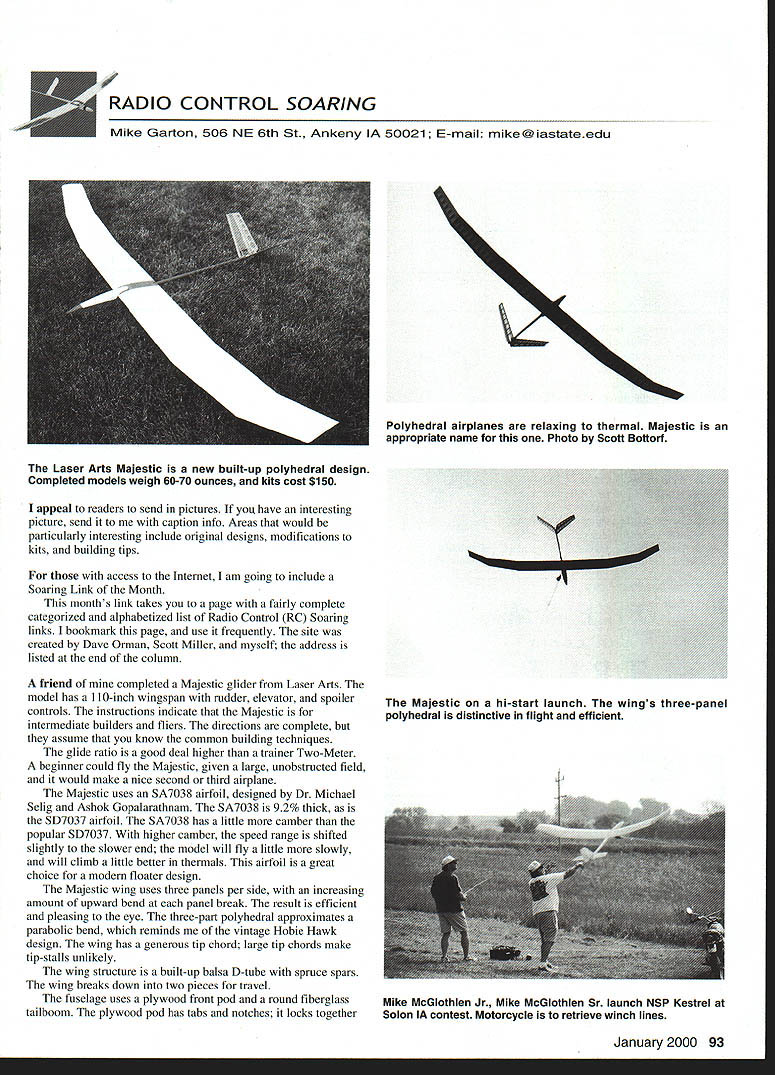
The Laser Arts Majestic is a new built-up polyhedral design. Completed models weigh 60–70 ounces, and kits cost $150.
I appeal to readers to send in pictures. If you have an interesting picture, send it to me with caption info. Areas that would be particularly interesting include original designs, modifications to kits, and building tips.
For those with access to the Internet, I am going to include a Soaring Link of the Month.
This month's link takes you to a page with a fairly complete categorized and alphabetized list of Radio Control (RC) Soaring links. I bookmark this page and use it frequently. The site was created by Dave Orman, Scott Miller, and myself; the address is listed at the end of the column.
A friend of mine completed a Majestic glider from Laser Arts. The model has a 110-inch wingspan with rudder, elevator, and spoiler controls. The instructions indicate that the Majestic is for intermediate builders and fliers. The directions are complete, but they assume that you know the common building techniques.
The glide ratio is a good deal higher than a trainer Two-Meter. A beginner could fly the Majestic, given a large, unobstructed field, and it would make a nice second or third airplane.
The Majestic uses an SA7038 airfoil, designed by Dr. Michael Selig and Ashok Gopalarathnam. The SA7038 is 9.2% thick, as is the SD7037 airfoil. The SA7038 has a little more camber than the popular SD7037. With higher camber, the speed range is shifted slightly to the slower end; the model will fly a little more slowly and will climb a little better in thermals. This airfoil is a great choice for a modern floater design.
The Majestic wing uses three panels per side, with an increasing amount of upward bend at each panel break. The result is efficient and pleasing to the eye. The three-part polyhedral approximates a parabolic bend, which reminds me of the vintage Hobie Hawk design. The wing has a generous tip chord; large tip chords make tip-stalls unlikely.
The wing structure is a built-up balsa D-tube with spruce spars. The wing breaks down into two pieces for travel.
The fuselage uses a plywood front pod and a round fiberglass tailboom. The plywood pod has tabs and notches; it locks together and fits well. The tailboom slips into the plywood pod and is pinned and glued. The canopy and nose block are hollowed balsa, and the model's center of gravity is near the access hatch so that adjustments are easy to make.
The stock kit includes plans for built-up surfaces. The elevator and rudder are both built-up. The stock design calls for spoilers in the wing, but the test model received a pair of airbrakes that extend from the wing's top surface. These are effective for approach control and make landings predictable and easy.
The Majestic has proven itself to be a pleasant, well-mannered thermal sailplane. It tows well behind a motorcycle winch and is predictable on aerotow. The three-panel polyhedral gives the model a calm and steady feel in turbulence and a good glide in lift.
January 2000
There is no additional PRIMARY ARTICLE text on this page beyond the PRIOR PAGE CONTEXT provided.
The airplane handles well. It takes time to get a V-tail set up just right. Usually, the surfaces are adjusted to have more down travel than up travel; this difference in travel is called V-tail differential. Too little V-tail differential makes an airplane fly nose-high in a thermal turn. This also changes with center of gravity. It helps to have an experienced V-tail person to tweak the amount of differential.
The Majestic plans are very nice CAD (Computer-Aided Drafting) drawings. All of the wooden parts are laser-cut. The kit is reasonably priced at $150 and is available direct from Laser Arts.
The Majestic is a classy airplane. It will be a contender in the Rudder-Elevator-Spoiler class.
Dave Meyers at Laser Arts provides custom laser-cutting; he is geared toward one-of-a-kind rib sets and small production runs. The cutting can be done from AutoCAD files or Compufile files. A CAD file can also be created from a verbal description. Dave can cut balsa and plywood, and he says that his laser is accurate to .003 inch.
Current rates are $30 per hour for CAD time and $30 per hour for laser time. Each job is quoted separately.
Typical costs:
- Sport airplane rib sets: $12–$25 (including laser time and wood)
- Hand-Launched Glider rib sets: $10–$16 (for laser time and wood)
Shipping and CAD time are not included in these prices.
More information about Laser Arts and its services can be found on its Web site (listed at the end of the article).
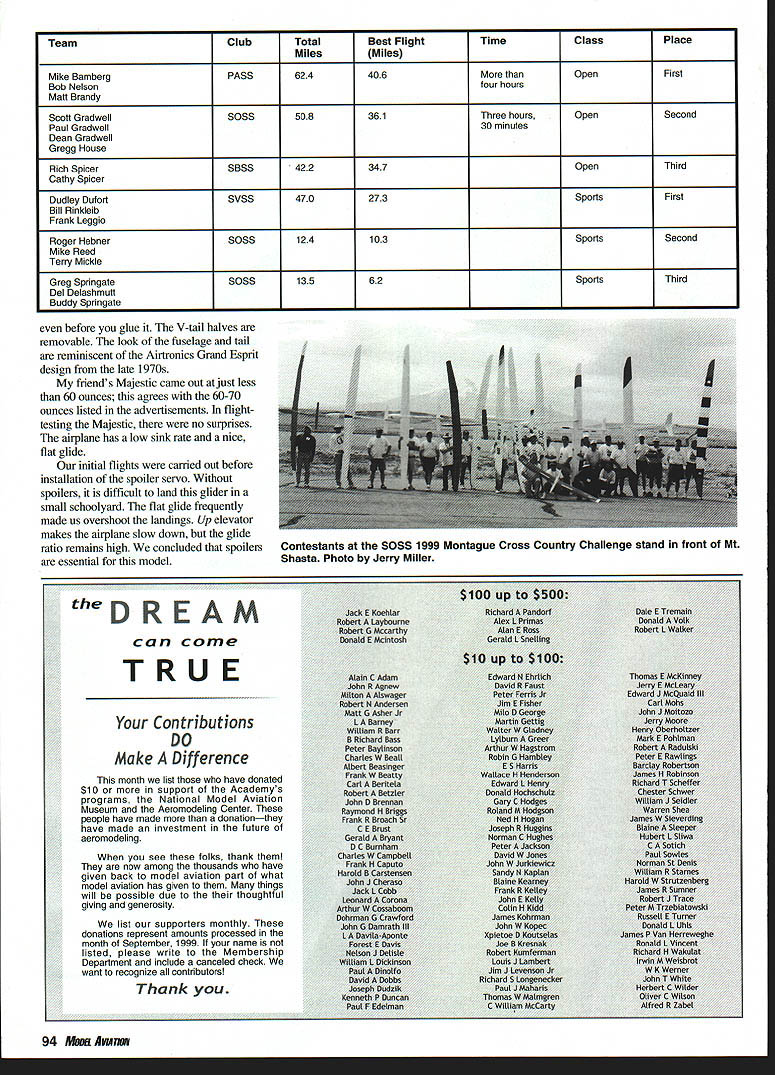
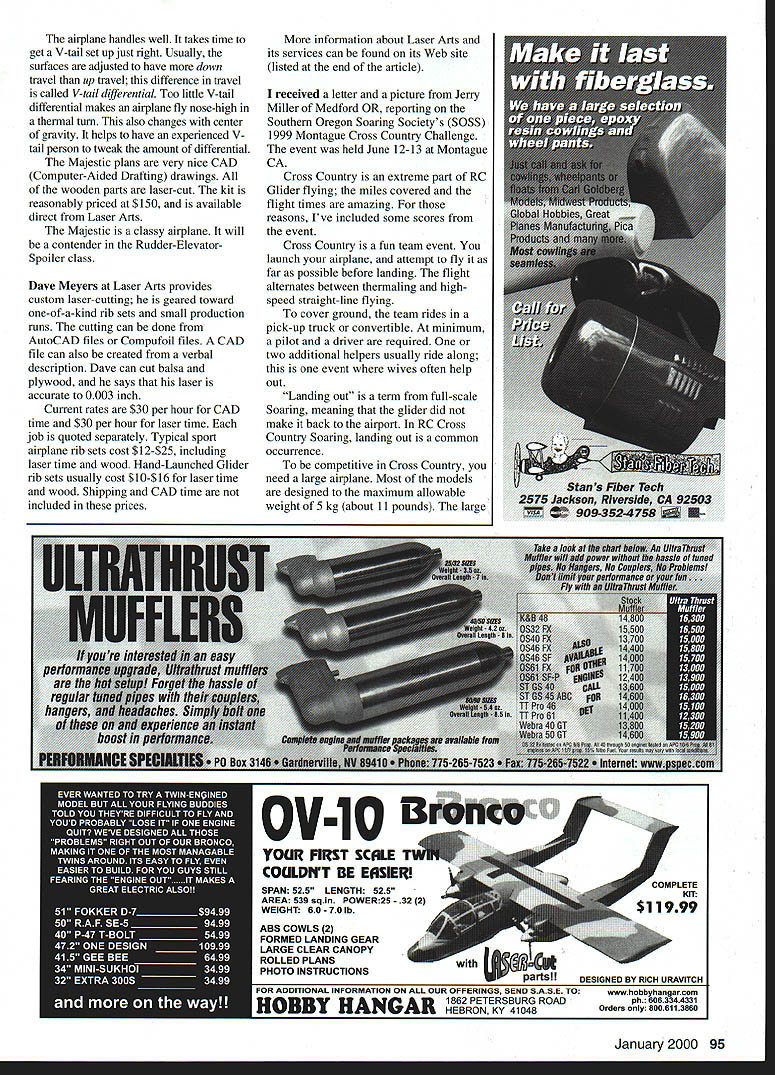
I received a letter and a picture from Jerry Miller of Medford OR, reporting on the Southern Oregon Soaring Society's (SOSS) 1999 Montague Cross Country Challenge. The event was held June 12–13 at Montague CA.
Cross Country is an extreme part of RC glider flying; the miles covered and the flight times are amazing. For that reason, I've included some scores from the event.
Cross Country is a fun team event. You launch your airplane and attempt to fly it as far as possible before landing. The flight alternates between thermaling and high-speed straight-line flying.
To cover ground, the team rides in a pick-up truck or convertible. At minimum, a pilot and a driver are required. One or two additional helpers usually ride along; this is one event where wives often help out.
"Landing out" is a term from full-scale soaring, meaning that the glider did not make it back to the airport. In RC Cross Country Soaring, landing out is a common occurrence.
To be competitive in Cross Country, you need a large airplane. Most of the models are designed to the maximum allowable weight of 5 kg (about 11 pounds). The large size gives them a huge glide ratio and good visibility at altitude.
The most-common model at the Montague event was the RnR Products SB-XC, an all-molded composite airplane. It has a wingspan of just more than 14 feet. A fast SD-2048 airfoil gives it a high top speed. The SB-XC is a bargain; it costs about the same amount as a smaller molded airplane.
The SOSS contest was run in two classes: Open and Sports (Sportsman). Dudley Dufort easily won the Sportsman class. He will be in the Open class next year. It was a great success and will be held again next year. MA
Soaring Link of the Month (EISS links page)
http://eiss.cnde.iastate.edu/links.shtml
Contacts and Resources
Laser Arts
- 445 E. Cheyenne Mountain Blvd. C-112
- Colorado Springs CO 80906
- E-mail: [email protected]
- Web site: http://members.aol.com/laserartco/index.html
Michael Selig’s Airfoil Web page:
SA7035 airfoil information:
Southern Oregon Soaring Society (SOSS)
- Club president DJ Buell: (541) 772-7531
- E-mail: [email protected]
- Web page: http://www.soaroregon.com/
RnR Products
- 1120 Wrigley Way, Milpitas CA 95035
- (408) 946-4751
- http://www.rnrproducts.com/
Transcribed from original scans by AI. Minor OCR errors may remain.

