
RC Soaring
Mike Garton, 506 NE 6th St., Ankeny IA 50021; E-mail: [email protected]
Epoxy: bonding vs. laminating
Epoxy applications are usually categorized into bonding and laminating. Bonding with epoxy is common for the highest-stress areas in most built-up glider kits. Laminating refers to wetting a structural fabric, such as carbon, with epoxy to form a composite.
I am concentrating this column on a couple of areas that have been underemphasized: choosing the right laminating resin and hand protection.
Making composites with epoxy opens up a can of worms. The level of knowledge, caution, and preparation required are much higher than when simply bonding with epoxy. Laminating composites is best left to serious modelers who are creating high-performance structures.
Composites are generally used to make a strong part lighter, or a light part stronger. The structural properties of the epoxy become very important. Distributors of laminating epoxies can give you a specification sheet. Low viscosity of the mixed epoxy is desired; this makes it easier to wet fiberglass and carbon fabrics.
The "pot life" and "thin film gel time" give an indication of how much time you will have to work before the epoxy sets up. Some epoxies require baking, or "postcuring," to fully cure. Most of the really strong epoxies require a postcure.
Heat resistance: Tg and HDT
The glass transition temperature (Tg) and/or heat deflection temperature (HDT) will dictate the maximum temperature at which the finished composite can be used. This is an important consideration; cured epoxies will become soft if you heat them above the Tg or the HDT. Did you ever wonder why some wings turn into bananas in a hot car? The temperature in the car exceeded the HDT for the epoxy, and it softened. Gravity and thermal stresses reshaped the part. Unpainted carbon parts on a glider wing are also at risk.
I tested my green car, and I learned that it typically reaches 170° F inside on a 90° day.
The HDT is learned by the epoxy formulator with a standardized test. A small ball bearing is pressed into a sample of cured epoxy with a specified force, and the temperature is slowly increased. When the ball bearing sinks a specified amount into the epoxy, the HDT has been reached.
The Tg and the HDT are usually within a few degrees of each other. Having data for one or the other should be sufficient. There is a general correlation between cure temperature and heat deflection temperature; the heat deflection temperature is usually a few degrees higher.
If you are serious about making a high-performance composite glider, you have to postcure the laminates.
Building a heat box (postcure oven)
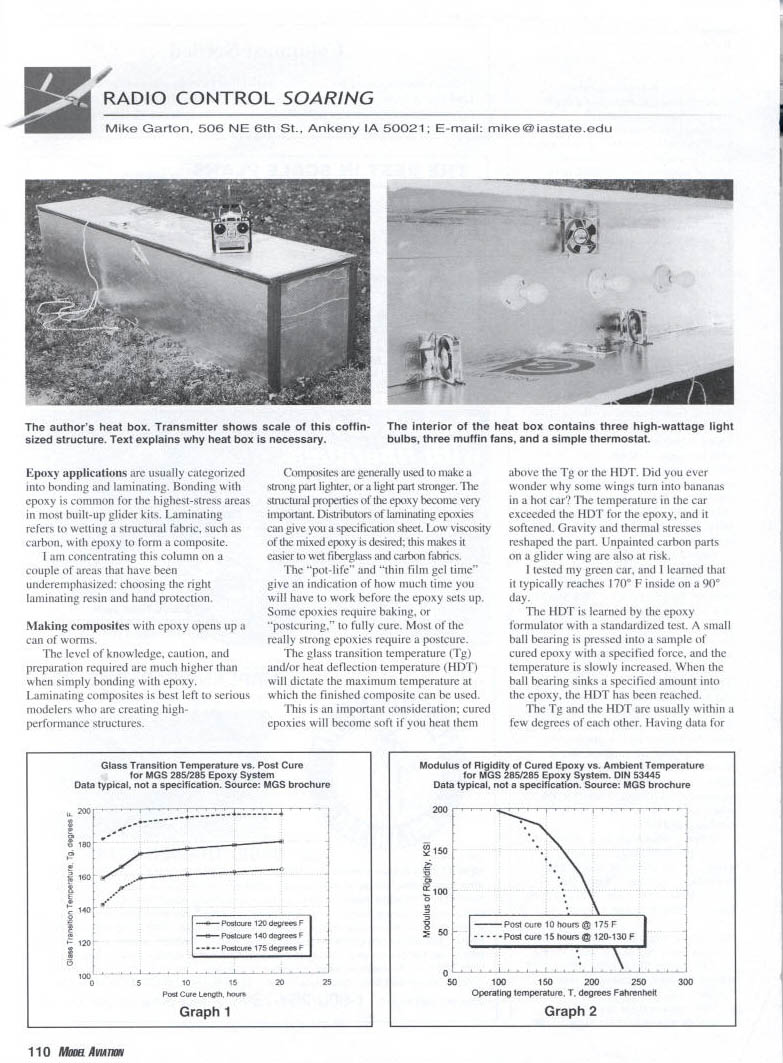
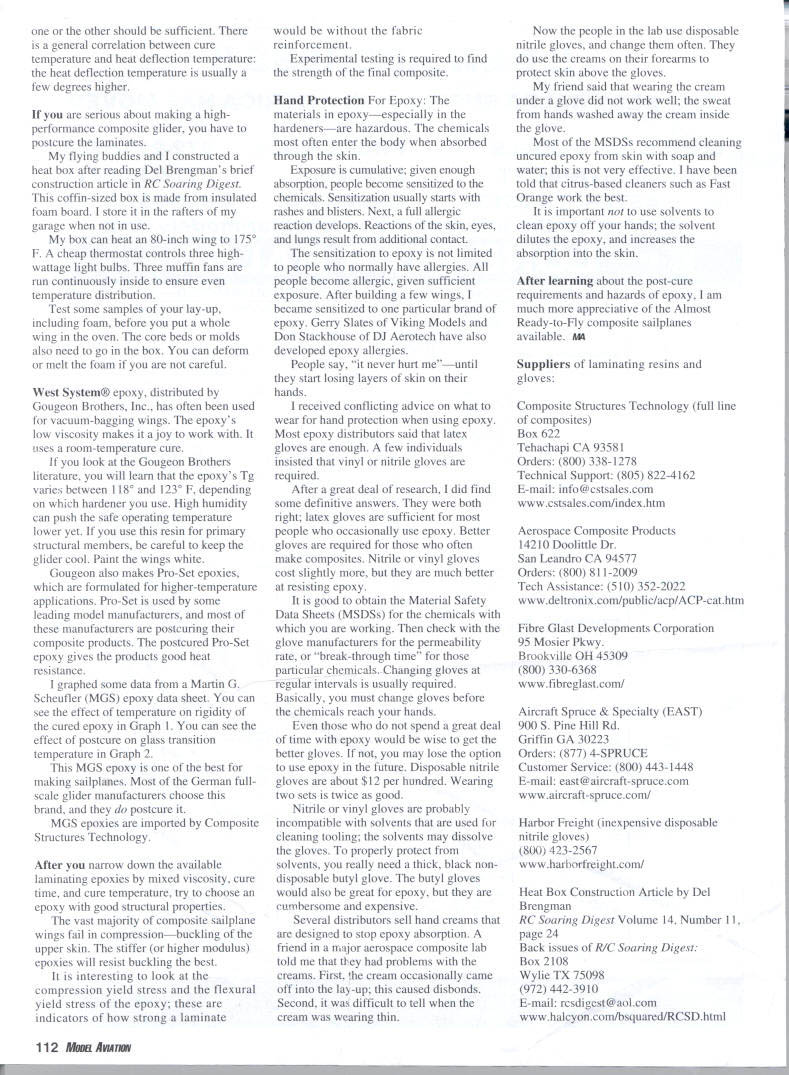
My flying buddies and I constructed a heat box after reading Del Brenngam's brief construction article in RC Soaring Digest. This coffin-sized box is made from insulated foam board. I store it in the rafters of my garage when not in use.
My box can heat an 80-inch wing to 175° F. A cheap thermostat controls three high-wattage light bulbs. Three muffin fans are run continuously inside to ensure even temperature distribution.
Test some samples of your lay-up, including foam, before you put a whole wing in the oven. The core, beads, or molds also need to go in the box. You can deform or melt the foam if you are not careful.
Common laminating epoxies and considerations
West System® epoxy, distributed by Gougeon Brothers, Inc., has often been used for vacuum-bagging wings. The epoxy's low viscosity makes it a joy to work with. It uses a room-temperature cure.
If you look at the Gougeon Brothers' literature, you will learn that the epoxy's Tg varies between 118° and 123° F, depending on which hardener you use. High humidity can push the safe operating temperature lower yet. If you use this resin for primary structural members, be careful to keep the glider cool. Paint the wings white.
Gougeon also makes Pro-Set epoxies, which are formulated for higher-temperature applications. Pro-Set is used by some leading model manufacturers, and most of these manufacturers are postcuring their composite products. The postcured Pro-Set epoxy gives the products good heat resistance.
I graphed some data from a Martin G. Scheufler (MGS) epoxy data sheet. You can see the effect of temperature on rigidity of the cured epoxy in Graph 1. You can see the effect of postcure on glass transition temperature in Graph 2.
This MGS epoxy is one of the best for making sailplanes. Most of the German full-scale glider manufacturers choose this brand, and they do postcure it.
MGS epoxies are imported by Composite Structures Technology.
After you narrow down the available laminating epoxies by mixed viscosity, cure time, and cure temperature, try to choose an epoxy with good structural properties.
The vast majority of composite sailplane wings fail in compression—buckling of the upper skin. The stiffer (or higher modulus) epoxies will resist buckling the best.
It is interesting to look at the compression yield stress and the flexural yield stress of the epoxy; these are indicators of how strong a laminate would be without the fabric reinforcement.
Experimental testing is required to find the strength of the final composite.
Hand protection for epoxy
The materials in epoxy—especially in the hardeners—are hazardous. The chemicals most often enter the body when absorbed through the skin.
Exposure is cumulative; given enough absorption, people become sensitized to the chemicals. Sensitization usually starts with rashes and blisters. Next, a full allergic reaction develops. Reactions of the skin, eyes, and lungs result from additional contact.
The sensitization to epoxy is not limited to people who normally have allergies. All people become allergic, given sufficient exposure. After building a few wings, I became sensitized to one particular brand of epoxy. Gerry Slates of Viking Models and Don Stackhouse of DJ Aerotech have also developed epoxy allergies.
People say, "it never hurt me"—until they start losing layers of skin on their hands.
I received conflicting advice on what to wear for hand protection when using epoxy. Most epoxy distributors said that latex gloves are enough. A few individuals insisted that vinyl or nitrile gloves are required.
After a great deal of research, I did find some definitive answers. They were both right; latex gloves are sufficient for most people who occasionally use epoxy. Better gloves are required for those who often make composites. Nitrile or vinyl gloves cost slightly more, but they are much better at resisting epoxy.
It is good to obtain the Material Safety Data Sheets (MSDSs) for the chemicals with which you are working. Then check with the glove manufacturers for the permeation rate, or "break-through time" for those particular chemicals. Changing gloves at regular intervals is usually required. Basically, you must change gloves before the chemicals reach your hands.
Even those who do not spend a great deal of time with epoxy would be wise to get the better gloves. If not, you may lose the option to use epoxy in the future. Disposable nitrile gloves are about $12 per hundred. Wearing two sets is twice as good.
Nitrile or vinyl gloves are probably incompatible with solvents that are used for cleaning tooling; the solvents may dissolve the gloves. To properly protect from solvents, you really need a thick, black non-disposable butyl glove. The butyl gloves would also be great for epoxy, but they are cumbersome and expensive.
Several distributors sell hand creams that are designed to stop epoxy absorption. A friend in a major aerospace composite lab told me that they had problems with these creams. First, the cream occasionally came off into the lay-up; this caused dis-bonds. Second, it was difficult to tell when the cream was wearing thin.
Now the people in the lab use disposable nitrile gloves, and change them often. They do use the creams on their forearms to protect skin above the gloves.
My friend said that wearing the cream under a glove did not work well; the sweat from hands washed away the cream inside the glove.
Most of the MSDSs recommend cleaning uncured epoxy from skin with soap and water; this is not very effective. I have been told that citrus-based cleaners such as Fast Orange work the best.
It is important not to use solvents to clean epoxy off your hands; the solvent dilutes the epoxy, and increases the absorption into the skin.
After learning about the post-cure requirements and hazards of epoxy, I am much more appreciative of the Almost Ready-to-Fly composite sailplanes available.
Suppliers of laminating resins and gloves
- Composite Structures Technology (full line of composites)
Box 622 Tehachapi CA 93581 Orders: (800) 338-1278 Technical Support: (805) 822-4162 E-mail: [email protected] www.cstsales.com/index.htm
- Aerospace Composite Products
14210 Doolittle Dr. San Leandro CA 94577 Orders: (800) 811-2009 Tech Assistance: (510) 352-2022 www.deltronix.com/public/acp/ACP-cat.htm
- Fibre Glast Developments Corporation
95 Mosier Pkwy. Brookville OH 45309 (800) 330-6368 www.fibreglast.com/
- Aircraft Spruce & Specialty (EAST)
900 S. Pine Hill Rd. Griffin GA 30223 Orders: (877) 4-SPRUCE Customer Service: (800) 443-1448 E-mail: [email protected] www.aircraft-spruce.com/
- Harbor Freight (inexpensive disposable nitrile gloves)
(800) 423-2567 www.harborfreight.com/
- Heat Box Construction Article by Del Brenngam
RC Soaring Digest Volume 14, Number 11, page 24
- Back issues of RC Soaring Digest:
Box 2108 Wylie TX 75098 (972) 442-3910 E-mail: [email protected] www.halcyon.com/bsquared/RCSD.html
Transcribed from original scans by AI. Minor OCR errors may remain.

