
RADIO CONTROL SOARING
Mike Garton, 506 NE 6th St., Ankeny IA 50021; E-mail: [email protected]
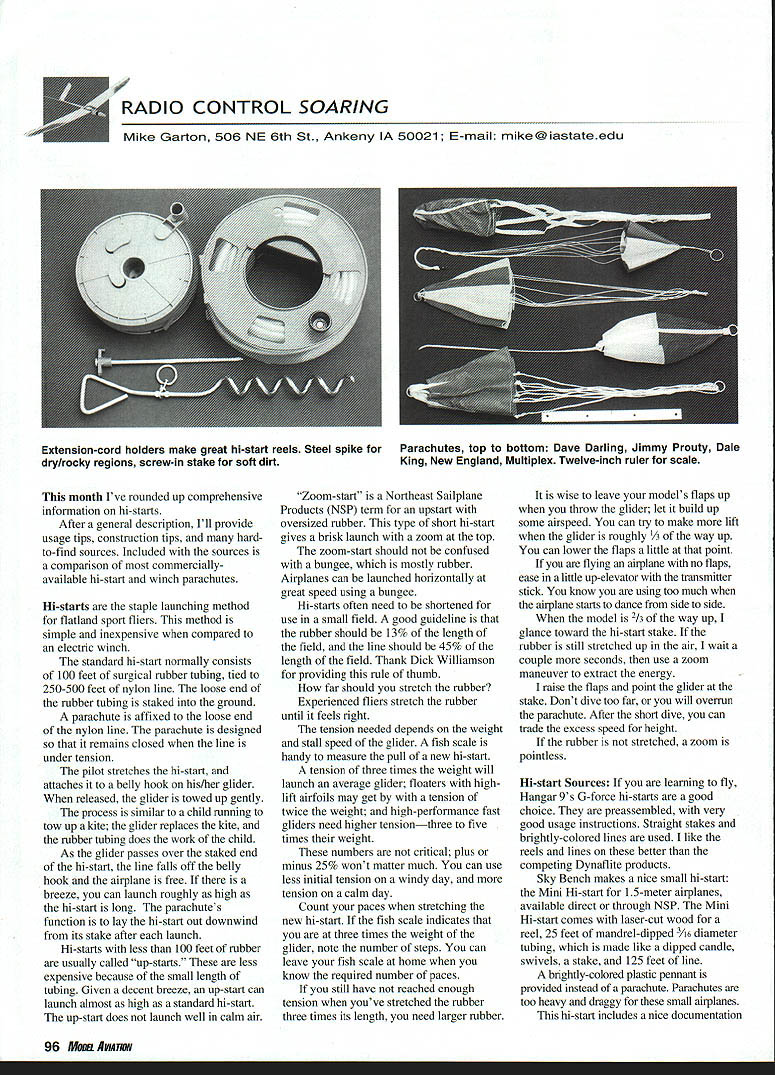
This month I've rounded up comprehensive information on hi-starts. After a general description, I'll provide usage tips, construction tips, and many hard-to-find sources. Included with the sources is a comparison of most commercially-available hi-start and winch parachutes.
Hi-starts are the staple launching method for flatland sport fliers. This method is simple and inexpensive when compared to an electric winch.
The standard hi-start normally consists of 100 feet of surgical rubber tubing, tied to 250–500 feet of nylon line. The loose end of the rubber tubing is staked into the ground. A parachute is affixed to the loose end of the nylon line. The parachute is designed so that it remains closed when the line is under tension.
The pilot stretches the hi-start, and attaches it to a belly hook on his/her glider. When released, the glider is towed up gently.
The process is similar to a child running to tow up a kite; the glider replaces the kite, and the rubber tubing does the work of the child.
As the glider passes over the staked end of the hi-start, the line falls off the belly hook and the airplane is free. If there is a breeze, you can launch roughly as high as the hi-start is long. The parachute's function is to lay the hi-start out downwind from its stake after each launch.
Hi-starts with less than 100 feet of rubber are usually called "up-starts." These are less expensive because of the small length of tubing. Given a decent breeze, an up-start can launch almost as high as a standard hi-start. The up-start does not launch well in calm air.
"Zoom-start" is a Northeast Sailplane Products (NSP) term for an up-start with oversized rubber. This type of short hi-start gives a brisk launch with a zoom at the top.
The zoom-start should not be confused with a bungee, which is mostly rubber. Airplanes can be launched horizontally at great speed using a bungee.
Hi-starts often need to be shortened for use in a small field. A good guideline is that the rubber should be 13% of the length of the field, and the line should be 45% of the length of the field. Thank Dick Williamson for providing this rule of thumb.
How far should you stretch the rubber? Experienced fliers stretch the rubber until it feels right.
The tension needed depends on the weight and stall speed of the glider. A fish scale is handy to measure the pull of a new hi-start.
A tension of three times the weight will launch an average glider; floaters with light airfoils may get by with a tension of twice the weight; and high-performance fast gliders need higher tension—three to five times their weight.
These numbers are not critical; plus or minus 25% won't matter much. You can use less initial tension on a windy day, and more tension on a calm day.
Count your paces when stretching the new hi-start. If the fish scale indicates that you are at three times the weight of the glider, note the number of steps. You can leave your fish scale at home when you know the required number of paces.
If you still have not reached the correct tension when you've stretched the rubber three times its length, you need larger rubber.
It is wise to leave your model's flaps up when you throw the glider; let it build up some airspeed. You can try to make more lift when the glider is roughly 1/3 of the way up. You can lower the flaps a little at that point. If you are flying an airplane with no flaps, ease in a little up-elevator with the transmitter stick. You know you are using too much when the airplane starts to nose down to one side.
When the model is 2/3 of the way up, I glide toward the hi-start stake. If the rubber is still stretched up in the air, I wait a couple more seconds, then use a zoom maneuver to extract the energy.
I raise the flaps and point the glider at the stake. Don't dive too far, or you will overrun the parachute. After the short dive, you can trade the excess speed for height.
If the rubber is not stretched, a zoom is pointless.
Hi-start Sources
- If you are learning to fly, Hangar 9's G-Force hi-starts are a good choice. They are preassembled, with very good usage instructions. Straight stakes and brightly-colored lines are used. I like the lines and reels on these better than the competing Dynaflite products.
- Sky Bench makes a nice small hi-start: the Mini Hi-Start for 1.5-meter airplanes, available direct or through NSP. The Mini Hi-Start comes with laser-cut wood for a reel, 25 feet of mandrel-dipped 3/16 inch diameter tubing (made like a dipped candle), swivels, a stake, and 125 feet of line. A brightly-colored plastic pennant is provided instead of a parachute. Parachutes are too heavy and draggy for these small airplanes. This hi-start includes a nice documentation packet and additional usage notes. In addition to assembly instructions, information is given on installing towhooks, launching, and hi-start-based contests.
- Dream Catcher Hobby sells a similar product — the Micro-Launch-System.
- NSP is the place to get a strong, high-quality hi-start. Costs range from $45 to $110 for the NSP Pinnacle. The spike, reel, and line are similar to the Hangar 9 products; however, NSP has a much wider selection of rubber sizes, and its parachutes and hardware are nicer.
You can save a few bucks, and maybe get higher quality if you round up the hi-start parts yourself.
Holliday Designs sells mandrel-dipped rubber hi-start tubing. Mandrel-dipping is a more-expensive process than extruding. It gives the rubber better properties, and it is less stiff and more stretchy. I use this type of rubber on my hi-starts.
If a hi-start ad does not read "mandrel-dipped," you can bet that it is not. If the ad reads "100 feet unspliced," that is another clue that the rubber is extruded.
Hobby Lobby, Sky Bench, Dream Catcher, Horizon Hobbies, and Tower Hobbies sell both kinds of tubing and assembled hi-starts.
Matching a Hi-start To a Glider
I stated that you usually want the hi-start’s tension to be roughly three times the weight of the glider.
The tension is proportional to the cross-sectional area of the rubber tubing, multiplied by distance stretched.
The required tension could be achieved with small tubing stretched a lot, or large tubing stretched a little. The small tubing stretched a lot will provide a continuous, gentle pull during most of the launch. The large tubing stretched a little will give a large burst of tension, then nothing. Continuous, gentle pull is much better.
Dick Williamson wrote a nice article on choosing the right size of rubber tubing. A link to an online copy is provided at the end of the column. Al Scidmore used similar methods in a December 1996 RC Soaring Digest article.
The measured "rubber spring rates" in these two articles differed by a factor of three. I concluded that Al was testing extruded rubber, and Dick was testing mandrel-dipped rubber.
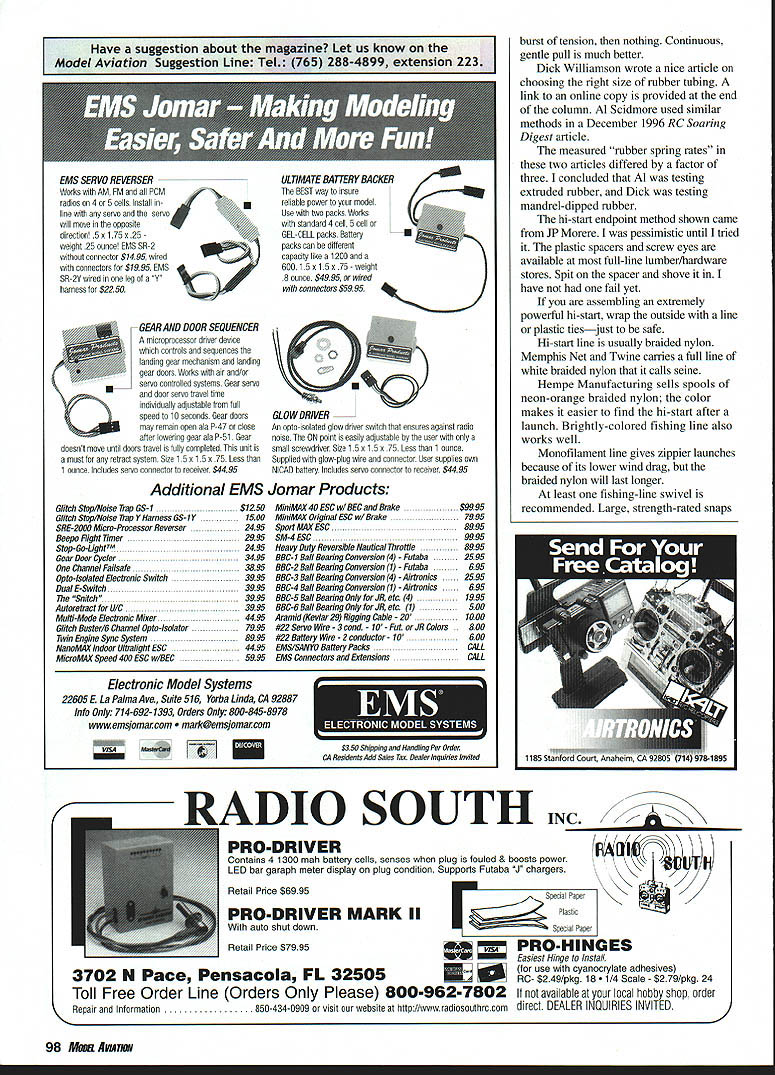
The hi-start endpoint method shown below was from JP Morere. I was pessimistic until I tried it. The plastic spacers and screw eyes are available at most full-line lumber/hardware stores. Spit on the spacer and shove it in. I have not had one fail yet.
If you are assembling an extremely powerful hi-start, wrap the outside with a line or plastic ties — just to be safe.
Hi-start line is usually braided nylon. Memphis Net and Twine carries a full line of white braided nylon that it calls seine. Hempe Manufacturing sells spools of neon-orange braided nylon; the color makes it easier to find the hi-start after a launch. Brightly-colored fishing line also works well.
Monofilament line gives zippier launches because of its lower wind drag, but braided nylon will last longer.
At least one fishing-line swivel is recommended. Large, strength-rated snaps and swivels are available from Into-The-Wind kite store.
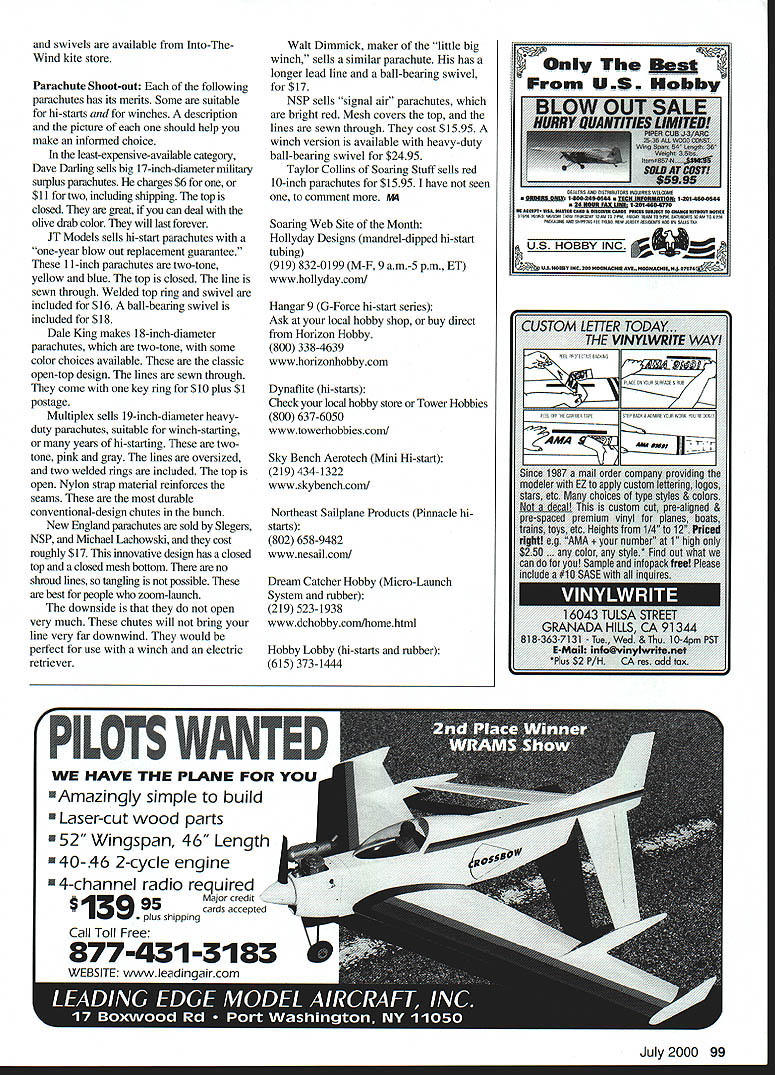
Parts for JP Morere’s Hi-Start Tubing Connection Method
All dimensions in inches.
- Tubing inside diameter | Plastic spacer outside diam. | Plastic spacer inside diam. | Plastic spacer length | Screw eye size designation | Screw eye length
- 1/4 | 0.375 | 0.171 | 1.0 | #208 | 1+3/8
- 1/8 | 0.250 | 0.140 | 1.0 | #210 | 1+3/16
- 1/16 | 0.187 | 0.115 | 1.0 | #212 | 15/16
If you are assembling an extremely powerful hi-start, wrap the outside with a line or plastic ties—just to be safe.
Parachute Shoot-out
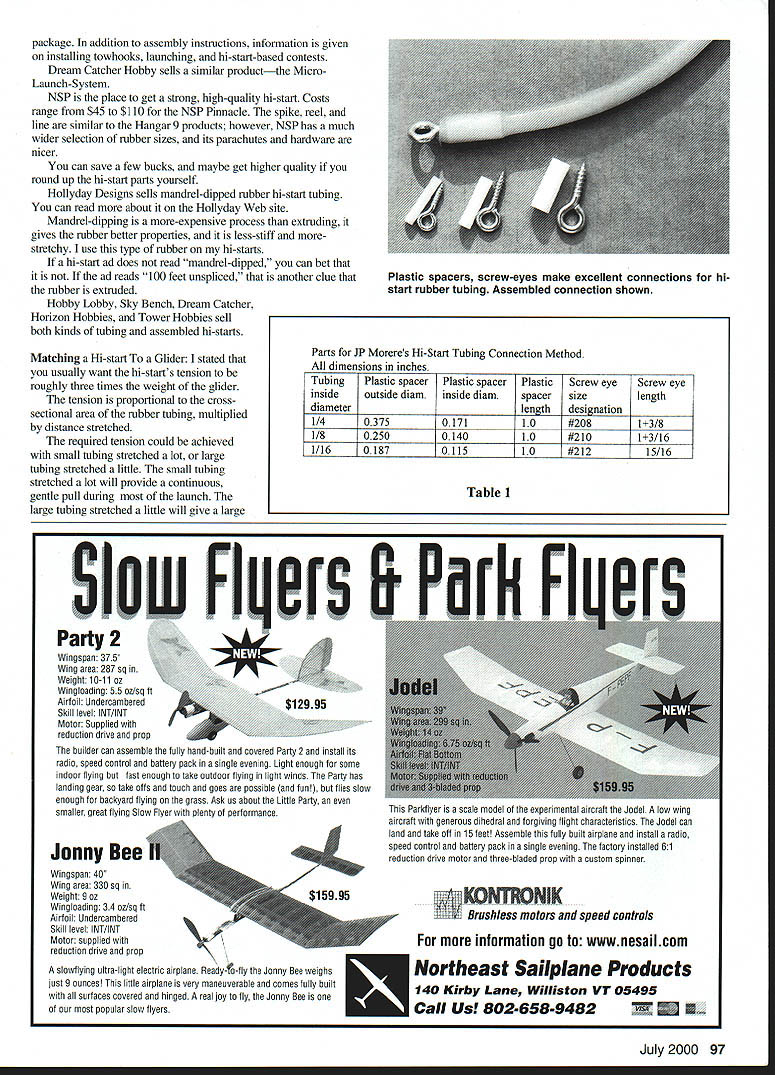
Each of the following parachutes has its merits. Some are suitable for hi-starts and for winches. A description of each one should help you make an informed choice.
- Dave Darling: Least-expensive-available category. Big 17-inch-diameter military surplus parachutes. He charges $6 for one, or $11 for two, including shipping. The top is closed. They are great if you can deal with the olive drab color. They will last forever.
- JT Models: Sells hi-start parachutes with a "one-year blow out replacement guarantee." These 11-inch parachutes are two-tone, yellow and blue. The top is closed. The line is sewn through. Welded top ring and swivel are included for $16. A ball-bearing swivel is included for $18.
- Dale King: Makes 18-inch-diameter parachutes, two-tone with some color choices available. These are the classic open-top design. The lines are sewn through. They come with one key ring for $10 plus $1 postage.
- Multiplex: Sells 19-inch-diameter heavy-duty parachutes, suitable for winch-starting or many years of hi-starting. These are two-tone, pink and gray. The lines are oversized, and two welded rings are included. The top is open. Nylon strap material reinforces the seams. These are the most durable conventional-design chutes in the bunch.
- New England parachutes (sold by Slegers, NSP, and Michael Lachowski): Cost roughly $17. This innovative design has a closed top and a closed mesh bottom. There are no shroud lines, so tangling is not possible. These are best for people who zoom-launch. The downside is that they do not open very much; these chutes will not bring your line very far downwind. They would be perfect for use with a winch and an electric retriever.
- Walt Dimmick: Maker of the "little big winch," sells a similar parachute. His has a longer lead line and a ball-bearing swivel, for $17.
- NSP: Sells "signal air" parachutes, which are bright red. Mesh covers the top, and the lines are sewn through. They cost $15.95. A winch version is available with heavy-duty ball-bearing swivel for $24.95.
- Taylor Collins (Soaring Stuff): Sells red 10-inch parachutes for $15.95. The author has not seen one to comment further.
Soaring Web Site / Vendor of the Month
- Holliday Designs (mandrel-dipped hi-start tubing)
- (919) 832-0199 (M-F, 9 a.m.–5 p.m., ET)
- www.holliday.com
- Hangar 9 (G-Force hi-start series)
- Ask at your local hobby shop, or buy direct from Horizon Hobby.
- (800) 338-4639
- www.horizonhobby.com
- Dynaflite (hi-starts)
- Check your local hobby store or Tower Hobbies
- (800) 637-6050
- www.towerhobbies.com
- Sky Bench Aerotech (Mini Hi-start)
- (219) 434-1322
- www.skybench.com
- Nesail Sailplane Products (Pinnacle hi-starts)
- (802) 658-9482
- www.nesail.com
- Dream Catcher Hobby (Micro-Launch System and rubber)
- (219) 523-1938
- www.dchobby.com/home.html
- Hobby Lobby (hi-starts and rubber)
- (615) 373-1444
Transcribed from original scans by AI. Minor OCR errors may remain.

