
RC Spread Spectrum DEMYSTIFIED
An overview of the inner workings of 2.4 GHz technology
by David Buxton
Go to a regional fun-fly or national event to watch airplanes and helicopters fly without the need of a frequency board. You have to wonder how it works. Is it true that the full 80 MHz-wide 2.4 GHz band can support as many as 200 airplanes? If you are like me, you are not willing to accept that several radios can share the same frequency until you understand how it's done. This article has evolved considerably—woven with popular theories and explanations that each were found to be incorrect. Too often, the correct information is buried in theoretical formulas that few would care to understand. The objective of this article is to present the theory of how our RC radios work in an easily understood format.
2.4 GHz Spread Spectrum
The following are three important technologies used by our 2.4 GHz-band radios. It is a frequency band that is increasingly popular for a growing variety of commercial products:
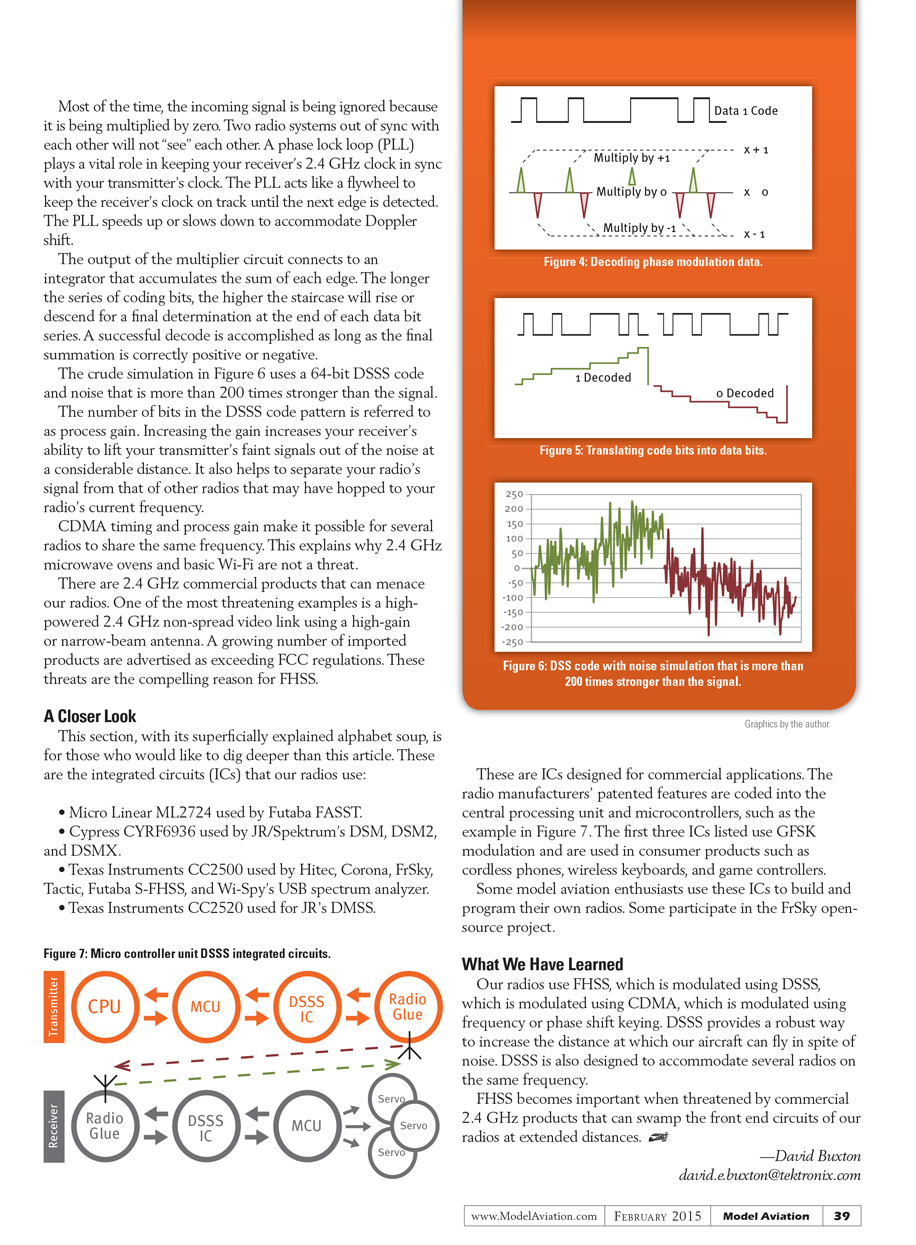
- Frequency Hopping Spread Spectrum (FHSS): Transmitter and receiver hop in unison to a mutually common pseudo-random sequence of frequencies. One or more packets of data are transmitted before each hop.
- Direct Sequence Spread Spectrum (DSSS): Digital sequence modulation applied to the carrier frequency. It looks like noise on a spectrum analyzer and is the recommended form of modulation used by FHSS for transmitting data.
- Cyclical Redundancy Code (CRC): A key premise is that data sometimes becomes corrupted. The transmitter's and receiver's CRC calculation won't match if one part is slightly off. RC receivers ignore flawed packets, but Wi-Fi asks for a retry.
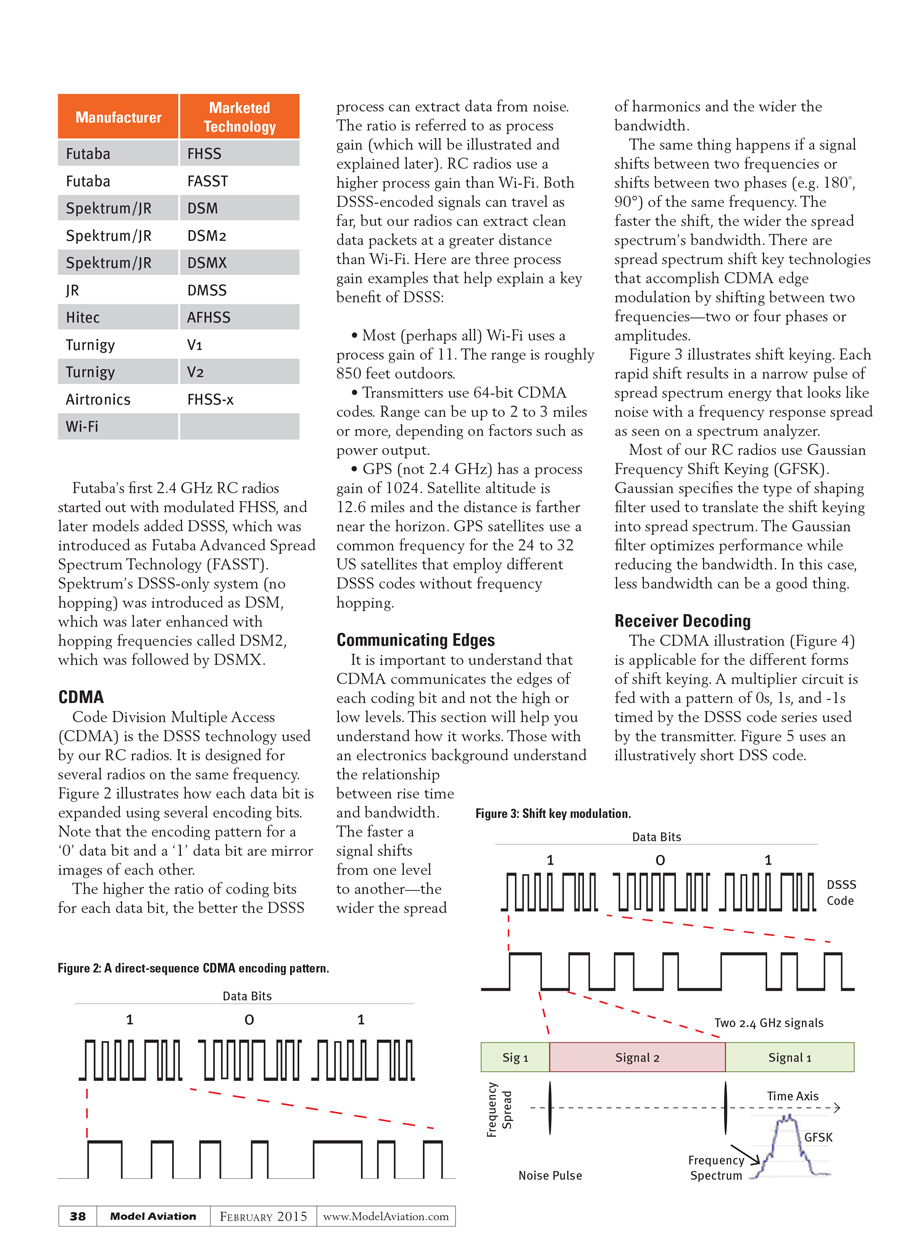
Futaba's first 2.4 GHz RC radios started out with 10 kHz-modulated FHSS, and later models added DSSS, introduced as Futaba Advanced Spread Spectrum Technology (FASST). Spektrum's DSSS-only system (no hopping) was introduced as DSM, which was later enhanced with two hopping frequencies called DSM2, and later with 23 FHSS frequencies called DSMX.
CDMA (Code Division Multiple Access) is the DSSS technology used by our RC radios. It is designed for several radios on the same frequency. In CDMA, each data bit is expanded using several encoding bits; the encoding pattern for a '0' and a '1' are mirror images of each other. The higher the ratio of coding bits per data bit, the better the DSSS process can extract data from noise. That ratio is referred to as process gain. RC radios use a higher process gain than Wi-Fi. Both DSSS-encoded signals can travel similar distances, but our radios can extract clean data packets at a greater distance than Wi-Fi.
Here are three process-gain examples that help explain a key benefit of DSSS:
- Most (perhaps all) Wi-Fi uses a process gain of 11. The outdoor range is roughly 850 feet.
- Transmitters that use 64-bit CDMA codes can have ranges up to 2 to 3 miles or more, depending on factors such as power output and environment.
- GPS (not 2.4 GHz) has a process gain of 1024. Satellite altitude is about 12.6 miles and the distance is farther near the horizon. GPS satellites use a common frequency for the 24 to 32 US satellites that employ different DSSS codes without frequency hopping.
Communicating Edges
It is important to understand that CDMA communicates the edges of each coding bit, not the static high or low levels. Those with an electronics background understand the relationship between rise time and bandwidth: the faster a signal shifts from one level to another, the wider the spread of harmonics and the wider the bandwidth. The same thing happens if a signal shifts between two frequencies or between two phases (for example, 180° or 90°) of the same frequency.
The faster the shift, the wider the spread spectrum’s bandwidth. There are spread-spectrum shift-key technologies that accomplish CDMA edge modulation by shifting between two frequencies, between two or four phases, or between amplitudes.
Each rapid shift results in a narrow pulse of spread-spectrum energy that looks like noise with a frequency response spread when viewed on a spectrum analyzer.
Most of our RC radios use Gaussian Frequency Shift Keying (GFSK). “Gaussian” specifies the type of shaping filter used to translate the shift keying into spread spectrum. The Gaussian filter optimizes performance while reducing the bandwidth. In this case, less bandwidth can be a good thing.
Receiver Decoding
The CDMA decode process is applicable for the different forms of shift keying. A multiplier circuit in the receiver is fed with a pattern of 0s, 1s, and -1s timed by the DSSS code sequence used by the transmitter. The receiver multiplies the incoming coded signal with the same DSSS code. A matched code collapses the noise-like waveform back to the original data bit stream while nonmatching codes remain noise and are rejected.
The longer the DSSS code (the greater the process gain), the better the receiver can extract data from noise and reject other signals. Most of the time, the incoming signal is being ignored because it is being multiplied by zero. Two radio systems out of sync with each other will not "see" each other.
A phase-locked loop (PLL) plays a vital role in keeping your receiver’s 2.4 GHz clock in sync with your transmitter’s clock. The PLL acts like a flywheel to keep the receiver’s clock on track until the next edge is detected. The PLL speeds up or slows down to accommodate Doppler shift.
The output of the multiplier circuit connects to an integrator that accumulates the sum of each edge. The longer the series of coding bits, the larger the cumulative result will rise or descend for a final determination at the end of each data-bit series. A successful decode is accomplished as long as the final summation is correctly positive or negative.
The number of bits in the DSSS code pattern is referred to as process gain. Increasing the gain increases your receiver’s ability to lift your transmitter’s faint signals out of the noise at considerable distance. It also helps to separate your radio’s signal from that of other radios that may have hopped to your radio’s current frequency.
CDMA timing and process gain make it possible for several radios to share the same frequency. This explains why common 2.4 GHz sources such as microwave ovens and basic Wi-Fi are not a significant threat.
There are 2.4 GHz commercial products that can menace our radios. One of the most threatening examples is a high-powered 2.4 GHz non-spread-spectrum video link using a high-gain or narrow-beam antenna. A growing number of imported products are advertised as exceeding FCC regulations. These threats are the compelling reason for FHSS.
A Closer Look
This section, with its superficially explained alphabet soup, is for those who would like to dig deeper. These are the integrated circuits (ICs) that our radios use:
- Micro Linear ML2724 — used by Futaba FASST.
- Cypress CYRF6936 — used by JR/Spektrum’s DSM, DSM2, and DSMX.
- Texas Instruments CC2500 — used by Hitec, Corona, FrSky, Tactic, Futaba S-FHSS, and Wi-Spy’s USB spectrum analyzer.
- Texas Instruments CC2520 — used for JR’s DMSS.
These are ICs designed for commercial applications. The radio manufacturers’ patented features are coded into central processing units and microcontrollers. The first three ICs listed use GFSK modulation and are used in consumer products such as cordless phones, wireless keyboards, and game controllers.
Some model aviation enthusiasts use these ICs to build and program their own radios. Some participate in the FrSky open-source project.
What We Have Learned
Our radios use FHSS, which is modulated using DSSS, which is implemented using CDMA, which is in turn modulated using frequency or phase shift keying. DSSS provides a robust way to increase the distance at which our aircraft can fly in spite of noise. DSSS is also designed to accommodate several radios on the same frequency.
FHSS becomes important when threatened by commercial 2.4 GHz products that can swamp the front-end circuits of our radios at extended distances.
— David Buxton [email protected]
Transcribed from original scans by AI. Minor OCR errors may remain.

