
RCRC Finds New Flying Site
By Sherwin Arculis
The Rocket City Radio Controllers (RCRC), charter number 715, has been an AMA-chartered club since 1964. It has operated from various sites in Huntsville, Alabama, since its inception. I am the club's publicity chairperson, and I'll tell you about the growth of the club and its present status. Perhaps these words will provide other clubs with incentive to improve.
Need to Move
In 1993 it became obvious to RCRC club members that they were going to have to move from their location off an old airport's runways. The move was necessary because of safety factors resulting from the encroachment of various sporting interests, an expanded golf course, and development of multiple soccer fields. After considerable debate, members of the club leadership elected to search for a new location for the group.
New Site Acquisition
A site was located at a recently closed landfill, not too far from the club's active field. After many months of interaction with various local and state agencies, the land was leased to the city of Huntsville from the Solid Waste Disposal Authority. The city subleased the land to the club at no cost, and the club received approval to use the landfill for a model airplane field.
A site layout was developed using recommendations by AMA. Today, RCRC operates under an agreement between the city of Huntsville and RCRC, codified by City Resolution 95-112.
Operating Requirements
Since the club is chartered by AMA, which provides insurance policies for its members, RCRC members (and flying guests) must be licensed by AMA before they can be issued a permit to use the facility. This requirement is further delineated in the city resolution, which requires that the club operate the facility in compliance with AMA safety rules. These requirements are amplified in the Flying Field Regulations, issued to all new members.
Additional requirements imposed by the city resolution govern any of the club's commercial functions, to assure compliance with existing law. This results in some acceptable, albeit prohibitive, activities that would not take place at a private field. These minor inconveniences do not hamper the club's operation, although the usual malcontents are sometimes overly vocal in protest.
Facility Name and Location
RCRC operates from the Captain Trey Wilbourn Model Airplane Park, located at the south end of Leeman Ferry Road. The facility was named by the city council, at the request of RCRC, to honor Captain Wilbourn, who was killed in action while piloting a Harrier jet during Operation Desert Storm.
Field and Supporting Facilities
The site is comprised of:
- a 500- by 52-foot paved runway,
- a large grass landing area adjacent to the runway,
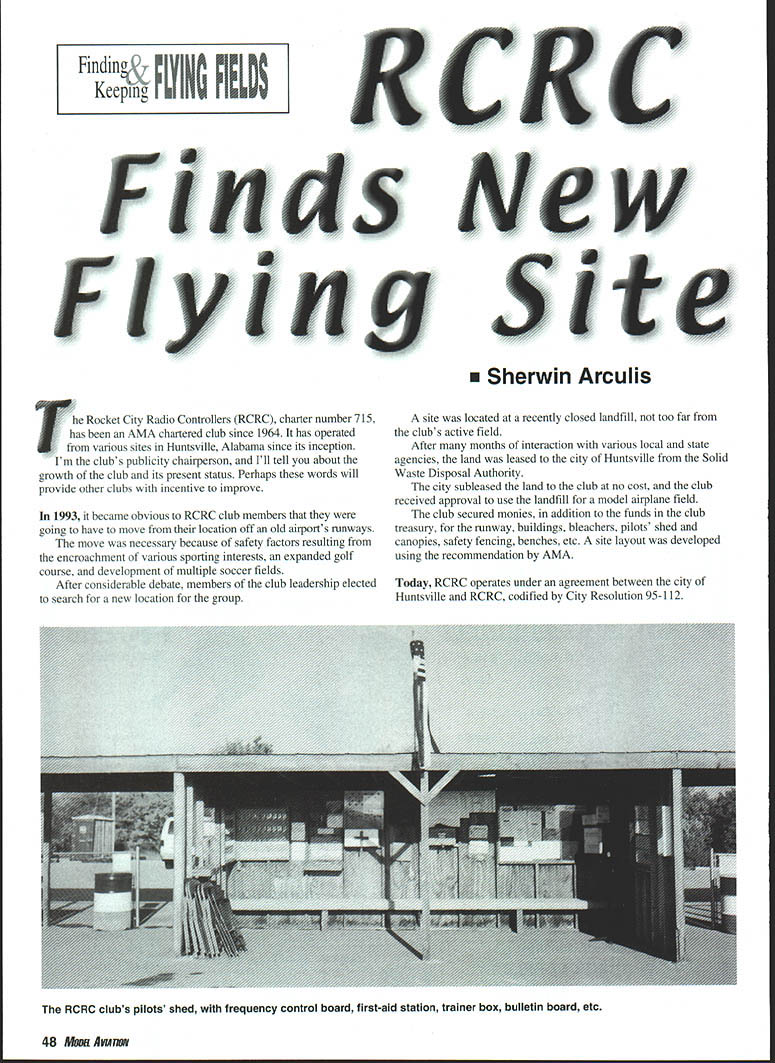
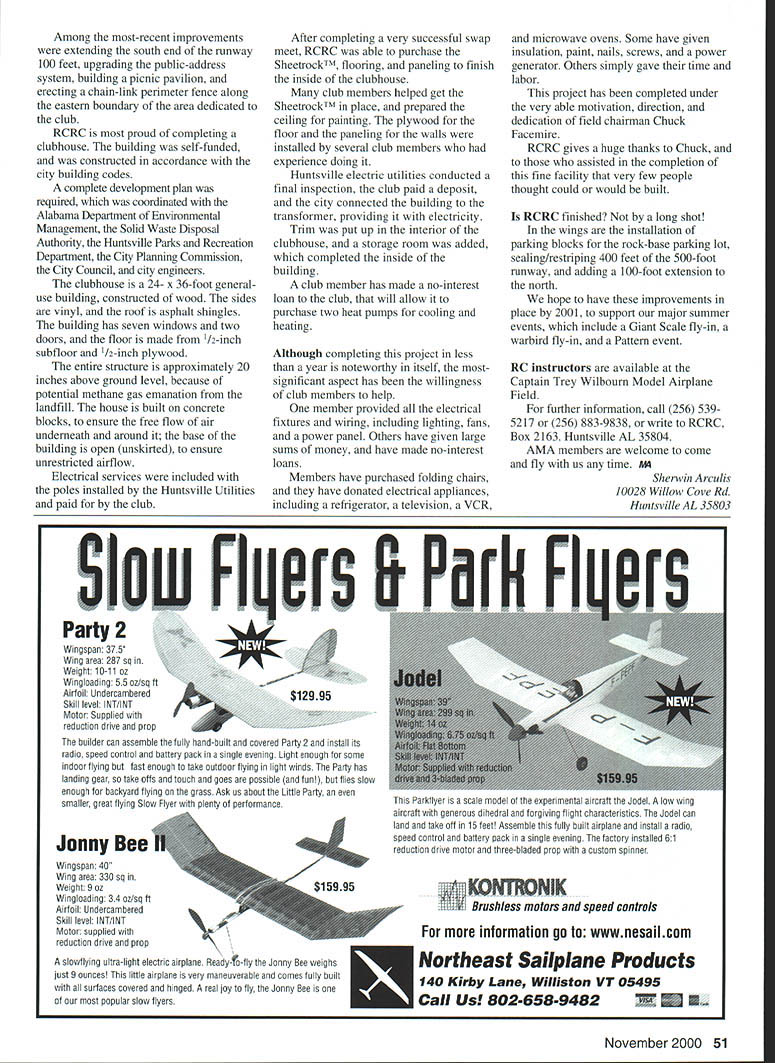
- a covered pit area,
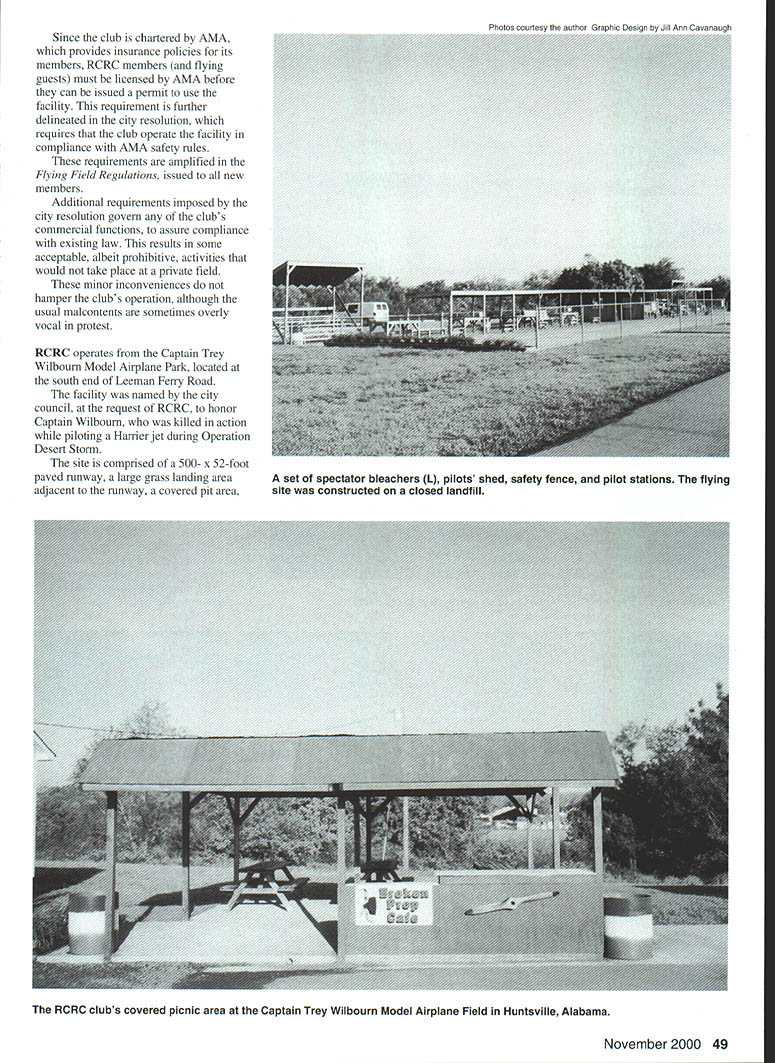
- a clubhouse,
- covered spectator bleachers,
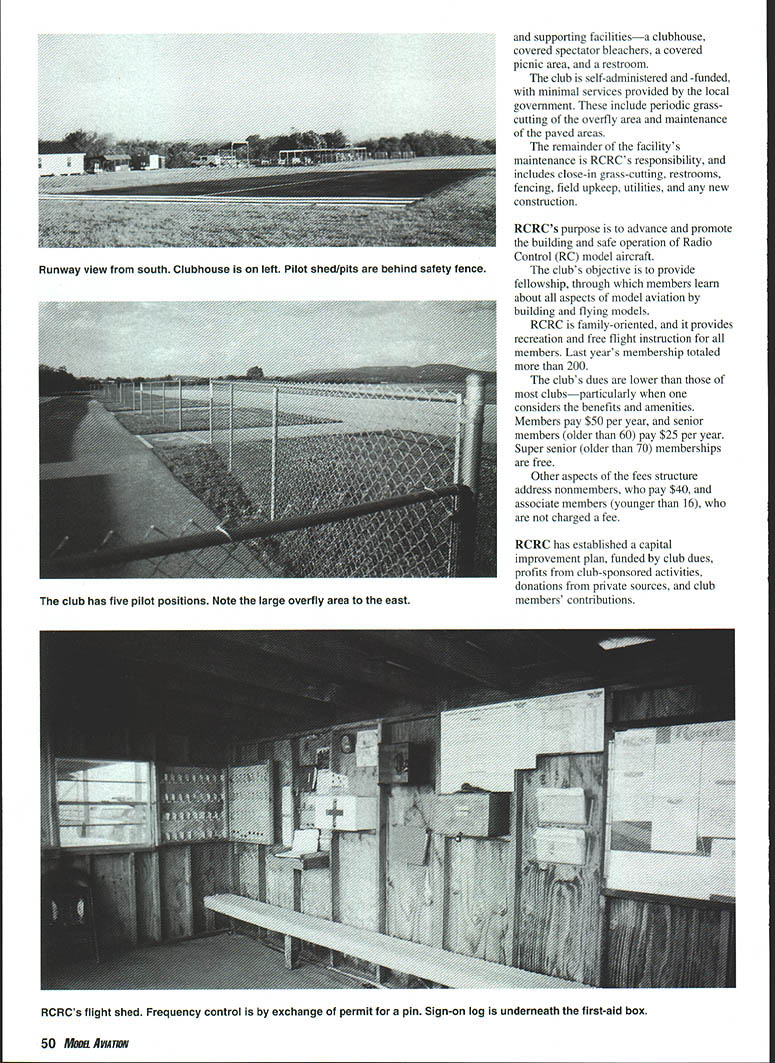
- a covered picnic area, and
- a restroom.
The club is self-administered and -funded, with minimal services provided by the local government. These include periodic grass-cutting of the overfly area and maintenance of the paved areas. The remainder of the facility's maintenance is RCRC's responsibility and includes close-in grass-cutting, restrooms, fencing, field upkeep, utilities, and any new construction.
Purpose and Membership
RCRC's purpose is to advance and promote the building and safe operation of Radio Control (RC) model aircraft. The club's objective is to provide fellowship through which members learn about all aspects of model aviation by building and flying models. RCRC is family-oriented, and it provides recreation and free flight instruction for all members. Last year's membership totaled more than 200.
Dues and fees:
- Members: $50 per year
- Senior members (older than 60): $25 per year
- Super senior (older than 70): free
- Nonmembers: $40
- Associate members (younger than 16): no charge
RCRC has established a capital improvement plan, funded by club dues, profits from club-sponsored activities, donations from private sources, and club members' contributions.
Recent Improvements and Clubhouse
Among the most recent improvements were:
- extending the south end of the runway 100 feet,
- upgrading the public-address system,
- building a picnic pavilion, and
- erecting a chain-link perimeter fence along the eastern boundary of the area dedicated to the club.
RCRC is most proud of completing a clubhouse. The building was self-funded and constructed in accordance with city building codes. A complete development plan was required, which was coordinated with the Alabama Department of Environmental Management, the Solid Waste Disposal Authority, the Huntsville Parks and Recreation Department, the City Planning Commission, the City Council, and city engineers.
Clubhouse details:
- 24- by 36-foot general-use building, constructed of wood
- vinyl siding and asphalt shingle roof
- seven windows and two doors
- floor made from 1/2-inch subfloor and 1/2-inch plywood
- structure approximately 20 inches above ground level because of potential methane gas emanation from the landfill
- built on concrete blocks to ensure free flow of air underneath and around it; base is open (unskirted) to ensure unrestricted airflow
Electrical services were included with poles installed by Huntsville Utilities and paid for by the club. After completing a very successful swap meet, RCRC purchased Sheetrock, flooring, and paneling to finish the inside of the clubhouse. Many club members helped install the Sheetrock and prepared the ceiling for painting. The plywood floor and paneling for the walls were installed by several experienced club members.
Huntsville electric utilities conducted a final inspection, the club paid a deposit, and the city connected the building to the transformer, providing electricity. Trim was put up in the interior, and a storage room was added, completing the inside of the building. A club member has made a no-interest loan to the club that will allow it to purchase two heat pumps for cooling and heating.
Although completing this project in less than a year is noteworthy, the most significant aspect has been the willingness of club members to help. One member provided all the electrical fixtures and wiring, including lighting, fans, and a power panel. Others have given large sums of money and made no-interest loans. Members have purchased folding chairs and donated electrical appliances, including a refrigerator, a television, a VCR, and microwave ovens. Some have given insulation, paint, nails, screws, and a power generator. Others simply gave their time and labor.
This project was completed under the motivation, direction, and dedication of field chairman Chuck Facemire. RCRC gives a huge thanks to Chuck and to those who assisted in the completion of this fine facility that very few people thought could or would be built.
Future Plans
Is RCRC finished? Not by a long shot. In the wings are:
- installation of parking blocks for the rock-base parking lot,
- sealing/restriping 400 feet of the 500-foot runway, and
- adding a 100-foot extension to the north.
We hope to have these improvements in place by 2001 to support our major summer events, which include a Giant Scale fly-in, a warbird fly-in, and a Pattern event.
RCRC instructors are available at the Captain Trey Wilbourn Model Airplane Field. AMA members are welcome to come and fly with us any time.
Contact
For further information:
- Phone: (256) 539-5217 or (256) 883-9838
- Mail: RCRC, Box 2163, Huntsville AL 35804
Sherwin Arculis 10028 Willow Cove Rd. Huntsville AL 35803
Transcribed from original scans by AI. Minor OCR errors may remain.

