
The Red Bull Connection
Thrills with flying things are what we're all about!
by Jay Smith and Bill Oberdieck
RED BULL, an Austrian corporation, launched its energy drink of the same name in 1987. Since then, the company has released Red Bull Cola and has been deeply involved in extreme sports.
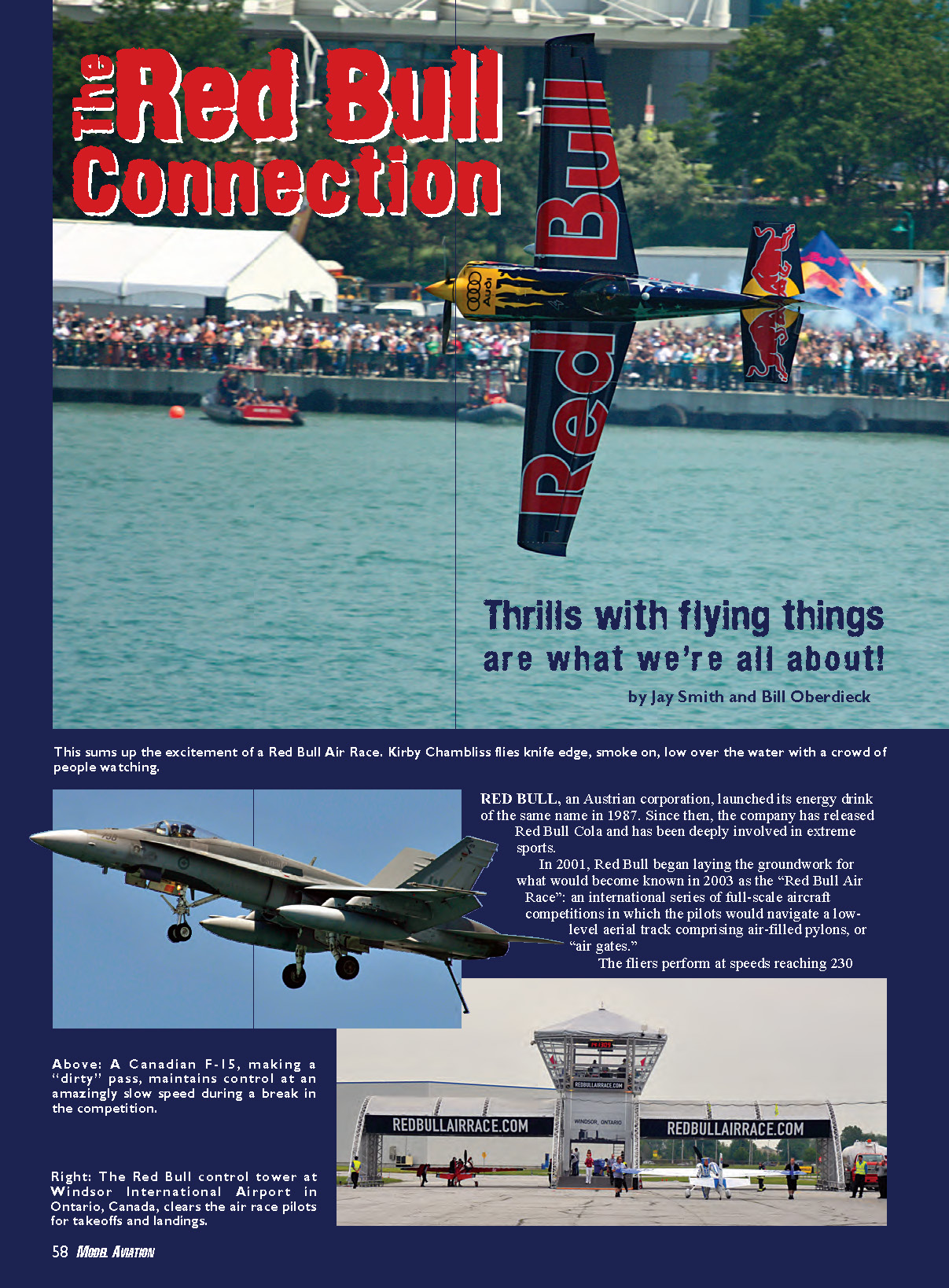
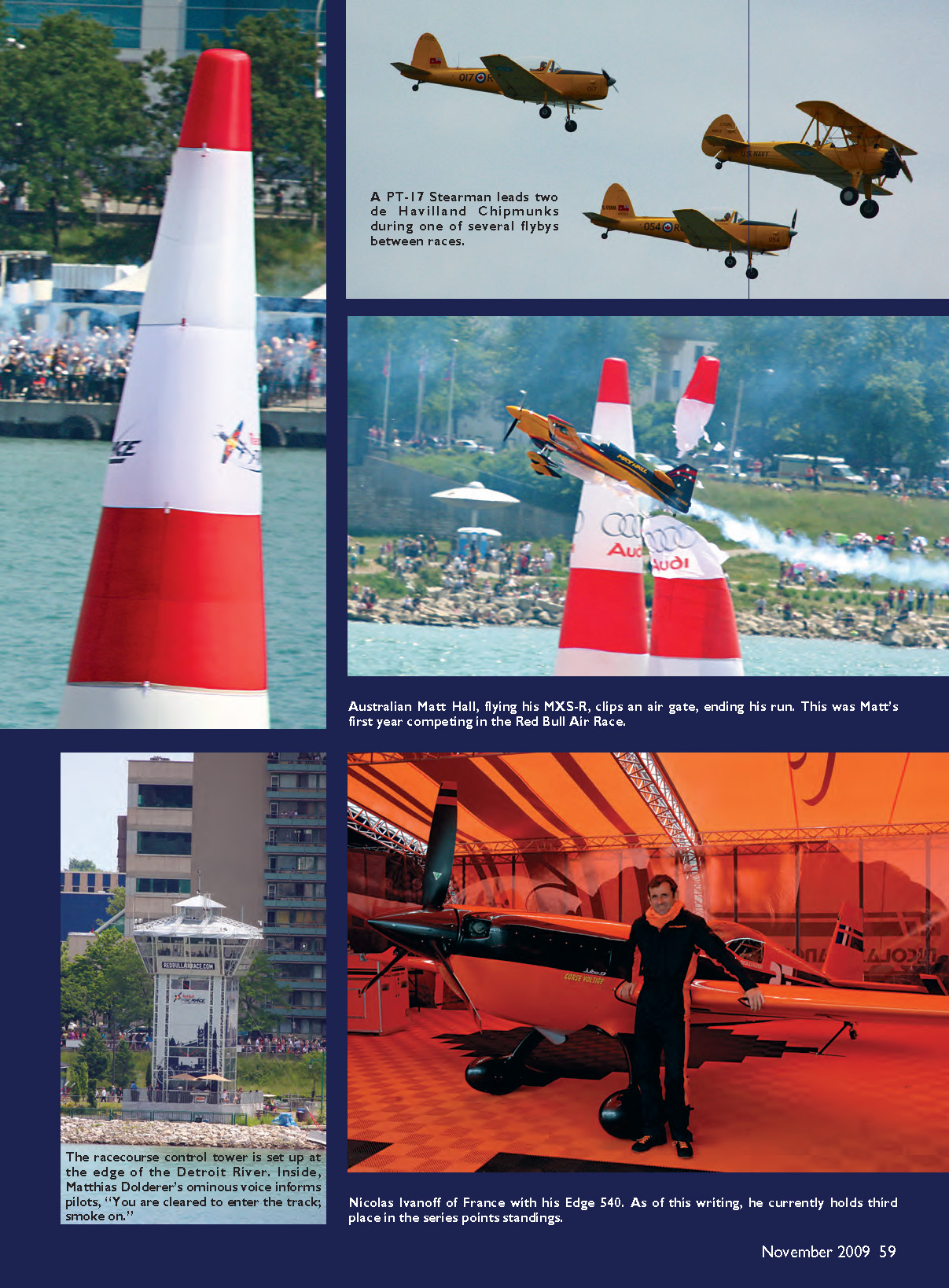
In 2001, Red Bull began laying the groundwork for what would become in 2003 the "Red Bull Air Race": an international series of full-scale aircraft competitions in which pilots navigate a low-level aerial track comprising air-filled pylons, or "air gates." The fliers perform at speeds reaching 230 mph while withstanding forces of up to 12 g.
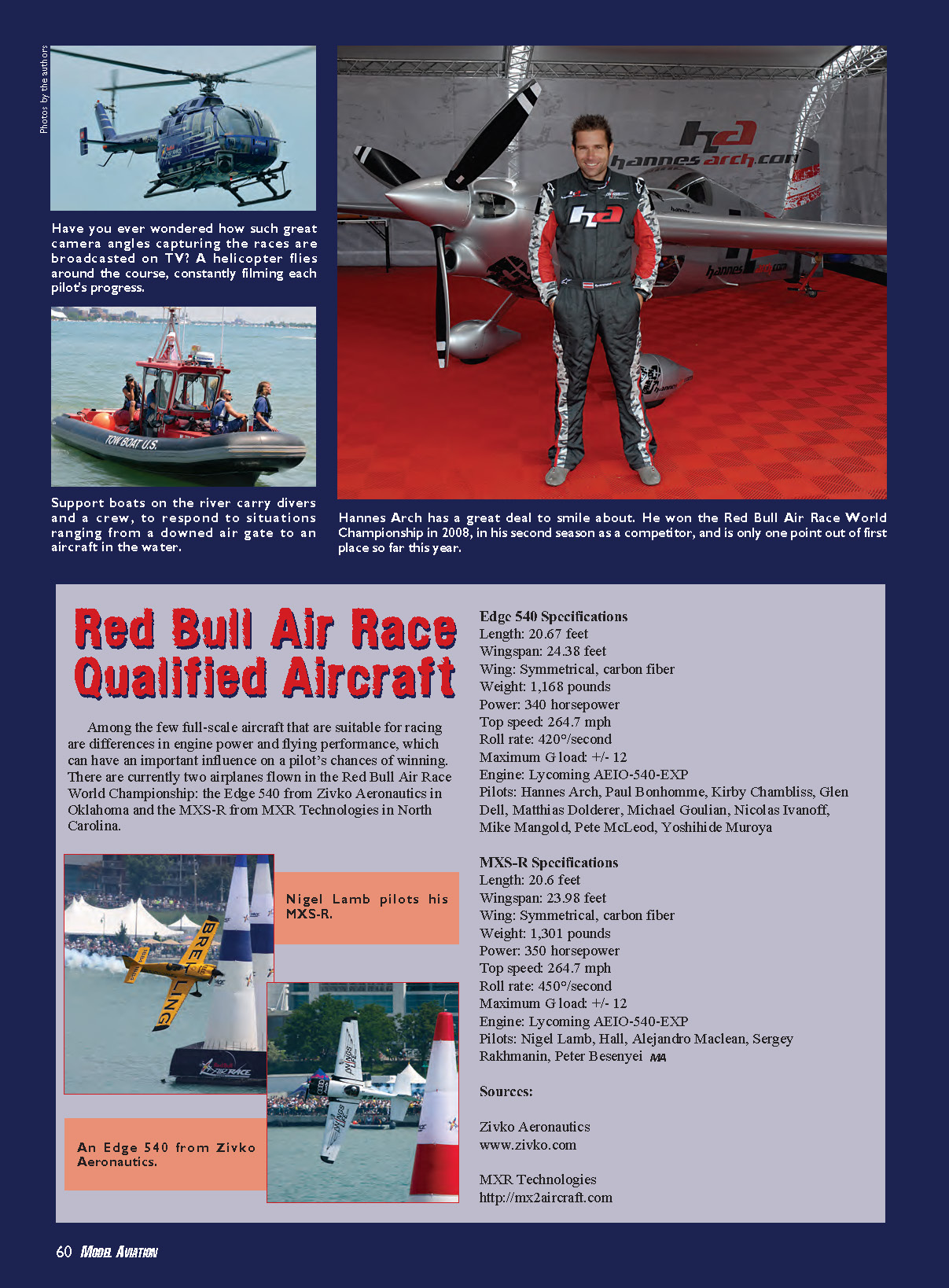
Have you ever wondered how such great camera angles capturing the races are broadcast on TV? A helicopter flies around the course, constantly filming each pilot’s progress. Support boats on the river carry divers and a crew to respond to situations ranging from a downed air gate to an aircraft in the water.
Hannes Arch has a great deal to smile about. He won the Red Bull Air Race World Championship in 2008, in his second season as a competitor, and is only one point out of first place so far this year.
Among the few full-scale aircraft suitable for racing, differences in engine power and flying performance can have an important influence on a pilot’s chances of winning. There are currently two airplanes flown in the Red Bull Air Race World Championship: the Edge 540 from Zivko Aeronautics in Oklahoma and the MXS-R from MXR Technologies in North Carolina.
Red Bull Air Race Qualified Aircraft
Edge 540 Specifications
- Length: 20.67 feet
- Wingspan: 24.38 feet
- Wing: Symmetrical, carbon fiber
- Weight: 1,168 pounds
- Power: 340 horsepower
- Top speed: 264.7 mph
- Roll rate: 420°/second
- Maximum G load: +/- 12
- Engine: Lycoming AEIO-540-EXP
- Pilots: Hannes Arch, Paul Bonhomme, Kirby Chambliss, Glen Dell, Matthias Dolderer, Michael Goulian, Nicolas Ivanoff, Mike Mangold, Pete McLeod, Yoshihide Muroya
MXS-R Specifications
- Length: 20.6 feet
- Wingspan: 23.98 feet
- Wing: Symmetrical, carbon fiber
- Weight: 1,301 pounds
- Power: 350 horsepower
- Top speed: 264.7 mph
- Roll rate: 450°/second
- Maximum G load: +/- 12
- Engine: Lycoming AEIO-540-EXP
- Pilots: Nigel Lamb, Matt Hall, Alejandro Maclean, Sergey Rakhmanin, Peter Besenyei
Sources:
- Zivko Aeronautics — www.zivko.com
- MXR Technologies — http://mx2aircraft.com
Red Bull Pilot Interviews
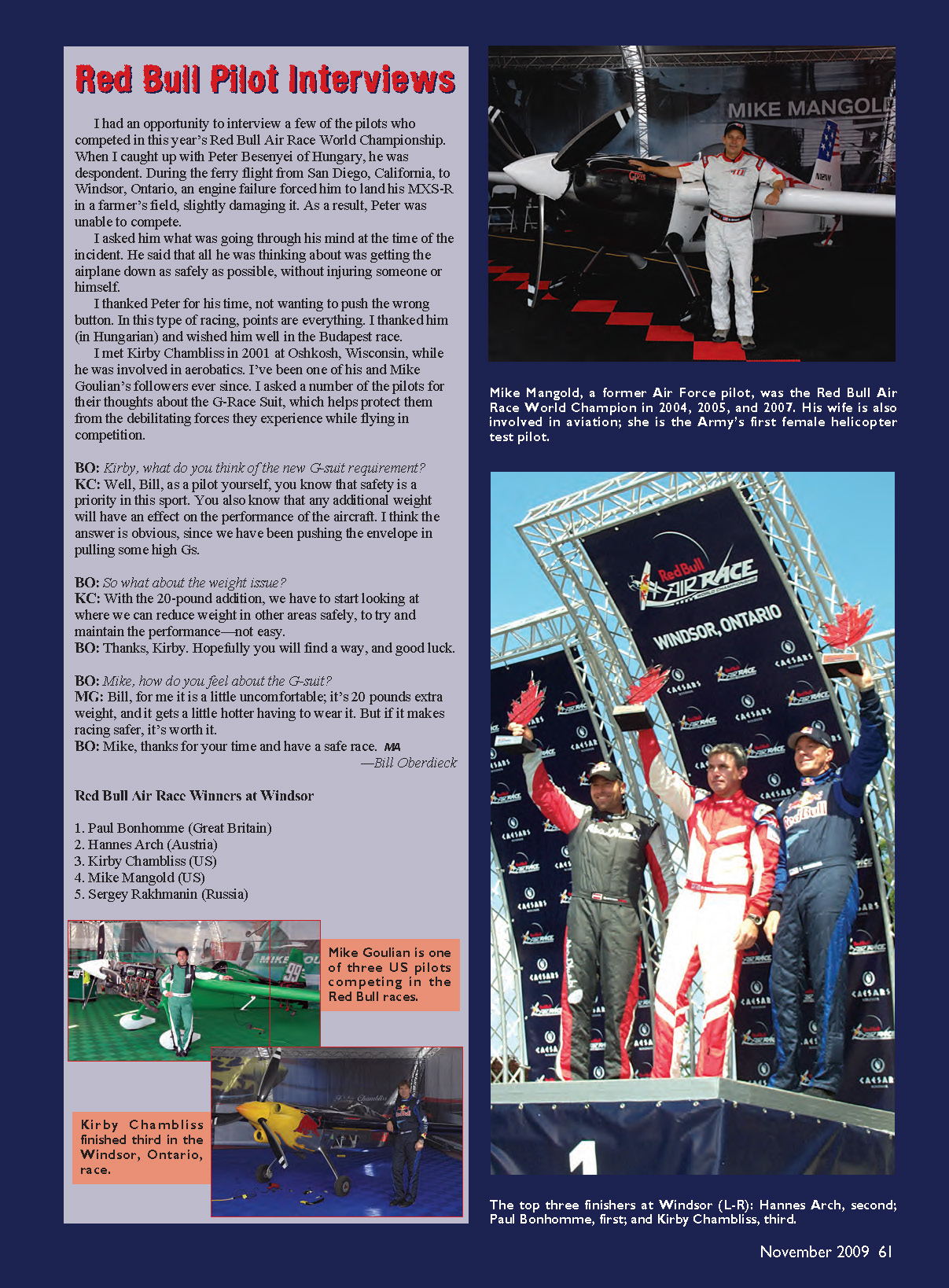
I had an opportunity to interview a few of the pilots who competed in this year’s Red Bull Air Race World Championship. When I caught up with Peter Besenyei of Hungary, he was despondent. During the ferry flight from San Diego, California, to Windsor, Ontario, an engine failure forced him to land his MXS-R in a farmer’s field, slightly damaging it. As a result, Peter was unable to compete.
I asked him what was going through his mind at the time of the incident. He said that all he was thinking about was getting the airplane down as safely as possible, without injuring someone or himself.
I thanked Peter for his time, not wanting to push the wrong button. In this type of racing, points are everything. I thanked him (in Hungarian) and wished him well in the Budapest race.
I met Kirby Chambliss in 2001 at Oshkosh, Wisconsin, while he was involved in aerobatics. I’ve been one of his and Mike Goulian’s followers ever since. I asked a number of the pilots for their thoughts about the G-Race Suit, which helps protect them from the debilitating forces they experience while flying in competition.
BO: Kirby, what do you think of the new G-suit requirement? KC: Well, Bill, as a pilot yourself, you know that safety is a priority in this sport. You also know that any additional weight will have an effect on the performance of the aircraft. I think the answer is obvious, since we have been pushing the envelope in pulling some high Gs.
BO: So what about the weight issue? KC: With the 20-pound addition, we have to start looking at where we can reduce weight in other areas safely, to try and maintain the performance—not easy. BO: Thanks, Kirby. Hopefully you will find a way, and good luck.
BO: Mike, how do you feel about the G-suit? MG: Bill, for me it is a little uncomfortable; it’s 20 pounds extra weight, and it gets a little hotter having to wear it. But if it makes racing safer, it’s worth it. BO: Mike, thanks for your time and have a safe race.
— Bill Oberdieck
Red Bull Air Race Winners at Windsor
- Paul Bonhomme (Great Britain)
- Hannes Arch (Austria)
- Kirby Chambliss (US)
- Mike Mangold (US)
- Sergey Rakhmanin (Russia)
Pilots must fly between the 65-foot-tall air gates in the correct position (either knife edge or level), taking care not to touch the pylons with their aircraft wings. Precision is crucial, because any mistakes incur penalty seconds, which are added to the pilot’s time. Pilots gain points at the series races that take place around the world, with the hope of becoming the Red Bull Air Race World Champion.
In 2009, the six race locations are:
- Abu Dhabi, United Arab Emirates
- San Diego, California
- Windsor, Ontario, Canada
- Budapest, Hungary
- Porto, Portugal
- Barcelona, Spain (to be contested in October)
The third race was held June 13–14 in Ontario, on the Detroit River. MA was given the opportunity to attend that stop in the series, because Red Bull and the AMA have a few things in common. Both organizations are involved with aviation. Both are interested in activities that engage the younger generation.
It was hoped that the Academy's 2009 membership drive, which ended September 14, would encourage more youngsters to get interested in aeromodelling. Earlier this year, Red Bull hosted a paper-airplane competition—Paper Wings—at Ball State University in Muncie, Indiana, as well as at several other colleges throughout the United States.
In addition, the Red Bull Air Race competition is governed by the FAI, as are the AMA’s members who compete in the world model aviation arena.
This article’s photographs were taken from both sides of the Detroit River. Bill took his pictures from the Ontario side, from which the event was held and the aircraft were kept. Jay took his photos from the Detroit, Michigan, side. Therefore, you get a 360° view of this amazing event.
There is much more to this story. Visit the Red Bull Air Race website for further information, videos, standings, and program history. With the great initiative and creativity that the AMA and Red Bull have, imagine what they could do together!
Jay Smith [email protected]
Bill Oberdieck [email protected]
Sources:
- Red Bull Air Race — +43 662 847 000, www.redbullairrace.com
Transcribed from original scans by AI. Minor OCR errors may remain.

