
FUTABA 10J TRANSMITTER
Chris Mulcahy [email protected]
An affordable telemetry and S.Bus-capable radio
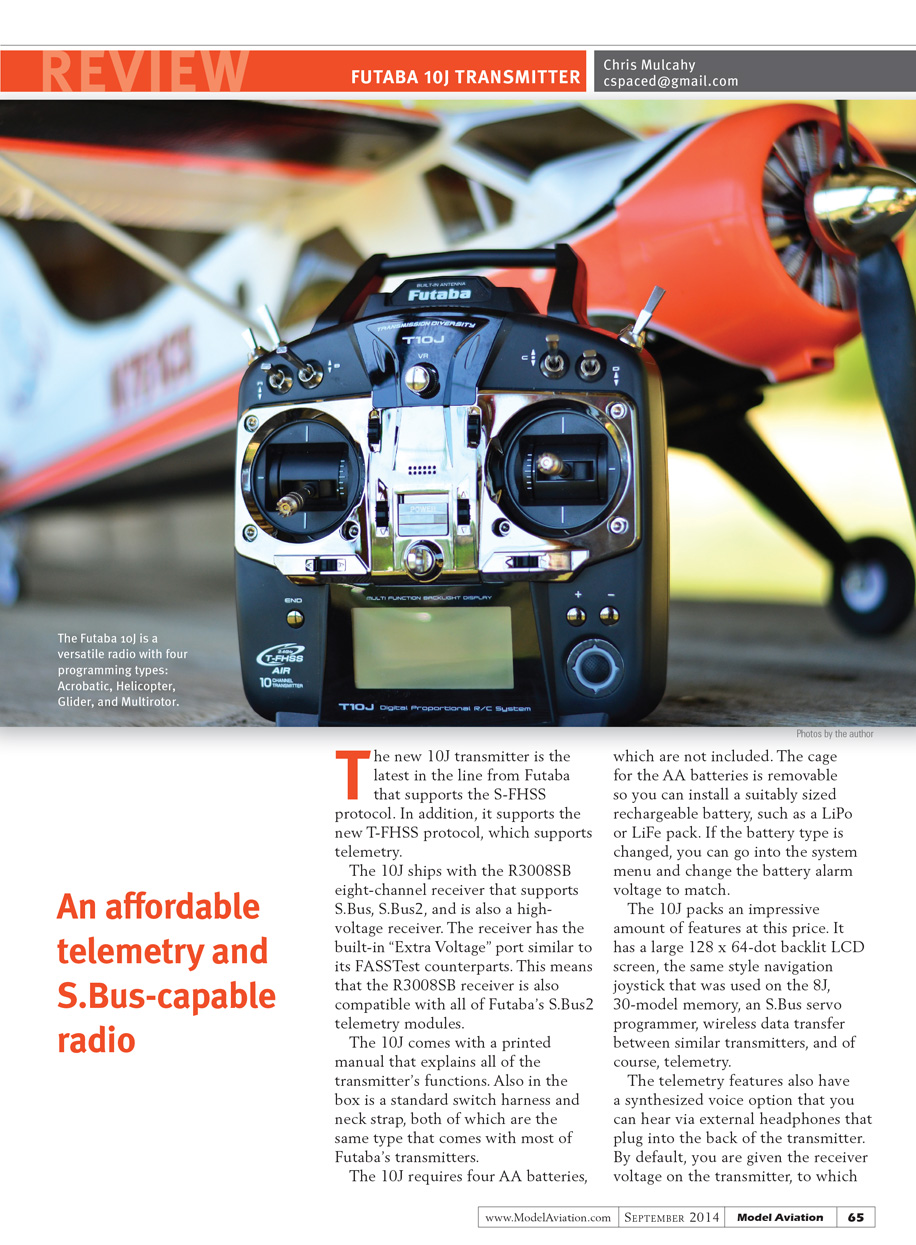
The new 10J transmitter is the latest in the line from Futaba that supports the S-FHSS protocol. In addition, it supports the new T-FHSS protocol, which adds telemetry.
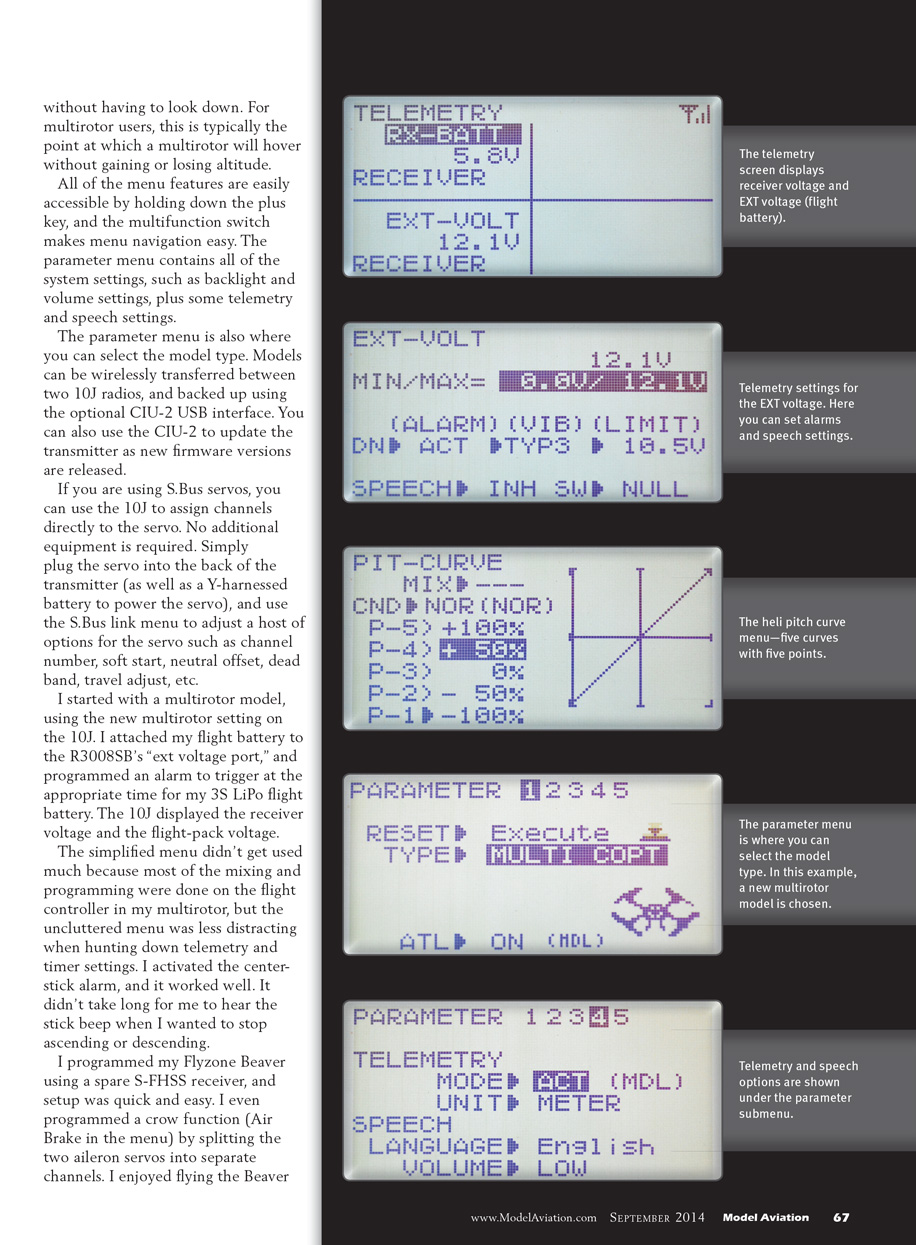
The 10J ships with the R3008SB eight-channel receiver that supports S.Bus and S.Bus2 and is also a high-voltage receiver. The receiver has a built-in "Extra Voltage" port similar to its FASSTest counterparts. This means the R3008SB is compatible with Futaba's S.Bus2 telemetry modules.
The 10J comes with a printed manual that explains all of the transmitter's functions. Also in the box are a standard switch harness and neck strap, both the same type that come with most Futaba transmitters.
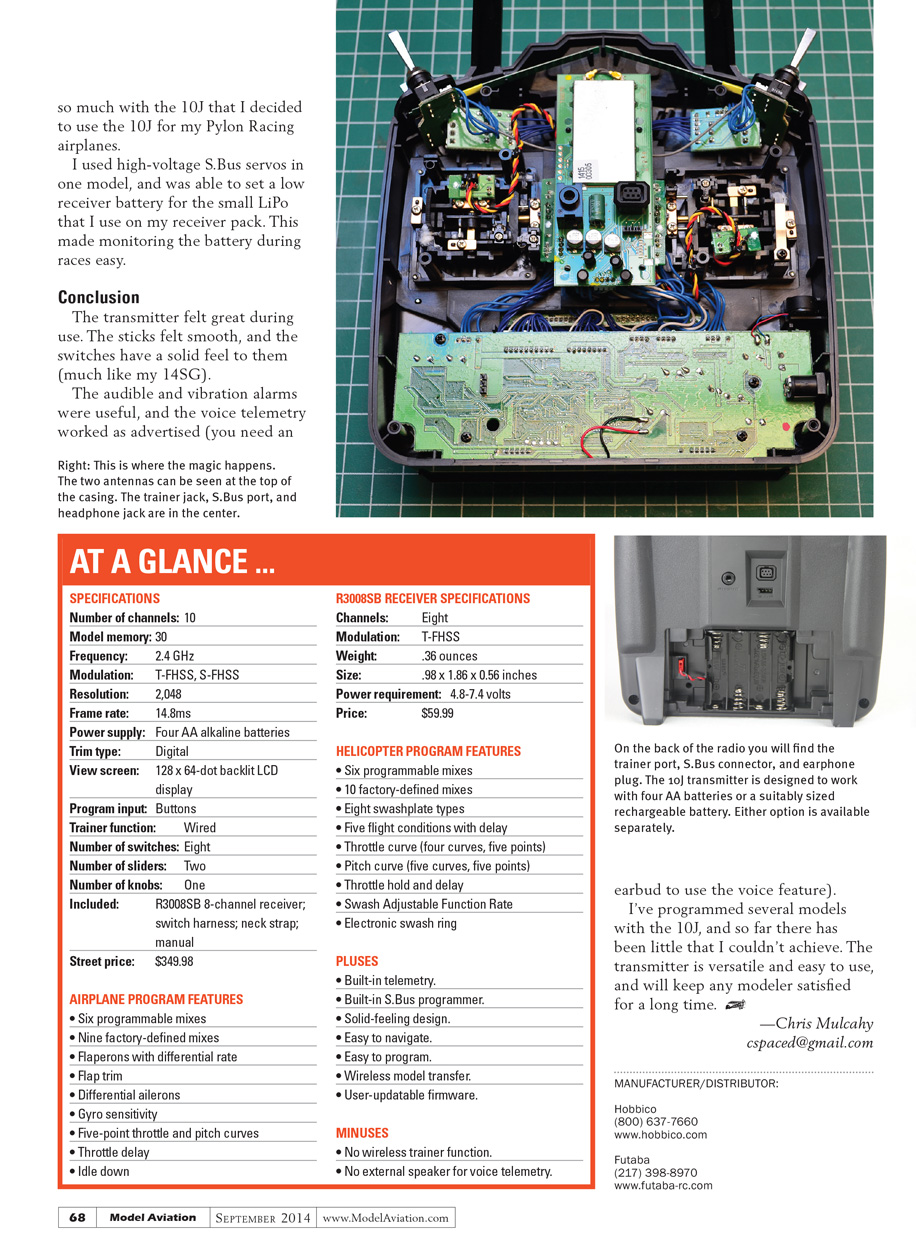
The 10J requires four AA batteries, which are not included. The cage for the AA batteries is removable so you can install a suitably sized rechargeable pack, such as a LiPo or LiFe battery. If the battery type is changed, you can go into the system menu and change the battery alarm voltage to match.
The 10J packs an impressive amount of features at this price:
- Large 128 x 64-dot backlit LCD screen
- Same style navigation joystick used on the 8J
- 30-model memory
- S.Bus servo programmer
- Wireless data transfer between similar transmitters
- Integrated telemetry
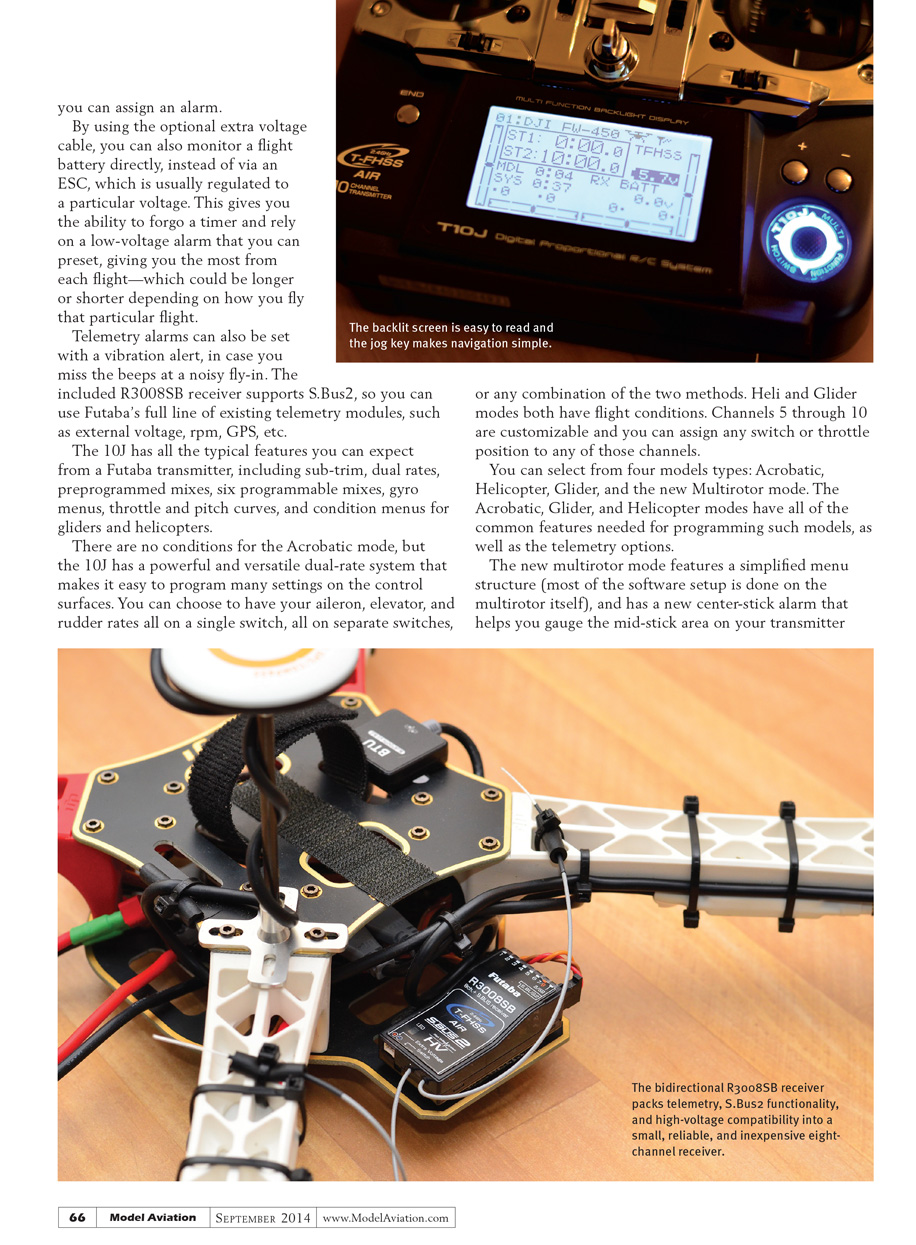
The telemetry features include a synthesized voice option that you can hear via external headphones that plug into the back of the transmitter. By default, the transmitter displays the receiver voltage, to which you can assign an alarm.
By using the optional extra voltage cable, you can also monitor a flight battery directly instead of via an ESC, which is usually regulated. This gives you the option to forgo a timer and rely on a preset low-voltage alarm, letting you maximize each flight—longer or shorter depending on how you fly.
Telemetry alarms can also be set with a vibration alert in case you miss audible beeps at a noisy fly-in. The included R3008SB receiver supports S.Bus2, so you can use Futaba's line of telemetry modules (external voltage, RPM, GPS, etc.).
The 10J includes typical Futaba features such as sub-trim, dual rates, preprogrammed mixes, six programmable mixes, gyro menus, throttle and pitch curves, and condition menus for gliders and helicopters.
There are no conditions for Acrobatic mode, but the 10J has a powerful, versatile dual-rate system that makes it easy to program many settings on the control surfaces. You can choose to have aileron, elevator, and rudder rates all on a single switch, all on separate switches, or any combination of the two methods. Heli and Glider modes both have flight conditions. Channels 5 through 10 are customizable, and you can assign any switch or throttle position to any of those channels.
You can select from four model types: Acrobatic, Helicopter, Glider, and the new Multirotor mode. The Acrobatic, Glider, and Helicopter modes include the common features needed for programming those models, as well as telemetry options.
The new Multirotor mode features a simplified menu structure (most of the software setup is done on the multirotor itself) and has a center-stick alarm that helps you gauge the mid-stick area on your transmitter without having to look down. For multirotor users, this is typically the point at which a multirotor will hover without gaining or losing altitude.
All menu features are easily accessible by holding down the plus key, and the multifunction switch makes menu navigation easy. The parameter menu contains system settings such as backlight and volume, plus telemetry and speech settings. The parameter menu is also where you select the model type.
Models can be wirelessly transferred between two 10J radios and backed up using the optional CIU-2 USB interface. You can also use the CIU-2 to update the transmitter as new firmware versions are released.
If you are using S.Bus servos, the 10J can assign channels directly to a servo with no additional equipment required. Simply plug the servo into the back of the transmitter (and a Y-harnessed battery to power the servo), and use the S.Bus link menu to adjust options for the servo such as channel number, soft start, neutral offset, dead band, travel adjust, etc.
I started with a multirotor model using the new Multirotor setting on the 10J. I attached my flight battery to the R3008SB's "ext voltage port" and programmed an alarm appropriate for my 3S LiPo. The 10J displayed both the receiver voltage and the flight-pack voltage.
The simplified menu wasn't used much because most mixing and programming were done on the flight controller, but the uncluttered menu was less distracting when hunting down telemetry and timer settings. I activated the center-stick alarm, and it worked well—promptly alerting me when I wanted to stop ascending or descending.
I programmed my Flyzone Beaver using a spare S-FHSS receiver, and setup was quick and easy. I even programmed a crow function (Air Brake in the menu) by splitting the two aileron servos into separate channels. I enjoyed flying the Beaver so much with the 10J that I decided to use it for my pylon racing airplanes.
I used high-voltage S.Bus servos in one model and was able to set a low receiver battery alarm for the small LiPo I use on my receiver pack. This made monitoring the battery during races easy.
Conclusion
The transmitter felt great during use. The sticks were smooth, and the switches have a solid feel (much like my 14SG).
The audible and vibration alarms were useful, and the voice telemetry worked as advertised (you need an earbud to use the voice feature).
I’ve programmed several models with the 10J, and so far there has been little I couldn’t achieve. The transmitter is versatile and easy to use, and will keep any modeler satisfied for a long time.
—Chris Mulcahy [email protected]
MANUFACTURER/DISTRIBUTOR
- Hobbico
(800) 637-7660 www.hobbico.com
- Futaba
(217) 398-8970 www.futaba-rc.com
Transcribed from original scans by AI. Minor OCR errors may remain.

