
AT-RISK YOUTH
TAKING FLIGHT IN THE RIGHT DIRECTION
by Rachelle Haughn
Knowing the right decisions to make in life can be difficult for anyone. There are the causes and effects to consider, the consequences, the repercussions, the smallest choices that can change lives. And for teens especially, the impulse to suddenly act can be powerful.
The same can be said for flying model airplanes. An incorrect input or a kneejerk reaction can result in a pile of balsa wood on the airfield. But, someone must pick up the pieces and put the airplane back together.
What was broken can nearly always be fixed, especially when it comes to the lives of some Georgia youngsters.
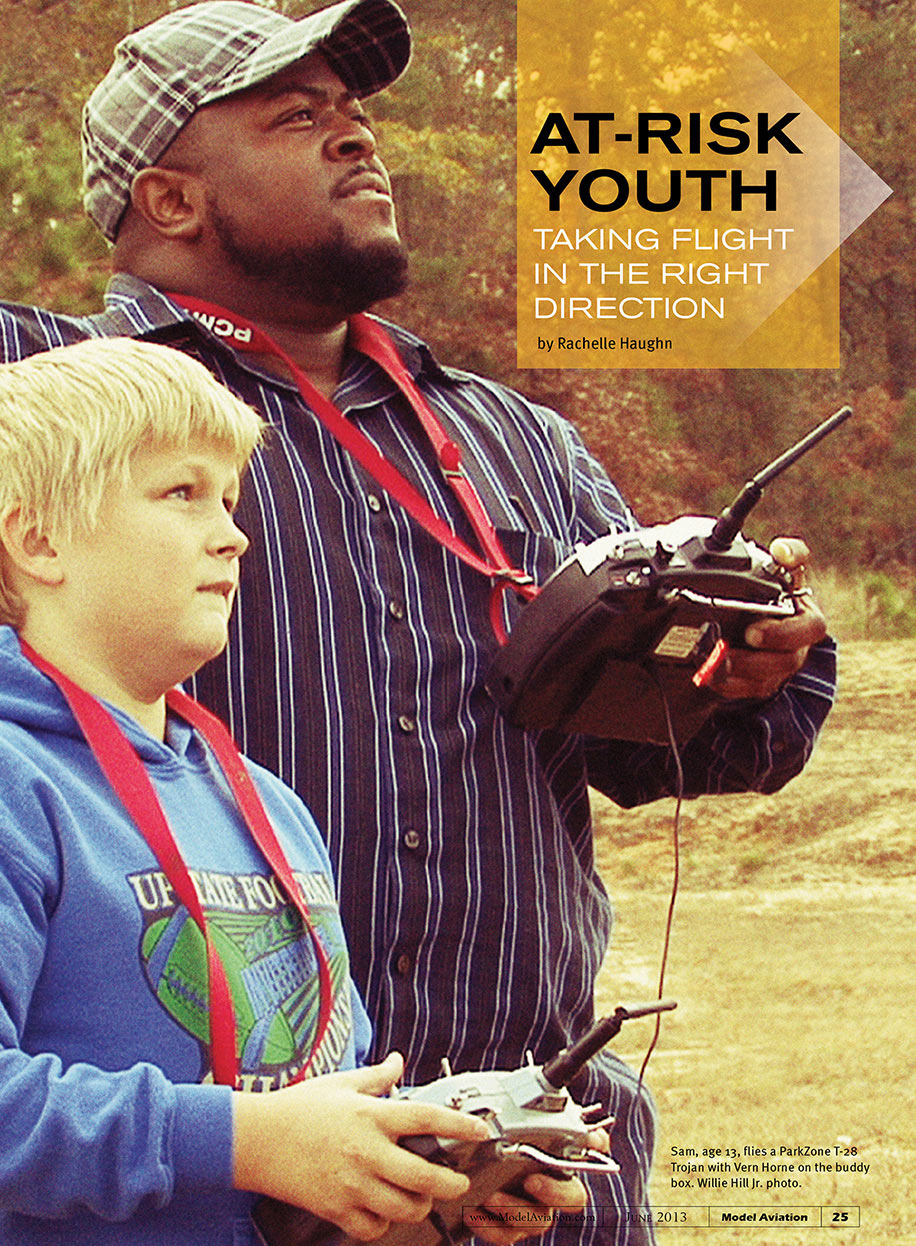
AMA member Vern Horne operates a program for troubled Georgia youth that uses model airplanes to teach them life lessons—such as the importance of making good choices.
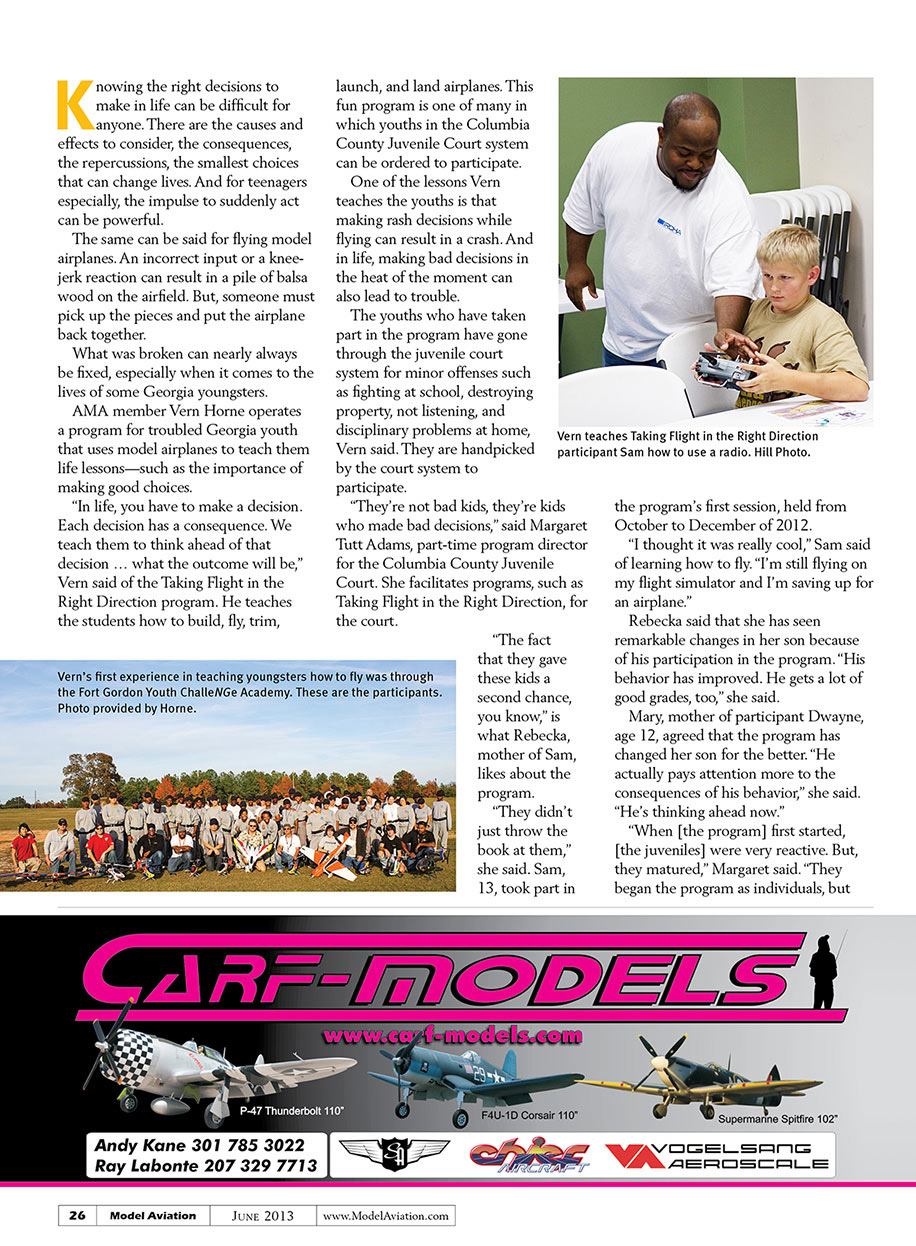
"In life, you have to make a decision. Each decision has a consequence. We teach them to think ahead of that decision … what the outcome will be," Vern said of the Taking Flight in the Right Direction program. He teaches the students how to build, fly, trim, launch, and land airplanes. This fun program is one of many in which youths in the Columbia County Juvenile Court system can be ordered to participate.
One of the lessons Vern teaches the youths is that making rash decisions while flying can result in a crash. And in life, making bad decisions in the heat of the moment can also lead to trouble.
The youths who have taken part in the program have gone through the juvenile court system for minor offenses such as fighting at school, destroying property, not listening, and disciplinary problems at home, Vern said. They are handpicked by the court system to participate.
"They're not bad kids, they're kids who made bad decisions," said Margaret Tutt Adams, part-time program director for the Columbia County Juvenile Court. She facilitates programs, such as Taking Flight in the Right Direction, for the court.
"The fact that they gave these kids a second chance, you know," is what Rebecka, mother of Sam, likes about the program.
"They didn't just throw the book at them," she said. Sam, 13, took part in the program's first session, held from October to December of 2012.
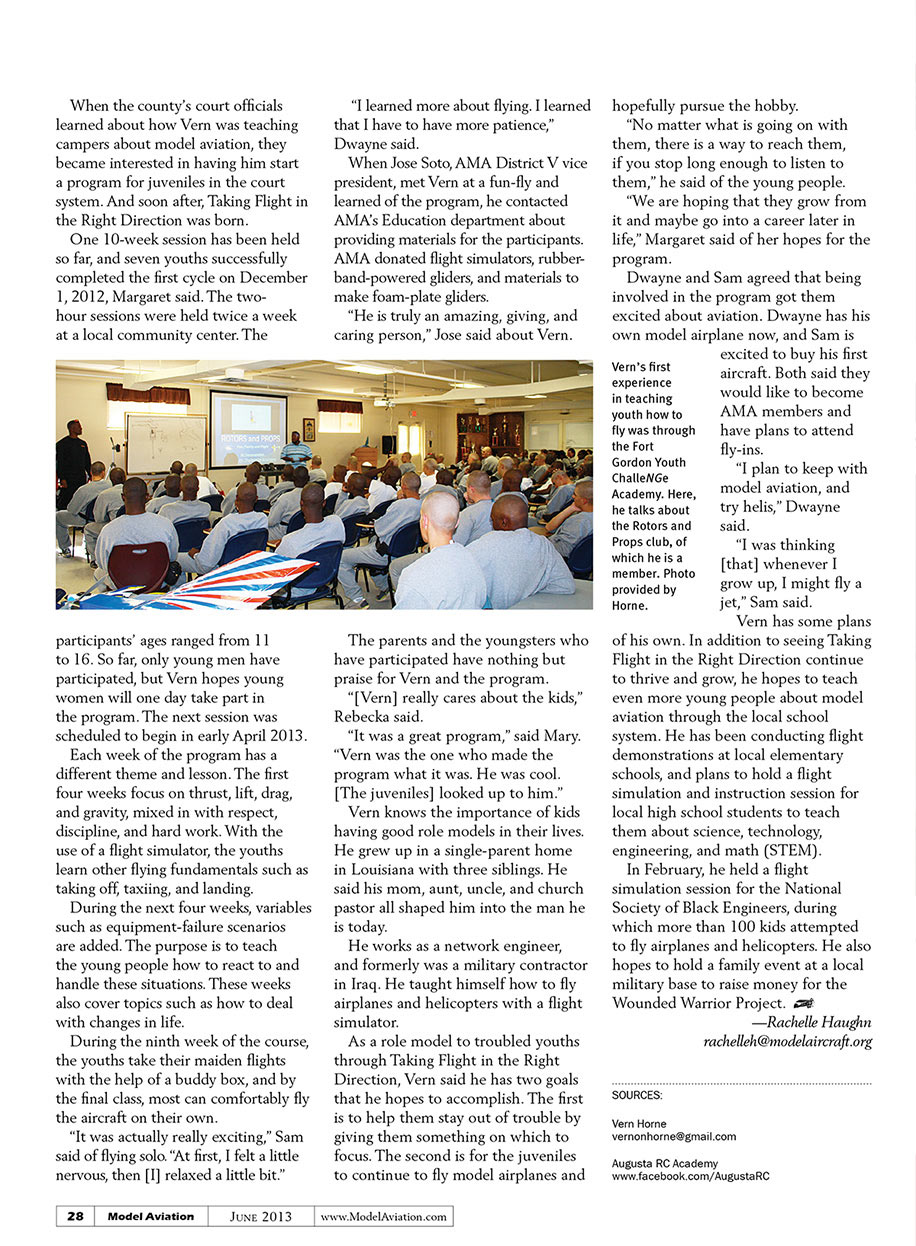
"I thought it was really cool," Sam said of learning how to fly. "I'm still flying on my flight simulator and I'm saving up for an airplane."
Rebecka said that she has seen remarkable changes in her son because of his participation in the program. "His behavior has improved. He gets a lot of good grades, too," she said.
Mary, mother of participant Dwayne, age 12, agreed that the program has changed her son for the better. "He actually pays attention more to the consequences of his behavior," she said. "He's thinking ahead now."
"When [the program] first started, [the juveniles] were very reactive. But, they matured," Margaret said. "They began the program as individuals, but they merged and walked out of the program as a team."
Vern said that as the weeks passed, the youths began to support and encourage each other.
"Some of the kids in that class I made real good friends with, Ma'am," Sam said. He added that he learned the importance of "being respectful of other people."
"I liked just being in the class and meeting all of the people and learning about [model airplanes]," Dwayne said.
One of the requirements of the program is that parents participate alongside their children. During the first session, the youths and their parents built two ParkZone T-28 Trojan trainer aircraft, which were purchased through Columbia County government funding. Some of the parents also tried out the flight simulators.
"I learned how to fly an airplane and put them together," Rebecka said of her time participating in the program. "Anything that I can do with my little boy helps strengthen our bond. We had a lot of fun." She purchased a flight simulator for Sam after he completed the 10-week program, and she likes to fly on it with him.
Mary said she had a little trouble with building the airplanes for the class to fly. "[Dwayne] was actually helping me build." She added that she liked the fact that by participating with their children, parents had the opportunity to encourage and support them. She said it sent the message that "we're still here and we still love you."
Mary's husband, Shane, is a member of the Rotors and Props RC Club, of Augusta, Georgia, and flies model helicopters. Before Dwayne participated in Taking Flight in the Right Direction, he and Shane sometimes discussed aeromodeling. But now, this program has introduced her to their world.
"They had that bond," she said of Shane and Dwayne. "[Learning about aeromodeling] gave me something to talk to him about. He lights up when he talks about model airplanes," Mary said about Dwayne.
That spark for aeromodeling is precisely what Vern hopes to see in the eyes of those he mentors.
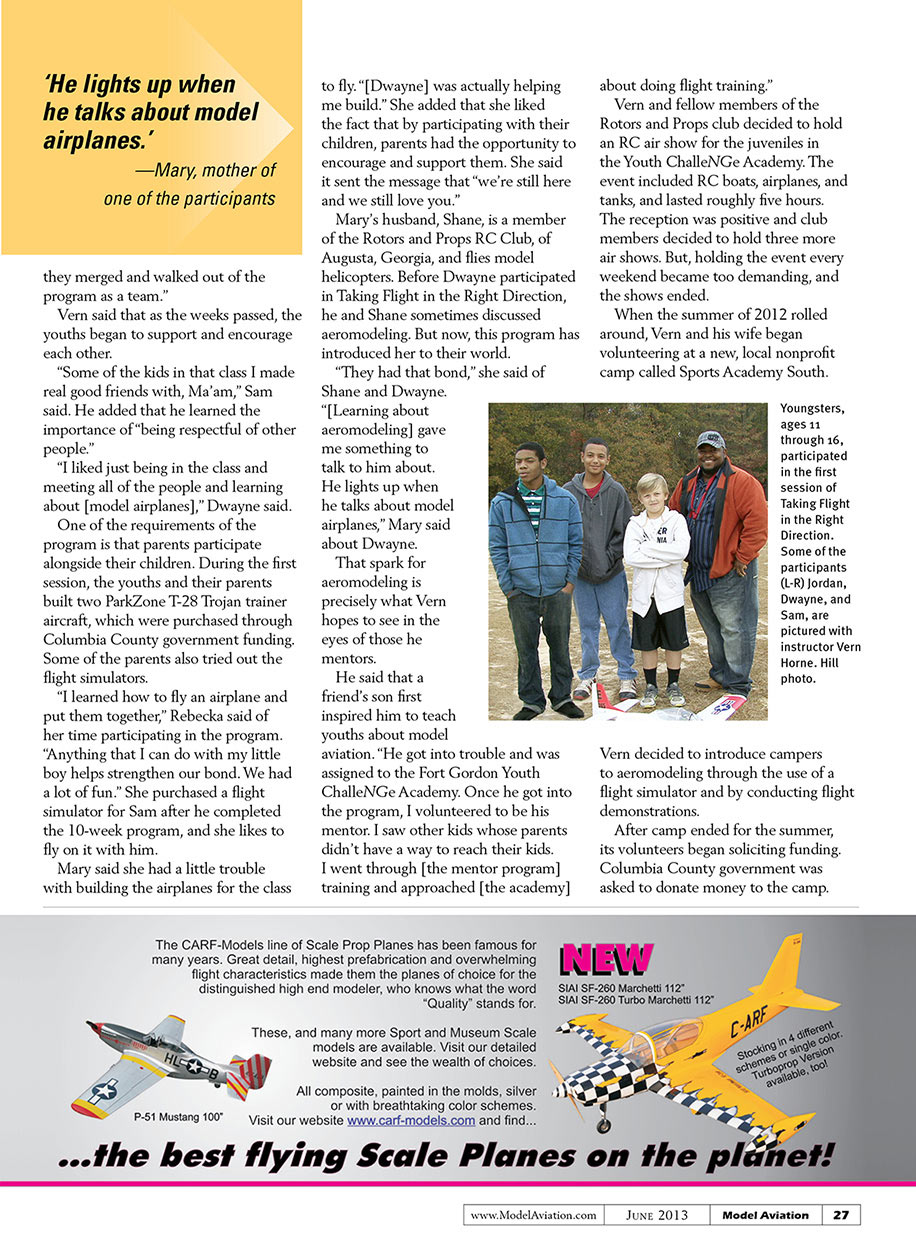
He said that a friend's son first inspired him to teach youths about model aviation. "He got into trouble and was assigned to the Fort Gordon Youth ChalleNGe Academy. Once he got into the program, I volunteered to be his mentor. I saw other kids whose parents didn't have a way to reach their kids. I went through [the mentor program] training and approached [the academy] about doing flight training."
Vern and fellow members of the Rotors and Props club decided to hold an RC air show for the juveniles in the Youth ChalleNGe Academy. The event included RC boats, airplanes, and tanks, and lasted roughly five hours. The reception was a positive and club members decided to hold three more air shows. But, holding the event every weekend became too demanding, and the shows ended.
When the summer of 2012 rolled around, Vern and his wife began volunteering at a new, local nonprofit camp called Sports Academy South.
Vern decided to introduce campers to aeromodeling through the use of a flight simulator and by conducting flight demonstrations.
After camp ended for the summer, its volunteers began soliciting funding. Columbia County government was asked to donate money to the camp.
At-Risk Youth
Rachelle Haughn
When the county’s court officials learned about how Vern was teaching campers about model aviation, they became interested in having him start a program for juveniles in the court system. And soon after, Taking Flight in the Right Direction was born.
One 10-week session has been held so far, and seven youths successfully completed the first cycle on December 1, 2012, Margaret said. The two-hour sessions were held twice a week at a local community center.
Participants’ ages ranged from 11 to 16. So far, only young men have participated, but Vern hopes young women will one day take part in the program. The next session was scheduled to begin in early April 2013.
Each week of the program has a different theme and lesson. The first four weeks focus on thrust, lift, drag, and gravity, mixed in with respect, discipline, and hard work. With the use of a flight simulator, the youths learn other flying fundamentals such as taking off, taxiing, and landing.
During the next four weeks, variables such as equipment-failure scenarios are added. The purpose is to teach the young people how to react to and handle these situations. These weeks also cover topics such as how to deal with changes in life.
During the ninth week of the course, the youths take their maiden flights with the help of a buddy box, and by the final class, most can comfortably fly the aircraft on their own.
“It was actually really exciting,” Sam said of flying solo. “At first, I felt a little nervous, then [I] relaxed a little bit.”
“I learned more about flying. I learned that I have to have more patience,” Dwayne said.
When Jose Soto, AMA District V vice president, met Vern at a fun-fly and learned of the program, he contacted AMA’s Education department about providing materials for the participants. AMA donated flight simulators, rubber-band-powered gliders, and materials to make foam-plate gliders.
“He is truly an amazing, giving, and caring person,” Jose said about Vern.
The parents and the youngsters who have participated have nothing but praise for Vern and the program.
“[Vern] really cares about the kids,” Rebecka said.
“It was a great program,” said Mary. “Vern was the one who made the program what it was. He was cool. [The juveniles] looked up to him.”
Vern knows the importance of kids having good role models in their lives. He grew up in a single-parent home in Louisiana with three siblings. He said his mom, aunt, uncle, and church pastor all shaped him into the man he is today.
He works as a network engineer, and formerly was a military contractor in Iraq. He taught himself how to fly airplanes and helicopters with a flight simulator.
As a role model to troubled youths through Taking Flight in the Right Direction, Vern said he has two goals that he hopes to accomplish. The first is to help them stay out of trouble by giving them something on which to focus. The second is for the juveniles to continue to fly model airplanes and hopefully pursue the hobby.
“No matter what is going on with them, there is a way to reach them, if you stop long enough to listen to them,” he said of the young people.
“We are hoping that they grow from it and maybe go into a career later in life,” Margaret said of her hopes for the program.
Dwayne and Sam agreed that being involved in the program got them excited about aviation. Dwayne has his own model airplane now, and Sam is excited to buy his first aircraft. Both said they would like to become AMA members and have plans to attend fly-ins.
“I plan to keep with model aviation, and try helis,” Dwayne said.
“I was thinking [that] whenever I grow up, I might fly a jet,” Sam said.
Vern has some plans of his own. In addition to seeing Taking Flight in the Right Direction continue to thrive and grow, he hopes to teach even more young people about model aviation through the local school system. He has been conducting flight demonstrations at local elementary schools, and plans to hold a flight simulation and instruction session for local high school students to teach them about science, technology, engineering, and math (STEM).
In February, he held a flight simulation session for the National Society of Black Engineers, during which more than 100 kids attempted to fly airplanes and helicopters. He also hopes to hold a family event at a local military base to raise money for the Wounded Warrior Project.
—Rachelle Haughn [email protected]
Sources: Vern Horne [email protected]
Augusta RC Academy www.facebook.com/AugustaRC
Transcribed from original scans by AI. Minor OCR errors may remain.

