
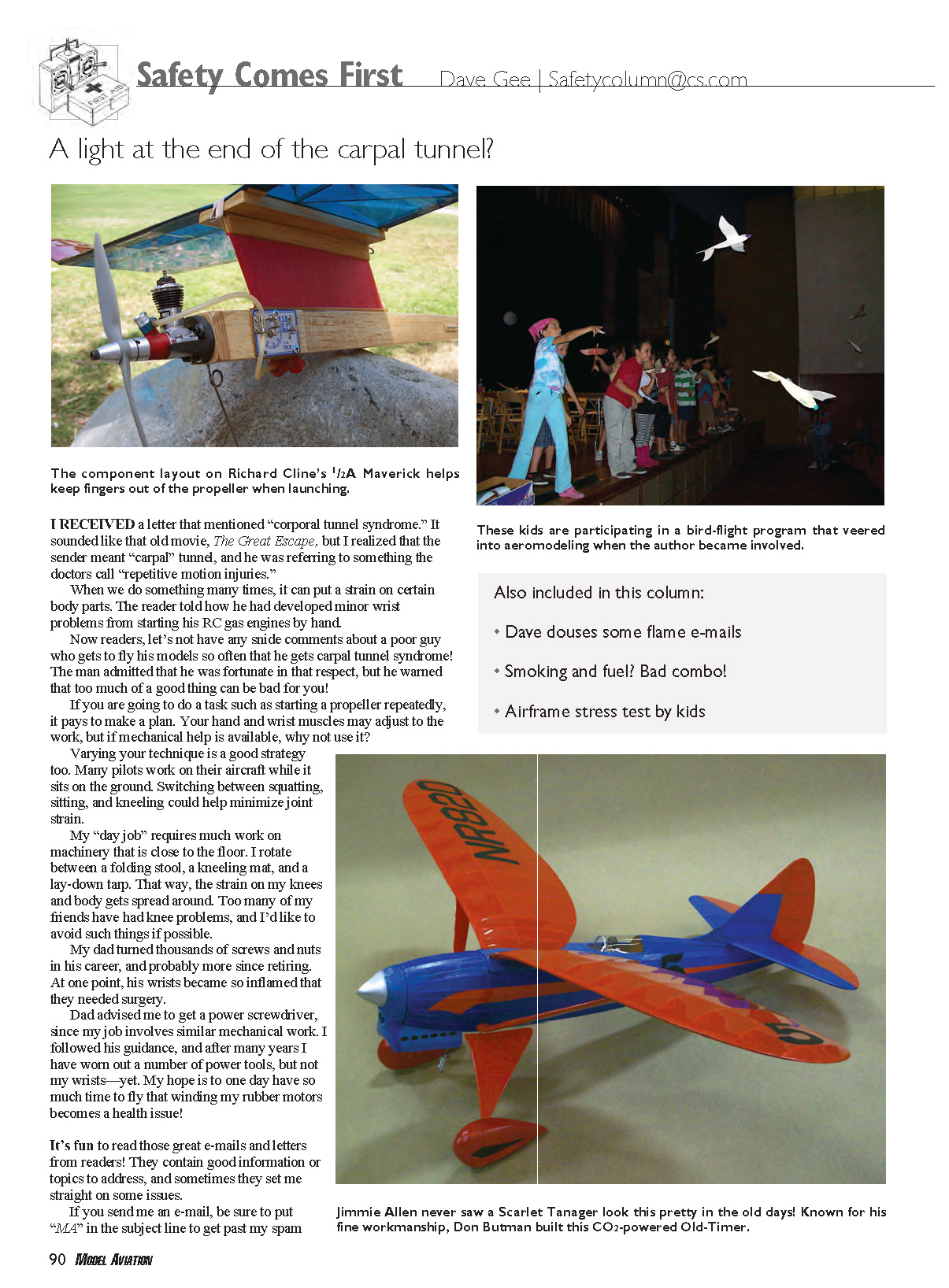
Safety Comes First
Dave Gee | [email protected]
A light at the end of the carpal tunnel?
I received a letter that mentioned "corporal tunnel syndrome." It sounded like that old movie, The Great Escape, but I realized the sender meant "carpal" tunnel, and he was referring to what doctors call repetitive motion injuries.
When we do something many times, it can put strain on certain body parts. The reader told how he had developed minor wrist problems from starting his RC gas engines by hand.
Now, readers, let's not have any snide comments about a poor guy who gets to fly his models so often that he gets carpal tunnel syndrome! The man admitted that he was fortunate in that respect, but he warned that too much of a good thing can be bad for you.
If you are going to perform a task such as starting a propeller repeatedly, it pays to make a plan. Your hand and wrist muscles may adjust to the work, but if mechanical help is available, why not use it?
Varying your technique is a good strategy, too. Many pilots work on their aircraft while it sits on the ground. Switching between squatting, sitting, and kneeling can help minimize joint strain.
My day job requires much work on machinery that is close to the floor. I rotate between a folding stool, a kneeling mat, and a lay-down tarp. That way, the strain on my knees and body gets spread around. Too many of my friends have had knee problems, and I'd like to avoid such things if possible.
My dad turned thousands of screws and nuts in his career, and probably more since retiring. At one point his wrists became so inflamed that they needed surgery.
Dad advised me to get a power screwdriver, since my job involves similar mechanical work. I followed his guidance, and after many years I have worn out a number of power tools, but not my wrists—yet. My hope is to one day have so much time to fly that winding rubber motors becomes a health issue!
It's fun to read those great e-mails and letters from readers. They contain good information or topics to address, and sometimes they set me straight on some issues.
If you send me an e-mail, be sure to put "MA" in the subject line to get past my spam filter. I delete plenty of spam messages, many from crooked sales outfits that collect e-mail addresses from modeling websites. Sometimes I receive copies of e-mail exchanges forwarded by other people. The most amazing ones are from senders who are irate about something but have no idea how to get what they want from a local club official, their AMA representative, or an AMA staff member. This type of e-mail is called a "flame," and you can't imagine how bad they get!
Most of us know that starting out with insults and obscenities is no way to win the hearts and minds of anyone. That kind of treatment doesn't put people in a cooperative mood. I've read some mighty rough language in messages about our hobby, and the senders actually expect the recipient or victim to do his or her bidding afterward. To put up with such things, AMA officials and staffers need great patience and thick skins. I have neither. They must represent the organization with dignity and restraint. I am only a lowly columnist, so I can call a crackpot a crackpot! Poison-pen writers sabotage their own causes, since nobody wants to read through a kooky e-mail to see if there is a valid point at the end. AMA policy gets changed all the time, but seldom as a result of nasty letters that use insults in lieu of logic.
The situation is different for a grown-up style of message. I've seen major effort and serious action result from such an e-mail. It's obvious: if you want people to take you seriously, don't call them names.
Your local and national AMA officials are not politicians. Generally they're modelers, as you are, who give up some flying time to volunteer to help others. Treat them with courtesy.
I was on a road trip visiting an RC field where nobody knew me. My bad landing approaches were all part of my disguise as an ordinary, mild-mannered modeler. The flying site in question is city-owned, and there is no real governing organization to enforce rules or safety.
On my left in the pit area was a group of men standing in a circle. They were laughing and talking about the airplanes parked at their feet. Roughly half of them were smoking cigarettes, despite the presence of fuel cans, pumps, oily rags, and the usual gas-powered model stuff.
The men began jokingly shoving one another around, trying to avoid stepping on the aircraft and waving their hands for balance. Some hands held lit cigarettes and at least one butt dropped onto the ground.
My feelings were torn. As stupid as these guys were acting, I felt deep gratitude for their help with this month's column.
On my right was a fellow prepping his airplane for flight. I thought I'd point out the impending barbecue to him, but the words wouldn't come out. This guy was crouched over his model, pumping gas into the tank while puffing on a lit cigar!
He even adjusted his fuel tubing with the hand that held the burning stogie. Not satisfied with being a spectator at the cookout, he wanted to be the main course.
The people I described really did those things in front of me. You might run into someone such as this at your site. What action, if any, can you take?
At this field I was a stranger and had no authority to give orders. Perhaps there was a diplomatic way to tell them they were acting stupid, but I couldn't think of any. They already knew they were doing something foolish. Having a stranger remind them of it would probably not work out well.
My solution was to leave before the fire department was needed. No confrontations this time.
In this case, the people were unaware of who was watching them and didn't seem very bright, so they will remain anonymous—until you see them on the news, being medevacked to the burn center.
Somewhere out there is a reader who wants to defend these dopes. I expect to read e-mail about how the ignition temperature of fuel is higher than the heat provided by tobacco products.
Sorry, but there is no defense of dumb stuff like this. There is a whole world of fine places to enjoy a smoke, but leaning over a model being refueled is not among them.
Our gas is not only flammable, but it is also explosive, and will make a swell fireball if it finds an ignition source at an inconvenient moment. The human eye cannot see gasoline fumes, so we cannot tell where a flammable air/gas mixture might lurk, unless some idiot locates it by waving fire around!
I don't care how many years someone has gotten away with it, what a chemistry whiz he or she is, or anything else. Fire and gasoline should be kept apart.
Have you ever seen a gas spill ignite and spread like—well, like wildfire? I have, and there's no stopping it without serious fire equipment. A small quantity of model fuel can make an incredible amount of flame in an instant.
I have friends who smoke. They all seem to know about gasoline being flammable, and they wouldn't put their buddies at risk just for a cigarette. This is an important qualification if you want to hang out with me; I am uncomfortable around people who might cause explosions.
The photos this month do not have much to do with safety. How do you illustrate flame e-mail? Nevertheless, here's a token effort to tie things together.
The FF Gas model was built by Richard Cline, who usually dominates the competition field with his gliders. He did an exceptionally tidy job on the hardware installation, with engine controls, timer, and fuel system neatly placed.
The model is a 1/2A Maverick with a 42-inch wingspan. I'll bet Richard keeps his fuel system well clear of any sources of ignition in the pits.
Don Butman is well-known for his top-notch workmanship. The model shown is his Old-Timer classic Scarlet Tanager, also known as Jimmie Allen's Bluebird Racer. Don used lightweight iron-on covering instead of tissue, and it looks nice. He powers his model with CO2, which eliminates any fire hazard during fueling.
The kids in a picture are students participating in a science program at their local natural history museum. The instructor thought the course on bird flight could use a little pep, so I was invited to bring in some indoor ornithopters and other model airplanes.
Naturally the kids wanted to fly something of their own, hence the bird-shaped gliders you see being mass-launched in a normally quiet auditorium. It got a little noisy that day, as the enthusiastic kids filled the air with balsa. Kids that age shouldn't smoke and the models do not use gasoline, so the fire danger was minimal.
Those bird gliders were made possible by well-known Society of Antique Modelers member Ron Boots, who kindly provided a giant load of 3/32-inch sheet balsa. I drew a custom design based on that dimension and was gratified to see it fly properly when tested.
My pride was short-lived, though, because the kids gave me a lesson in stress analysis. Do you want to know where your airplane's weak spots are? Let a little girl fly it!
Subsequent bird gliders were equipped with additional reinforcement at the tail and wing root.
Practical tips
- Use mechanical aids (power starters, power screwdrivers) to reduce repetitive strain.
- Vary your working position (squatting, sitting, kneeling) to spread joint stress.
- Rotate seating/support options (folding stool, kneeling mat, tarp) when working low to the ground.
- Never smoke or hold a lit cigar/cigarette while refueling or working near fuel.
- Treat AMA officials and volunteers with courtesy; polite, reasoned communication is far more effective than insults.
Sources
Dave Gee Box 7081 Van Nuys, CA 91409
Transcribed from original scans by AI. Minor OCR errors may remain.

