
Safety Comes First
Contact
Box 7081, Van Nuys CA 91409 E-mail: [email protected]
About the author
And so another columnist springs forth!
Long ago, when dinosaurs walked the earth, my father Ralph encouraged my interest in aviation by bringing home a Len Marlow Shark kit. He patiently taught me to build and fly stick-and-tissue models in the pre-superglue era of "pin it down and wait overnight." (Fast-drying cyanoacrylate products proved to be better suited to my temperament when they arrived.)
I never acquired my dad's high standards of craftsmanship, but that hasn't stopped me from slapping models together ever since. My son Jeff grew up to be an RC pilot, so model aviation bridges our three generations.
A supportive spouse is a must for someone whose hobby involves smelly paint and balsa dust. I am blessed to have sweet Diedra, who is more likely to borrow my new tool than complain about the purchase price. When she's not dulling my blades on her craft projects, she helps out at contests. I'm a lucky man!
My flying and building
I dabble in many types of flying models and use enthusiasm to compensate for a lack of skill. It is said that exhibitions of my RC stickhandling expertise have led to a local resurgence of FF activity. There are also a few electric-powered CL models in the hangar—many with unexplained impact damage. My endurance airplanes scarcely deserve the name, but once in a while I turn out a decent Scale model.
If I had to pick a favorite category, it would be Indoor Scale—especially Peanut. I've flown RC helicopters only on computer simulator programs, but the results indicate that I should stick to fixed-wing flying. If I shattered as many real rotor blades as digital ones, the lumber industry would be hard-pressed to meet the demand.
I perform frequent demonstrations for schools and groups of kids just to see the amazed looks on their faces, which reflect my inner 8-year-old's fascination with model airplanes. When a youngster says "Wow!" I know exactly how he or she feels. Growing up is overrated, although it does enable one to afford better kits.
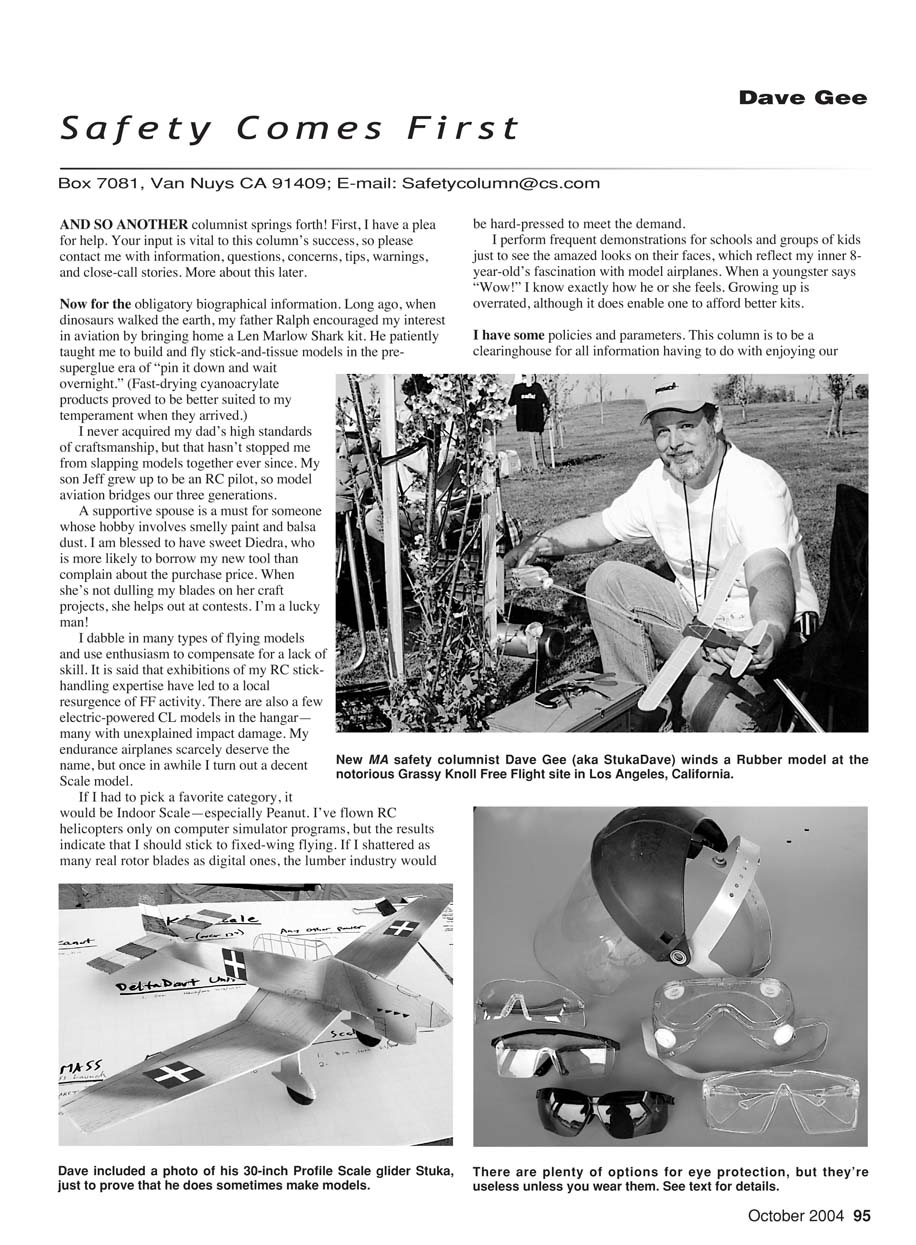
As an old-fashioned stick-and-tissue guy, I have limited experience with many of the popular newfangled building materials. Foam and carbon fiber lack the classic romance of balsa, but they sure make fine, strong wings. I will depend on more knowledgeable readers for the latest tips and warnings about high-tech structures. Some readers may know me as StukaDave on the Internet. I realize that there are still plenty of modelers who don't have computers, despite the perception that everyone is online. A great deal of the stuff I'll discuss here has developed from the immense satisfaction of our hobby.
Column purpose and policies
This column is to be a clearinghouse for all information having to do with enjoying our sport safely. Your input is vital since I don't know everything and can't be everywhere. I'm idealistic enough to hope that by pooling all the experience and expertise of this magazine's readership, we can do some good and perhaps save someone from getting hurt.
- You'll see serious studies and statistics here.
- Anecdotal information is also welcome because it's interesting and motivational to hear about someone else's harrowing close call.
- If you have a story, please consider sharing it in the hope that a modeler you never met will be saved from embarrassment or harm.
Anonymity can be provided if you want.
On attitudes and safety
It is not a team sport, but generally an individual pursuit, which gives utter control over all aspects of our miniature flying machines (except, in my case, landings). We are in command of our air fleet, and we are used to being the boss at all stages: conception, design, construction, test-flying, etc. Even ARF pilots answer to no one when they pick out a new foamie and zoom skyward. This can sometimes breed a subtle reluctance to accept guidance and the feeling that safety precautions can be bypassed if circumstances warrant.
Does that sound familiar? I admit to being a longtime sufferer and to making mildly arrogant decisions based on an illusion of vast experience and skill. When you're standing at the hobby-shop counter with cash in hand, let your fantasies take wing. The time for humility is later, when you face a mental crossroad regarding some precaution that seems annoying. Why not go clear across the room for the mask when I'm only going to spray this little bit? I've started that engine or performed that task a hundred times, so I'll skip the onerous safety rule this once. I am The Boss and I say it's okay.
The point is to remain aware of these tendencies and make the smart choice when you weigh a bit of inconvenience against what seems like a small risk. Don't leave yourself vulnerable to a mishap when you have control and the power to keep things shipshape.
Story: Close call at the workbench
One afternoon approximately three years ago, I was happily puttering at my workbench, using my trusty cordless rotary tool on a cowling. Suddenly the piece split and threw sharp wooden shrapnel around the room. A chunk of plywood struck my cheek and left a nasty wound. The shard hit my face roughly three-quarters of an inch from my right eye, which was unprotected. A fine pair of safety glasses sat unused on the table.
Excuses? I have none that sound good or that you would believe. I was spending some casual time on model building and only had a bit of work to do with the power tool before returning to a sanding block. It was only one cut; I had done it a million times. But not like that!
The pain of a minor injury was nothing compared to the chill that ran up my spine as I gazed into the mirror and realized how close I had come to a life-altering loss of binocular vision. I felt like an idiot, but a lucky idiot. While plucking the plywood shard out of my face, I vowed to never take such a foolish risk again.
Since that day, the eye protection goes on before I reach for the tool. I even sprung for some fancier safety glasses to remove any rationalization about how "I can't see through those scratchy old things." By the way, a close examination showed that some of the scratches were apparently caused by other shards impacting the lenses. Well, that's what they're for, and better to ruin the plastic than my eyeballs.
Eye protection: practical advice
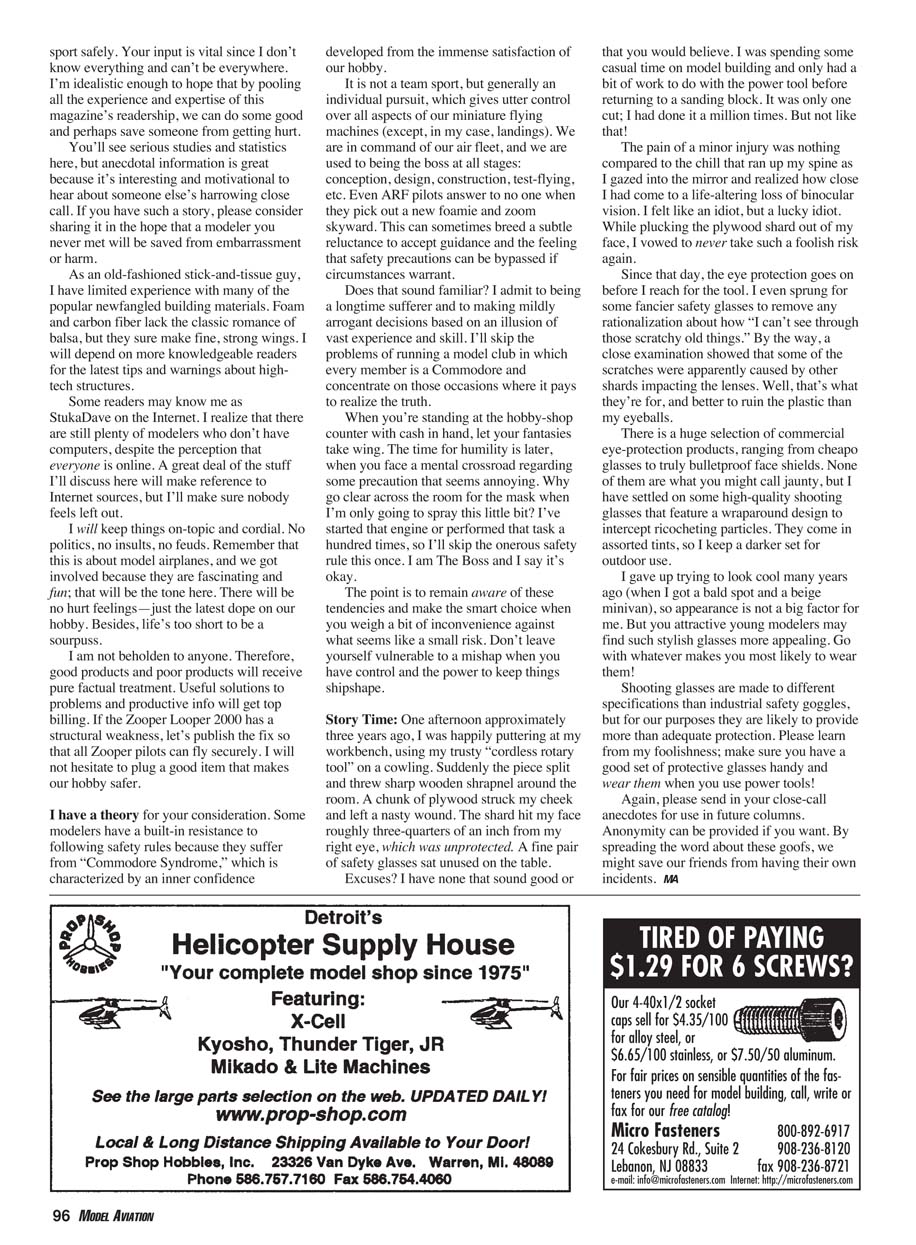
There is a huge selection of commercial eye-protection products, ranging from cheap glasses to truly bulletproof face shields. None of them are what you might call jaunty, but I have settled on some high-quality shooting glasses that feature a wraparound design to intercept ricocheting particles. They come in assorted tints, so I keep a darker set for outdoor use.
Shooting glasses are made to different specifications than industrial safety goggles, but for our purposes they are likely to provide more than adequate protection. Please learn from my foolishness; make sure you have a good set of protective glasses handy and wear them when you use power tools!
Go with whatever makes you most likely to wear them—appearance is less important than safety. If a stylish pair gets younger modelers to protect their eyes, that's a win.
Send your close-call anecdotes
Again, please send in your close-call anecdotes for use in future columns. Anonymity can be provided if you want. By spreading the word about these goofs, we might save our friends from having their own incidents.
MA
Transcribed from original scans by AI. Minor OCR errors may remain.

