

Safety Comes First
Dave Gee Box 7081, Van Nuys CA 91409; E-mail: [email protected]
"WITH CONTROL LINE, the airplane never gets more than 60 feet away from you and you can watch it all the time—in fact, you better watch it all the time!" — Nick V.
CL combat fliers may disagree (they can fly by feel while watching their competitor's airplane), but keeping your aircraft in sight is important for the rest of us. Outdoor RC pilots frequently have an issue with glare from the sun. The Red Baron made use of the fact that an airplane is hard to see when it's in the sun, but now we also know that ultraviolet (UV) rays from sunlight can damage human eyes. Do you wear UV-blocking glasses when flying?
Eye protection
After my recent mention of various eye-protection choices, Bruce Holden of Zurich International contacted me. He is a real sparkplug and promotes his high-quality safety sunglasses with great zeal. Bruce says that UV protection is as important as impact resistance because you will usually be exposed to harmful rays, but seldom (it is hoped) will you test the shatterproof properties of your lenses. He sent me one of his products which withstood a bullet impact. (Note to Bruce: To butter up a columnist, send him glasses without bullet holes.) If gunfire becomes a common issue at my field, I'll take up something safer, such as bullriding, but readers have sent in plenty of stories about propellers shattering and engine mounts breaking. Flying shrapnel is a possibility, and your eyes are worth shielding. UV and impact protection in one product is great!
I asked about cheap, off-brand glasses that claim to have UV protection—especially the ones available from local street-corner vendors. Bruce said it's easy to tell whether or not a lens blocks UV; just visit a well-equipped laboratory that has the proper multi-thousand-dollar test meter. He wasn't kidding, either. It might be easier to just stick to a reputable brand and skip the $2 specials. Zurich products come in a variety of tints and will fit over prescription glasses. And no, I really didn't get a free pair; we run a legit operation here.
First-aid tools: splinters and tweezers
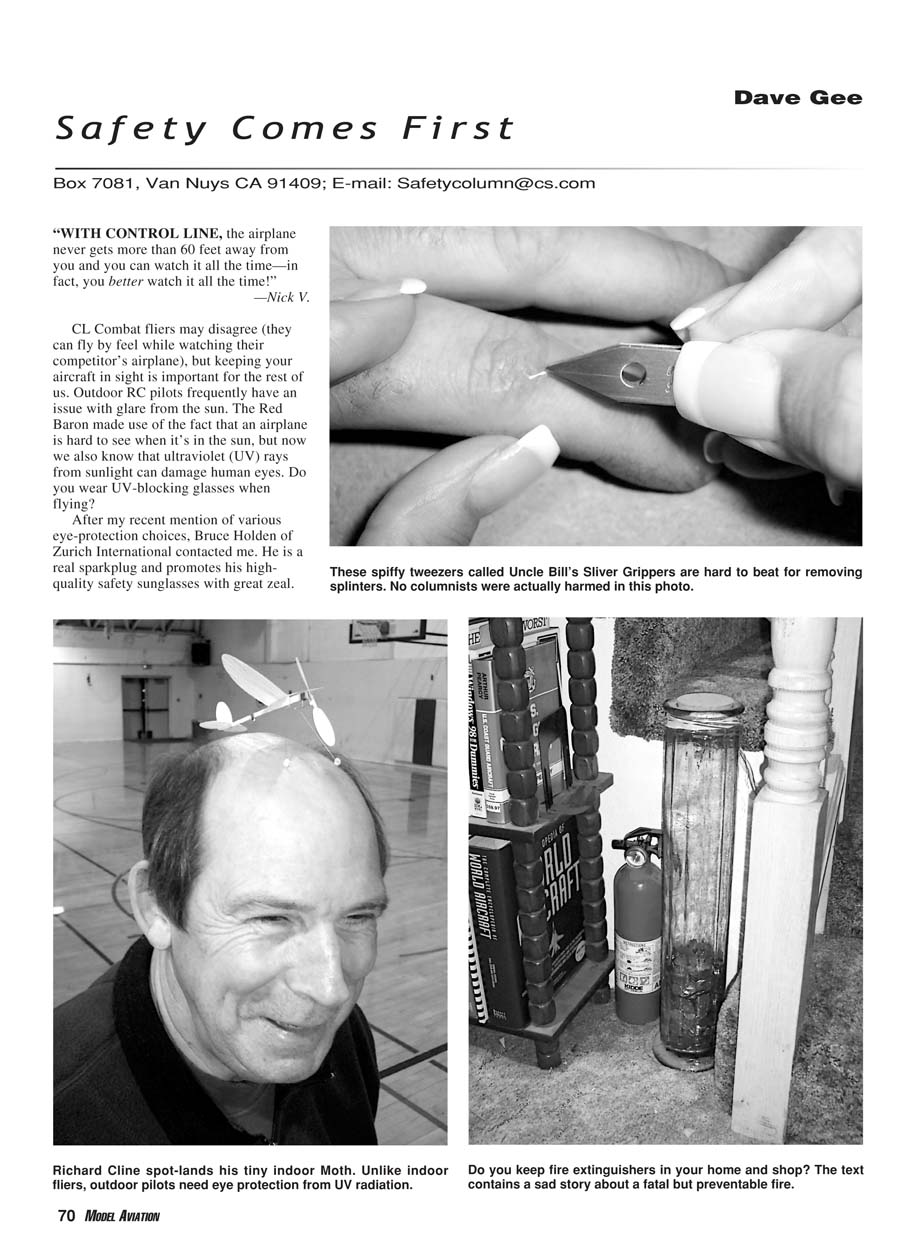
As long as I'm plugging products, I have a first-aid tool that you will appreciate. Look at the picture showing Sweet Diedra removing a (simulated) splinter from my finger; she is using a special pair of tweezers called Uncle Bill's Sliver Grippers. They are short and have extremely sharp tips. I own several pairs, and one lives in my field box. They are by far the best implement for sliver removal that I have tried, including sterilized needles, scalpels, serrated tweezers, and the kind with a built-in magnifying glass.
A young relative of mine once tolerated a splinter for two days until her scheduled visit to my house, claiming that "Dave can get it out without hurting me." Don't argue with a 4-year-old about 48 hours of pain versus 20 seconds, but you get my point. This original brand is well made, but I have seen knockoffs lately that look pretty good. You can find them at camping stores, drug stores, or, of course, on the Internet by searching the brand name. The price is roughly $5.
Buddy-box interference
This is a heads-up about buddy-box interference. I've gotten several e-mails about instances of problems, including hits on other aircraft while training with a buddy box. The information is unclear and sometimes contradictory, so I'm doing more research and asking for your help. So far it seems to be confined to certain older units and maybe to particular geographic areas. If you have had such trouble, please contact me. I'll have more about this soon.
Andrew Chiaraviglio checked in via e-mail with kind greetings and claimed, "I have learned more than a few things in the short time that I've been reading your section." He's not the only one learning things around here!
It's been a few months, but I'm still not used to being an AMA celebrity author. My wise-guy friends are always on the lookout for unsafe behavior. It is: "Hey mister safety guy, aren't you being a bit casual with that blade?" and "Dave should know better than to launch like that." And heaven help me if I wear a Band-Aid.
The problem is, anyone watching for me to goof up won't have a long wait. Sheesh!
Soldering-iron safety
Reheating the soldering-iron issue: I recently discussed good ways and bad ways to keep hot soldering irons away from body parts. Paul Anderson recommends RadioShack's soldering-station tool, part 64-2078.
The device features a heavy metal coil to hold the iron off of the table and has a built-in sponge to clean the soldering tip. It's less than $10, says Paul, and he claims to have the scars to prove how necessary it is.
Many e-mails came in on this topic, and too many modelers have had unpleasant encounters while soldering. Please use caution and a good holder!
Fire safety at home, shop, and vehicle
This subject is a bit off-topic from modeling but still worth discussing. One night last week a house caught fire a few miles from my home. Several occupants were badly burned, and a young boy died because the back door could not be opened without a key. There were no fire extinguishers available.
This is an awful story, but let's learn from it. Please give your home and shop the once-over for fire hazards, and make sure your smoke alarms and fire extinguishers are in good condition. I have an extinguisher in each room and occasionally drill my family on the locations.
These inexpensive but vital cylinders do not complement the decor—until you need one, and then they look real pretty! Be sure to get the kind of extinguisher that works on multiple types of fires, including electrical.
It's surprising to me that few people carry fire extinguishers in their vehicles. I have used the one in my van on several occasions throughout the years, and each time my $8 investment saved someone's car from total destruction.
Photography submissions
Have you noticed from the pictures in this column that I possess a near-total lack of camera-operating skill? It's either practice photography or landings, and I need the landing practice even more.
Therefore, if you have a picture that might be suitable for this column, your submissions are welcome and will be gratefully accepted. It is hard to predict what concepts will need illustrating in a given month, but I will print as many as possible. Check out the MA submission guidelines for photographs (at www.modelaircraft.org/mag/AuthorGuidelines.htm) before you send them in.
I deeply appreciate the feedback and topic suggestions that come in. Your information and stories are the heart of this discussion, so please keep 'em coming. I use nearly all of what I get, so be patient and your topic will come up. We all love hangar flying, so send your best "close-call" story and let us all enjoy it.
Material Safety Data Sheets (MSDS)
What is a Material Safety Data Sheet (MSDS), and why should you care? It is a collection of information about a specific substance or product, designed to inform workers and emergency personnel about the proper procedures for handling or working with it.
The program is set up for industry rather than home use, but an MSDS has so much useful information that we should take advantage of it when possible. You can find out exactly how toxic a product is and what precautions to use—or reassure yourself of the harmlessness of something with which you come into contact.
Internet users have an advantage because there are many free online MSDS libraries. Use a search engine such as Google, and chances are that you can get a copy of any MSDS you seek. Keep in mind that a hobbyist's use of any given product will be far different from the industrial processes for which the MSDS was written, but the data is still useful.
Hobby-knife tips
On the cutting edge of the hobby-knife matter, several readers wrote in with even more tricks to keep them on the table and out of your foot. Michael Montgomery uses a yardstick to make a removable "fence" around his workbench and claims that it keeps small parts in sight too. Clever guy!
Andy Kunz suggests using the rubber eraser tips that plug onto the ends of pencils, but he warns that some shapes don't do the job as well as others. I wonder if a piece of thin dowel stuck crosswise through the eraser would work for those knives that can't be drilled through. Some brands of knives have octagonal cross-sections, which reduces the chance of rolling, but I use a crosspiece as well.
After researching this subject, I found that my tool drawer contains quite a collection of these knives, with six brands represented. Why not keep buying more of them? And is it really possible to have enough tools?
— MA
Transcribed from original scans by AI. Minor OCR errors may remain.

