
Safety Comes First
Box 7081, Van Nuys CA 91409; E-mail: [email protected]
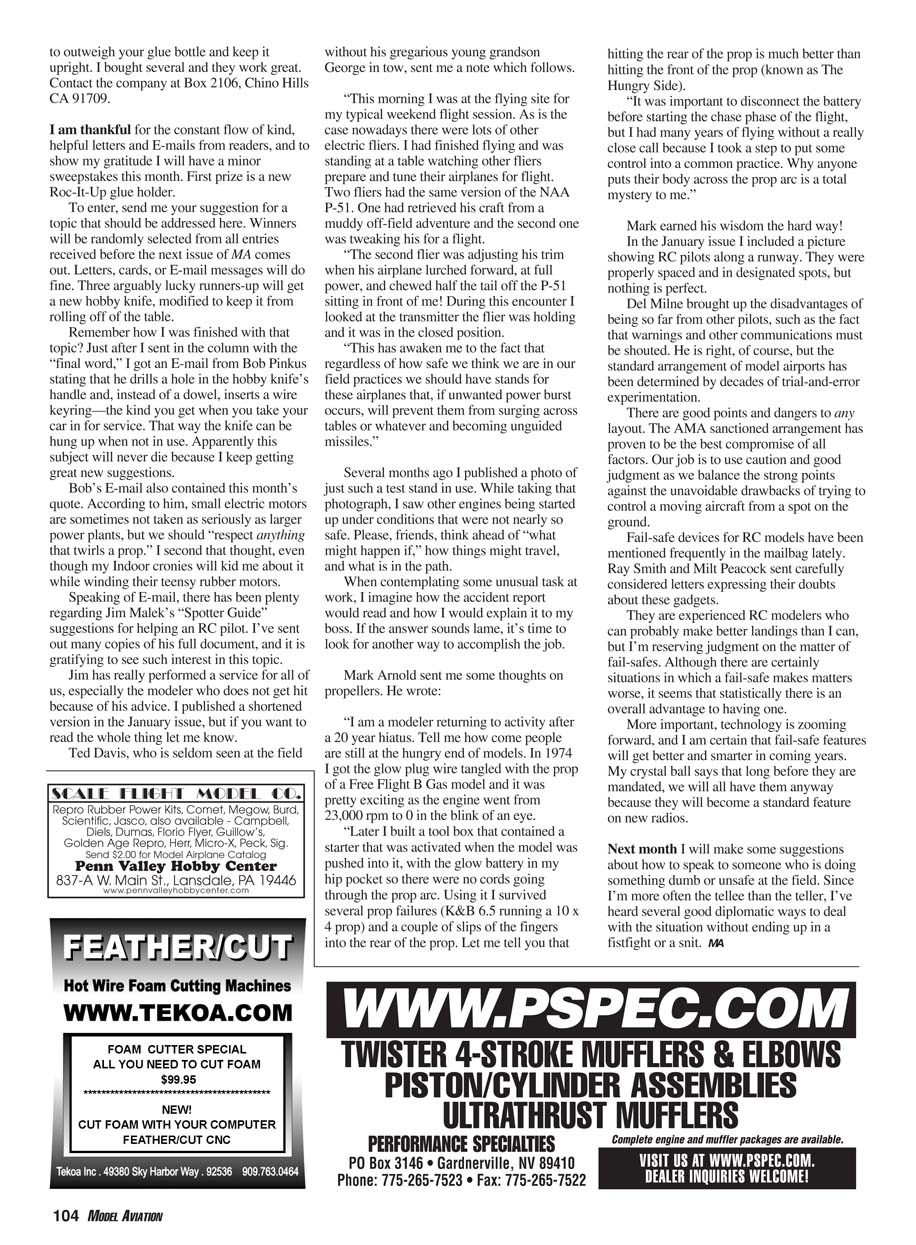
Indoor RC blimps
The time has come to address the dangers of indoor RC blimps. We must begin to put pressure on the operators of these models, given the gravity of the situation. Lighter-Than-Air (LTA) fliers make inflated claims of harmlessness for their craft, but I refuse to make light of the helium issue and allow them to simply float through life. This is a weighty matter, and the LTA crowd's arguments won't hold air. There have been bloated reports of trouble, and I'm not just making this up.
I am reminded that blimps are a chronic problem here in Los Angeles every time I fly. My friend Shannon Doah said:
"The level of concern is ballooning. LTA fliers are moored to obsolete ideas and are puffed up with confidence, but you, Dave, must puncture their arguments and make this a Goodyear for indoor RC safety. Thanks for letting me vent some gas."
She does not take the blimp threat lightly, and neither should we. Next time some gasbag full of hot air advocates indoor dirigibles, remember that operating these models is not just a walk in the clouds. Oh, and happy April Fools' Day!
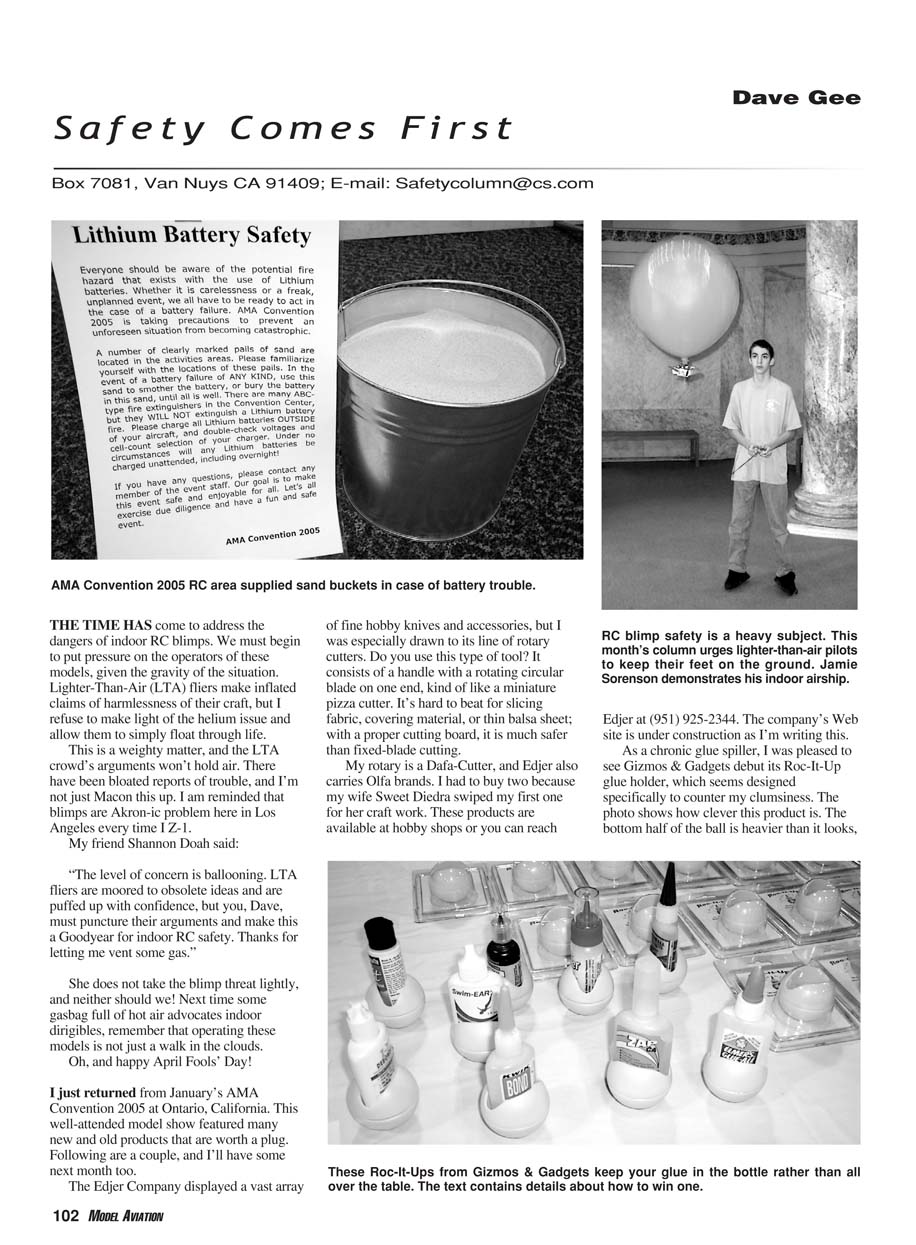
AMA Convention 2005
I just returned from January's AMA Convention 2005 in Ontario, California. This well-attended model show featured many new and old products that are worth a plug. Following are a couple; I'll have some more next month.
The Edjer Company displayed a vast array of fine hobby knives and accessories, but I was especially drawn to its line of rotary cutters. Do you use this type of tool? It consists of a handle with a rotating circular blade on one end, kind of like a miniature pizza cutter. It's hard to beat for slicing fabric, covering material, or thin balsa sheet; with a proper cutting board, it is much safer than fixed-blade cutting. My rotary is a Dafa-Cutter, and Edjer also carries Olfa brands. I had to buy two because my wife, Diedra, swiped my first one for her craft work. These products are available at hobby shops or you can reach Edjer at (951) 925-2344. The company's Web site was under construction as I was writing this.
As a chronic glue spiller, I was pleased to see Gizmos & Gadgets debut its Roc-It-Up glue holder, which seems designed specifically to counter my clumsiness. The bottom half of the ball is heavier than it looks, to outweigh your glue bottle and keep it upright. I bought several and they work great. Contact the company at Box 2106, Chino Hills CA 91709.
Sweepstakes
I am thankful for the constant flow of kind, helpful letters and e-mails from readers, and to show my gratitude I will have a minor sweepstakes this month. First prize is a new Roc-It-Up glue holder. To enter, send me your suggestion for a topic that should be addressed here. Winners will be randomly selected from all entries received before the next issue of MA. Letters, cards, or e-mail messages will do fine. Three arguably lucky runners-up will get a new hobby knife, modified to keep it from rolling off of the table.
Hobby knife tip
Just after I sent in the column with the "final word" on hobby knives, I got an e-mail from Bob Pinkus stating that he drills a hole in the hobby knife's handle and, instead of a dowel, inserts a wire keyring—the kind you get when you take your car in for service. That way the knife can be hung up when not in use. Apparently this subject will never die because I keep getting great new suggestions. Bob's e-mail also contained this month's quote.
Field incident and test stands
A reader (without his gregarious young grandson George in tow) sent me a note which follows:
“This morning I was at the flying site for my typical weekend flight session. As is the case nowadays there were lots of other electric fliers. I had finished flying and was standing at a table watching other fliers prepare and tune their airplanes for flight. Two fliers had the same version of the NAA P-51. One had retrieved his craft from a muddy off-field adventure and the second one was tweaking his for a flight.
“The second flier was adjusting his trim when his airplane lurched forward, at full power, and chewed half the tail off the P-51 sitting in front of me! During this encounter I looked at the transmitter the flier was holding and it was in the closed position.
“This has awakened me to the fact that regardless of how safe we think we are in our field practices we should have stands for these airplanes that, if unwanted power bursts occur, will prevent them from surging across tables or whatever and becoming unguided missiles.”
Several months ago I published a photo of just such a test stand in use. While taking that photograph, I saw other engines being started up under conditions that were not nearly so safe. Please, friends, think ahead to “what might happen if,” how things might travel, and what is in the path.
When contemplating some unusual task at work, I imagine how the accident report would read and how I would explain it to my boss. If the answer sounds lame, it’s time to look for another way to accomplish the job.
Propeller safety
Mark Arnold sent me some thoughts on propellers. He wrote:
“I am a modeler returning to activity after a 20-year hiatus. Tell me how come people are still at the hungry end of models. In 1974 I got the glow plug wire tangled with the prop of a Free Flight B gas model and it was pretty exciting as the engine went from 23,000 rpm to 0 in the blink of an eye.
“Later I built a toolbox that contained a starter that was activated when the model was pushed into it, with the glow battery in my hip pocket so there were no cords going through the prop arc. Using it I survived several prop failures (K&B 6.5 running a 10 x 4 prop) and a couple of slips of the fingers into the rear of the prop. Let me tell you that hitting the rear of the prop is much better than hitting the front of the prop (known as The Hungry Side).
“It was important to disconnect the battery before starting the chase phase of the flight, but I had many years of flying without a really close call because I took a step to put some control into a common practice. Why anyone puts their body across the prop arc is a total mystery to me.”
Mark earned his wisdom the hard way.
Pilot spacing and field layout
In the January issue I included a picture showing RC pilots along a runway. They were properly spaced and in designated spots, but nothing is perfect. Del Milne brought up the disadvantages of being so far from other pilots, such as the fact that warnings and other communications must be shouted. He is right, of course, but the standard arrangement of model airports has been determined by decades of trial-and-error experimentation.
There are good points and dangers to any layout. The AMA-sanctioned arrangement has proven to be the best compromise of all factors. Our job is to use caution and good judgment as we balance the strong points against the unavoidable drawbacks of trying to control a moving aircraft from a spot on the ground.
Fail-safe devices
Fail-safe devices for RC models have been mentioned frequently in the mailbox lately. Ray Smith and Milt Peacock sent carefully considered letters expressing their doubts about these gadgets.
They are experienced RC modelers who can probably make better landings than I can, but I’m reserving judgment on the matter of fail-safes. Although there are certainly situations in which a fail-safe makes matters worse, it seems that statistically there is an overall advantage to having one.
More important, technology is zooming forward, and I am certain that fail-safe features will get better and smarter in coming years. My crystal ball says that long before they are mandated, we will all have them anyway because they will become a standard feature on new radios.
Next month
Next month I will make some suggestions about how to speak to someone who is doing something dumb or unsafe at the field. Since I’m more often the fellow than the teller, I’ve heard several good diplomatic ways to deal with the situation without ending up in a fistfight or a snit.
MA
Transcribed from original scans by AI. Minor OCR errors may remain.

