
Safety Comes First
Byline
Dave Gee Box 7081, Van Nuys CA 91409; E-mail: [email protected]
Teaching Yourself to Fly RC
"TEACH YOURSELF to fly RC? You're gonna need a lot of airplanes." Hobby-shop owner Tony Naccarato has taught hundreds of budding pilots and knows what works.
Several readers have inquired about self-taught RC flying. Flight instruction is a subject on which wise people can have different opinions. I am less wise than the average RC instructor, but I do have some thoughts. There are valid reasons for going it alone; the following may or may not be them.
- Scheduling. You can fly whenever it is convenient; there is no need to rendezvous with an instructor. You can also more easily schedule the repair of your crashed model.
- Pride. There is no need to humble yourself by taking advice and direction from some schmo just because he or she has more experience. Your ego stays intact, right up until you "land" during an uncontrolled inverted flat spin.
- Pace. You can learn at your own speed, which is no faster than you can rebuild your trainer's damaged parts after each session.
Now some reasons for using a flight instructor.
- Your chances of success are much greater. Therefore, you will have more fun more quickly.
- Any bad habits you pick up will be noticed and corrected before they become ingrained.
- It is much cheaper, as measured in repair/replacement cost of models.
- Having a good instructor makes the learning process much safer. Hey, this is the safety column, right? Naturally we want to make choices that minimize the chances of harming ourselves or others.
Adjusting an RC model takes skill and experience. The controls and flight surfaces must be set up properly or the model might not fly at all. Who wants to learn how to preflight a model by trial and error?
Adjusting Models and Stages for Solo Learning
If you insist on going it alone, plan on progressing in stages. FF (free flight) is a great way to learn how and why models fly. Start with a "disturbed FF" aircraft. That does not refer to emotional problems, although that may describe some of my own creations. Disturbed FF means the model will fly on its own but can also be mildly steered via a rudder-only RC system. Once you have mastered that, try a two-channel airplane with rudder and elevator control. Gliders are great fun, fly well on two channels, and provide excellent deadstick landing experience. Adding engine control is next. Then try an "advanced trainer," which is an aileron-equipped model with true three-axis control and a great deal to think about during landing approach. Eventually you will be competing at a world-class level with your Scale ducted-fan VTOL (Vertical Take Off & Landing) Harrier. Maybe.
This method of stages is only the least costly approach to a poor idea and is much less desirable than finding a competent RC instructor. You will need many models and plenty of expensive gear, along with tremendous determination to deal with the inevitable crashes and disappointments solo RC training holds in store.
Finding an Instructor
Finding an instructor is not always easy, but it is worth the effort. Fortunate newbies will live near an active field with a club that welcomes new members and provides lessons. Good hobby shops will often have some arrangement to teach RC pilots how to fly their new purchases, which makes for a happy pilot who will buy even more models. Internet groups are a fine way to locate experienced teachers in your area, and I have seen many such requests. FF, CL (control line), and indoor neophytes have made good use of computers to find local enthusiasts. Don't be discouraged if a particular teacher's style doesn't fit you. Shop around and find an instructor-student relationship that feels comfortable.
RTF Foam Electric Models
The market is flooded with inexpensive RTF (ready-to-fly) foam electric-powered RC models with rudder/throttle or controlled only by differential thrust of twin motors. I have an indoor RTF with throttle only, which is great fun and surprisingly controllable.
These airplanes are an exception to the rule, in that it is possible for a new pilot to fly them successfully without help. The problem is that mastering throttle-controlled "foamies" does not necessarily prepare you for the conventional full-house, gas-powered models.
They may only be a step on the path toward "conventional" RC flying, but to many sport modelers they are an end unto themselves. These models are great fun, and as a cheapskate I enjoy the low prices. Also, the electronic systems can really perform when transplanted into a custom-built airframe after the stock one wears out.
Just don't forget that mastering this type of model is only preparation for actual RC flight instruction—not a substitute.
Simulator Programs
Now I'll touch on the dreaded "third rail" of RC flight training: computer-based simulator programs. At the risk of receiving loads of irate E-mail from those with strong feelings on the subject, here is an opinion: I like 'em!
Simulator games are great fun and offer you a chance to practice flying RC regardless of the weather and without risking an actual model. Flying on a computer can also be quite useful as a training aid.
Admittedly there are limitations and adjustments to be made when translating your "sim time" to real life. Still, I have seen how much skill can be obtained with no repairs or cost. Virtual RC helps develop correct reflexes and gives pilots a head start on the enjoyment of RC flight. It is possible to try new model configurations and designs before construction. And did I mention how much fun they are?
Knife Handle and Tool Use
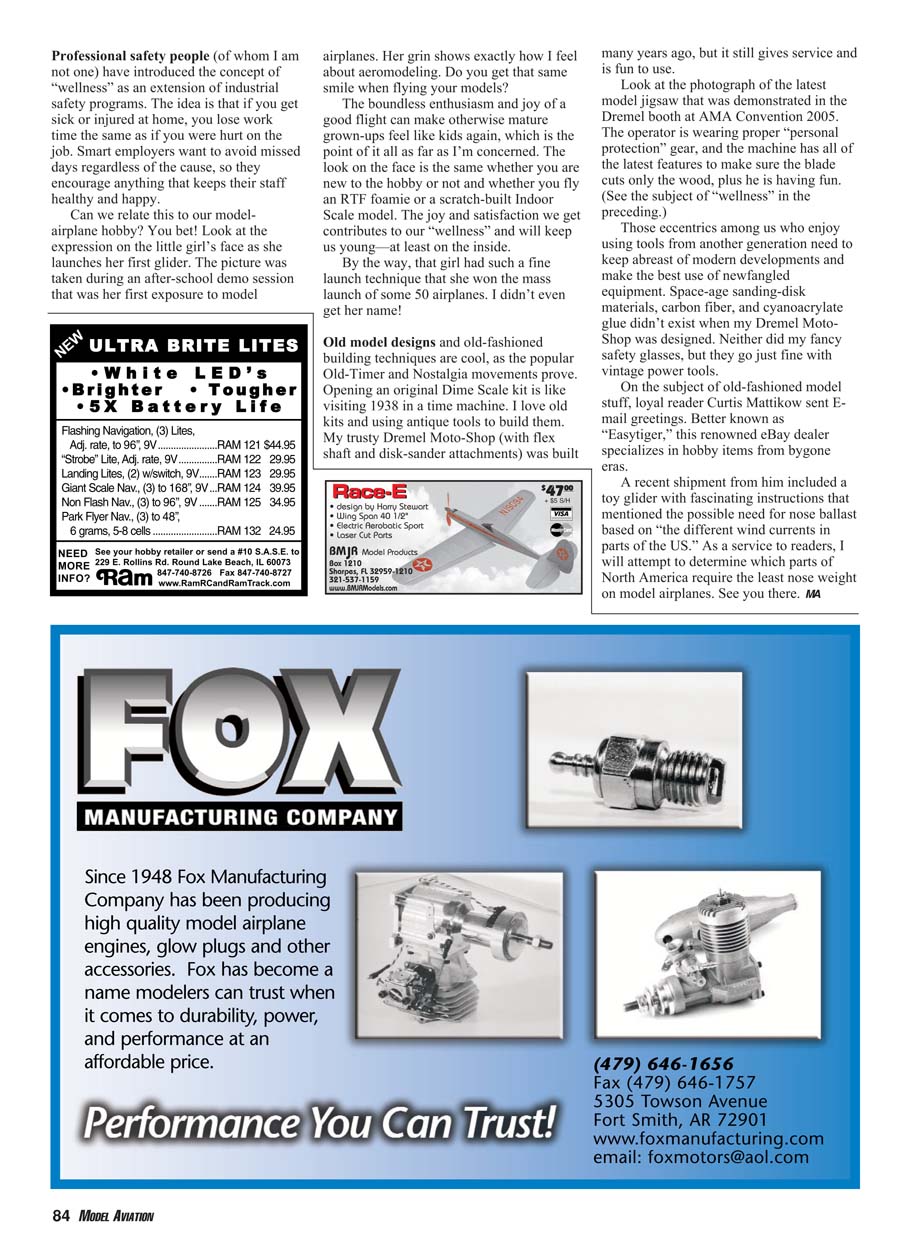
Andy Kunz sent a picture of the custom knife handle his friend Ellis Grumer (age 91) built. Ellis has apparently outgrown the need for adult supervision when using sharp tools because he grafted the commercial blade holder into a beautifully carved custom handle.
The knife is now much easier to hold, and it will not roll off the table, either!
Professional safety people (of whom I am not one) have introduced the concept of "wellness" as an extension of industrial safety programs. The idea is that if you get sick or injured at home, you lose work time the same as if you were hurt on the job. Smart employers want to avoid missed days regardless of the cause, so they encourage anything that keeps their staff healthy and happy.
Wellness and the Joy of Aeromodeling
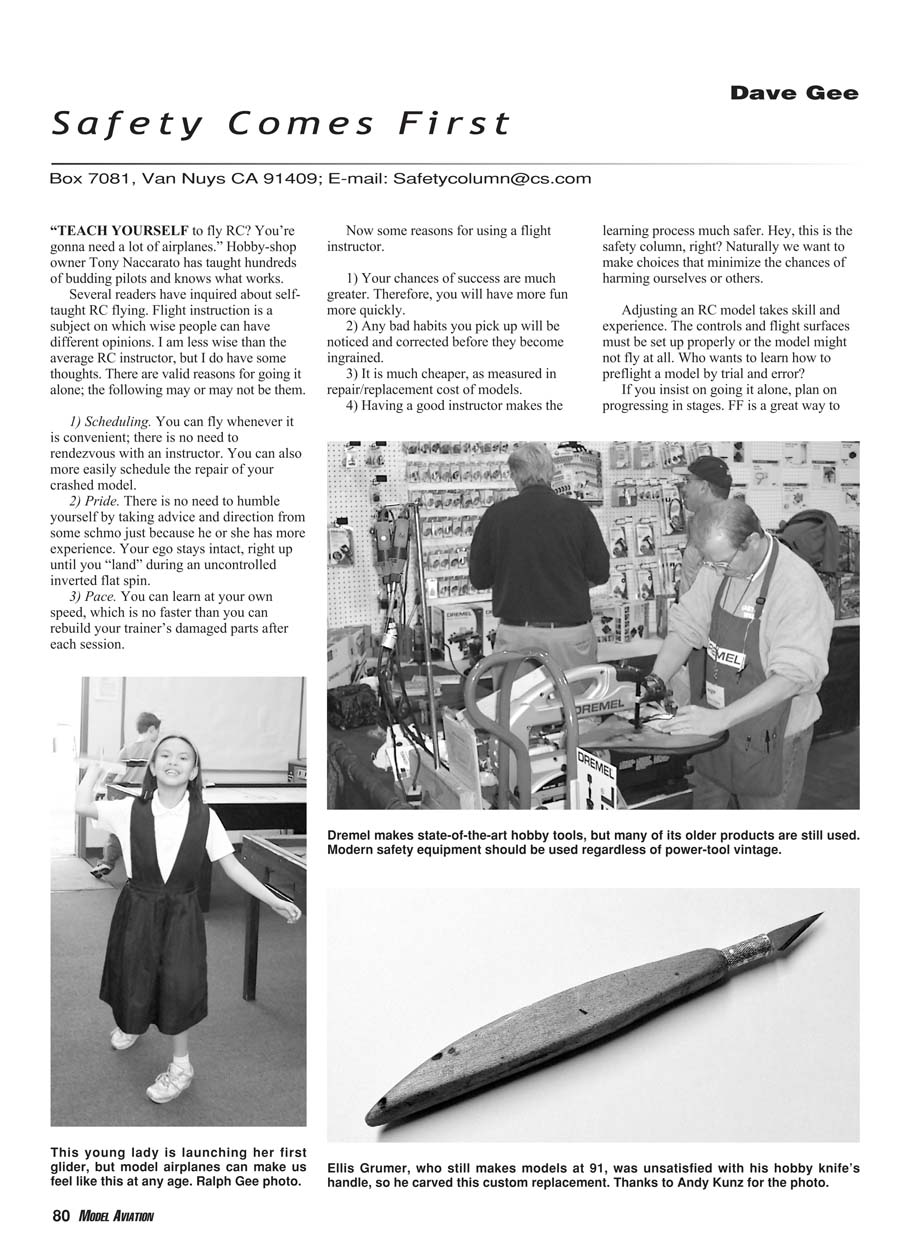
Can we relate this to our model-airplane hobby? You bet! Look at the expression on the little girl's face as she launches her first glider. The picture was taken during an after-school demo session that was her first exposure to model airplanes. Her grin shows exactly how I feel about aeromodeling. Do you get that same smile when flying your models?
The boundless enthusiasm and joy of a good flight can make otherwise mature grown-ups feel like kids again, which is the point of it all as far as I'm concerned. The look on the face is the same whether you are new to the hobby or not and whether you fly an RTF foamie or a scratch-built Indoor Scale model. The joy and satisfaction we get contributes to our "wellness" and will keep us young—at least on the inside.
By the way, that girl had such a fine launch technique that she won the mass launch of some 50 airplanes. I didn't even get her name!
Old Designs, Tools, and Safety Gear
Old model designs and old-fashioned building techniques are cool, as the popular Old-Timer and Nostalgia movements prove. Opening an original Dime Scale kit is like visiting 1938 in a time machine. I love old kits and using antique tools to build them. My trusty Dremel Moto-Shop (with flex-shaft and disk-sander attachments) was made many years ago, but it still gives service and is fun to use.
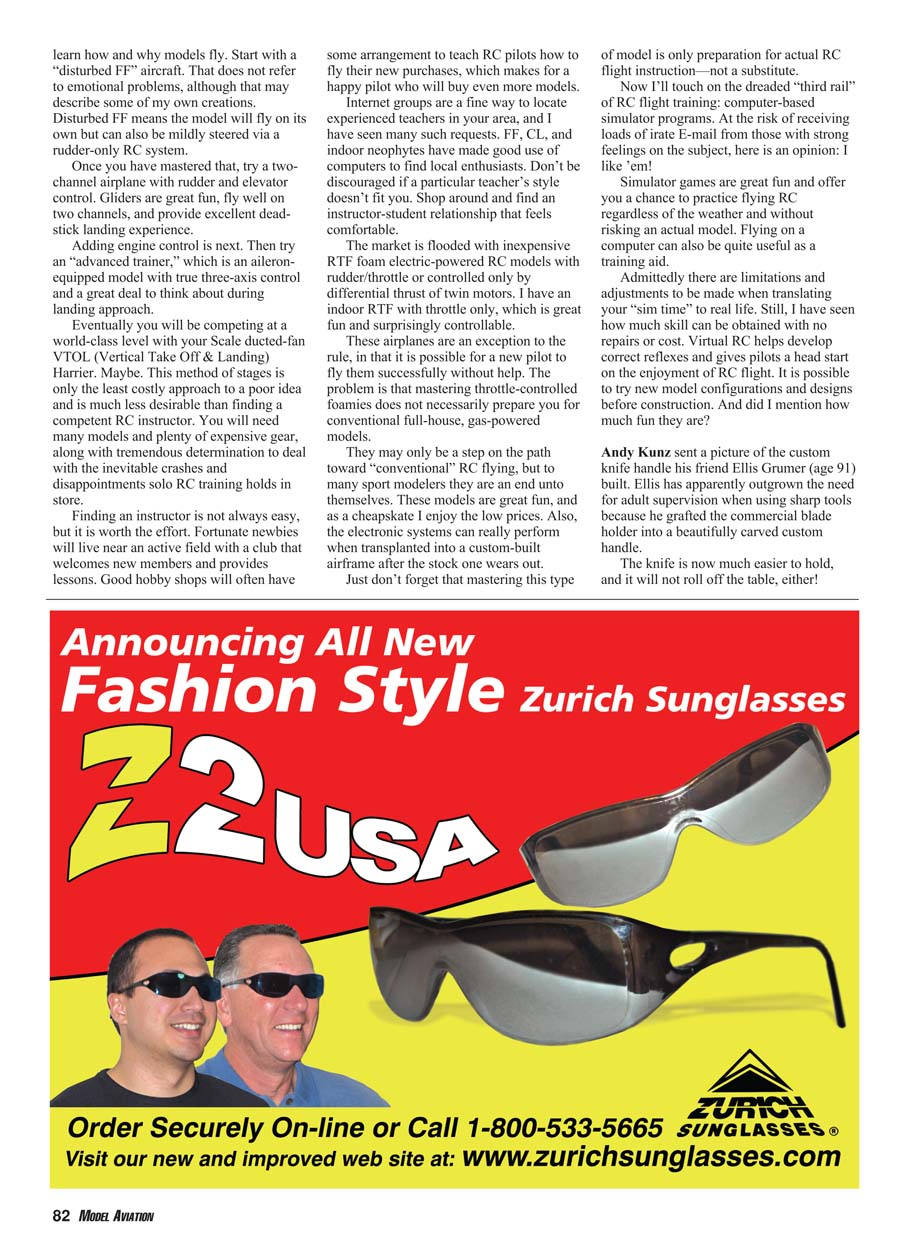
Look at the photograph of the latest model jigsaw that was demonstrated in the Dremel booth at AMA Convention 2005. The operator is wearing proper "personal protection" gear, and the machine has all of the latest features to make sure the blade cuts only the wood, plus he is having fun. (See the subject of "wellness" in the preceding.)
Those eccentrics among us who enjoy using tools from another generation need to keep abreast of modern developments and make the best use of newfangled equipment. Space-age sanding-disk materials, carbon fiber, and cyanoacrylate glue didn't exist when my Dremel Moto-Shop was designed. Neither did my fancy safety glasses, but they go just fine with vintage power tools.
Reader Notes and Closing
On the subject of old-fashioned model stuff, loyal reader Curtis Mattikow sent E-mail greetings. Better known as "Easytiger," this renowned eBay dealer specializes in hobby items from bygone eras.
A recent shipment from him included a toy glider with fascinating instructions that mentioned the possible need for nose ballast based on "the different wind currents in the parts of the US." As a service to readers, I will attempt to determine which parts of North America require the least nose weight on model airplanes. See you there. MA
Transcribed from original scans by AI. Minor OCR errors may remain.

