
Safety Comes First
Dave Gee | [email protected]
Another propeller-strike story!
Propeller strike — John Kupinski
As former avid CL Combat pilots, my son and I were used to making waist-high, handheld, one-flip hand starts. On Saturdays we would join 15 to 20 other like-minded "cowboys," members of Henderson's Combat Team, in a schoolyard located on a busy county highway to practice various aspects of the event.
Since the school was next to a commercial area, the engine noise would invariably draw spectators. One of those Saturdays I was about to begin a practice match assisted by my son. We were also being watched by a family of four who had stopped to observe.
After I started the engine and as I reached around the propeller arc (wooden) to adjust the needle valve, I either reached too far or my son swayed backward. This resulted in the big knuckle of my index finger being hit by the back of the blades. Both blades split lengthwise and the two fragments went flying, luckily striking nothing.
My initial reaction was to grab the struck hand, utter a few expletives, and then slowly examine the damage. Amazingly, there was no blood or cuts, but the skin on the knuckle was pure white, as apparently the blood in that area had been driven out.
I then noticed that the mother in the spectator family had moved into some deep grass and was doubled over on her knees, vomiting. It appeared she had seen the propeller blade fragments flying and thought they were my fingers. She calmed down when I showed her both my hands still had five fingers each. The finger was stiff for about four days, and the whiteness in the knuckle stayed for over a month before normal skin color returned with no scarring.
I get more letters about propeller strikes than any other topic, so I will continue to harp on it: Watch the propeller! Send more stories like this one to Box 7081, Van Nuys, CA 91409.
Li-Poly battery fires
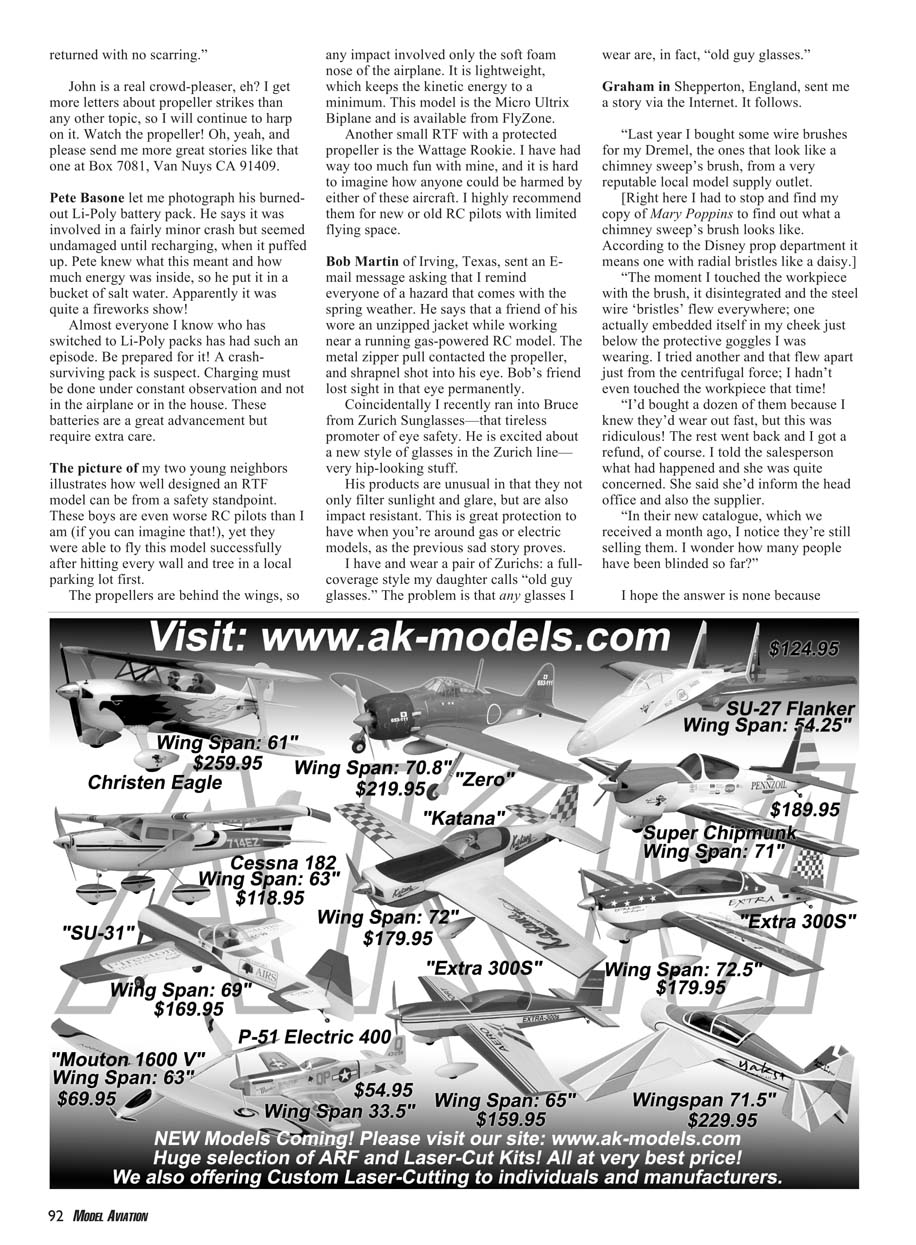
Pete Basone let me photograph his burned-out Li-Poly battery pack. He says it was involved in a fairly minor crash but seemed undamaged until recharging, when it puffed up. Pete knew what this meant and how much energy was inside, so he put it in a bucket of salt water. Apparently it was quite a fireworks show.
Almost everyone I know who has switched to Li-Poly packs has experienced a similar episode. Be prepared: a crash-surviving pack is suspect. Charging must be done under constant observation and not in the airplane or in the house. These batteries are a great advancement but require extra care.
Safe RTF models for limited space
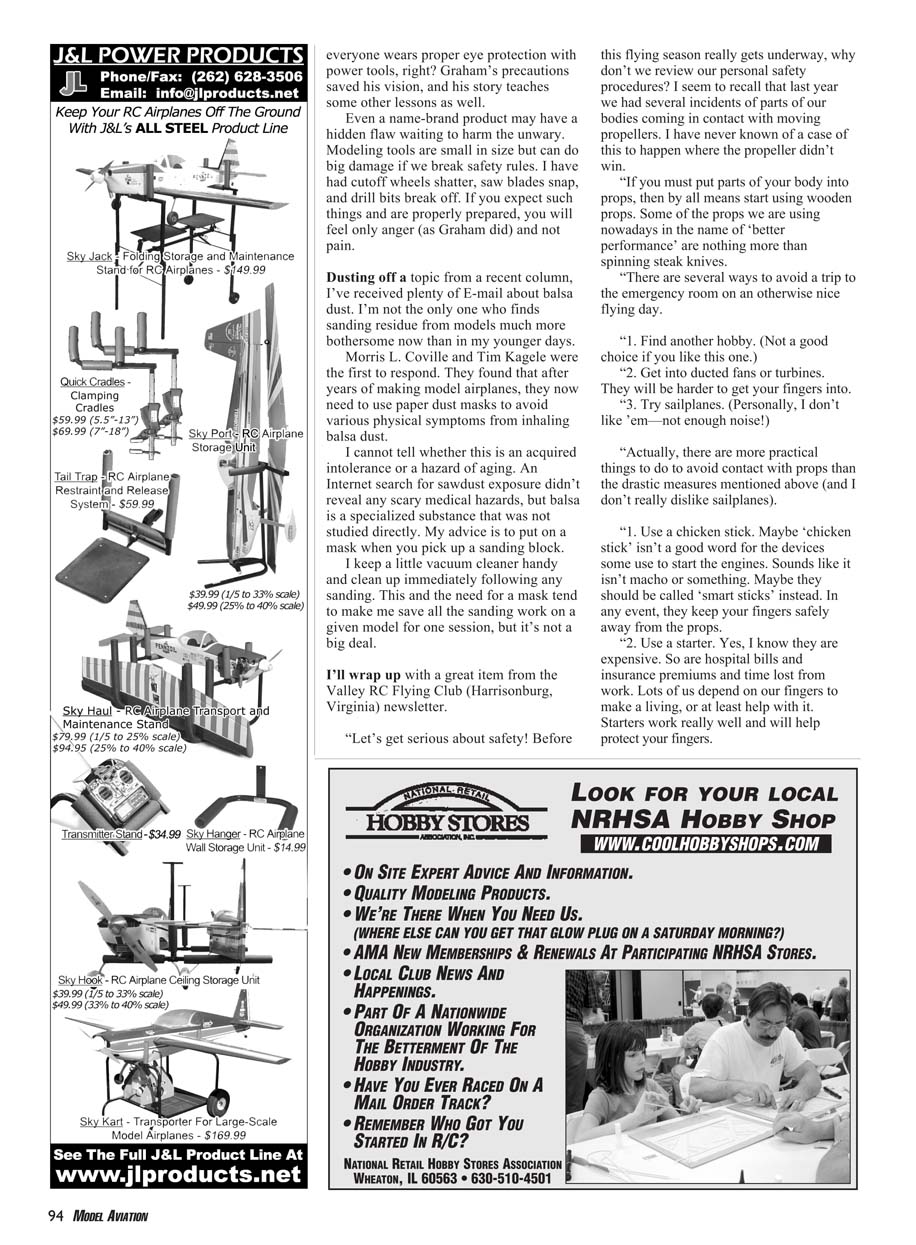
A picture of my two young neighbors illustrates how well designed an RTF model can be from a safety standpoint. These boys are even worse RC pilots than I am (if you can imagine that!), yet they were able to fly this model successfully after hitting every wall and tree in a local parking lot.
The propellers are behind the wings, so any impact involved only the soft foam nose of the airplane. It is lightweight, which keeps the kinetic energy to a minimum. This model is the Micro Ultrix Biplane, available from FlyZone.
Another small RTF with a protected propeller is the Wattage Rookie. I have had a lot of fun with mine, and it is hard to imagine how anyone could be harmed by either of these aircraft. I highly recommend them for new or experienced RC pilots with limited flying space.
Zipper pull eye injury and eye protection
Bob Martin of Irving, Texas, sent an e-mail asking that I remind everyone of a springtime hazard. A friend of his wore an unzipped jacket while working near a running gas-powered RC model. The metal zipper pull contacted the propeller, and shrapnel shot into his eye. Bob's friend lost sight in that eye permanently.
Coincidentally, I recently ran into Bruce from Zurich Sunglasses—the tireless promoter of eye safety. He is excited about a new style in the Zurich line—very hip-looking stuff. Their products not only filter sunlight and glare but are also impact resistant. This is great protection to have around gas or electric models, as the previous sad story proves. I wear a pair of Zurichs: a full-coverage style my daughter calls "old guy glasses."
Wire brush incident — Graham, Shepperton, England
Graham sent this story via the Internet:
Last year I bought some wire brushes for my Dremel, the ones that look like a chimney sweep's brush, from a very reputable local model supply outlet. (By "chimney sweep's brush" I mean brushes with radial bristles like a daisy.)
The moment I touched the workpiece with the brush, it disintegrated and the steel wire bristles flew everywhere; one actually embedded itself in my cheek just below the protective goggles I was wearing. I tried another brush and that flew apart just from centrifugal force; I hadn't even touched the workpiece that time.
I'd bought a dozen of them because I knew they'd wear out fast, but this was ridiculous! The rest went back and I got a refund, of course. I told the salesperson what had happened and she was quite concerned. She said she'd inform the head office and the supplier. In their new catalogue, which we received a month ago, I noticed they were still selling them. I wonder how many people have been harmed so far?
Fortunately I was wearing goggles, so although one bristle went into my cheek, it didn't penetrate the goggles. Graham's precautions saved his vision, and his story teaches several lessons:
- Even a name-brand product may have a hidden flaw.
- Modeling tools are small but can do big damage if you break safety rules.
- Expect breakage: cutoff wheels can shatter, saw blades can snap, and drill bits can break off. If you expect these failures and are prepared, you'll feel anger, not pain.
Balsa dust and sanding safety
I've received plenty of e-mail about balsa dust. I'm not the only one who finds sanding residue from models much more bothersome now than in younger days. Morris L. Coville and Tim Kagele were the first to respond, saying that after years of making model airplanes they now need to use paper dust masks to avoid various physical symptoms from inhaling balsa dust.
I cannot tell whether this is an acquired intolerance or a hazard of aging. An Internet search for sawdust exposure didn't reveal any scary medical hazards, but balsa is a specialized substance that was not studied directly. My advice is to put on a mask when you pick up a sanding block. Keep a little vacuum cleaner handy and clean up immediately after sanding. I tend to save all sanding work on a given model for one session to limit exposure.
Valley RC Flying Club safety roundup
From the Valley RC Flying Club (Harrisonburg, Virginia) newsletter:
Let's get serious about safety! Before this flying season really gets underway, review your personal safety procedures. Last year we had several incidents of body parts coming in contact with moving propellers. I have never known of a case where the propeller didn't win.
If you must put parts of your body into props, then by all means start using wooden props. Some of the props we use nowadays in the name of "better performance" are nothing more than spinning steak knives.
There are several ways to avoid a trip to the emergency room on an otherwise nice flying day:
- Find another hobby. (Not a good choice if you like this one.)
- Get into ducted fans or turbines. They will be harder to get your fingers into.
- Try sailplanes. (Personally, I don't like them—not enough noise!)
Actually, there are more practical things to do to avoid contact with props than the drastic measures above:
- Use a "chicken stick" (also called a smart stick). These devices keep your fingers safely away from the props while starting engines.
- Use an electric starter. Yes, they are expensive, but so are hospital bills, insurance premiums, and lost work time. Starters work well and help protect your fingers.
- Use a glove. Not just any glove; get a good, heavy leather glove to wear if you insist on starting an engine by hand. If you get kicked by a prop, it might hurt, but a glove can prevent cuts.
- A. I get a better feel of what the engine is doing or trying to do.
- B. I'm intolerant of engines I can't start by hand.
- C. I find a glove handier to use than a starter or a stick. I used sticks before, until one day when using one to start a gasser I ruined two $25 props because the engine kicked and hit the stick before I could get it out of the way.
- Try this for a day: tape your index and middle fingers tightly together so they are basically useless, then go about your normal daily tasks. After you're tired of that, think that it could be a permanent condition if you get careless around these models. And yes, that prop is likely to take more than one finger.
Be safe; accidents don't just happen—they are caused! MA
Transcribed from original scans by AI. Minor OCR errors may remain.

