
Safety Comes First
Dave Gee | [email protected]
Brace yourself for Dave’s first column subject …
Also included in this column:
- Dave gets stuck at the AMA Convention …
- … and explains “drop kicking”
- Where to get those neat Battery Bunkers
- Zurich International impact-resistant sunglasses
- A warning against changing crystals
- Good, old fuel
- A Jetex starting primer from Dave’s son Jeff
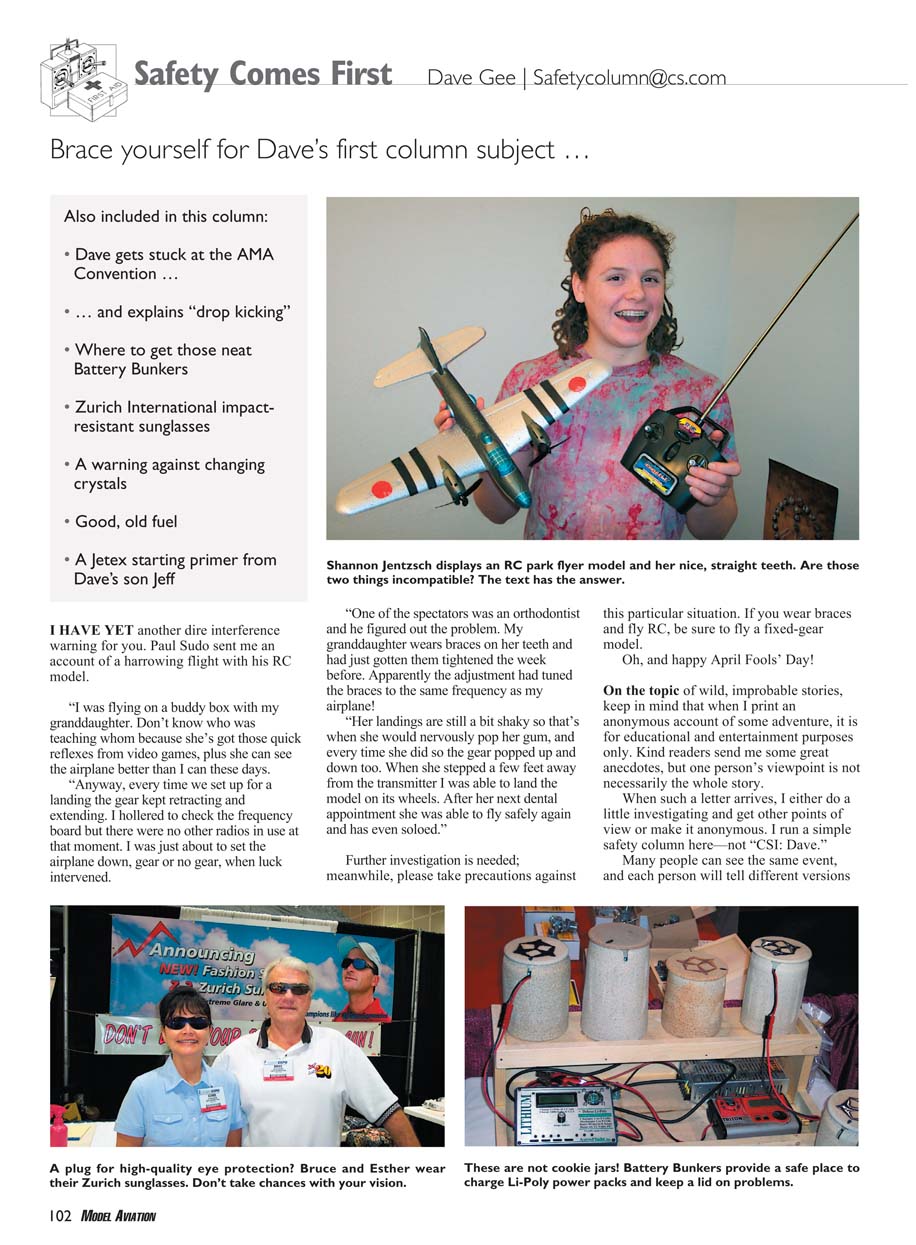
Interference warning: braces and RC radios
I have yet another dire interference warning for you. Paul Sudo sent me an account of a harrowing flight with his RC model.
“I was flying on a buddy box with my granddaughter. Don’t know who was teaching whom because she’s got those quick reflexes from video games, plus she can see the airplane better than I can these days.
“Anyway, every time we set up for a landing the gear kept retracting and extending. I hollered to check the frequency board but there were no other radios in use at that moment. I was just about to set the airplane down, gear or no gear, when luck intervened.
“One of the spectators was an orthodontist and he figured out the problem. My granddaughter wears braces on her teeth and had just gotten them tightened the week before. Apparently the adjustment had tuned the braces to the same frequency as my airplane!
“Her landings are still a bit shaky so that’s when she would nervously pop her gum, and every time she did so the gear popped up and down too. When she stepped a few feet away from the transmitter I was able to land the model on its wheels. After her next dental appointment she was able to fly safely again and has even soloed.”
Further investigation is needed; meanwhile, please take precautions against this particular situation. If you wear braces and fly RC, be sure to fly a fixed-gear model.
Oh, and happy April Fools’ Day!
Anonymity and reporting
On the topic of wild, improbable stories, keep in mind that when I print an anonymous account of some adventure, it is for educational and entertainment purposes only. Kind readers send me some great anecdotes, but one person’s viewpoint is not necessarily the whole story.
When such a letter arrives, I either do a little investigating and get other points of view or make it anonymous. I run a simple safety column here—not “CSI: Dave.” Many people can see the same event, and each person will tell different versions of it. By removing names and places it simply becomes a good story for everyone’s enjoyment. If you recognize an incident and have a conflicting account, I would appreciate your input.
I recently printed a close-call story and, not surprisingly, the different people at the field had dissimilar opinions about how close the call was. The important facts are that nobody actually got hurt and the story was published here for other readers’ benefit. I don’t want to offend anyone, and I promise to redouble my efforts at anonymity when I have only one side of a story.
The exception to this policy is when a reader relates a moment of less-than-perfect judgment involving only himself or herself. It takes courage and humility to share that type of story, but it is the best way to spread the word about a hazard. You also get the satisfaction of having possibly saved some other modeler from harm. My only problem involving personal stories of disaster is picking from the huge list of dumb things I have done.
AMA Convention 2006 — public goof-ups
AMA Convention 2006 in Ontario, California, in January provided an opportunity to goof up in public, and I made the most of it. I was in a display booth filled with old-fashioned stick-and-tissue models (that’s right; no foam!), and I had a kit under construction.
Visitors were watching with interest and asking questions as I worked. This distraction usually results in my making two or three left wings, to the delight of the crowd. In this particular case I was pinning down some fuselage parts while chatting. I stuck my finger but good. You know how there is just a moment before the bleeding starts? I casually asked if anyone had a tissue, thus was able to avoid staining the plans (and having to explain the stains all weekend). Apparently I have not yet learned my lesson about paying attention. Tetanus booster, anyone?
Cyanoacrylate accelerator — the drip-bottle method
Matt Keennon had his display of amazing tiny RC models next to my stuff at the AMA Convention, and we discussed the use of cyanoacrylate accelerator spray. He noticed that I spray almost every glue joint. The glue fumes really get to me otherwise, but the accelerator spritz seems to remove whatever component bothers my nose. Matt gave me a little plastic bottle with a tiny piece of tubing sticking out and showed me how to put a small drop of kicker on the glue joint.
This method uses far less liquid and smells far less, and the glue’s curing can be tightly controlled. It was a revelation! The problem is that when I tried to spread the word about this "new" drip-bottle method, everyone seemed to be familiar with it already. I’m writing about it now in hopes that I am not the last modeler on earth to hear about using a bottle with a thin tube to drip accelerator onto a cyanoacrylate-glue joint.
Matt says the bottles can be obtained at medical-supply places, and I found similar items at local drugstores.
Battery Bunkers
The AMA Convention is also where I found the neat-o ceramic battery-charging containers shown. Kevin Kelley makes each Battery Bunker by hand, and they are stylish and handy.
His booth featured a scary video showing a battery exploding inside one of his jars. I have heard some bad stories about Li-Poly battery failures, and the Battery Bunker looks to be cheap insurance. Contact Kevin at www.batterybunker.net or (760) 247-6980.
Eye protection
Another picture shows Bruce and Esther of Zurich International showing off their new impact-resistant sunglasses. I continue to recommend such protection at the flying field because of a continual stream of e-mails telling about eye injuries that could have been avoided if good-quality safety glasses were used. Look for the Zurich ad in this magazine.
A warning against changing crystals
I received several messages about the practice of changing crystals in your transmitter for each model you fly. It is not only a bad idea to do this; it is also illegal! The Federal Communications Commission regulations forbid it, and the penalty is a large fine and/or jail time. I don't know how many modelers "do time" for crystal-swapping, but this is one more good reason not to do it!
Good, old fuel
Another recent e-mail topic has been old fuel. I've heard from some knowledgeable people that fuel that is properly stored in opaque, tightly sealed cans remains usable for years. Even when fuel "breaks down," it will not harm model airplane engines.
Even so, many fliers prefer their favorite brand of fuel nice and fresh for reliability and use their old dregs for cleaning tools and such. Afterward it goes to the local hazardous-chemical disposal site, of course.
Jetex starting primer (from Jeff, the Donuthunter)
I’m known as StukaDave on the Internet, and my son Jeff is the Donuthunter. He loves a chance to show me up, and a while ago he took all my old Jetex equipment and figured out how to make it run. These motors are collector's items, and the fuel is no longer produced, but Jetex fans (such as those at http://jetex.org/) still get a kick out of rocket-powered model flying.
Jeff's account of how to safely operate a Jetex rocket motor shows his methodical approach.
This is how I start and run my Jetex motor:
- Open the motor and inspect the barrel for dents and cracks. Then make sure the hole is free from obstruction.
- Insert one fuel pellet and crush it, using a piece of dowel, until it is mostly powder. This will give an extra little boost just before the end of the run.
- Insert more fuel pellets with the hole facing out; the '50' will hold three more pellets for about a 30-second run.
- Install the washer, making sure the beveled edges are inward.
- Now prepare the fuse by cutting off a piece that is about one and a half inches long. Now double it over for about 1/4 inch and stick the folded end through the hole so the doubled side is in the barrel.
- Put the cap and fuse on the barrel so that the fuse is in the hole of the fuel pellet, and set the clamp.
- Mount the motor on the aircraft.
- Grab a pair of pliers and a lighter. Light the fuse, and most of the time if you are lucky, the fuse will blow out of the hole. If it doesn't, just wait until blue smoke is coming out and pull the fuse out with the pliers. Use the pliers because the fuse gets really hot!
- Launch the airplane.
“These instructions should help you run your motor with some consistency. The motor should outlast your pocketbook because the fuel, washers, and fuse add up to a pretty penny.
“Make sure your fuel is very dry, and keep it sealed from moisture. The Jetex 50 I use puts out about an ounce of thrust or so, so judge the size of the airplane you will fly accordingly. I haven't tried one of the new electric starters yet, but they sound great.”
I have never been able to get these little motors to do a thing, but Jeff got them to run fairly reliably after he had done a little research and experimentation. Yeah, I'm jealous.
Closing and contact
I thoroughly enjoy your e-mails and letters. Please share your opinions about safety, and suggestions for any topic because if I'm working on something it's up to you to let me know.
In addition to e-mail, I can be reached at:
- [email protected]
- Box 7081, Van Nuys CA 91409
Transcribed from original scans by AI. Minor OCR errors may remain.

