
Safety Comes First - 2006/07
Dave Gee | [email protected]
Also included in this column:
- Near-disaster story
- Rubber winding issues and stories
- Bill Hannan’s special Delta Dart
- Ni-Cds can have charging issues too!
- Bad bearings can cause interference
- More Randy Ryman tips
- Not all hazards are modeling related
I LOVE READING E-mail messages and letters from modelers. We seem to be an upbeat bunch despite the fact that nearly all of us seem to have some ghastly tale of near disaster.
Near-disaster: Winn Kausch
Winn Kausch of the New Orleans Model Aviation Club was kind enough to share an especially good story. He wrote:
"At the field one of our more experienced fliers was starting his engine, kneeling in front of the airplane with an electric starter. When the motor is running at about 1/4 throttle he finds he cannot slow it down or speed it up. What's wrong? Aha! The switch on the airplane was not turned on.
"To turn on the switch from his position he reaches with his right hand to the left side of the fuselage, with his arm moving too close to the prop arc. One of his flying buddies screams over the noise of the motor 'Watch the prop!' and he pulls back with only a scratch on his right arm.
"Lucky him. This only shows why every student is taught to make sure all controls are working before starting the engine."
That is an excellent argument for not flying alone! I am always grateful when a buddy stops me from doing something dumb or dangerous. The tiny bruise to my ego heals much faster than the injury I avoided would have.
Your stories, comments, and suggestions are welcome. My E-mail address is at the top of this page, but pen-and-ink letters are a treat. Send 'em to me at Box 7081, Van Nuys CA 91409.
Clarification: This column and AMA policy
I get occasional requests for my "official AMA position" on an issue. A bit of clarification may be in order.
I am not actually part of the AMA leadership, nor do I serve on the AMA Safety Committee. This column contains my opinions and whatever I can pass along from experts, which does not constitute AMA policy in any way.
My views on any given matter are just the thoughts of an AMA member—not the final word from Muncie. Since I am not an actual AMA muck-a-muck, I retain the right of all members to gripe and claim that I know all the answers. (Don't we all?) I do serve on the AMA Education Committee, but even there I am a mere lowly schlub newbie among the actual trained schoolteachers who volunteer their time on committee projects.
About those pictures: OFFC and ingenuity
Southern California is home to the OFFC: a casual group of retired modelers. Their low level of organization borders on anarchy, but new members are warmly welcomed and given help and advice as needed.
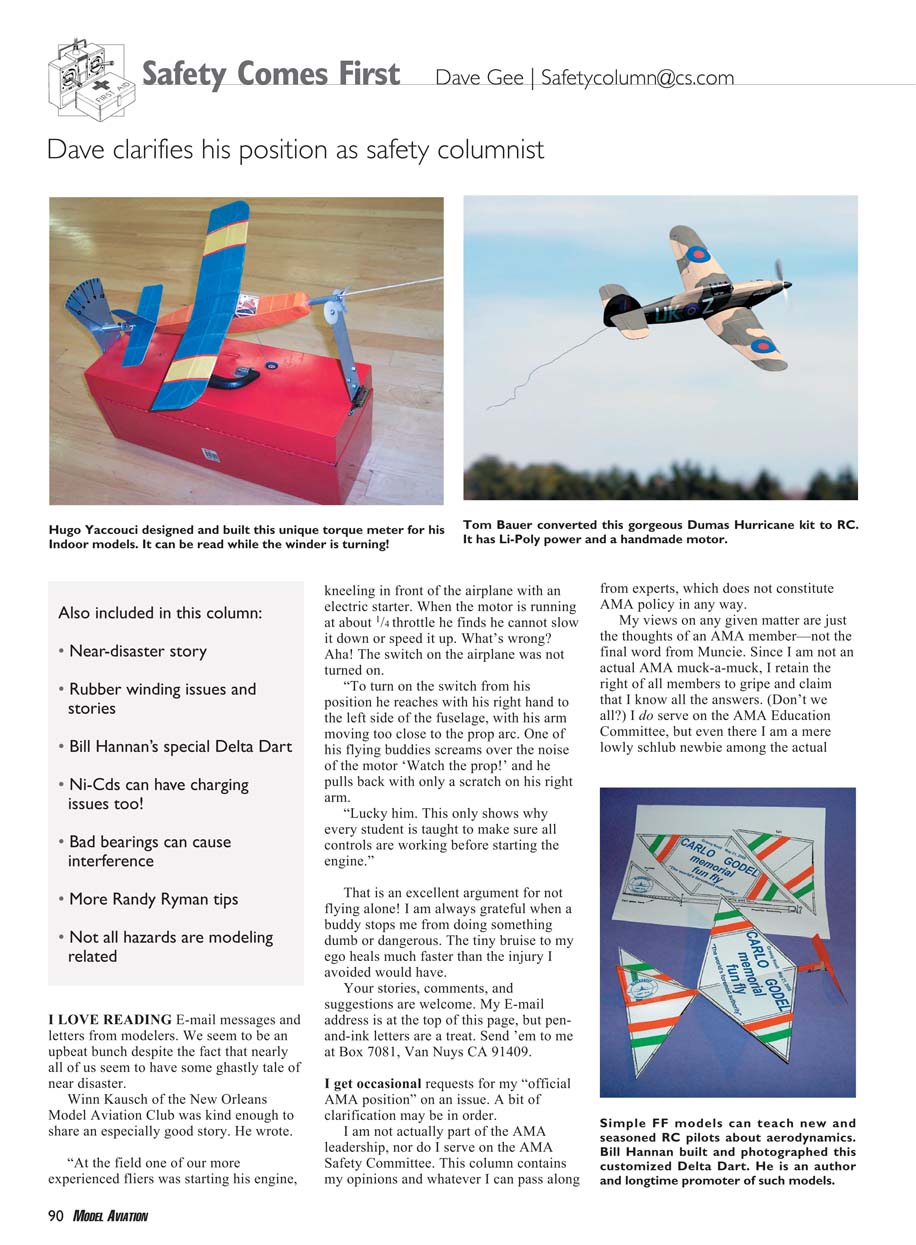
Hugo Yaccouci quickly moved from "new guy" to "respected competitor" because of his top-notch craftsmanship and ingenuity. He heard that a torque meter was useful for winding rubber motors, but the units he saw require the user to stop winding momentarily to read the dial. Hugo is a busy man and has no time to waste, so he designed and hand-built the winding rig shown. The torque reading is visible while the winding progresses, which has helped Hugo do well in several recent OFFC contests.
Will Woods is another loyal OFFC member, and he showed me a nasty welt on his hand with a great story to accompany it. He was breaking in a new rubber motor, carefully following the time-tested practice of prestretching the strands according to a published chart. In the middle of this exercise the motor had the nerve to break with sufficient force to leave the aforementioned injury.
Will was not only hurt physically but emotionally. He claimed to hold the motor personally responsible for failing to abide by well-known standards of strength and endurance.
We discussed the fact that model-airplane rubber has occasional variations in consistency despite the manufacturers' best efforts. The best grades are fairly expensive, and Will said he tried not to waste good rubber-motor material since it didn't exactly grow on trees. When I mentioned that it actually does grow on trees, he indicated that our discussion was over.
Every rubber-power enthusiast has seen motors break, and the savvy ones arrange their winding rig so that no body parts can get hit if a snap occurs. This is obvious with big outdoor competition motors, but I have been snagged by a tiny wire hook when a relatively small indoor motor let go. It provides all the joy of a fishhook snag without the barb, plus your friends get to ask you if you need CPR or just a Band-Aid.
Bill Hannan’s Delta Dart and resources
I have long been a fan of famed author and designer Bill Hannan. He enjoys simple, fun models that provide maximum enjoyment and education for minimum effort and expense. Such airplanes can teach us all a few things about flight, and many RC pilots take pleasure in an occasional FF model even though their thumbs twitch nervously while it circles overhead.
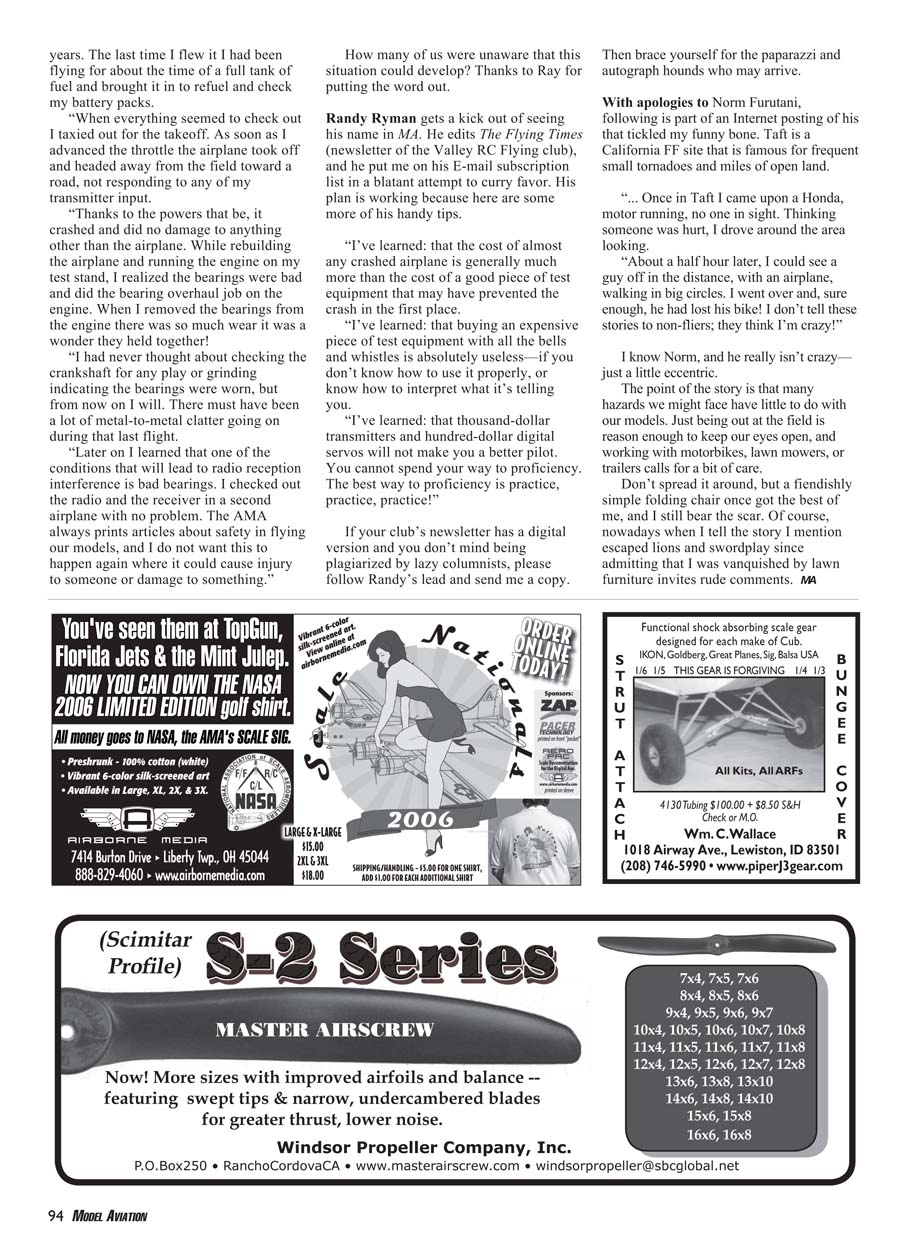
Bill sent me a shot of a Delta Dart he made from the "invitation" to Carlo Godel's memorial fun-fly, printed as model plans/covering sheet. More Delta Darts have been built than any other design in history, and it has been thousands of people's first model airplane. It is delightful that this timeless Frank Ehling design was used to draw modelers together to honor a departed friend.
Many of Bill Hannan's excellent publications are available from his wife Joan Hannan's Runway Web site at www.hrunway.com. You can look for the out-of-print books at www.abebooks.com.
Ni-Cd charging warning (and Tom Bauer’s Hurricane)
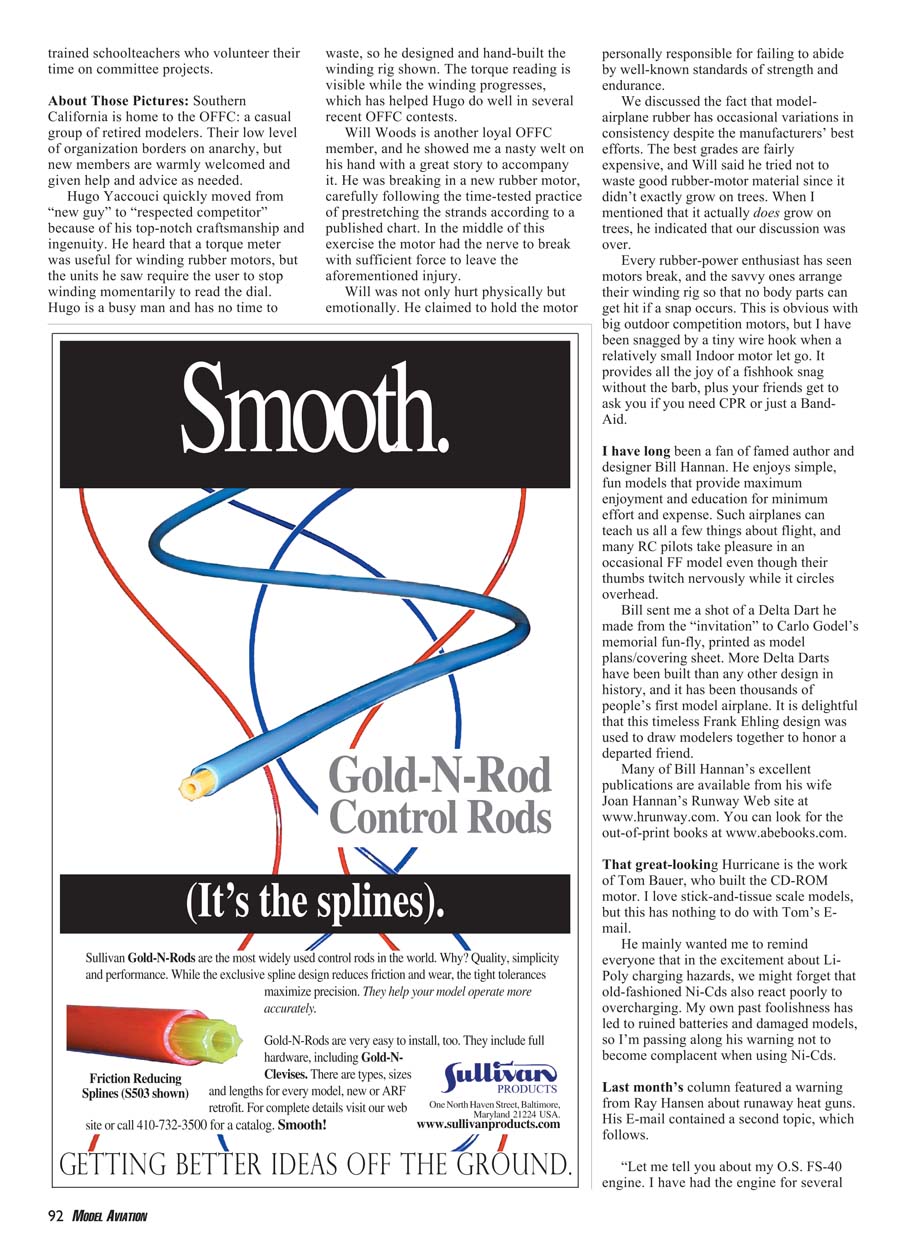
That great-looking Hurricane is the work of Tom Bauer, who built the CD-ROM motor. I love stick-and-tissue scale models, but this has nothing to do with Tom's E-mail.
He mainly wanted me to remind everyone that in the excitement about Li-Poly charging hazards, we might forget that old-fashioned Ni-Cds also react poorly to overcharging. My own past foolishness has led to ruined batteries and damaged models, so I'm passing along his warning not to become complacent when using Ni-Cds.
Bad bearings can cause interference — Ray Hansen’s story
Last month's column featured a warning from Ray Hansen about runaway heat guns. His E-mail contained a second topic, which follows.
"Let me tell you about my O.S. FS-40 engine. I have had the engine for several years. The last time I flew it I had been flying for about the time of a full tank of fuel and brought it in to refuel and check my battery packs.
"When everything seemed to check out I taxied out for the takeoff. As soon as I advanced the throttle the airplane took off and headed away from the field toward a road, not responding to any of my transmitter input.
"Thanks to the powers that be, it crashed and did no damage to anything other than the airplane. While rebuilding the airplane and running the engine on my test stand, I realized the bearings were bad and did the bearing overhaul job on the engine. When I removed the bearings from the engine there was so much wear it was a wonder they held together!
"I had never thought about checking the crankshaft for any play or grinding, indicating the bearings were worn, but from now on I will. There must have been a lot of metal-to-metal clatter going on during that last flight.
"Later on I learned that one of the conditions that will lead to radio reception interference is bad bearings. I checked out the radio and the receiver in a second airplane with no problem. The AMA always prints articles about safety in flying our models, and I do not want this to happen again where it could cause injury to someone or damage to something."
How many of us were unaware that this situation could develop? Thanks to Ray for putting the word out.
Randy Ryman’s tips
Randy Ryman gets a kick out of seeing his name in MA. He edits The Flying Times (newsletter of the Valley RC Flying Club), and he put me on his E-mail subscription list in a blatant attempt to curry favor. His plan is working because here are some more of his handy tips.
- "I've learned: that the cost of almost any crashed airplane is generally much more than the cost of a good piece of test equipment that may have prevented the crash in the first place.
- "I've learned: that buying an expensive piece of test equipment with all the bells and whistles is absolutely useless—if you don't know how to use it properly, or know how to interpret what it's telling you.
- "I've learned: that thousand-dollar transmitters and hundred-dollar digital servos will not make you a better pilot. You cannot spend your way to proficiency. The best way to proficiency is practice, practice, practice!"
If your club's newsletter has a digital version and you don't mind being plagiarized by lazy columnists, please follow Randy's lead and send me a copy. Then brace yourself for the paparazzi and autograph hounds who may arrive.
Non-model hazards and a closing thought
With apologies to Norm Furutani, following is part of an Internet posting of his that tickled my funny bone. Taft is a California FF site that is famous for frequent small tornadoes and miles of open land.
"... Once in Taft I came upon a Honda, motor running, no one in sight. Thinking someone was hurt, I drove around the area looking.
"About a half hour later, I could see a guy off in the distance, with an airplane, walking in big circles. I went over and, sure enough, he had lost his bike! I don't tell these stories to non-fliers; they think I'm crazy!"
I know Norm, and he really isn't crazy—just a little eccentric.
The point of the story is that many hazards we might face have little to do with our models. Just being at the field is reason enough to keep our eyes open, and working with motorbikes, lawn mowers, or trailers calls for a bit of care.
Don't spread it around, but a fiendishly simple folding chair once got the best of me, and I still bear the scar. Of course, nowadays when I tell the story I mention escaped lions and swordplay since admitting that I was vanquished by lawn furniture invites rude comments.
Transcribed from original scans by AI. Minor OCR errors may remain.

