
Safety Comes First
Dave Gee | [email protected]
Problems with starting your engine could blow you away
Also included in this column:
- RC crash videos are a great learning tool
- Model airplanes for utter beginners
- Comments about demo pilots
- Cell-phone interference test
- What long storage periods will do to your model
- This month’s Li-Poly battery tale
- Advice to event organizers about young pilots
I always like to start with a bang, so following is a story of burning interest from John Rogalski.
“I read your piece about the exploding airplane in the May 2006 issue—reminds me of an episode back in the mid-1960s when my brother and I were building and flying Carrier airplanes. These airplanes were Roberts Maulers, full-fuselage beauties, running glow Mac .60s on 40% nitro, with crankcase pressure. These engines churned out the power (at least for that time!).
“We were having one heck of a time getting this one airplane started (no electric starters). Ordinarily these babies started on the second or third flip, at most. We were ready to give up when my brother decided to put in a hotter plug—just in case.
“We made the plug swap, connected the starting battery, and flipped the propeller. The next thing I knew, he and I were both on our backs, with a ringing in our ears, and the Mauler fuselage opened up from cowl to fin. The dry grass around us was on fire, but fortunately we had a blanket that snuffed everything out. By the grace of God, nobody was hurt.
“Seems like there was a pinhole leak where the fuel line exited the rear of the crankcase, and every time we flipped the propeller, fuel got pumped into the well-sealed fuselage. With the hotter plug, the engine backfired and ignited the pool of fuel in the airplane.”
I’ll bet John got plenty of elbow room in the pits after that! His was another example of “target fixation,” where we concentrate so hard on the problem at hand that we miss other things. That’s one of my specialties, by the way, and I have the scars to prove it.
On the subject of mayhem, have you seen those popular videos of RC model crashes? They show one after the other, with musical accompaniment, for an hour. These unintentionally exciting flights are entertaining but somewhat sad after a while. Wouldn’t it be great if all RC pilots had a working knowledge of model-airplane aerodynamics? As a free-flight (FF) flier I recognized that most of the video crashes were caused by CG problems—especially tail heaviness. This is exactly the sort of thing you can learn with a small rubber model or glider without the fleeting fame of seeing your expensive scale model scattered across the field on high-definition DVD.
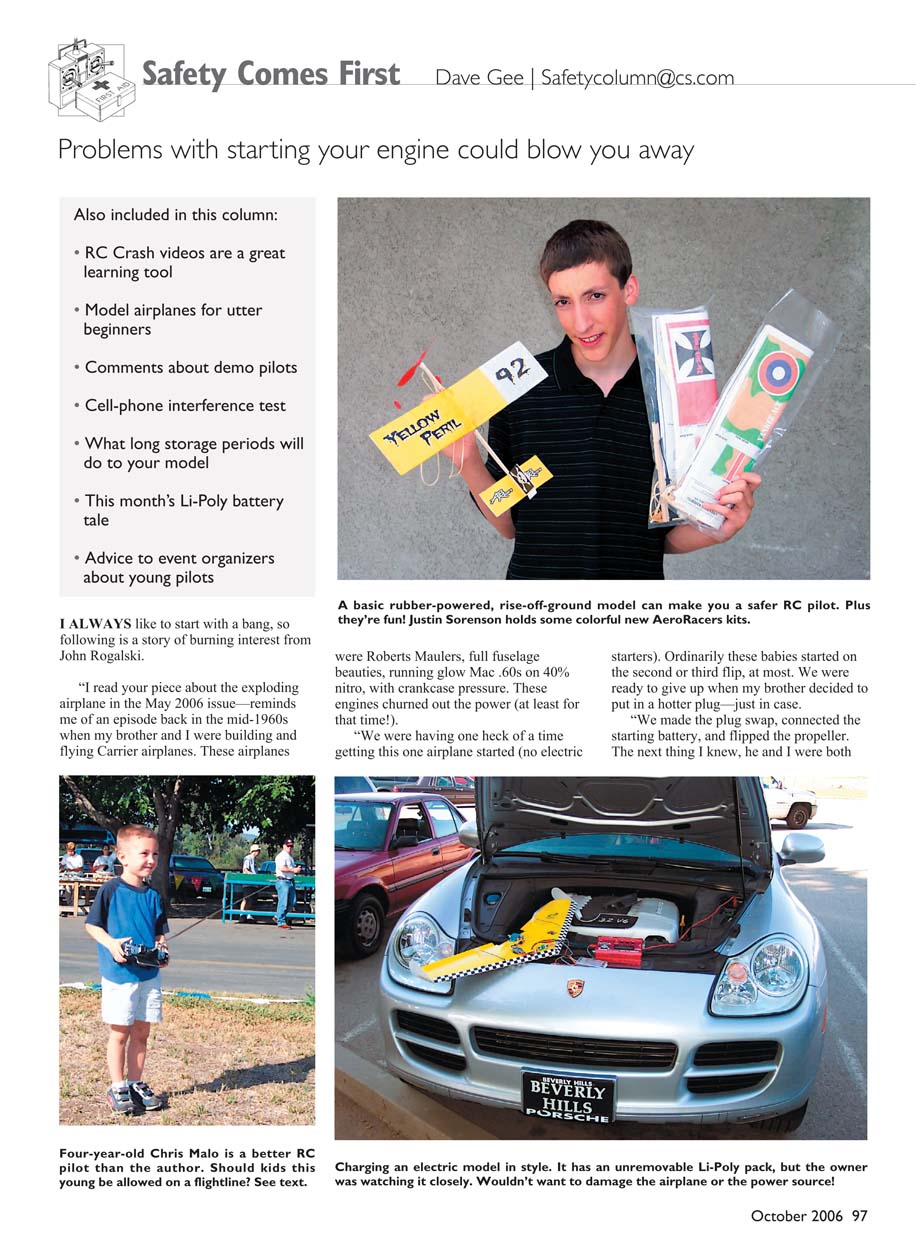
Coincidentally, AeroRacers (www.aeroracers.com) has a line of model airplanes for utter beginners, with crystal-clear instructions and precut lumber so a kid can have success with no outside help at all. Said kid (or adult) will gain an understanding of flight and aerodynamics that will make him or her a safer RC pilot later. These kits aren’t hard to build; I was able to construct one all by myself. The covering is preprinted in an assortment of eye-catching styles. I showed my Yellow Peril to the kid next door, and he said it looked “rad” and that it was “the bomb.” Or something like that.
These models are intended for use in the Great American Aero Derby (www.aeroderby.com), which looks like a great way to get youngsters involved in our hobby and teach them hands-on techniques that are getting scarce in these digital days.
Do you remember the picture in the September column of a hobby-show demonstration pilot flying his indoor RC model close over spectators' heads? It brought in many comments about demo pilots and their flying techniques. Some guys cornered me in a hobby shop and told me about a public demonstration during which a 3-D pilot held the transmitter behind his back and hovered his airplane very close to himself.
I'm the first to admit that these professional demo pilots are much more skilled than I am. They are in the business of showing what their cutting-edge equipment can do, and they make their models perform to the utmost.
In that case I'm not sure how much danger existed. The airplane's velocity was zero, and the mass of the model was low, but that propeller was spinning like mad and contacting it would have smarted. The reliability rate of radio-control systems is extremely high these days, but it is not 100%.
A valid point is to compare these pro fliers to the barnstormers and air-show operators after World War I. They were in fierce competition with one another, and "topping" a rival required ever more daring stunts. Eventually the accident rate got more attention than the flying, and aviation started to get a bad reputation.
These days, most hobby manufacturers exercise great care with their teams. There are some unbelievably cool products on the market, and customers are perfectly happy to see them demonstrated in safe ways.
There's always some dope in the crowd who will go home and try whatever he sees, regardless of his skill level and his aircraft's capability. Sometimes I am that dope.
I recently commented on a much-forwarded Internet report about cell-phone interference with a radio-control system. I called it an "urban legend," but that is not really accurate because the gist of the story is true.
How is this for cool? I heard from the guy at the heart of the story! His name is Ron Delahoussaye. He wrote:
"I am a member of the faculty in the School of Mechanical and Aerospace Engineering at Oklahoma State University. I am almost certainly the source of the 'study' you referred to in your article. We found interference under certain circumstances with a Futaba 9Z transmitter with the synthesized RF module (not a fixed-frequency module).
"The problem occurred when a cell phone received a call while close to the transmitter. Right before the phone rings, the servos jitter, showing signs of corrupted signal. We used a PPM receiver so we could see the jittering. A PCM receiver would mask the jitters by going into Hold or Failsafe.
"At some distance, there is no longer any signal corruption generated when a call is received by the phone. That would be the 'safe' distance for that particular phone. Try a different phone and a different safe distance may be observed—some longer and some shorter.
"You said that people should not panic, and I fully agree. I would encourage any who uses the synthesized 9Z transmitter to simply try the test I have outlined and determine for themselves their system's vulnerability, if any."
Ron made it clear that he tested only that particular radio, and it is what would now be considered an older unit. I've heard from many people who have made these tests with different hardware at different locations, and I am convinced that there is little danger of cell-phone-related interference. More recent Futaba synthesized 9Z radios do not seem to be vulnerable.
I'm not going to try this with every radio and every cell phone. Test yours if you like, but meanwhile keep a bit of space between your phone and any RC transmitter.
On the other end of technology, there was a recent Internet discussion about taking old FF models out for a spin after a long storage period. Is it possible or wise to launch them without fully retrimming first? This topic spills over to RC models, although the RC pilot has a greater chance of compensating for some hidden warp or CG problem.
The FF fliers are aware of the lack of control they have over an airplane once it is launched, and a large gas airplane packs quite a wallop. They want to make sure the already small risk to bystanders is minimized to the maximum.
Nearly everyone had a story about an "old dependable" model that was suddenly not so dependable. Some modelers take great care in packing their airplanes, securing them to fixtures to keep wings and tail surfaces straight. Others hang them up or cram them into boxes.
I'm not too methodical when it comes to storing models, but some of them have been extraordinarily resilient and fly okay despite my rough treatment. Other times I learned (too late) that a given model had "hangar rash," and a cracked elevator led to a cracked-up airplane.
The consensus was that although a complete retrim is overkill, an extraordinarily thorough preflight inspection is prudent if a model has been stored away for a while, regardless of how reliable the model is or how carefully it was packed.
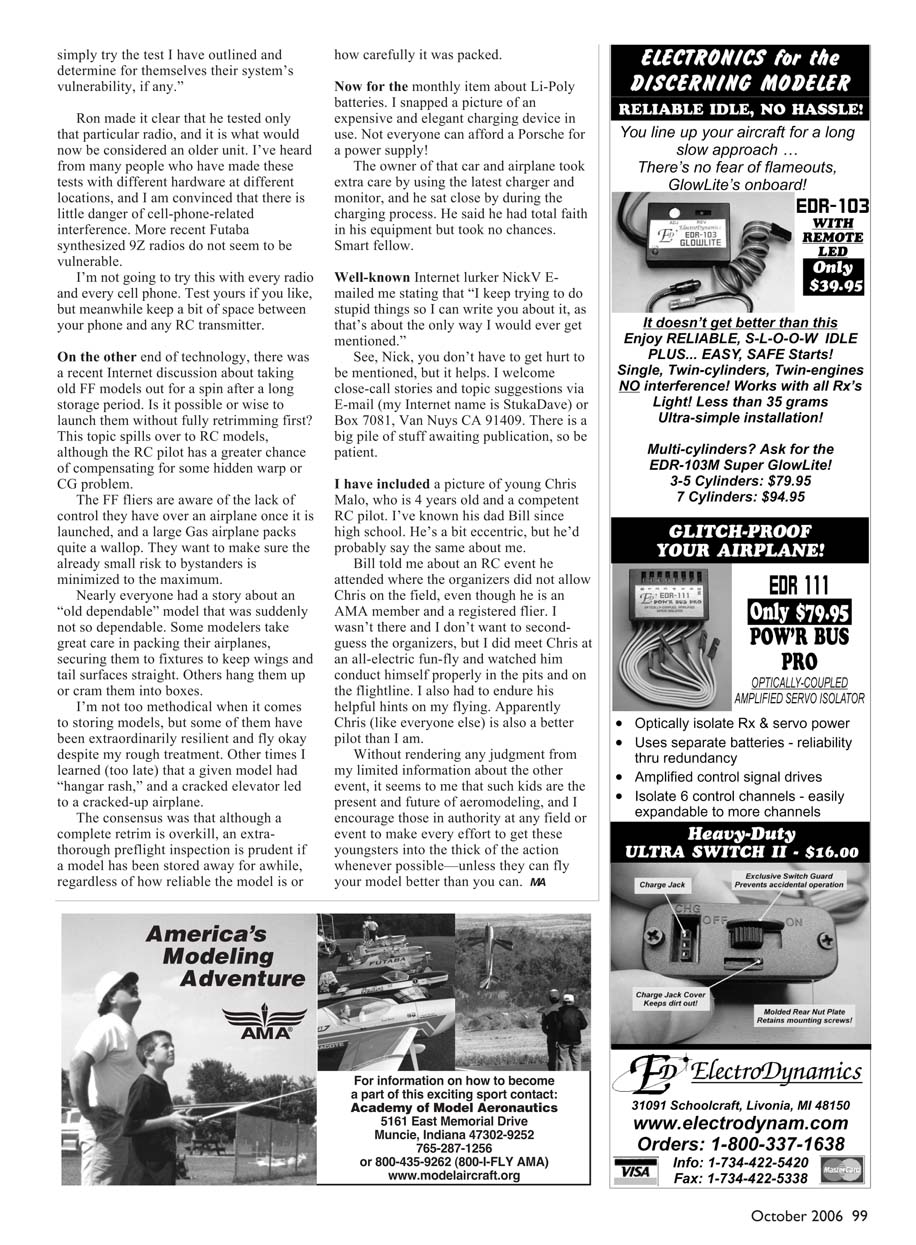
Now for the monthly item about Li-Poly batteries. I snapped a picture of an expensive and elegant charging device in use. Not everyone can afford a Porsche for a power supply!
The owner of that car and airplane took extra care by using the latest charger and monitor, and he sat close by during the charging process. He said he had total faith in his equipment but took no chances. Smart fellow.
Well-known Internet lurker Nick V. emailed me stating that "I keep trying to do stupid things so I can write you about it, as that's about the only way I would ever get mentioned." See, Nick, you don't have to get hurt to be mentioned, but it helps. I welcome close-call stories and topic suggestions via e-mail (my Internet name is StukaDave) or Box 7081, Van Nuys, CA 91409. There is a big pile of stuff awaiting publication, so be patient.
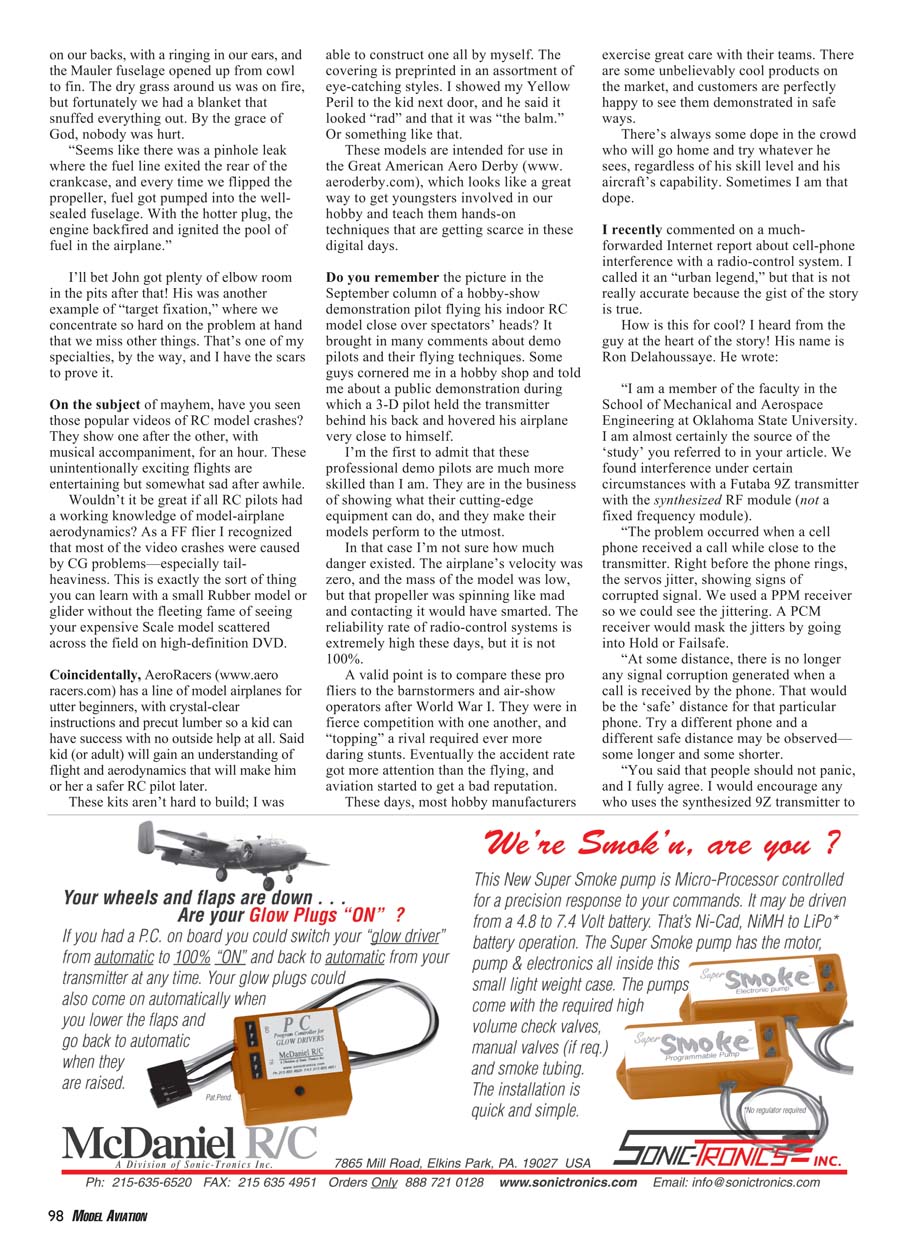
I have included a picture of young Chris Malo, who is 4 years old and a competent RC pilot. I've known his dad Bill since high school. He's a bit eccentric, but he'd probably say the same about me.
Bill told me about an RC event he attended where the organizers did not allow Chris on the field, even though he is an AMA member and a registered flier. I wasn't there and I don't want to second-guess the organizers, but I did meet Chris at an all-electric fun-fly and watched him conduct himself properly in the pits and on the flightline. I also had to endure his helpful hints on my flying. Apparently Chris (like everyone else) is also a better pilot than I am.
Without rendering any judgment from my limited information about the other event, it seems to me that such kids are the present and future of aeromodeling, and I encourage those in authority at any field or event to make every effort to get these youngsters into the thick of the action whenever possible—unless they can fly your model better than you can.
MA
Transcribed from original scans by AI. Minor OCR errors may remain.

