
Safety Comes First
Dave Gee | [email protected]
A humorous, albeit painful, flying story from the past
W.L. "Bill" Kincheloe had an exciting day in 1941. It took him a while to get around to writing about it, but the tale is worth retelling.
That July young Bill convinced his parents to drive him from Saint Louis, Missouri, to Quincy, Illinois, for an FF contest. (For you younger readers, that means the models have no radio control at all. Can you believe it?)
During the usual late-night rush to finish his model, Bill inadvertently let a hobby knife roll off the workbench and into his thigh. He managed to perform first aid without waking his family and applied a bandage before continuing the final installation of an Ohlsson .19 engine in his Wildcat 13 model.
A trip to the emergency room would have resulted in an angry mother and a canceled trip!
The next day Bill arrived at a windy, unfamiliar field with an untested model. He did have a secret weapon, though: a folding steel propeller. This glide-enhancing gadget was legal in those days! The propeller had another big advantage: the blades were protected during landing because they were folded back alongside the fuselage.
After some test glides Bill fired up the .19 and aimed the airplane down the grass runway. He wrote:
"I released the model and was busy picking up my booster battery and fuel can when I noticed that the airplane was performing a loop on takeoff. I expected that dihedral would roll it at the top of the loop and was disappointed that the climb wasn't really that good.
"Then I realized that it wasn't rolling out; it was accelerating downward in a continuation of the loop and I was standing in the flight path! A bit clumsy due to my wounded thigh, I tried to move out of the path of the speeding airplane. The loop terminated about three feet behind me in a resounding crash.
"During impact one of the propeller blades separated from the hub and shot upward to stick, tip first, in the left cheek of my bottom. While pained by this occurrence, I was forced to join in the general hilarity by the sheer ridiculousness of having a prop blade protruding from the now bloody seat of my pants!"
The humor soon dissipated as Bill's mother arrived and went through a first-aid procedure that involved removing his pants and underwear. Her mood turned even darker when she spotted the makeshift bandage on his thigh. He wrote:
"My ride home that afternoon was uncomfortable, and sitting was a trial for several days. Later, I did have some trouble convincing the Army medical examiner at a reception center how I really got that scar on my posterior!"
Bill learned 65 years ago that a metal folding propeller on a gas engine is a dangerous thing, and he says he still has two scars as a reminder of that eventful day. I'm gonna take his word on that, considering the location of the scars.
Okay, back to the 21st century and some discussion about an old problem that can be treated but maybe never cured. I've corresponded with numerous readers about problem fliers at their fields. There is no need for specifics; you probably know what I mean and some will recognize themselves or someone they know. People write, "We have a small number of fliers who habitually fly behind the flightline" and "... [there have been] many instances of people losing control (or orientation, or whatever) and getting way behind the flightline." Then there are more serious problems with RC pilots who cause trouble by disrupting low-time fliers with unsafe maneuvers or deliberate interference.
Club officers write:
- "We're not sure how to handle it. Something similar to a 'swear jar' perhaps; fliers have to put a dollar in the jar anytime they cross the flightline. Or perhaps a black flag rule where they are not allowed to fly for the rest of the day after they've crossed the flightline."
Those are good ideas that might work, depending on the camaraderie of the fliers and how much control the club has over the field. Some clubs have made safety training a regular feature of their meetings, with a brief presentation about the basics and a short discussion. I really like this approach.
The toughest problem to solve is a chronically careless or aggressive flier. I've read plenty of accounts that feature some loose-cannon pilot who refuses to follow safe field procedures, thus deliberately endangering others. Some of these boors might be oblivious to the situation, but how should we handle those who know what they are doing and want to get a rise out of people?
My e-mail is full of suggestions to walk up and belt the offender, call the police, or both. I've been there, and I know how that initial response pops into your head.
Such bluster is a poor response to the situation, and the wrong person may end up in the slammer. Fisticuffs have no place in aeromodeling!
I have no magic answer, but I do have some thoughts and suggestions:
- The flightline restriction is not a guarantee of safety for spectators, but it is a time-tested tool toward that goal. Breaking safety rules through ignorance or inexperience is more easily treated than the conduct of a habitual miscreant who shows a lack of concern for the health of his fellow beings.
- I have seen the scorn and ridicule of a group of fliers get surprising results. Few attention-seekers can put up with a crowd of their peers mocking their foolish, showy conduct.
- Consider the enforcement angle as well as education. How much power does your club have at the field? Is it possible to ban a flagrant offender? Would it really be worth it to do so?
- Are your club meetings well attended? If so, a series of short mentions and training/skits/lectures may serve to keep this issue foremost in fliers' minds.
- How about an airhorn or bell at the field that is sounded when an aircraft breaks the flightline as a warning to all and a reminder to the pilot? It would require someone to be ready to operate it, but perhaps there will be fewer occasions for the noise after some loud attention is called to the unsafe piloting. The horn could be positioned in a central location and available to whoever notices the errant pilot.
Please share your comments and ideas with me about this or any other issues. E-mail is fine or you can write to me at Box 7081, Van Nuys CA 91409. Remember to mention MA in your e-mail subject line so the spam filter lets you through!
Picture Time!
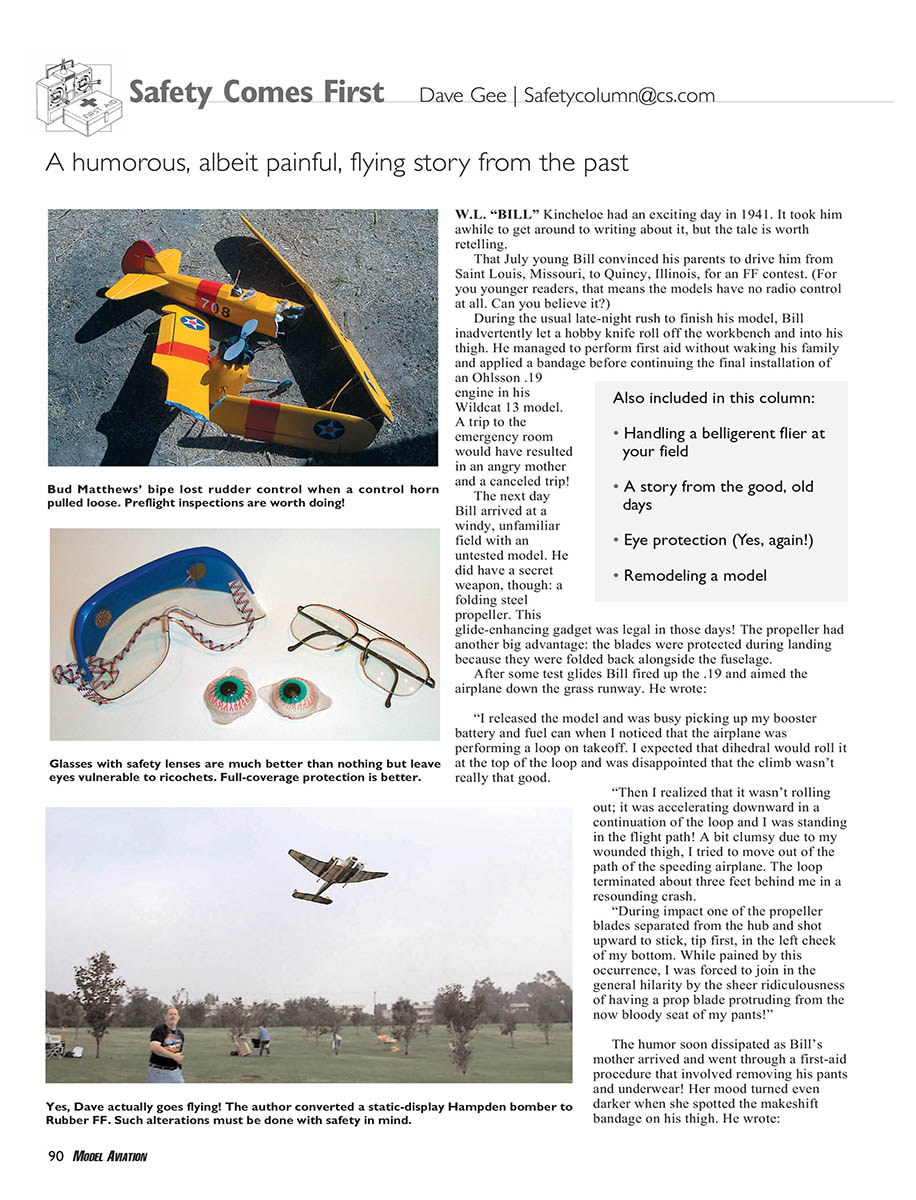
Bud Matthews sent me a shot of his electric-powered biplane after an "abrupt arrival" caused by a control horn pulling out of the rudder structure. This led to a loss of control and the result you see. Bud says the model crashed much too close to a group of people, but there were no injuries.
Full-scale aircraft get a preflight inspection before each takeoff. Shouldn't we treat our models with similar care? Maybe a Peanut Scale airplane can get by with a quick glance, but larger models with more kinetic energy and complex control systems deserve a good once-over. I've heard too many stories about linkages and structural members working loose on models. It's better to catch a problem on the ground!
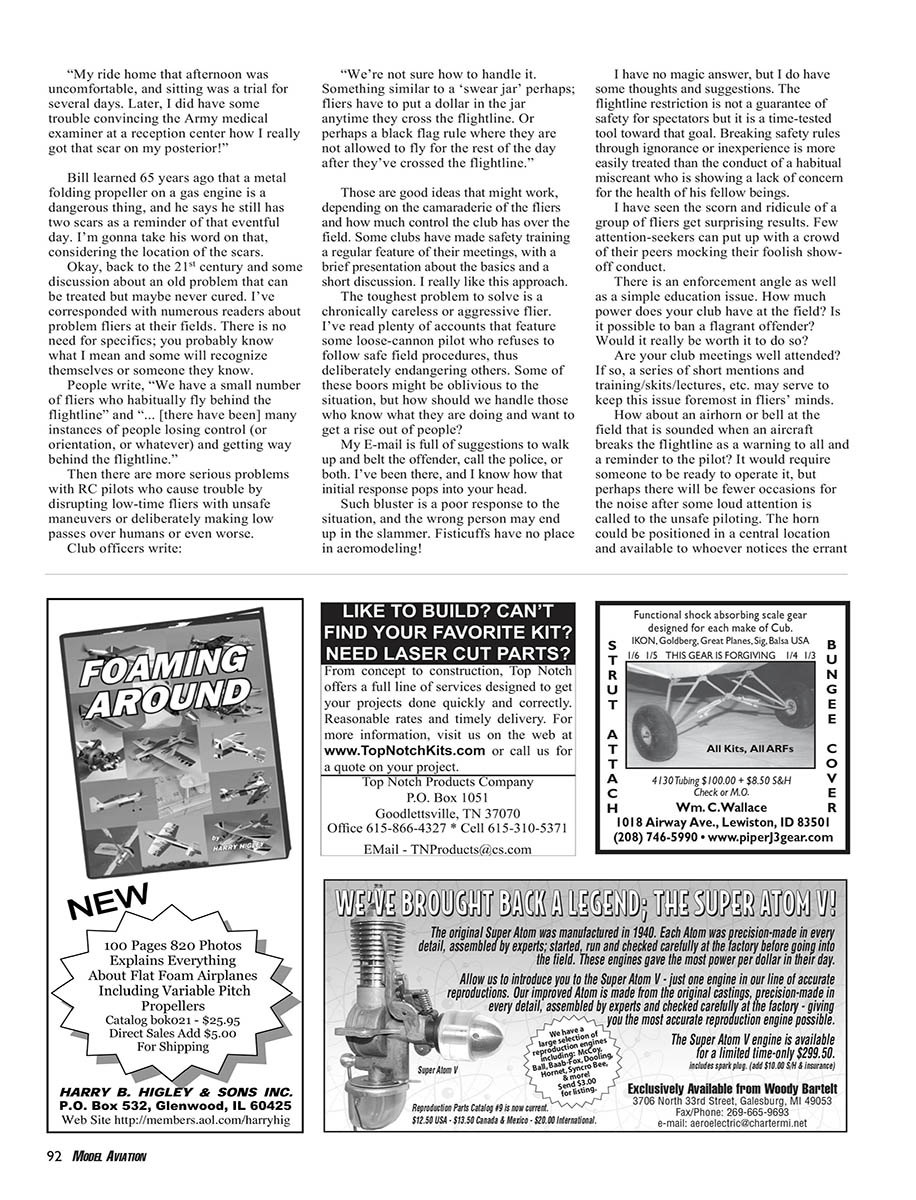
Readers may remember my confession about sometimes neglecting to use eye protection for "quick jobs" with my rotary tool until my age led to a need for glasses. It was a good excuse to get safety lenses, and I was forced to use them since now I can't see without help.
Since then many readers have sent me advice about how regular glasses do not provide full protection against flying particles. Some of their stories are gruesome and highly motivating.
I've been testing different styles of over-the-glasses safety goggles, hoping for one that is comfortable and handy enough for a lazy guy like me to use. I reason that my regular glasses provide direct protection against heavy flying particles, so the secondary goggles can be lighter since they need only cover against ricochets and dust.
My father used to have some plastic add-on side flaps for his glasses that did the trick, but they seem to have gone out of style years ago. Please don't be a dope like me and rationalize your way into risky behavior. Find some eye protection that suits you and use it!
By the way, the eyes in the picture are made from candy and are disgusting to anyone who is older than 12.
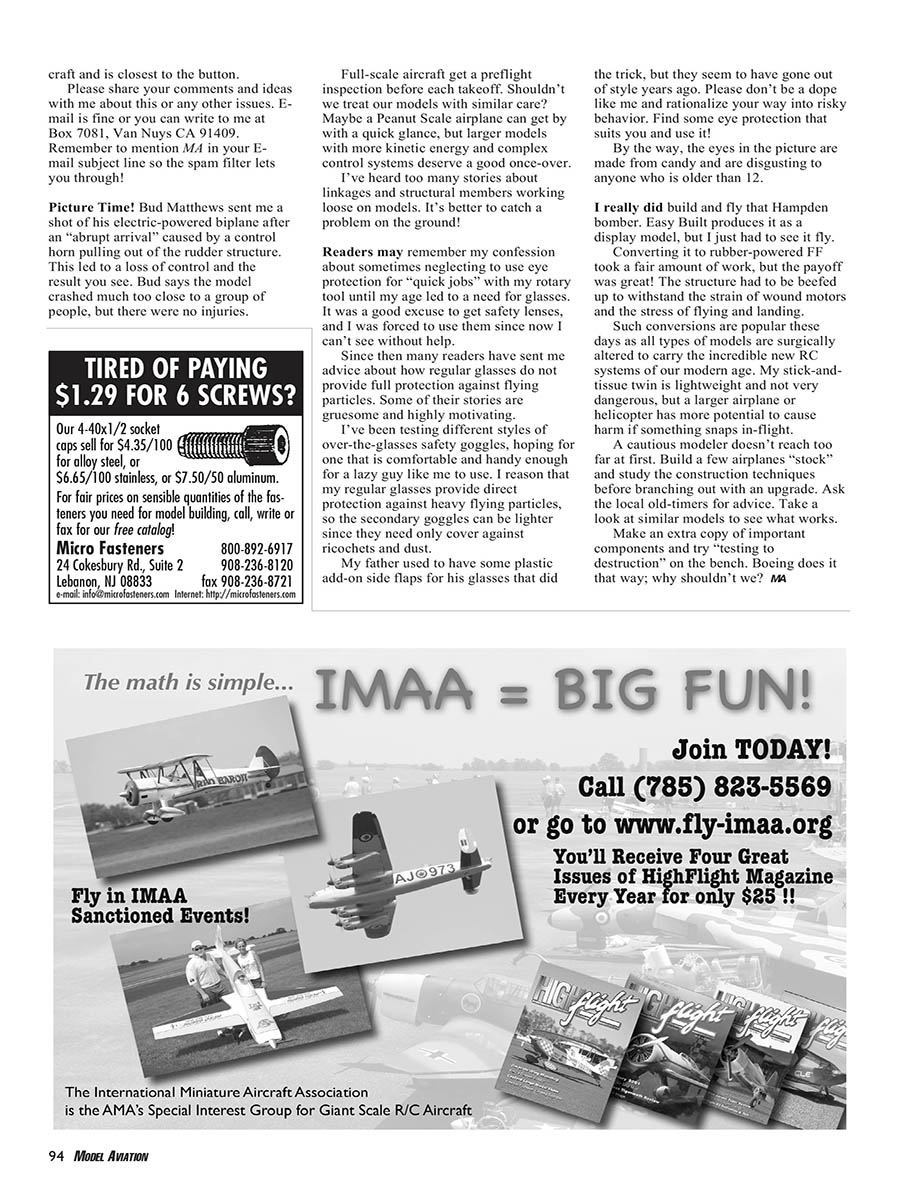
I really did build and fly that Hampden bomber. Easy Built produces it as a display model, but I just had to see it fly.
Converting it to rubber-powered FF took a fair amount of work, but the payoff was great! The structure had to be beefed up to withstand the strain of wound motors and the stress of flying and landing.
Such conversions are popular these days as all types of models are surgically altered to carry the incredible new RC systems of our modern age. My stick-and-tissue twin is lightweight and not very dangerous, but a larger airplane or helicopter has more potential to cause harm if something snaps in flight.
A cautious modeler doesn't reach too far at first. Build a few airplanes "stock" and study the construction techniques before branching out with an upgrade. Ask the local old-timers for advice. Take a look at similar models to see what works.
Make an extra copy of important components and try "testing to destruction" on the bench. Boeing does it that way; why shouldn't we?
MA
Transcribed from original scans by AI. Minor OCR errors may remain.

