
Safety Comes First
Dave Gee | [email protected]
The twisted truth about warps
WARPS! Those dreaded unplanned curvatures that appear in the wings, tails, and rotors of our models can spell disaster. Wooden structures are always vulnerable to warpage, and even foamies need to be checked for straightness and proper alignment.
If you build your own models you know about the need to "eyeball" the surfaces during construction. Certain building techniques such as geodetic construction or triangular bracing can make it harder for warps to sneak in. A prudent modeler will check an aircraft during and after the building process, and especially when dusting the winter cobwebs off of a stored model in springtime.
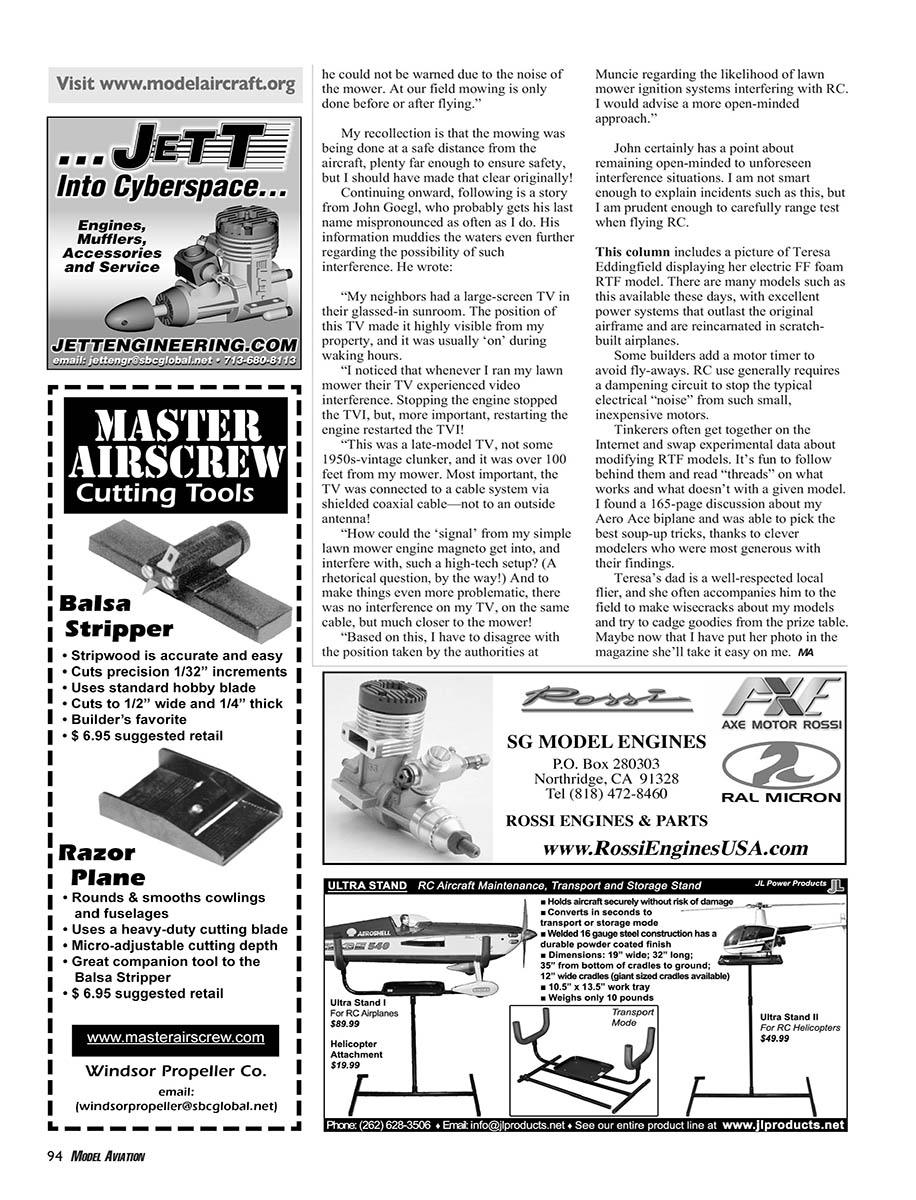
As does intestinal bacteria, warps come in good and bad varieties. Look at the picture of Don Smith's well-worn P-40 No-Cal model. Don't try flying your outdoor RC airplane with that much twist in the wing! This is an extreme case of wing warpage, but it is also the exception to the rule because this model is designed for indoor flying under a low ceiling. The asymmetrical wings actually help it fly the tight circles necessary to avoid collisions with the walls. Don takes some ribbing about this model, but he can afford to be big about it since it is a proven contest winner!
Few airplanes, model or full-scale, can fly with perfectly straight surfaces. Intentional warps are built into most aircraft. Wings that have washout will stall more gently since the tips angle down more than the roots. The torque and airflow from a single rotating propeller often require built-in compensation at the tail. This is especially important in an FF model, which must maintain stability all by itself. Check out a lightplane at the airport sometime and you'll see the same feature. Student pilots appreciate it!
Some model plans specify that an offset rudder or other permanent adjustment be added during construction. You may have heard a version of the story about a hand-me-down model that was inspected by a new owner who found, to his horror, that the flying surfaces were full of warps. After steaming, clamping, and rebracing, the airplane was finally straight, but the test flight resulted in a disastrous crash. A consultation with the designer or builder or plans afterward revealed that the original warps were deliberate and necessary!
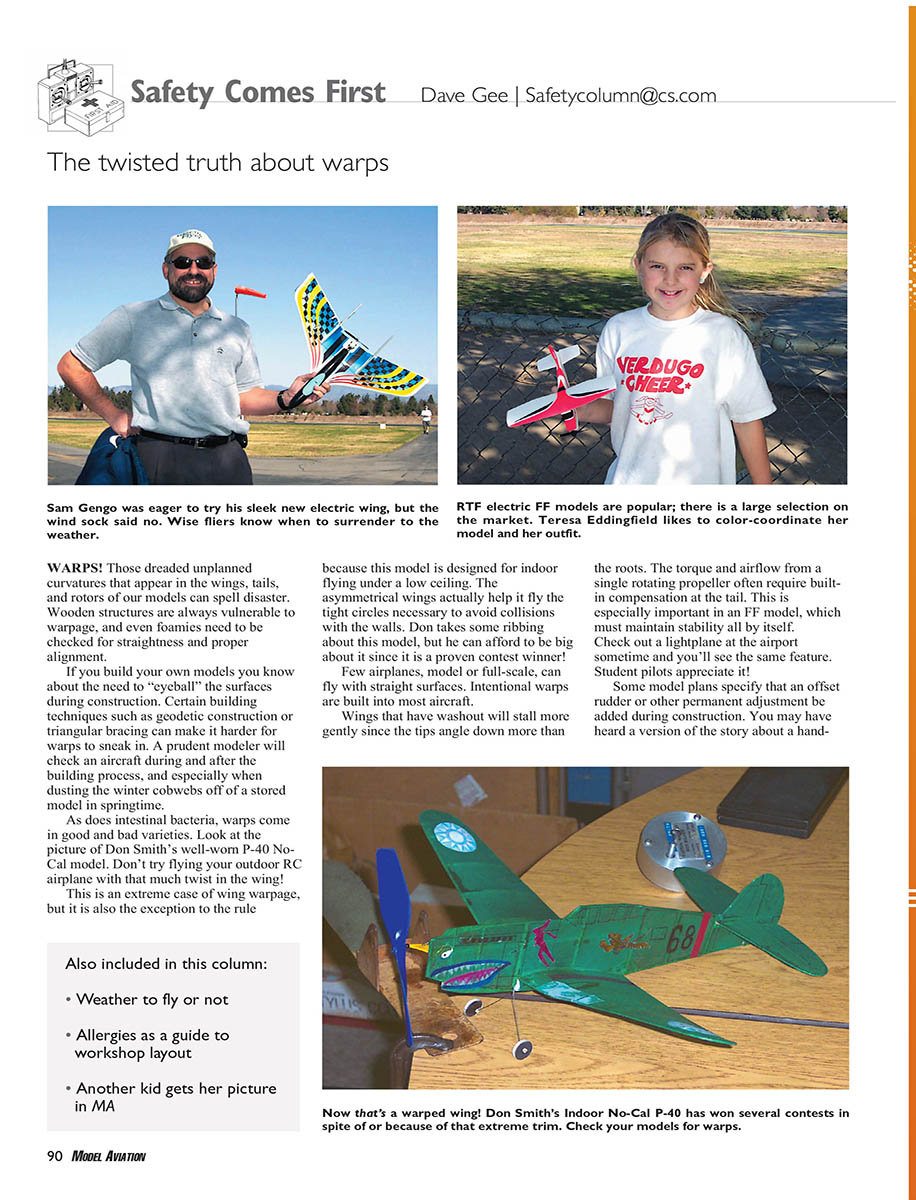
Pilots who fly foam models have much less concern about warped wings, but if they're in this column you can bet there's some problem lurking. Check out the photo of Sam Gengo with his sleek, new electric flying wing. He was all set to try it out until he saw the weather conditions at the local field. Thanks to my poor photographic skills, the wind sock appears to be growing out of Sam's shoulder. Actually it is flying high above the taxiway, and a horizontal sock means trouble for lightweight models! Sam and his model were disappointed but showed wisdom and prudence in postponing the wing's maiden flight. Modelers do not always use such sound judgment when weighing their eagerness to fly against adverse conditions, and the trashcan contents at the field prove it.
Speaking of poor judgment, I recently moved into a larger home and I write this while surrounded by unpacked boxes. One of the most important features in choosing a new place was a suitable workshop area. When I was a young fellow a bit of table space in the dining room would do, but nowadays I face the dangers of allergic reaction to my modeling materials, spillage, sawdust mess, and a possible scolding from my wife Sweet Diedra if I stink up the house with dope.
Luckily the mild California weather allows for plenty of ventilation year-round. I have my worktable next to a sliding-glass door, and an open window behind me holds an inexpensive exhaust fan to carry fumes and dust across my workboard and out of the house. Power sanding can be done outside on a wheeled table that holds my trusty Dremel Moto-Shop and disc sander. As do many other old guys I have had to develop the habit of wearing a dust-filter mask when sanding. The sawdust I ignored as a kid now bothers me plenty! Careful planning of this work area will save a great deal of trouble in the coming years and allow domestic bliss to continue.
Don Lewis e-mailed me a copy of a seasonal safety reminder from The Tailwind, the newsletter for the Hendersonville Radio Control Club of Hendersonville, Tennessee. It’s not a bad idea to occasionally give an overview of the basics. There’s always something new to be learned or relearned. Following is an excerpt that applies to me especially.
“Keep your work area neat and orderly.
In addition to being able to find what you are looking for when you need it, you lessen the chance of tripping over something and injuring yourself (or worse, damaging the airplane you just finished). There is an old saying in the Navy that we should keep in mind: There is a place for everything, and everything should be in its place. Pick up after yourself and return tools where they go after each time you use them. You will have a happier time in the shop and will work more efficiently in the long run.”
Don was most kind to send that info, but we live in different worlds; I can’t even find my desk chair sometimes.
I appreciate it when newsletter editors send me e-mail copies of their safety features. Input from readers is always welcome. If you have helpful or sardonic comments, please e-mail me or drop a letter to Box 7081, Van Nuys CA 91409. And don’t worry; nobody is made to look foolish in this column except me.
Some time ago I published information about a possible case of RC interference from a lawnmower engine. Phil Shellabarger read between the lines and brought up an excellent point. He wrote:
“I wonder why they would allow anyone to be mowing near the runways while aircraft were flying. If an airplane were out of control and headed for the guy mowing, he could not be warned due to the noise of the mower. At our field mowing is only done before or after flying.”
My recollection is that the mowing was being done at a safe distance from the aircraft, plenty far enough to ensure safety, but I should have made that clear originally!
Continuing onward, following is a story from John Goeghl, who probably gets his last name mispronounced as often as I do. His information muddies the waters even further regarding the possibility of such interference. He wrote:
"My neighbors had a large-screen TV in their glassed-in sunroom. The position of this TV made it highly visible from my property, and it was usually 'on' during waking hours.
"I noticed that whenever I ran my lawn mower their TV experienced video interference. Stopping the engine stopped the TV, but, more important, restarting the engine restarted the TV!
"This was a late-model TV, not some 1950s-vintage clunker, and it was over 100 feet from my mower. Most important, the TV was connected to a cable system via shielded coaxial cable — not to an outside antenna!
"How could the 'signal' from my simple lawn mower engine magneto get into, and interfere with, such a high-tech setup? (A rhetorical question, by the way!) And to make things even more problematic, there was no interference on my TV, on the same cable, but much closer to the mower!
"Based on this, I have to disagree with the position taken by the authorities at Muncie regarding the likelihood of lawn mower ignition systems interfering with RC. I would advise a more open-minded approach."
John certainly has a point about remaining open-minded to unforeseen interference situations. I am not smart enough to explain incidents such as this, but I am prudent enough to carefully range-test when flying RC.
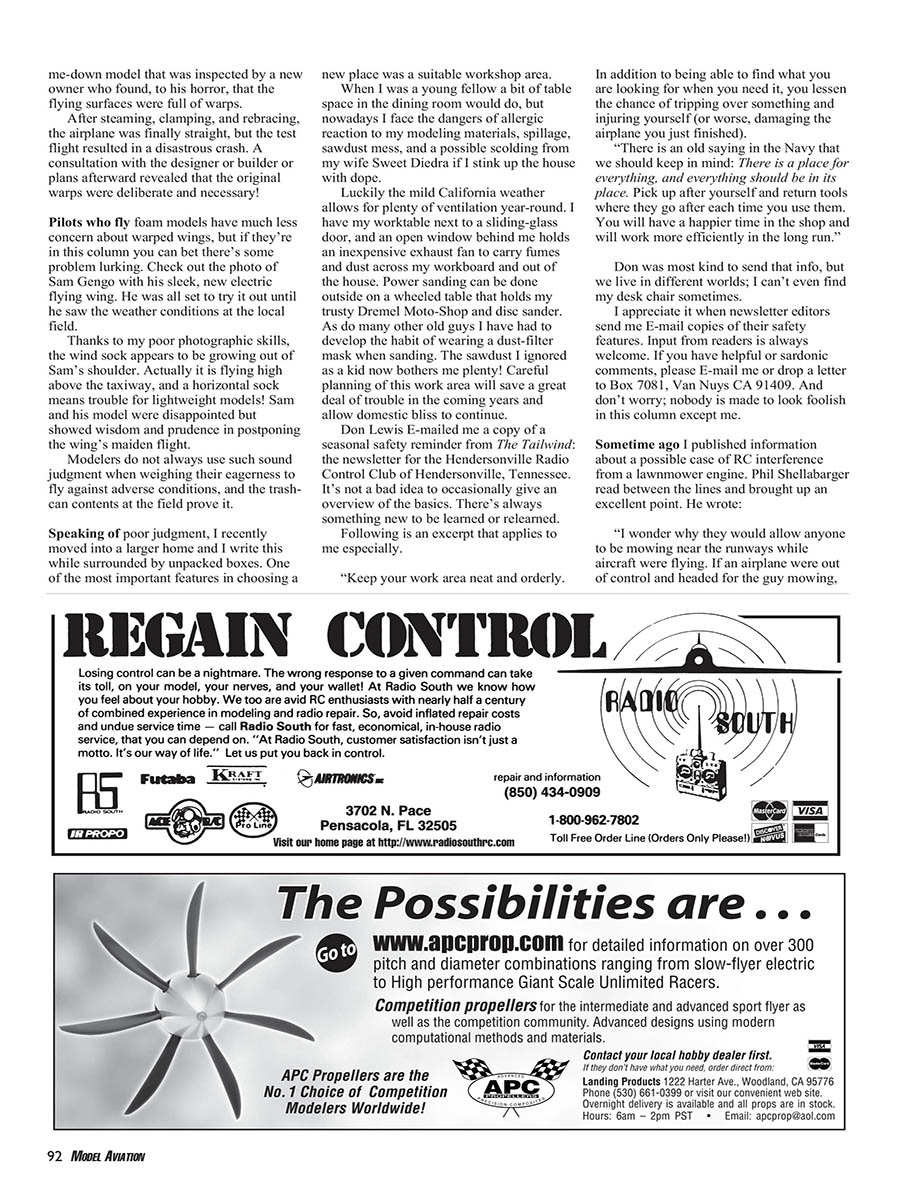
This column includes a picture of Teresa Eddingfield displaying her electric FF foam RTF model. There are many models such as this available these days, with excellent power systems that outlast the original airframe and are reincarnated in scratch-built airplanes.
Some builders add a motor timer to avoid fly-aways. RC use generally requires a dampening circuit to stop the typical electrical "noise" from such small, inexpensive motors.
Tinkerers often get together on the Internet and swap experimental data about modifying RTF models. It's fun to follow them and read "threads" on what works and what doesn't with a given model. I found a 165-page discussion about my Aero Ace biplane and was able to pick the best soup-up tricks, thanks to clever modelers who were most generous with their findings.
Teresa's dad is a well-respected local flier, and she often accompanies him to the field to make wisecracks about my models and try to coddle goodies from the prize table. Maybe now that I have put her photo in the magazine she'll take it easy on me.
Transcribed from original scans by AI. Minor OCR errors may remain.

