
Safety Comes First
Dave Gee | [email protected]
The aeromodeling community mourns the passing of Addie Mae Naccarato
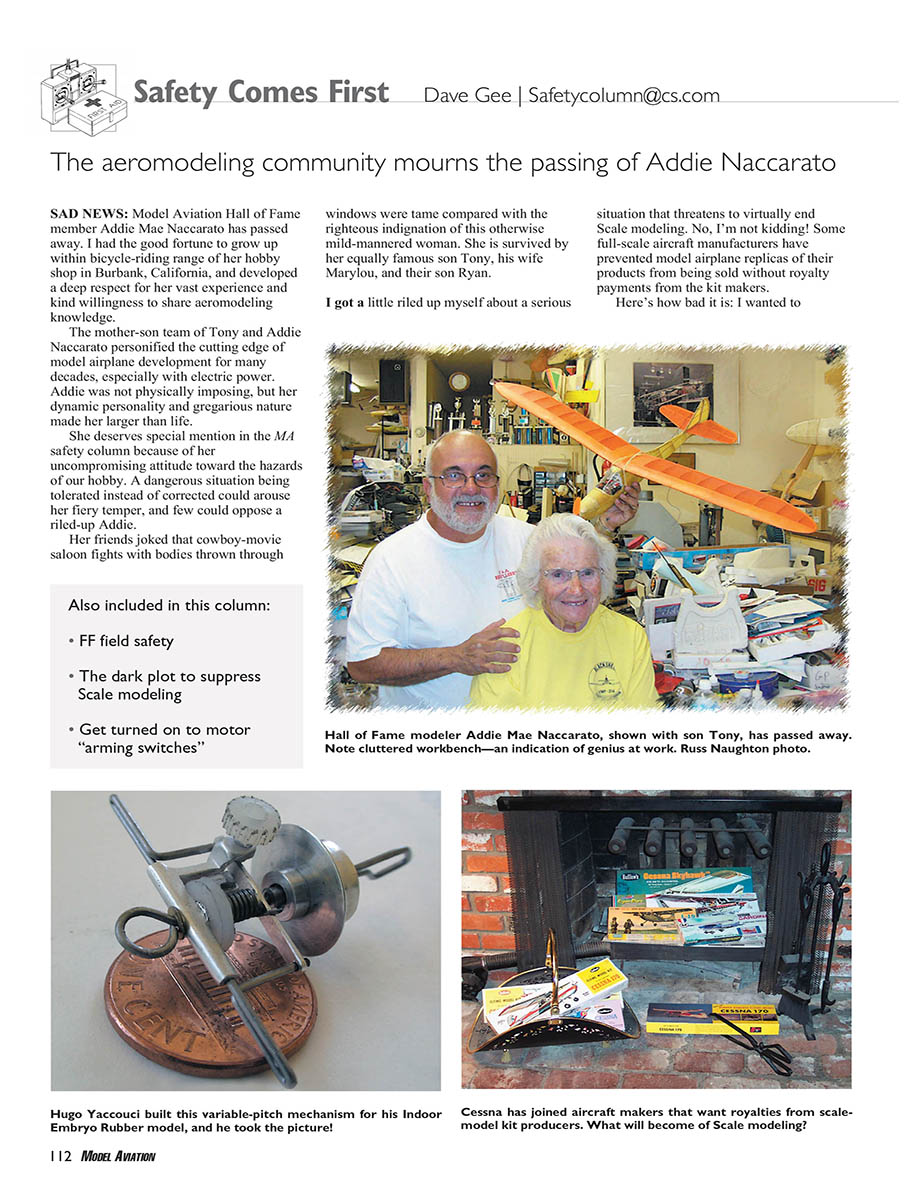
Sad news: Model Aviation Hall of Fame member Addie Mae Naccarato has passed away. I had the good fortune to grow up within bicycle-riding range of her hobby shop in Burbank, California, and developed a deep respect for her vast experience and kind willingness to share aeromodeling knowledge.
The mother–son team of Tony and Addie Naccarato personified the cutting edge of model airplane development for many decades, especially with electric power. Addie was not physically imposing, but her dynamic personality and gregarious nature made her larger than life.
She deserves special mention in the MA safety column because of her uncompromising attitude toward the hazards of our hobby. A dangerous situation being tolerated instead of corrected could arouse her fiery temper, and few could oppose a riled-up Addie. Her friends joked that cowboy-movie saloon fights with bodies thrown through windows were tame compared with the righteous indignation of this otherwise mild-mannered woman. She is survived by her equally famous son Tony, his wife Marylou, and their son Ryan.
Scale modeling and intellectual property
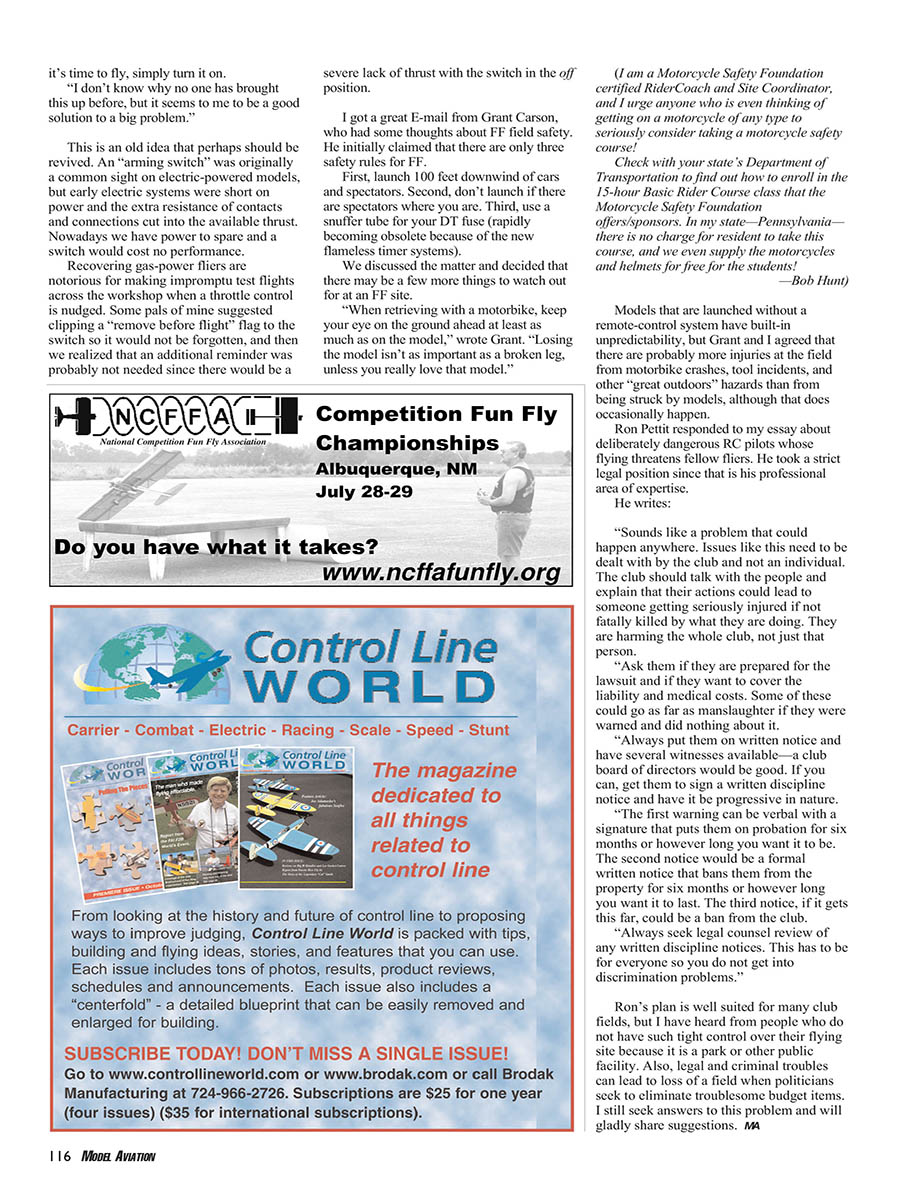
I got a little riled up myself about a serious situation that threatens to virtually end scale modeling. No, I'm not kidding. Some full-scale aircraft manufacturers have prevented model airplane replicas of their products from being sold without royalty payments from the kit makers.
Here's how bad it is: I wanted to purchase a pair of Dumas Cessna 120 kits (since the ones I built for FF and RC flew so sweetly), but they had been removed from the market at the behest of Cessna lawyers. Lockheed has already put such a damper on those who produce P-38 models that they are being sold under names such as "Twin-38." If all brands follow this trend, it will become impossible to purchase scale RTFs, kits, or plans. The hobby industry's profit margin is just too small for such payoffs, never mind the expense of fighting lawsuits. Legislative efforts such as the Military Toy Replica Act are currently stalled, and other negotiations have ceased.
I'm mentioning this shameful situation here because one of the justifications given by corporate attorneys was that, theoretically, if a model of a company's aircraft crashed and did harm to someone or something, the full-scale aircraft manufacturer could be sued for damages. I'm no lawyer, but that sounds ridiculous. My research did not uncover any instance of this situation ever occurring.
I spoke with Doug Oliver, the director of corporate communication for Cessna, and described the fond feelings modelers have for Cessna aircraft. There is nothing like a sleek, high-wing cabin monoplane to make a nice-flying model. I added that countless modelers had gone on to fly and purchase full-scale aircraft. The positive impression builders of miniature versions have surely contributed to sales of current Cessna products.
Doug agreed with those points but said that the leadership of Cessna and its parent company Textron were committed to protecting the "intellectual property" of their aircraft designs—even those that have been out of production for many decades. I understand that argument but do not agree that it should apply to miniature historical replicas sold for personal recreational use. I think it makes Cessna and other companies look bad.
Will this disgraceful policy affect the purchasing decisions of a current or former modeler who is shopping for corporate transportation? I know it will run through my mind when faced with a choice of which brand of lightplane I will ride in.
Variable‑pitch propeller for Indoor Embryo Rubber
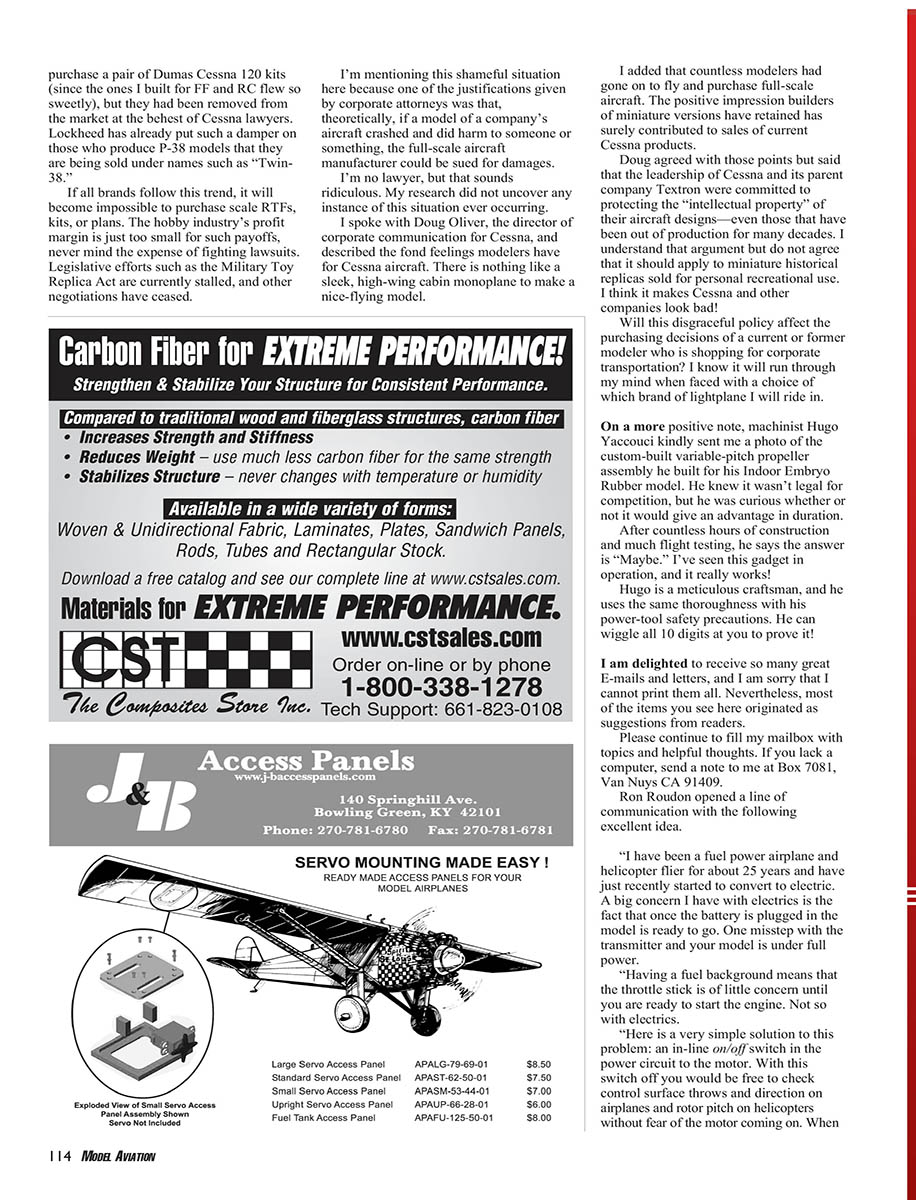
On a more positive note, machinist Hugo Yaccouci kindly sent me a photo of the custom-built variable-pitch propeller assembly he built for his Indoor Embryo Rubber model. He knew it wasn't legal for competition, but he was curious whether or not it would give an advantage in duration.
After countless hours of construction and much flight testing, he says the answer is "Maybe." I've seen this gadget in operation, and it really works!
Hugo is a meticulous craftsman, and he uses the same thoroughness with his power-tool safety precautions. He can wiggle all 10 digits at you to prove it!
Mailbag and reader suggestions
I am delighted to receive so many great e-mails and letters, and I am sorry that I cannot print them all. Nevertheless, most of the items you see here originated as suggestions from readers. Please continue to fill my mailbox with topics and helpful thoughts. If you lack a computer, send a note to me at Box 7081, Van Nuys CA 91409.
Ron Roudon opened a line of communication with the following excellent idea:
"I have been a fuel-power airplane and helicopter flier for about 25 years and have just recently started to convert to electric. A big concern I have with electrics is the fact that once the battery is plugged in the model is ready to go. One misstep with the transmitter and your model is under full power.
"Having a fuel background means that the throttle stick is of little concern until you are ready to start the engine. Not so with electrics.
"Here is a very simple solution to this problem: an in-line on/off switch in the power circuit to the motor. With this switch off you would be free to check control surface throws and direction on airplanes and rotor pitch on helicopters without fear of the motor coming on. When the switch is turned on, the motor is ready to run."
This is an old idea that perhaps should be revived. An "arming switch" was originally a common sight on electric-powered models, but early electric systems were short on power and the extra resistance of contacts and connections cut into the available thrust. Nowadays we have power to spare and a switch would cost no performance.
Recovering gas-power fliers are notorious for making impromptu test flights across the workshop when a throttle control is nudged. Some pals of mine suggested clipping a "remove before flight" flag to the switch so it would not be forgotten, and then we realized that an additional reminder was probably not needed since there would be a severe lack of thrust with the switch in the off position.
Free Flight (FF) field safety
I got a great e-mail from Grant Carson, who had some thoughts about FF field safety. He initially claimed that there are only three safety rules for FF:
- Launch 100 feet downwind of cars and spectators.
- Don't launch if there are spectators where you are.
- Use a snuffer tube for your DT fuse (rapidly becoming obsolete because of the new flameless timer systems).
We discussed the matter and decided that there may be a few more things to watch out for at an FF site.
"When retrieving with a motorbike, keep your eye on the ground ahead at least as much as on the model," wrote Grant. "Losing the model isn't as important as a broken leg, unless you really love that model."
I am a Motorcycle Safety Foundation–certified RiderCoach and Site Coordinator, and I urge anyone who is even thinking of getting on a motorcycle of any type to seriously consider taking a motorcycle safety course. Check with your state's Department of Transportation to find out how to enroll in the 15-hour Basic Rider Course class that the Motorcycle Safety Foundation offers/sponsors. In my state—Pennsylvania—there is no charge for residents to take this course, and we even supply the motorcycles and helmets for free for the students!
—Bob Hunt
Models that are launched without a remote-control system have built-in unpredictability, but Grant and I agreed that there are probably more injuries at the field from motorbike crashes, tool incidents, and other "great outdoors" hazards than from being struck by models, although that does occasionally happen.
RC club discipline and legal steps
Ron Pettit responded to my essay about deliberately dangerous RC pilots whose flying threatens fellow fliers. He took a strict legal position since that is his professional area of expertise. He wrote:
"Sounds like a problem that could happen anywhere. Issues like this need to be dealt with by the club and not an individual. The club should talk with the people and explain that their actions could lead to someone getting seriously injured if not fatally killed by what they are doing. They are harming the whole club, not just that person.
"Ask them if they are prepared for the lawsuit and if they want to cover the liability and medical costs. Some of these could go as far as manslaughter if they were warned and did nothing about it.
"Always put them on written notice and have several witnesses available—a club board of directors would be good. If you can, get them to sign a written discipline notice and have it be progressive in nature.
"The first warning can be verbal with a signature that puts them on probation for six months or however long you want it to be. The second notice would be a formal written notice that bans them from the property for six months or however long you want it to last. The third notice, if it gets this far, could be a ban from the club.
"Always seek legal counsel review of any written discipline notices. This has to be for everyone so you do not get into discrimination problems."
Ron's plan is well suited for many club fields, but I have heard from people who do not have such tight control over their flying site because it is a park or other public facility. Also, legal and criminal troubles can lead to loss of a field when politicians seek to eliminate troublesome budget items. I still seek answers to this problem and will gladly share suggestions.
MA
Transcribed from original scans by AI. Minor OCR errors may remain.

