
Safety Comes First
Dave Gee | [email protected]
A great new glue for foam
Are you a sportsman/sportswoman or a hobbyist? Some say the dividing line between the two is whether you build your aircraft or buy it ready to fly. Even this line gets blurry because there are kits available with a portion or most of the work undone.
I was discussing the difference with a friend of mine who is wiser than I am (come to think of it, most of my friends are wiser than I am), and he cringes when I joke about "playing with toy airplanes" because he thinks it demeans our hobby (sport?). I think it gives us power over an otherwise belittling term, plus it sounds funny when applied to the sometimes serious and expensive pursuit of aeromodeling.
I tend to see things from a hobbyist/builder viewpoint, which is why I like to report on the safety angle of new tools and gadgets. ARFs are great fun, but my enjoyment of this hobby peaks when I get a clean sheet of paper and balsa and begin a new model. I have a plug for something new that will please the hard-core builders and the "open the box, let's go fly" types.
Ed Sussman is in the TV and movie industry, in which breakaway propellers and temporary sets are made from foam. Time is money in showbiz, so a unique glue system is used to build things in a hurry, and flammable, smelly fumes are not okay in the studio.
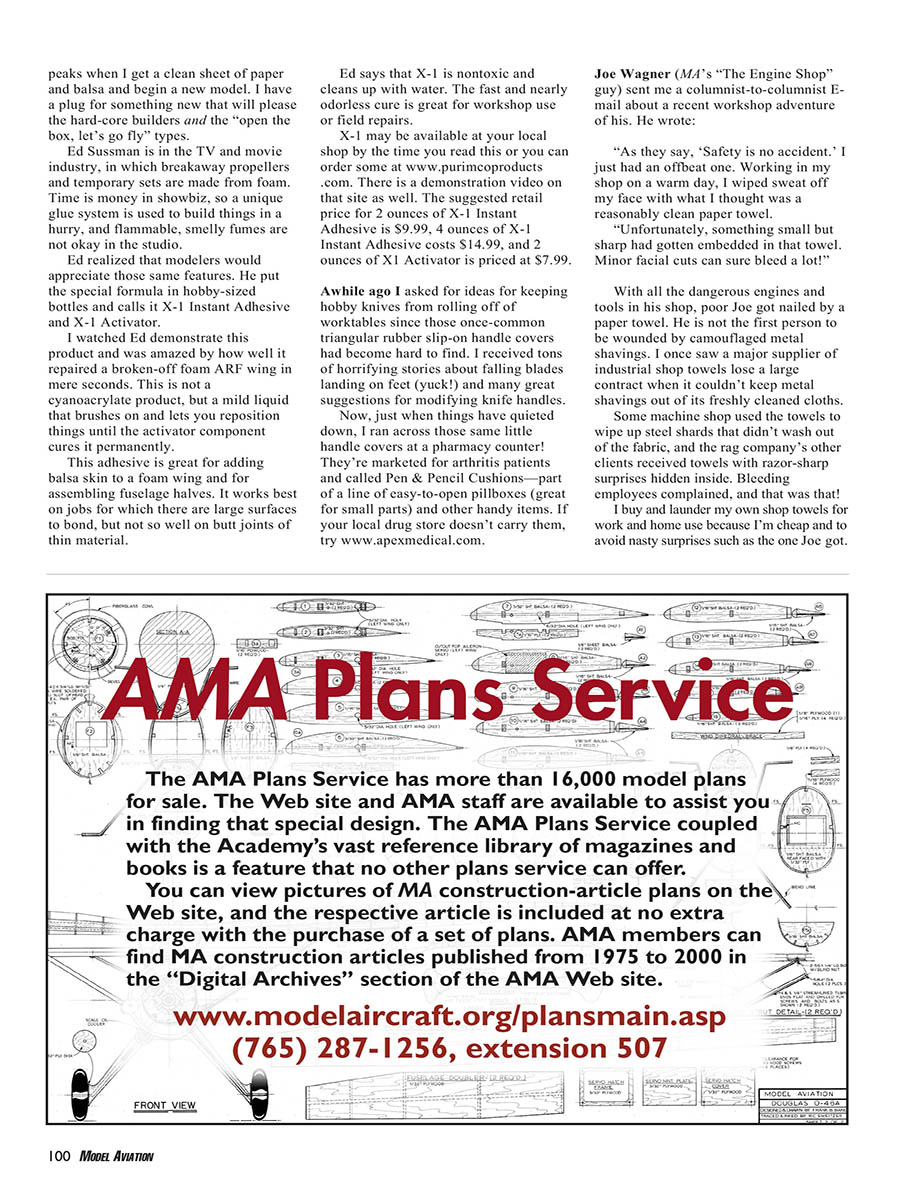
Ed realized that modelers would appreciate those same features. He put the special formula in hobby-sized bottles and calls it X-1 Instant Adhesive and X-1 Activator.
I watched Ed demonstrate this product and was amazed by how well it repaired a broken-off foam ARF wing in mere seconds. This is not a cyanoacrylate product, but a mild liquid that brushes on and lets you reposition things until the activator component cures it permanently.
This adhesive is great for adding balsa skin to a foam wing and for assembling fuselage halves. It works best on jobs for which there are large surfaces to bond, but not so well on butt joints of thin material.
Ed says that X-1 is nontoxic and cleans up with water. The fast and nearly odorless cure is great for workshop use or field repairs.
X-1 may be available at your local shop by the time you read this or you can order some at www.purimcoproducts.com. There is a demonstration video on that site as well. Suggested retail prices:
- 2 ounces X-1 Instant Adhesive — $9.99
- 4 ounces X-1 Instant Adhesive — $14.99
- 2 ounces X-1 Activator — $7.99
Knife-handle covers and small parts storage
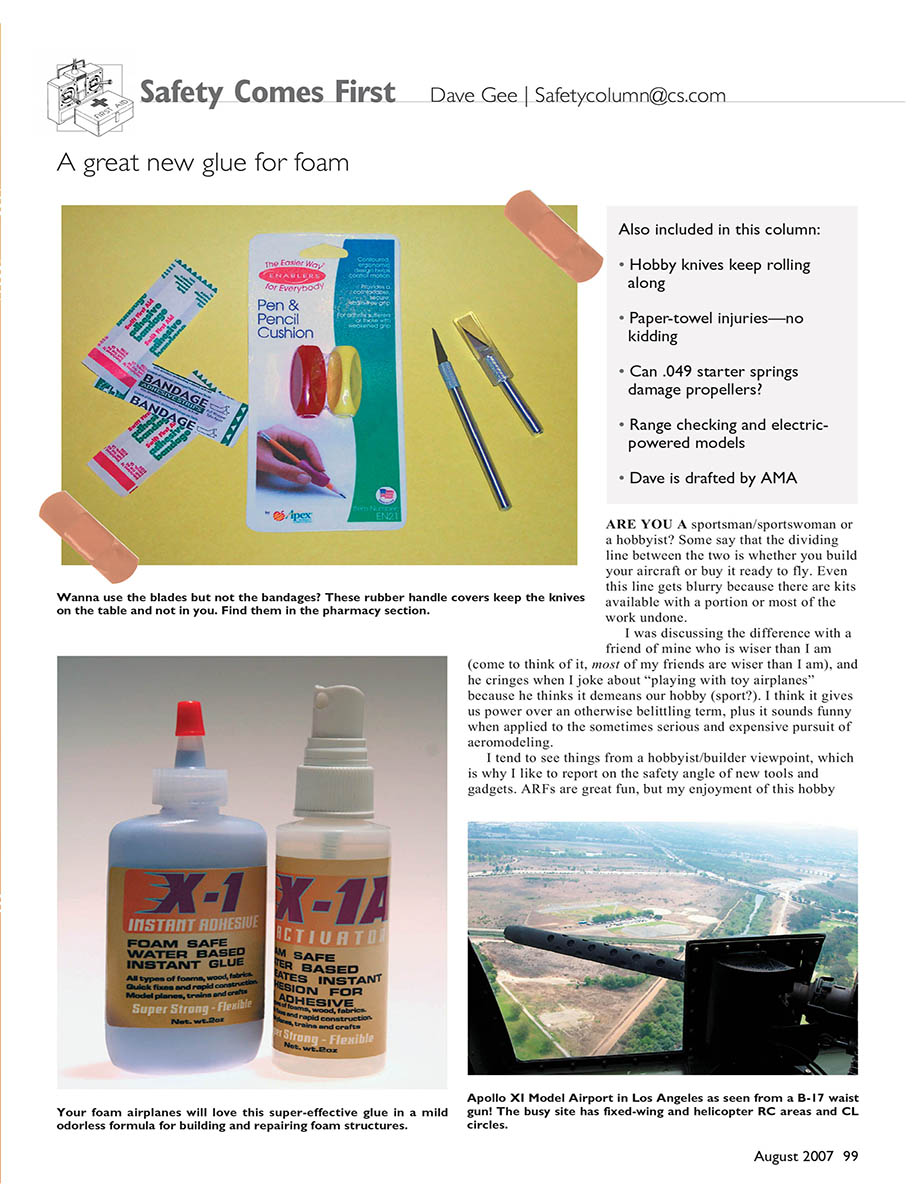
A while ago I asked for ideas for keeping hobby knives from rolling off worktables since those once-common triangular rubber slip-on handle covers had become hard to find. I received tons of horrifying stories about falling blades landing on feet (yuck!) and many great suggestions for modifying knife handles.
Now, just when things have quieted down, I ran across those same little handle covers at a pharmacy counter! They're marketed for arthritis patients and called Pen & Pencil Cushions—part of a line of easy-to-open pillboxes (great for small parts) and other handy items. If your local drug store doesn't carry them, try www.apexmedical.com.
Paper-towel hazard
Joe Wagner (MA's "The Engine Shop" guy) sent me a columnist-to-columnist e-mail about a recent workshop adventure of his. He wrote:
"As they say, 'Safety is no accident.' I just had an offbeat one. Working in my shop on a warm day, I wiped sweat off my face with what I thought was a reasonably clean paper towel.
"Unfortunately, something small but sharp had gotten embedded in that towel. Minor facial cuts can sure bleed a lot!"
With all the dangerous engines and tools in his shop, poor Joe got nailed by a paper towel. He is not the first person to be wounded by camouflaged metal shavings. I once saw a major supplier of industrial shop tools lose a large contract when it couldn't keep metal shavings out of its freshly cleaned cloths.
Some machine shop used the towels to wipe up steel shards that didn't wash out of the fabric, and the rag company's other clients received towels with razor-sharp surprises hidden inside. Bleeding employees complained, and that was that!
I buy and launder my own shop towels for work and home use because I'm cheap and to avoid nasty surprises such as the one Joe got.
Starter-spring damage to propellers
A much more pleasant surprise was running into Bill Grove tending his swap-shop table at AMA Convention 2007. He showed me a Cox 1/2A propeller with deep score marks in it.
Bill said that he often sees where the starter spring on these old engines has rubbed against the plastic propeller and left serious structural damage. He wondered if any of these propellers had failed while in use because of starter-spring damage.
I seldom run these little engines, but I'll bet some wise MA readers know all about this. Have you ever seen this phenomenon, and has it ever led to a blade failure?
Please e-mail me about your experiences with this and mention "safety" in the subject line to set your message apart from loan scams and chain letters. If you prefer, a letter written on paper is just as good. Send 'em to Box 7081, Van Nuys CA 91409.
Aerial perspective and field conduct
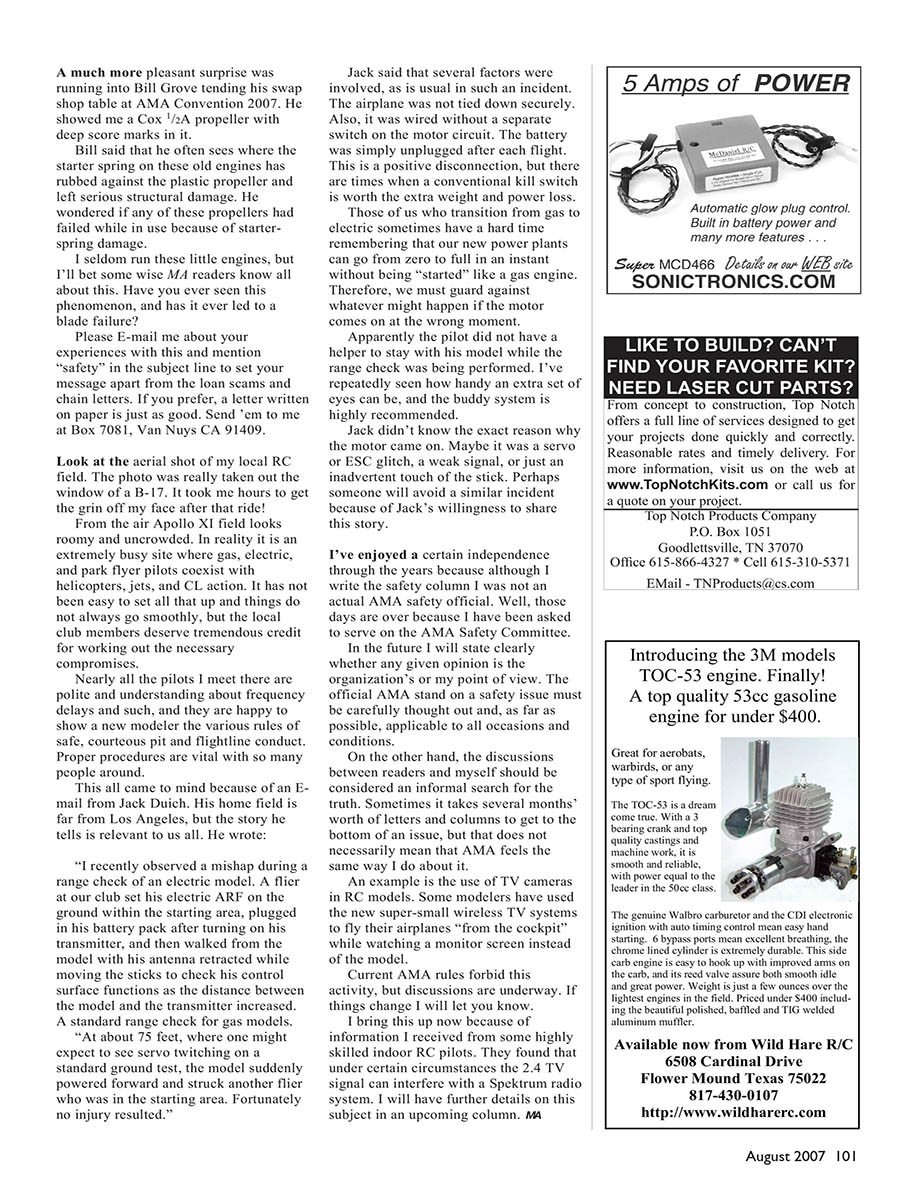
Look at the aerial shot of my local RC field. The photo was really taken out the window of a B-17. It took me hours to get the grin off my face after that ride!
From the air Apollo XI field looks roomy and uncrowded. In reality it is an extremely busy site where gas, electric, and park-flyer pilots coexist with helicopters, jets, and CL action. It has not been easy to set all that up and things do not always go smoothly, but the local club members deserve tremendous credit for working out the necessary compromises.
Nearly all the pilots I meet there are polite and understanding about frequency delays and such, and they are happy to show a new modeler the various rules of safe, courteous pit and flight-line conduct. Proper procedures are vital with so many people around.
Electric model range-check incident
This all came to mind because of an e-mail from Jack Duch. His home field is far from Los Angeles, but the story he tells is relevant to us all. He wrote:
"I recently observed a mishap during a range check of an electric model. A flier at our club set his electric ARF on the ground within the starting area, plugged in his battery pack after turning on his transmitter, and then walked from the model with his antenna retracted while moving the sticks to check his control-surface functions as the distance between the model and the transmitter increased. A standard range check for gas models.
"At about 75 feet, where one might expect to see servo twitching on a standard ground test, the model suddenly powered forward and struck another flier who was in the starting area. Fortunately no injury resulted."
Jack said that several factors were involved, as is usual in such an incident:
- The airplane was not tied down securely.
- It was wired without a separate switch on the motor circuit; the battery was simply unplugged after each flight. This is a positive disconnection, but there are times when a conventional kill switch is worth the extra weight and power loss.
- The pilot apparently did not have a helper to stay with his model while the range check was being performed.
Those of us who transition from gas to electric sometimes have a hard time remembering that our new power systems can go from zero to full in an instant without being "started" like a gas engine. Therefore, we must guard against whatever might happen if the motor comes on at the wrong moment.
Jack didn't know the exact reason why the motor came on. Maybe it was a servo or ESC glitch, a weak signal, or just an inadvertent touch of the stick. Perhaps someone will avoid a similar incident because of Jack's willingness to share this story.
I've repeatedly seen how handy an extra set of eyes can be, and the buddy system is highly recommended.
AMA Safety Committee and TV cameras
I've enjoyed a certain independence through the years because although I write the safety column I was not an actual AMA safety official. Well, those days are over because I have been asked to serve on the AMA Safety Committee.
In the future I will state clearly whether any given opinion is the organization's or my point of view. The official AMA stand on a safety issue must be carefully thought out and, as far as possible, applicable to all occasions and conditions.
On the other hand, the discussions between readers and myself should be considered an informal search for the truth. Sometimes it takes several months' worth of letters and columns to get to the bottom of an issue, but that does not necessarily mean that AMA feels the same way I do about it.
An example is the use of TV cameras on RC models. Some modelers have used the new super-small wireless TV systems to fly their airplanes "from the cockpit" while watching a monitor screen instead of the model.
Current AMA rules forbid this activity, but discussions are underway. If things change I will let you know.
I bring this up now because of information I received from some highly skilled indoor RC pilots. They found that under certain circumstances the 2.4 GHz TV signal can interfere with a Spektrum radio system. I will have further details on this subject in an upcoming column.
Transcribed from original scans by AI. Minor OCR errors may remain.

