
Safety Comes First
Dave Gee | [email protected]
Manual arming switches for electric-powered models
A reader suggested using an arming switch on an electric-powered model to prevent accidental motor runs, and since then I have heard from several savvy electricians about how our modern power systems do not like such switches. Steven Nicholson wrote:
“An inline switch may work on a small current ESC (5 or maybe 8 amps); however, as you progress up (in power) this will be a problem. I lost one airplane on takeoff due to a switch malfunction.
“The switch acts like a fuse link. With electrics using 20 to 110 amps, you would have to have a switch that handles very high current.”
My models tend to be small enough not to cause switch problems, but there have been some serious unexpected incidents with powerful motors and I still think a manual arming switch is a good idea.
During my research some hobby-industry people showed me new heavy-duty switches and arming plugs that are being marketed for such use. Since I wrote this roughly three months before the magazine’s cover date, these products may be available by the time you read it.
Engine exhaust and workshop ventilation
On the topic of three months, winter weather will be here soon. That means many modelers will be working in their cozy, warm workshops. Do you ever bench-run your gas engines in a place with limited ventilation? We know better than to do that with an automobile, but a harmless little model engine seems different, right?
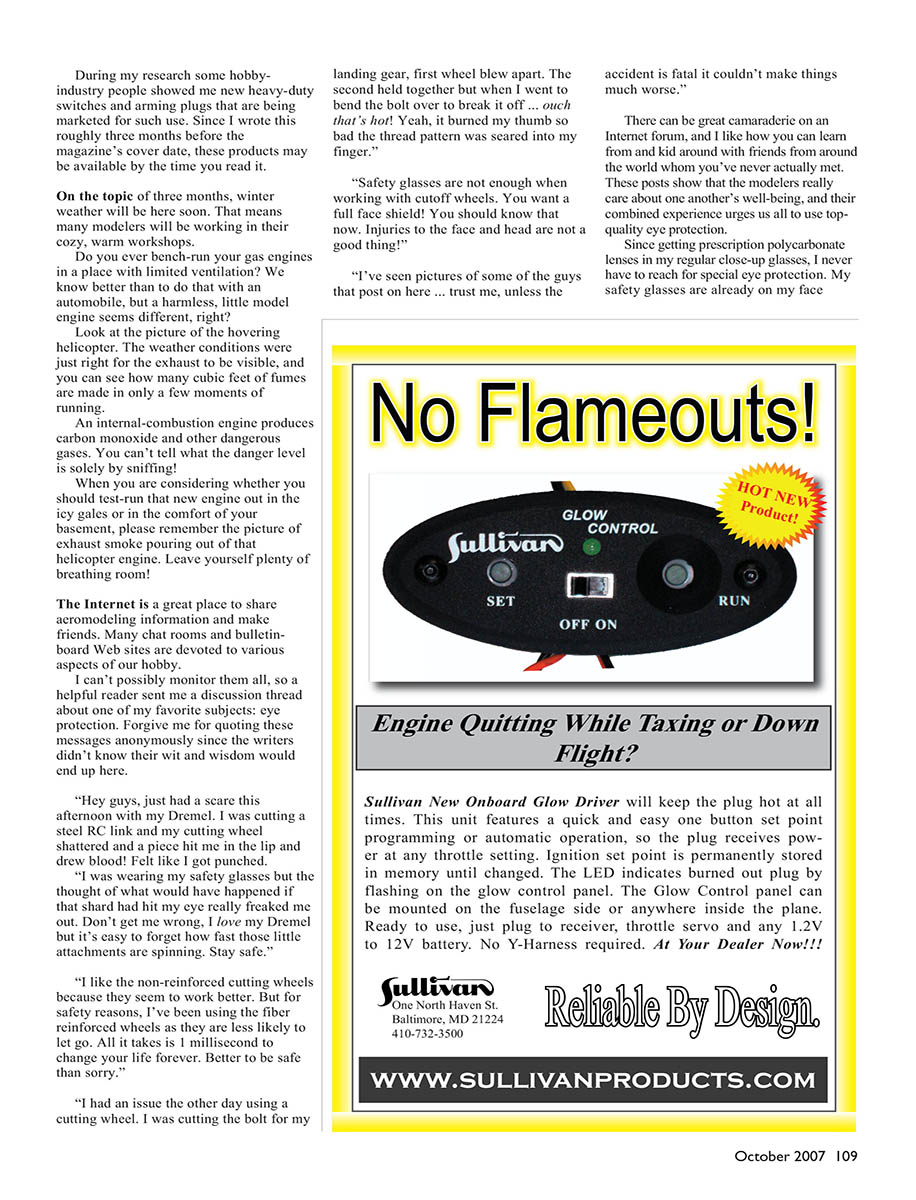
Look at the picture of the hovering helicopter. The weather conditions were just right for the exhaust to be visible, and you can see how many cubic feet of fumes are made in only a few moments of running. An internal-combustion engine produces carbon monoxide and other dangerous gases. You can’t tell what the danger level is solely by sniffing!
When you are considering whether you should test-run that new engine out in the icy gales or in the comfort of your basement, please remember the picture of exhaust smoke pouring out of that helicopter engine. Leave yourself plenty of breathing room!
Eye protection — forum stories
The Internet is a great place to share aeromodeling information and make friends. Many chat rooms and bulletin-board Web sites are devoted to various aspects of our hobby. I can’t possibly monitor them all, so a helpful reader sent me a discussion thread about one of my favorite subjects: eye protection. Forgive me for quoting these messages anonymously since the writers didn’t know their wit and wisdom would end up here.
- “Hey guys, just had a scare this afternoon with my Dremel. I was cutting a steel RC link and my cutting wheel shattered and a piece hit me in the lip and drew blood! Felt like I got punched. I was wearing my safety glasses but the thought of what would have happened if that shard had hit my eye really freaked me out. Don’t get me wrong, I love my Dremel but it’s easy to forget how fast those little attachments are spinning. Stay safe.”
- “I like the non-reinforced cutting wheels because they seem to work better. But for safety reasons, I’ve been using the fiber reinforced wheels as they are less likely to let go. All it takes is 1 millisecond to change your life forever. Better to be safe than sorry.”
- “I had an issue the other day using a cutting wheel. I was cutting the bolt for my landing gear, first wheel blew apart. The second held together but when I went to bend the bolt over to break it off ... ouch — that's hot! Yeah, it burned my thumb so bad the thread pattern was seared into my finger. Safety glasses are not enough when working with cutoff wheels. You want a full face shield! You should know that now. Injuries to the face and head are not a good thing!”
- “I've seen pictures of some of the guys that post on here ... trust me, unless the accident is fatal it couldn't make things much worse.”
There can be great camaraderie on an Internet forum, and I like how you can learn from and kid around with friends from around the world whom you've never actually met. These posts show that the modelers really care about one another's well-being, and their combined experience urges us all to use top-quality eye protection.
Since getting prescription polycarbonate lenses in my regular close-up glasses, I never have to reach for special eye protection. My safety glasses are already on my face whether I'm running a drill or cutting balsa. This has saved me more than once when fast-moving specks have flown into my face.
I confess that at times in the past I have done "just a little bit" of grinding or drilling without eye protection. What a dumb move!
For outdoor occasions, following is yet another plug for Zurich impact-resistant sunglasses. I am unaware of anything else like these on the market. They come in various shades and styles and are advertised in this magazine. Once you try these glasses you will understand my enthusiasm. My pair has protected me from glare and flying particles for several years.
A very light, very slow flyer
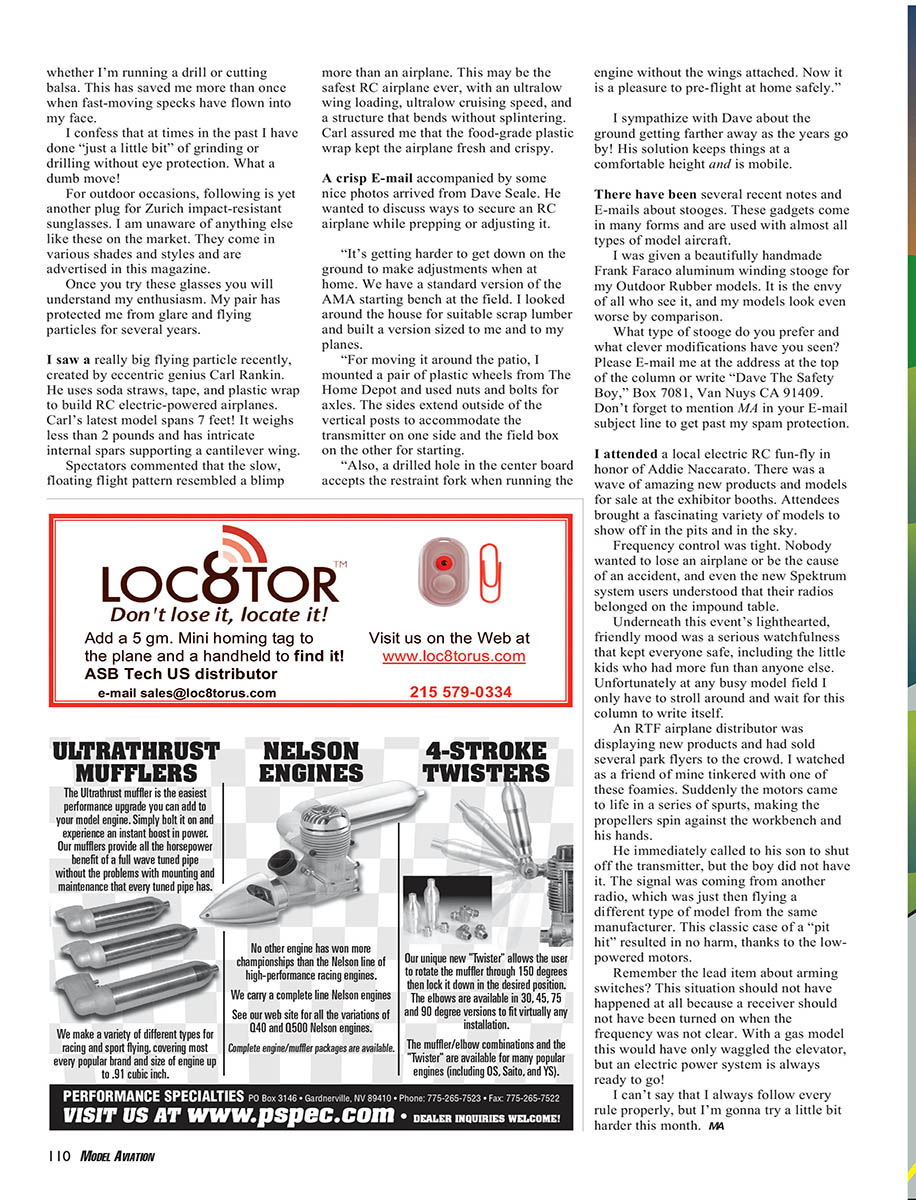
I saw a really big flying particle recently, created by eccentric genius Carl Rankin. He uses soda straws, tape, and plastic wrap to build RC electric-powered airplanes. Carl's latest model spans 7 feet! It weighs less than 2 pounds and has intricate internal spars supporting a cantilever wing.
Spectators commented that the slow, floating flight pattern resembled a blimp more than an airplane. This may be the safest RC airplane ever, with an ultralow wing loading, ultralow cruising speed, and a structure that bends without splintering. Carl assured me that the food-grade plastic wrap kept the airplane fresh and crispy.
Bench setup and stooges
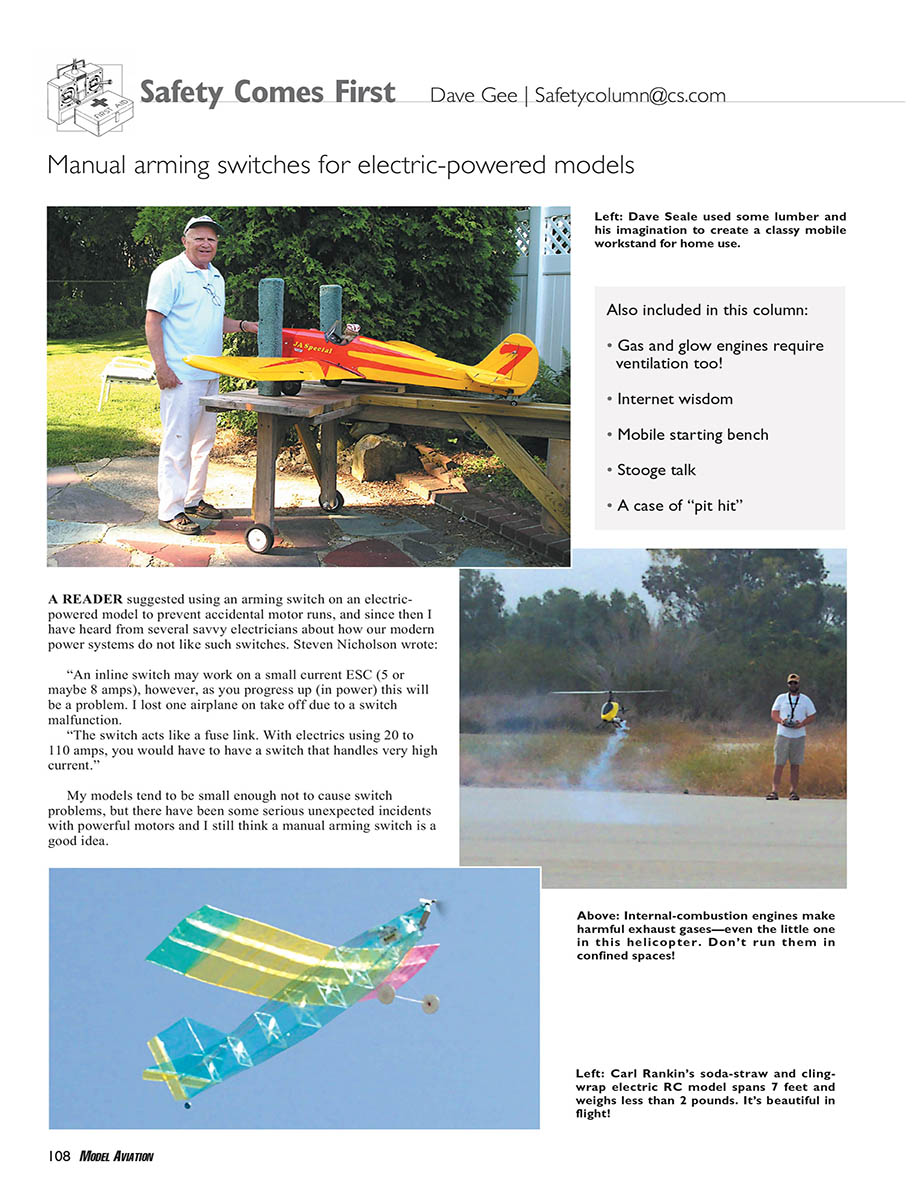
A crisp E-mail accompanied by some nice photos arrived from Dave Seale. He wanted to discuss ways to secure an RC airplane while prepping or adjusting it.
"It's getting harder to get down on the ground to make adjustments when at home. We have a standard version of the AMA starting bench at the field. I looked around the house for suitable scrap lumber and built a version sized to me and to my planes.
"For moving it around the patio, I mounted a pair of plastic wheels from The Home Depot and used nuts and bolts for axles. The sides extend outside of the vertical posts to accommodate the transmitter on one side and the field box on the other for starting.
"Also, a drilled hole in the center board accepts the restraint fork when running the engine without the wings attached. Now it is a pleasure to pre-flight at home safely."
I sympathize with Dave about the ground getting farther away as the years go by! His solution keeps things at a comfortable height and is mobile.
There have been several recent notes and E-mails about stooges. These gadgets come in many forms and are used with almost all types of model aircraft. I was given a beautifully handmade Frank Faraco aluminum winding stooge for my outdoor rubber models. It is the envy of all who see it, and my models look even worse by comparison.
What type of stooge do you prefer and what clever modifications have you seen? Please E-mail me at the address at the top of the column or write "Dave The Safety Boy," Box 7081, Van Nuys, CA 91409. Don't forget to mention MA in your E-mail subject line to get past my spam protection.
Electric RC fun-fly and frequency control
I attended a local electric RC fun-fly in honor of Addie Naccarato. There was a wave of amazing new products and models on display to interest the crowds. Attendees brought a fascinating variety of models to show off in the pits and in the sky.
Frequency control was tight. Nobody wanted to lose an airplane or be the cause of an accident, and even the new Spektrum system users understood that their radios belonged on the impound table.
Underneath this event's lighthearted, friendly mood was a serious watchfulness that kept everyone safe, including the little kids who had more fun than anyone else. Unfortunately, at any busy model field I only have to stroll around and wait for this column to write itself.
An RTF airplane distributor was displaying new products and had sold several park flyers to the crowd. I watched as a friend of mine tinkered with one of those foamies. Suddenly the motors came to life in a series of spurts, making the propellers spin against the workbench and his hands.
He immediately called to his son to shut off the transmitter, but the boy did not have it. The signal was coming from another radio, which was just then flying a different type of model from the same manufacturer. This classic case of a "pit hit" resulted in no harm, thanks to the low-powered motors.
Remember the lead item about arming switches? This situation should not have happened at all because a receiver should not have been turned on when the frequency was not clear. With a gas model this would have only waggled the elevator, but an electric power system is always ready to go!
I can't say that I always follow every rule properly, but I'm gonna try a little bit harder this month.
MA
Transcribed from original scans by AI. Minor OCR errors may remain.

