
Safety Comes First Dave Gee | [email protected]
AMA policy: Should we report incidents or just accidents?
I enjoy taking my camera to different RC flying fields. It is fun to meet new modelers and publish their photographs. I always try to concentrate on the positive, praiseworthy things I see because if people were embarrassed and shamed by my photographs, I would not be so welcome at the field.
Nitpicking would be easier because there are always little problems to be found and some rule or other that is being broken. Most of us are guilty of a small safety infraction now and then, but we generally get away with it and aim to do better next time. If the incident is something that might happen to someone else, we tell the story around or maybe even e-mail it to some magazine columnist to make sure the information is available to others.
This came up because of a sharp-eyed club safety officer who read the AMA’s instructions to "report all incidents and close calls." There is an official AMA form for insurance claims but nothing for reporting minor stuff. Can you imagine the giant Muncie storage room that would be needed to track all the close calls that occur? The "Dave Gee" file alone would be a foot thick!
There could be some benefits to tracking small incidents and near misses, but it would be a tremendous task and could create liability problems for the AMA. I'm going to mention this at the next Safety Committee meeting and suggest that the reporting instructions be rewritten. Either way, I will continue to share reports of aeromodeling adventures, such as the following from Joe Wagner, MA's "The Engine Shop" columnist.
Joe wrote: "I was away from home for more than a month last year and left a full bottle of thin CA sitting atop my table saw. I returned to find that, to my dismay, the bottom of the plastic CA bottle had disintegrated. A solidified puddle of hardened glue had spread over the tabletop.
"Evidently something like an electrolytic reaction had taken place between the cast-iron surface and the cyanoacrylate inside the bottle. The glue had hardened to an extremely brittle solid, which took me hours to remove.
"From this experience I learned not to set CA bottles onto anything metallic. At least nobody got hurt."
Joe and I discussed this incident. I mentioned that I have seen old cyanoacrylate glue begin to cure inside the bottle and split the container, allowing the uncured portion to leak out and make a mess. This seemed more likely to have caused his situation than the ion-transfer theory, at least to me, but Joe politely told me I was all wet. He is probably right because my knowledge of electrochemical reactions would fit inside a small cyanoacrylate bottle.
This informal investigation is tough because there are so many variables. Different brands of cyanoacrylate glue have different formulas, they come in various viscosities, and they behave differently as they get old, as the weather changes, and so on. Out there among loyal MA readers are some with just the expertise needed to solve this mysterious sticky mess. Would you please shed some light on things? I can be reached via e-mail or on paper at Box 7081, Van Nuys CA 91409. Remember to mention MA in your e-mail subject line to avoid my overzealous spam filter.
These cyanoacrylate-glue issues got to me long ago, and I devised a set of dirty tricks to avoid problems. The old clogged-tip problem seemed to improve when I learned to keep the kicker bottle far from the glue bottle. Seems obvious? Not to me!
My modeling work comes irregularly, and I sometimes found that a large bottle of my favorite stuff had gone bad during a slack period. Now I buy small bottles only, and they stay in the fridge until I need a fresh one.
Don't take them in and out of cold storage; the water condensation is bad for the glue. Once a bottle warms up, it should be stored at room temperature.
I have a deeply rooted brand loyalty, but there are several great cyanoacrylate makers, so out of fairness I will not make an endorsement. Even so, I suggest sticking with one brand and bottle style because many exciting cyanoacrylate moments in my career have involved trying a new kind of cyanoacrylate and finding out the hard way that it has different flow characteristics than my usual.
That process usually involves my wife, Sweet Diedra, giggling as she rescues me from being bonded to a tabletop. "Did Mister Safety have some problems with his glue?" She promised to always stick with me, but apparently there are limits.
When I travel I pack a fresh bottle of cyanoacrylate in my checked-luggage toolbox. I use it during my trip, but when it's time to leave I give it away or toss it, even if there is plenty left. An airliner baggage compartment undergoes large changes in air pressure, and any unsealed glue bottle will make a mess!
A problem with small bottles of thick-style cyanoacrylate is that when they are nearly empty, they become top-heavy and won't sit properly. The glue stays near the cap after an application, so every time you set it down it falls over—at least until the glue runs back to the bottom of the container. This is more than annoying; it can be hazardous!
I've plugged the Roc-It-Up before, and it is a unique and excellent product. This gadget is a little yellow weighted ball with a cutout on the top for a glue bottle. You will be amazed by how clever it is, and you will want more than one. Visit your local hobby shop or go to the web site.
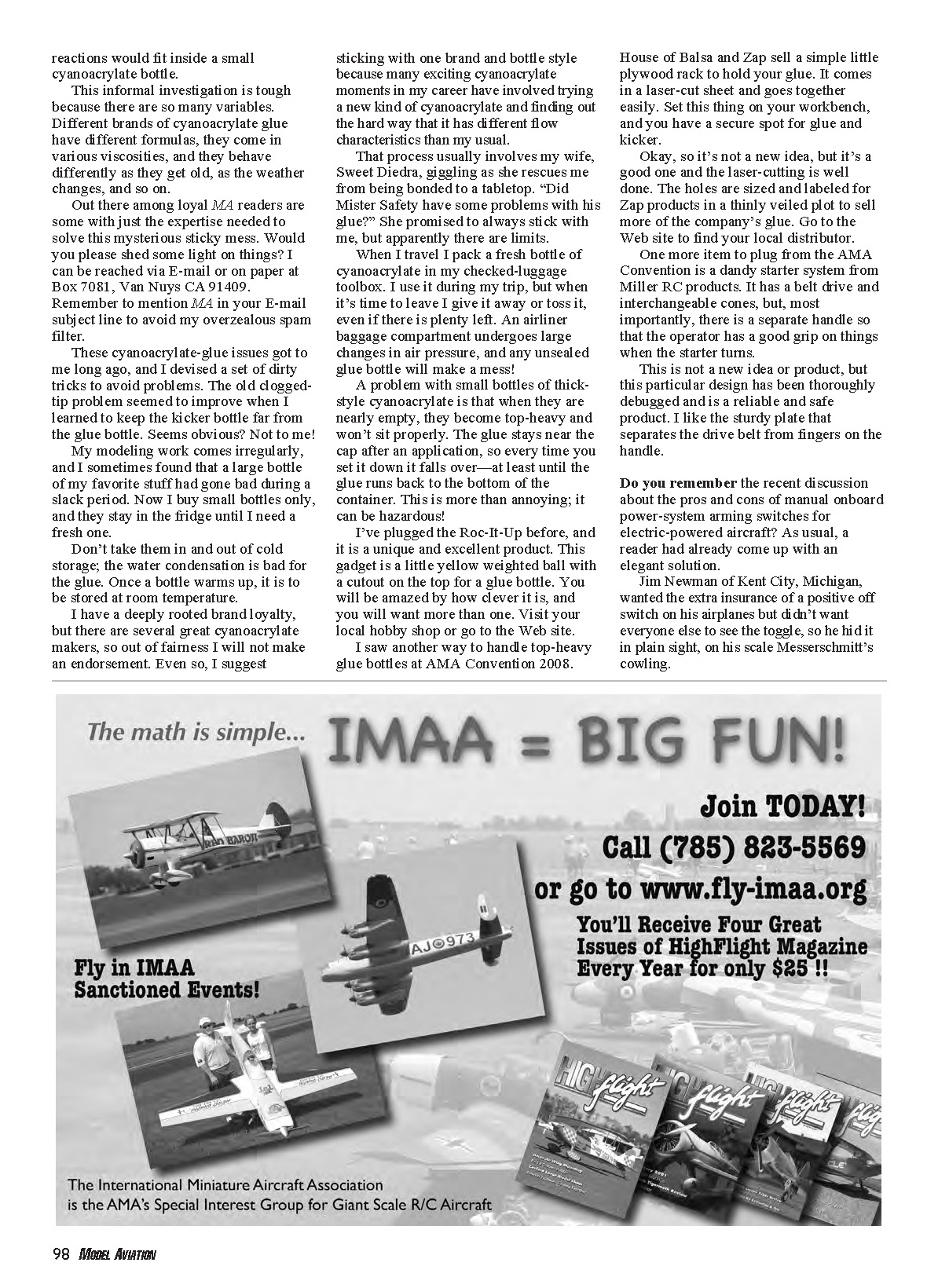
I saw another way to handle top-heavy glue bottles at AMA Convention 2008. House of Balsa and Zap sell a simple little plywood rack to hold your glue. It comes in a laser-cut sheet and goes together easily. Set this thing on your workbench, and you have a secure spot for glue and kicker.
Okay, so it's not a new idea, but it's a good one and the laser-cutting is well done. The holes are sized and labeled for Zap products in a thinly veiled plot to sell more of the company's glue. Go to the web site to find your local distributor.
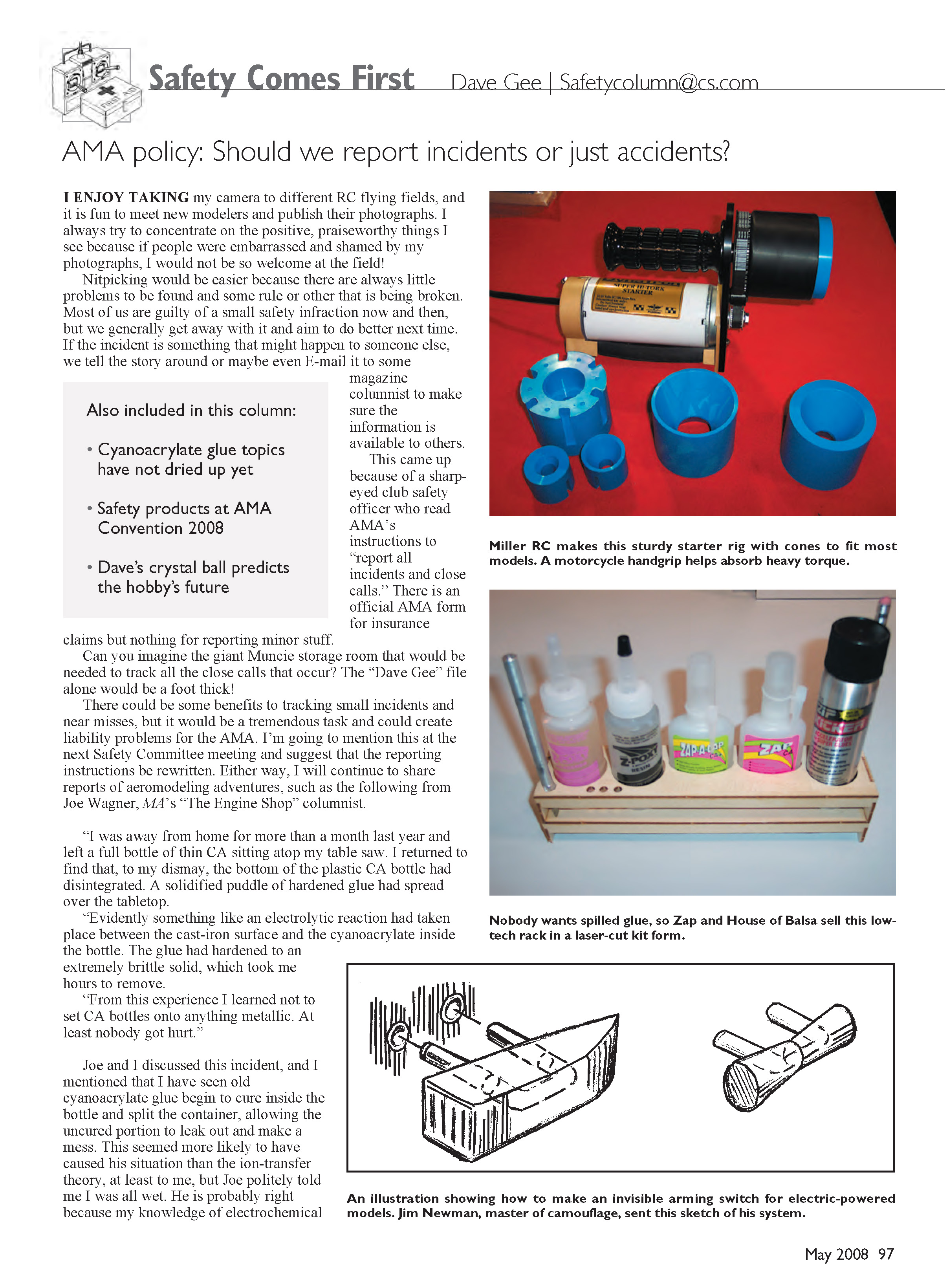
One more item to plug from the AMA Convention is a dandy starter system from Miller RC Products. It has a belt drive and interchangeable cones, but, most importantly, there is a separate handle so that the operator has a good grip on things when the starter turns.
This is not a new idea or product, but this particular design has been thoroughly debugged and is a reliable and safe product. I like the sturdy plate that separates the drive belt from fingers on the handle.
Do you remember the recent discussion about the pros and cons of manual onboard power-system arming switches for electric-powered aircraft? As usual, a reader had already come up with an elegant solution.
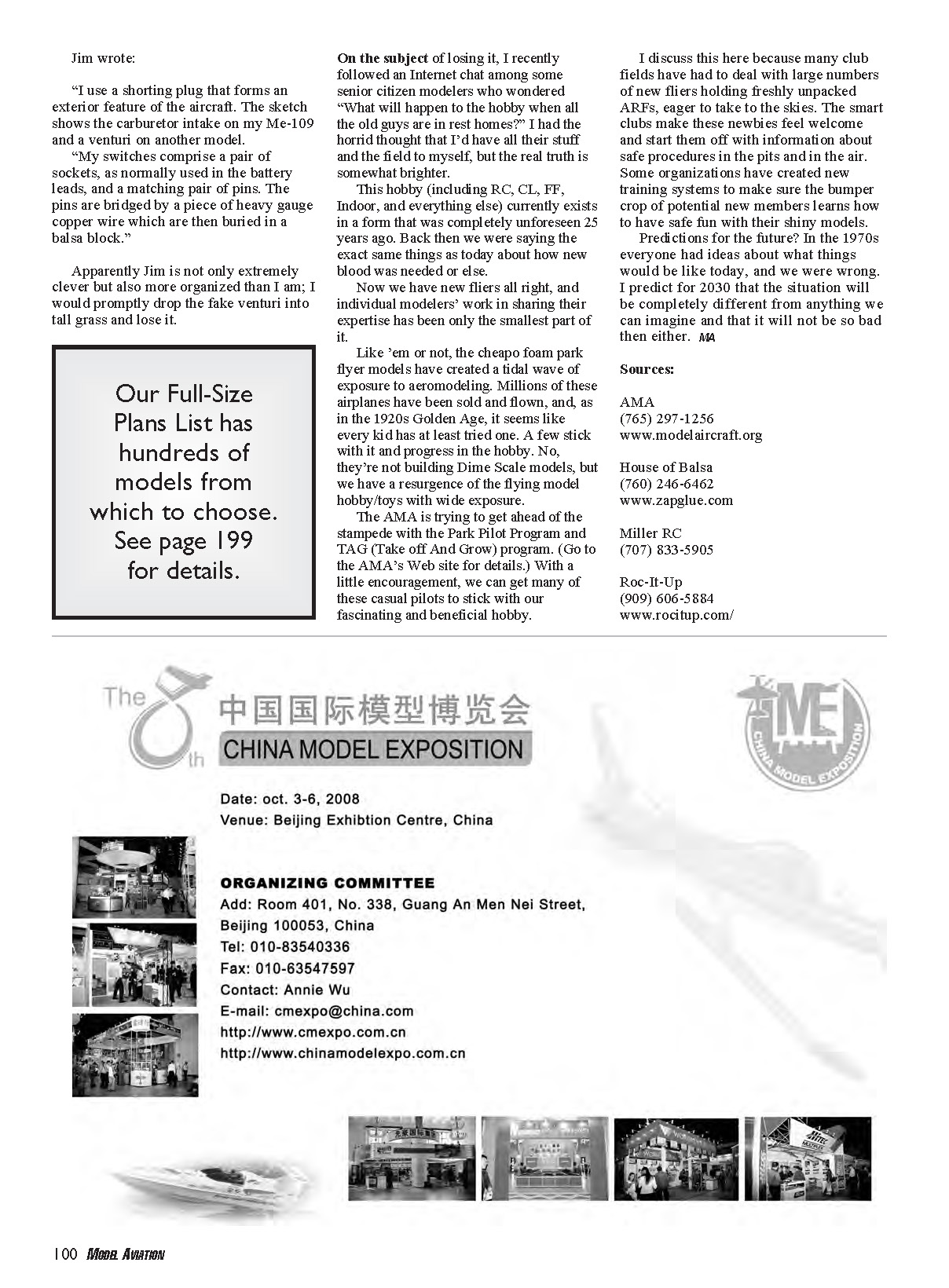
Jim Newman of Kent City, Michigan, wanted the extra insurance of a positive off switch on his airplanes but didn't want everyone else to see the toggle, so he hid it in plain sight, on his scale Messerschmitt's cowling.
Jim wrote: "I use a shorting plug that forms an exterior feature of the aircraft. The sketch shows the carburetor intake on my Me-109 and a venturi on another model.
"My switches comprise a pair of sockets, as normally used in the battery leads, and a matching pair of pins. The pins are bridged by a piece of heavy-gauge copper wire which are then buried in a balsa block."
Apparently Jim is not only extremely clever but also more organized than I am; I would promptly drop the fake venturi into tall grass and lose it.
On the subject of losing it, I recently followed an Internet chat among some senior citizen modelers who wondered, "What will happen to the hobby when all the old guys are in rest homes?" I had the horrid thought that I'd have all their stuff and the field to myself, but the real truth is somewhat brighter.
This hobby (including RC, CL, FF, indoor, and everything else) currently exists in a form that was completely unforeseen 25 years ago. Back then we were saying the exact same things as today about how new blood was needed or else.
Now we have new fliers all right, and individual modelers' work in sharing their expertise has been only the smallest part of it.
Like 'em or not, the cheapo foam park flyer models have created a tidal wave of exposure to aeromodeling. Millions of these airplanes have been sold and flown, and, as in the 1920s Golden Age, it seems like every kid has at least tried one. A few stick with it and progress in the hobby. No, they're not building Dime Scale models, but we have a resurgence of the flying model hobby/toys with wide exposure.
The AMA is trying to get ahead of the stampede with the Park Pilot Program and TAG (Take-off And Grow) program. (Go to the AMA's web site for details.) With a little encouragement, we can get many of these casual pilots to stick with our fascinating and beneficial hobby.
I discuss this here because many club fields have had to deal with large numbers of new fliers holding freshly unpacked ARFs, eager to take to the skies. The smart clubs make these newbies feel welcome and start them off with information about safe procedures in the pits and in the air. Some organizations have created new training systems to make sure the bumper crop of potential new members learns how to have safe fun with their shiny models.
Predictions for the future? In the 1970s everyone had ideas about what things would be like today, and we were wrong. I predict for 2030 that the situation will be completely different from anything we can imagine and that it will not be so bad then either.
MA
Also included in this column:
- Cyanoacrylate glue topics have not dried up yet
- Safety products at AMA Convention 2008
- Dave’s crystal ball predicts the hobby’s future
Sources:
- AMA
(765) 297-1256 www.modelaircraft.org
- House of Balsa / Zap
(760) 246-6462 www.zapglue.com
- Miller RC
(707) 833-5905
- Roc-It-Up
(909) 606-5884 www.rocitup.com/
Transcribed from original scans by AI. Minor OCR errors may remain.

