

Safety Comes First
Dave Gee | [email protected]
Table-saw terror tale: your fingers might miss you if you're gone
Al Knight wrote in from his New Jersey workshop with a great story starring his trusty 4-inch table saw.
“I was ripping a thick piece of balsa on the table saw that was just sitting on a dust-covered tabletop. The wood jammed and the saw proceeded to slide forward on the slippery dust and tried to shorten my three middle fingers by about an inch. I grabbed a dirty rag to stop the bleeding (who keeps sterile dressings by the workbench?).
“I went upstairs and told my wife that I may need a bandage or two and managed to drip blood on the living room carpet. After some discussion in which I didn’t have any say, I found myself being driven to the hospital emergency room by a friend.
“As we were entering the hospital a man appeared with his leg wrapped in a bloody rag and we opened the door for him to go in first. Mistake! He had to only wait three hours for the doctor but we waited for four hours until the doctor finished with him.
“When the doctor saw my wounds he said that my cuts would be much easier to sew up as they were smoother than the fellow before us, since the chainsaw the other man tried to cut his leg off with really ripped his flesh up. I guess I won on that point. Anyway, after about thirty stitches and a mile of gauze I came home.
“Needless to say the table saw is now firmly clamped down to the bench, but whenever I look at it, that semi-circle slot in the front [to allow the blade to tilt] seems to be smiling at me and waiting. If anyone ever strips the covering off the plane I was working on at that time they will wonder why the nice clean balsa has a lot of red splotches on it.”
Al learned a few lessons but paid a big price for the knowledge. We sometimes take our power tools for granted because they are pint-sized hobby versions and we are just making one cut anyway. Wrong attitude! These machines deserve our utmost attention and care if we don’t want to reenact Al’s adventure. I wonder if his wife ever got the carpet stains out?
Everybody But Dave Already Knew About It
This month we’ll try a new feature called “Everybody But Dave Already Knew About It.” The photographs show some keen items that were news to me but have apparently been around for years.
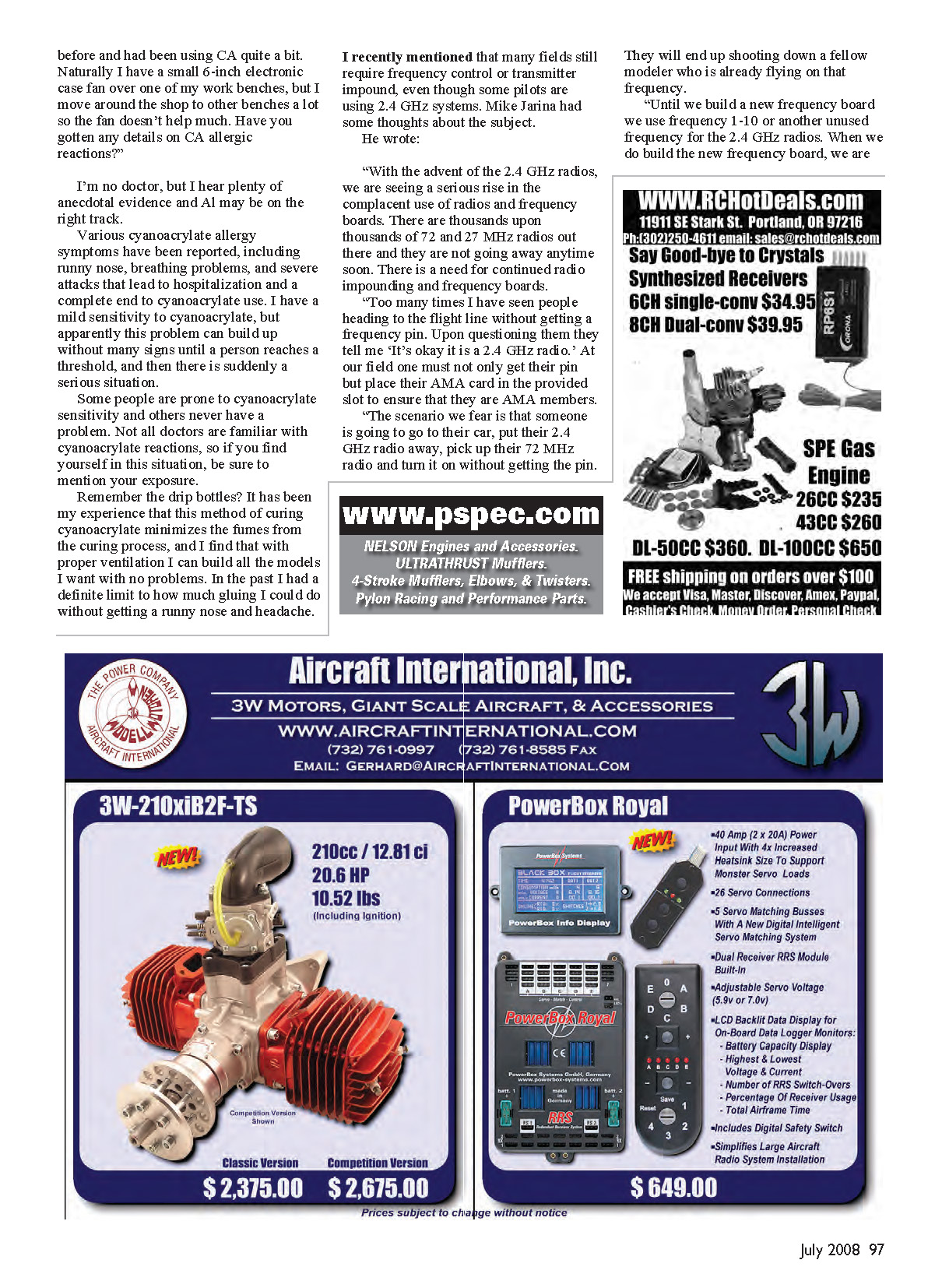
- The orange plastic wheel supports are called Model Chocks. They are designed to keep your airplane from rolling off the workbench and to keep it steady during transportation. Little teeth are molded into the bottom of each chock so it grabs onto whatever blanket or rug you have in your vehicle, and it keeps the aircraft from sliding around. Clever!
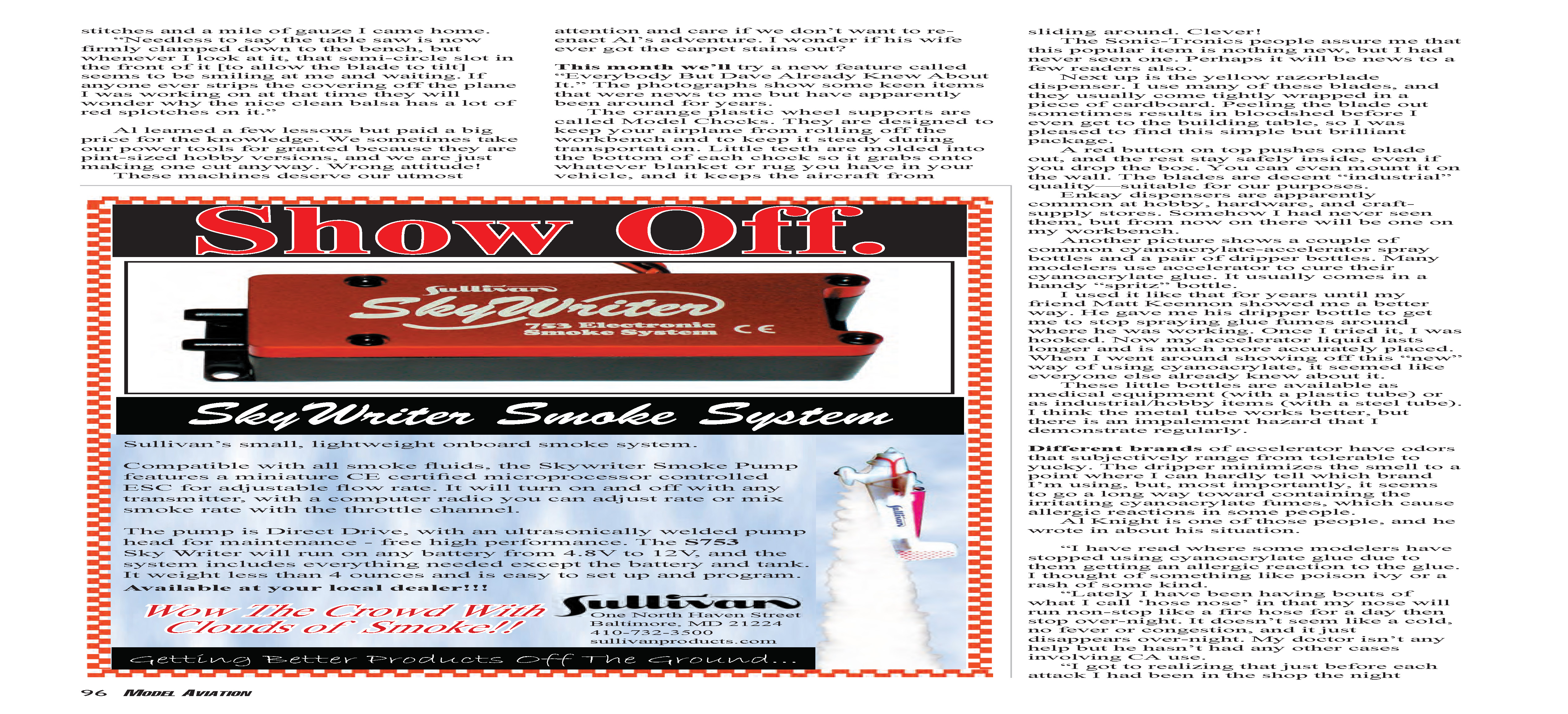
- The yellow razor-blade dispenser is simple but brilliant. I use many of these blades and they usually come tightly wrapped in a piece of cardboard. Peeling the blade out sometimes results in bloodshed before I even get to the building table, so I was pleased to find this dispenser. A red button on top pushes one blade out, and the rest stay safely inside, even if you drop the box. You can even mount it on the wall. The blades are decent “industrial” quality—suitable for our purposes. Enkay dispensers are apparently common at hobby, hardware, and craft-supply stores. Somehow I had never seen one, but from now on there will be one on my workbench.
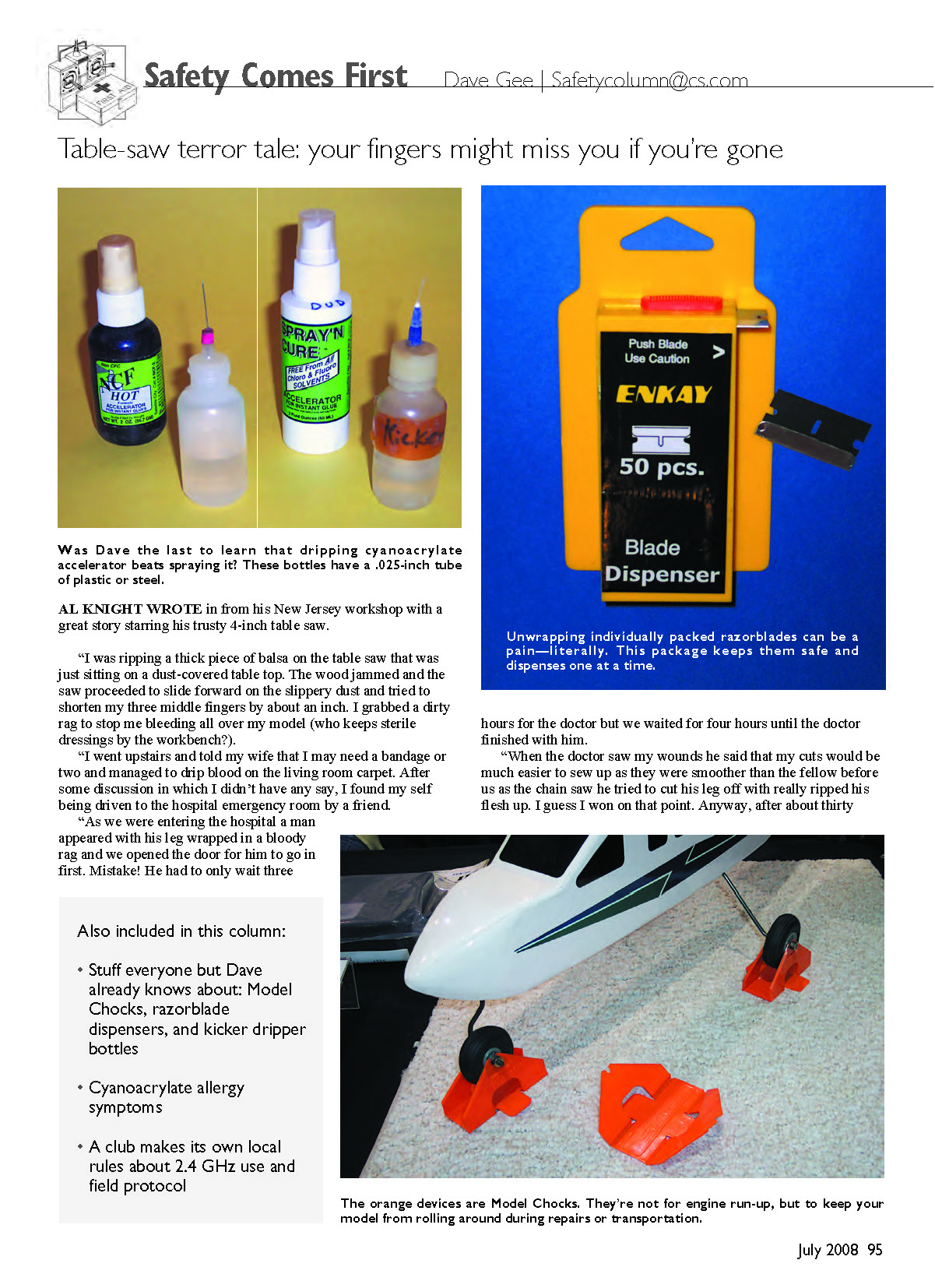
- A picture shows a couple of common cyanoacrylate-accelerator spray bottles and a pair of dripper bottles. Many modelers use accelerator to cure cyanoacrylate glue. It usually comes in a handy spray bottle.
I used the spray for years until my friend Matt Kechohn showed me a better way. He gave me his dripper bottle to get me to stop spraying glue fumes around where he was working. Once I tried it I was hooked. Now my accelerator liquid lasts longer and is much more accurately placed. When I went around showing off this new way of using cyanoacrylate, it seemed like everyone else already knew about it.
These little bottles are available as medical equipment (with a plastic tube) or as industrial hobby items (with a steel tube). I think the metal tube works better but there is an important hazard that I demonstrate regularly.
Different brands of accelerator have odors that subjectively range from tolerable to pukey. The dripper minimizes the smell to a point where I can hardly tell which brand I'm using, but most importantly it seems to go a long way toward containing the irritating cyanoacrylate fumes which can trigger allergic reactions in some people.
Al Knight is one of those people, and he wrote in about his situation.
"I have read where some modelers have stopped using cyanoacrylate glue due to getting an allergic reaction to the glue. I thought of something like poison ivy or a rash of some kind.
"Lately I have been having bouts of what I call 'nose-rosis' in that my nose will run non-stop like a fire hose for a day then stop overnight. It doesn't seem like a cold—no fever or congestion—and it just disappears overnight. My doctor isn't any help but I haven't had any other cases involving CA use.
"I realized that just before each attack I had been in the shop the night before and had been using CA quite a bit. Naturally I have a small 6-inch electronic case fan over one of my workbenches, but I move around the shop to other benches a lot so the fan doesn't help much. Have you gotten any details on CA allergic reactions?"
I'm no doctor, but I hear plenty of anecdotal evidence and Al may be on the right track.
Various cyanoacrylate allergy symptoms have been reported, including runny nose, breathing problems, and severe attacks that lead to hospitalization and a complete end to cyanoacrylate use. I have a mild sensitivity to cyanoacrylate, but apparently this problem can build up without many signs until a person reaches a threshold, and then there is suddenly a serious situation.
Some people are prone to cyanoacrylate sensitivity and others never have a problem. Not all doctors are familiar with cyanoacrylate reactions, so if you find yourself in this situation, be sure to mention your exposure.
Remember the drip bottles? It has been my experience that this method of curing cyanoacrylate minimizes the fumes from the curing process, and I find that with proper ventilation I can build all the models I want with no problems. In the past I had a definite limit to how much gluing I could do without getting a runny nose and headache.
Frequency control and 2.4 GHz radios
I recently mentioned that many fields still require frequency control or transmitter impound, even though some pilots are using 2.4 GHz systems. Mike Jarina had some thoughts about the subject. He wrote:
"With the advent of the 2.4 GHz radios, we are seeing a serious rise in the complacent use of radios and frequency boards. There are thousands upon thousands of 72 and 27 MHz radios out there and they are not going away anytime soon. There is a need for continued radio impounding and frequency boards.
"Too many times I have seen people heading to the flight line without getting a frequency pin. Upon questioning them they tell me 'It's okay, it is a 2.4 GHz radio.' At our field one must not only get their pin but place their AMA card in the provided slot to ensure that they are AMA members.
"The scenario we fear is that someone is going to go to their car, put their 2.4 GHz radio away, pick up their 72 MHz radio and turn it on without getting the pin.
"They will end up shooting down a fellow modeler who is already flying on that frequency.
"Until we build a new frequency board we use frequency 1–10 or another unused frequency for the 2.4 GHz radios. When we do build the new frequency board, we are considering the alphabet for the 2.4 GHz guys. Safety is no accident and it is not going to hurt anyone to impound their radio, no matter how much time is involved."
Mike is right; this is a time of transition, and being overcautious about frequency control is not out of line. There are now fields that require 2.4 GHz systems only and prohibit 72 MHz radios because of close proximity to another field.
As these new radios take hold, there will be cases in which frequency control becomes unneeded. But at a "mixed" site I put my Spektrum transmitter into the impound like everyone else does.
Club safety recommendations
I got a note from Frank Baity, who said he used one of my columns as a discussion topic at his club meeting. Most clubs just use it to mop up coffee spills, so I was flattered.
Frank wrote:
"The diversity of interest in a club like the West Alabama Aero Modelers is vast, presenting safety challenges when it comes time to fly. The mix of 3-D, foamy, fast movers and helicopters was the topic in last month's meeting and the membership had a productive discussion. Here are the safety recommendations that came out of this session:
- When flying, all pilots should be within the pilot area and announce their intentions, i.e., takeoff, landing, deadstick, etc.
- A direction of flight will be established, generally into the wind, and it is recommended that all pilots attempt to land and take off in this direction.
- When flying alone, 3-D flying should be done from the runway centerline out, but when other models are in the air, 3-D should be flown from the runway outer edge and outward.
- When there are more than three pilots flying (we have a max of five limitation) it is recommended pilots use a spotter to aid in situational awareness.
- Helicopters should not conduct prolonged hovering on the runway unless there are no other fixed-wing models in operation. Use the heli pad for hovering practice.
- Engine running should only be accomplished from the starting stands out (toward the runway) and no powered taxi back into the pit area."
Frank's group came up with some good local rules that are fine-tuned to its field. Posting these will be a reminder to members and a courtesy to visiting pilots. Sounds like a great bunch of modelers!
Contact
I welcome your comments and suggestions. You can send paper mail to Box 7081, Van Nuys, CA 91409. My e-mail address is at the top of the column ([email protected]), but if you use it, please put MA in the subject line to set you apart from spammers and other lower forms of life. — MA
Sources
Sonic-Tronics Inc. (215) 635-4951 www.sonictronics.com
Transcribed from original scans by AI. Minor OCR errors may remain.

