
Safety Comes First
Dave Gee | [email protected]
Fail-safe and a spare battery save the day
The guys at the Keystone Radio Control Club in Hatfield, Pennsylvania, had quite an adventure. Richard Byrnes sent me an e-mail about their amazing save.
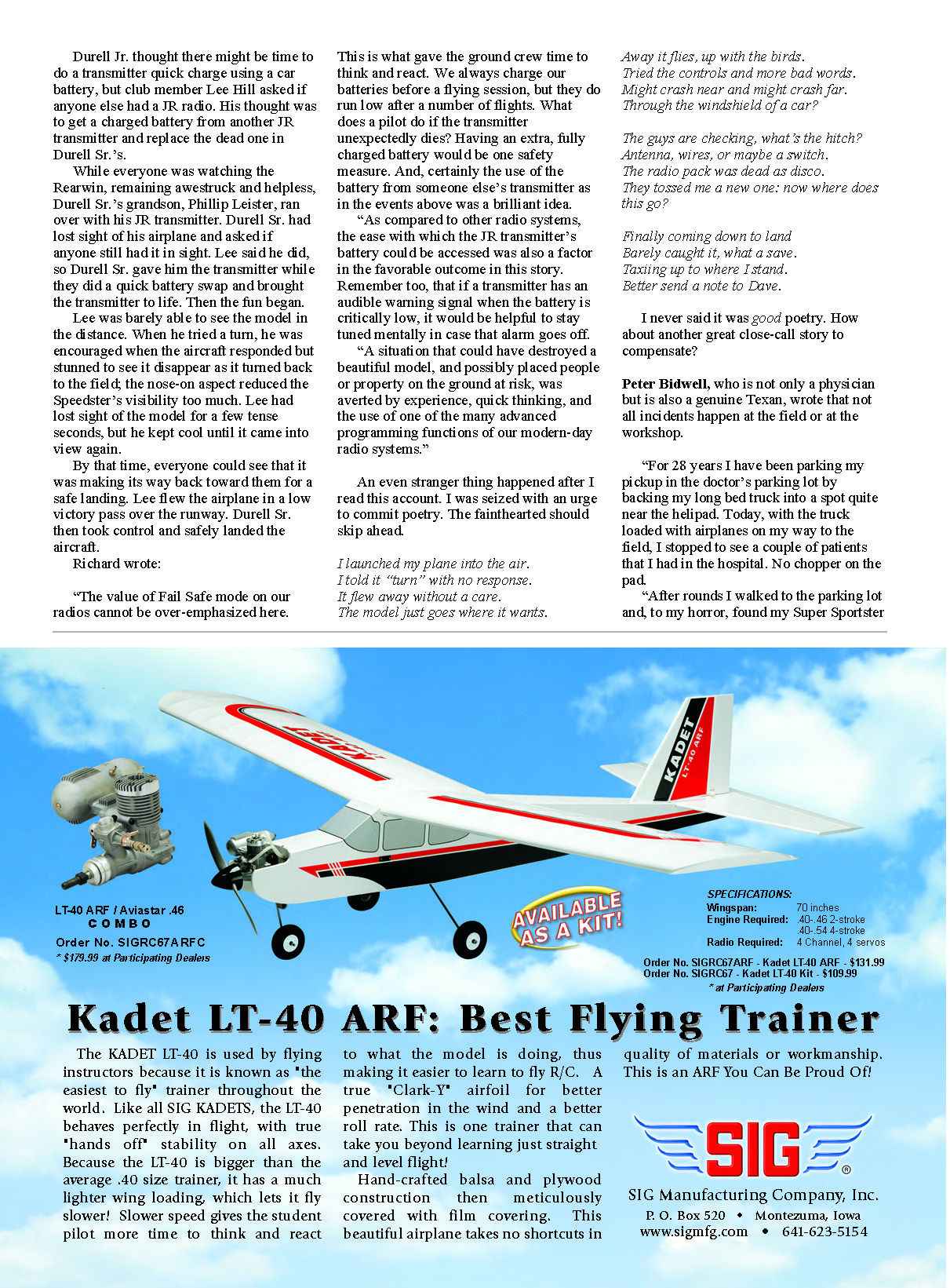
According to Richard, the weather was perfect as Durell Leister Sr. flew his beautiful Kankakee USA Rearwin Speedster. The 96-inch Golden Age model had a U.S. Engines 41cc gasser for power.
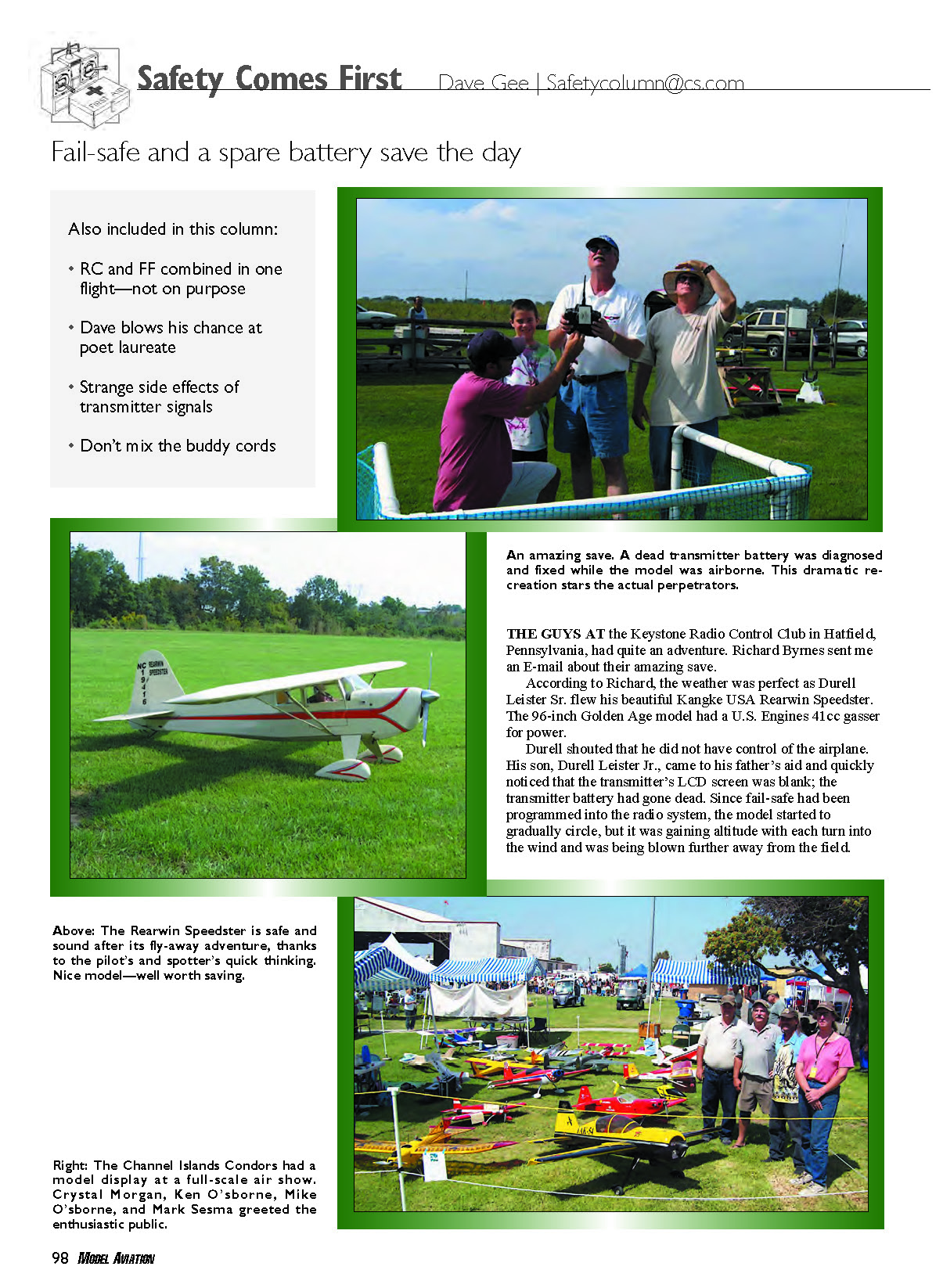
Durell shouted that he did not have control of the airplane. His son, Durell Leister Jr., came to his father's aid and quickly noticed that the transmitter's LCD screen was blank; the transmitter battery had gone dead. Since fail-safe had been programmed into the radio system, the model started to gradually circle, but it was gaining altitude with each turn into the wind and was being blown further away from the field.
Durell Jr. thought there might be time to do a transmitter quick charge using a car battery, but club member Lee Hill asked if anyone else had a JR radio. His thought was to get a charged battery from another JR transmitter and replace the dead one in Durell Sr.'s. While everyone was watching the Rearwin, remaining awestruck and helpless, Durell Sr.'s grandson, Phillip Leister, ran over with his JR transmitter. Durell Sr. had lost sight of his airplane and asked if anyone still had it in sight. Lee said he did, so Durell Sr. gave him the transmitter while they did a quick battery swap and brought the transmitter to life.
Then the fun began. Lee was barely able to see the model in the distance. When he tried a turn, he was encouraged when the aircraft responded but stunned to see it disappear as it turned back to the field; the nose-on aspect reduced the Speedster's visibility too much. Lee had lost sight of the model for a few tense seconds, but he kept cool until it came into view again. By that time, everyone could see that it was making its way back toward them for a safe landing. Lee flew the airplane in a low victory pass over the runway. Durell Sr. then took control and safely landed the aircraft.
Richard wrote: "The value of Fail Safe mode on our radios cannot be over-emphasized here. This is what gave the ground crew time to think and react. We always charge our batteries before a flying session, but they do run low after a number of flights. What does a pilot do if the transmitter unexpectedly dies? Having an extra, fully charged battery would be one safety measure. And, certainly the use of the battery from someone else's transmitter as in the events above was a brilliant idea.
"As compared to other radio systems, the ease with which the JR transmitter's battery could be accessed was also a factor in the favorable outcome in this story. Remember too, that if a transmitter has an audible warning signal when the battery is critically low, it would be helpful to stay tuned mentally in case that alarm goes off.
"A situation that could have destroyed a beautiful model, and possibly placed people or property on the ground at risk, was averted by experience, quick thinking, and the use of one of the many advanced programming functions of our modern-day radio systems."
Suggested safety measures from the incident:
- Always charge transmitter batteries before a flying session.
- Carry an extra, fully charged battery.
- Be familiar with how to access and replace the battery quickly on your transmitter.
- Use fail-safe programming where available.
- Pay attention to audible low-battery warnings.
Poetry (skip if fainthearted)
I launched my plane into the air. I told it "turn" with no response. It flew away without a care. The model just goes where it wants.
Away it flies, up with the birds. Tried the controls and more bad words. Might crash near and might crash far. Through the windshield of a car?
The guys are checking, what's the hitch? Antenna, wires, or maybe a switch. The radio pack was dead as disco. They tossed me a new one: now where does this go?
Finally coming down to land Barely caught it, what a save. Taxiing up to where I stand. Better send a note to Dave.
I never said it was good poetry.
More close calls
How about another great close-call story to compensate?
Peter Bidwell, who is not only a physician but is also a genuine Texan, wrote that not all incidents happen at the field or at the workshop.
"For 28 years I have been parking my pickup in the doctor's parking lot by backing my long-bed truck into a spot quite near the helipad. Today, with the truck loaded with airplanes on my way to the field, I stopped to see a couple of patients that I had in the hospital. No chopper on the pad.
"After rounds I walked to the parking lot and, to my horror, found my Super Sportster fuselage in the middle of the parking lot in one piece but with multiple, but repairable, dings. The wing was still in the truck bed. Of course: the chopper was now on the pad.
"I live in East Texas and we are no stranger to hurricanes and tornadoes but a flying fuselage by helicopter is new to me. Won't do that again."
You think that's an unusual situation? Noel Cross sent in one of his own.
There had been several interference glitches at Noel's field. The pilots were finally able to isolate the cause to a buddy-box setup of Hitec radios. The master transmitter was on channel 42, and the buddy box was a Focus 4 on channel 32. A round DIN-to-DIN plug trainer cord connected the two. When this system was activated, it transmitted on both channels—a bad situation.
Billy Tompkins, a customer-service representative at Hitec, said that Hitec radios need a Hitec one-way trainer cord. If a different brand is used, it is possible to actively transmit from both radios at once.
Noel's friends had used a Futaba two-way cord with their Hitec radios, and this is a big no-no. Thanks to these guys for getting to the bottom of this mystery and for sharing the word with all of us.
Radio interference oddities
Can the stories get any stranger? Oh, yeah. Following is the gist of a long e-mail chain I received from AMA Headquarters. It's unconfirmed but definitely worth telling.
"A pilot left his transmitter turned on at the end of an outdoor flying session. The radio was set in the back of a 1998 Dodge pickup, pretty much directly over the rear differential. After a few hours, the transmitter had been taken indoors and placed on the charger. He went back out to the truck and was shocked to find the speedometer behaving very erratically, swinging back and forth between 0 and 100 mph. In addition, the ABS and brake warning lights were on.
"The owner's manual said that the sophisticated electronics incorporated in the ABS system might be harmed by exposure to high frequency radio signals. A transmitter broadcasting on 72 megahertz can certainly be considered high frequency in this context.
"A wiring diagram for the Dodge truck showed that the speedometer, ABS, and brake sensors were all tied together with one sensor at the differential. So, an expensive sensor replacement was ordered. The final repair bill was $308.
"Of course, it is not absolutely certain that the transmitter output fried the ABS sensor, but at least it certainly seems a striking coincidence."
After all the oddball things I've seen in this world, I have an open mind, but this one is on the edge. Even if it is a coincidence, though, the point is well taken: our radio equipment sends out energy waves, and it can have secondary effects beyond making our models do loops. It is best to make sure it is turned off when not in use.
A normal note
After all those offbeat stories, perhaps I should finish with a group that makes our hobby look downright normal. To an outsider, the stuff I write about here might make us all look like a bunch of wild disaster magnets, bouncing from one catastrophe to another. That describes my situation rather well, but most modelers are stable, thoughtful people—pillars of the community, even.
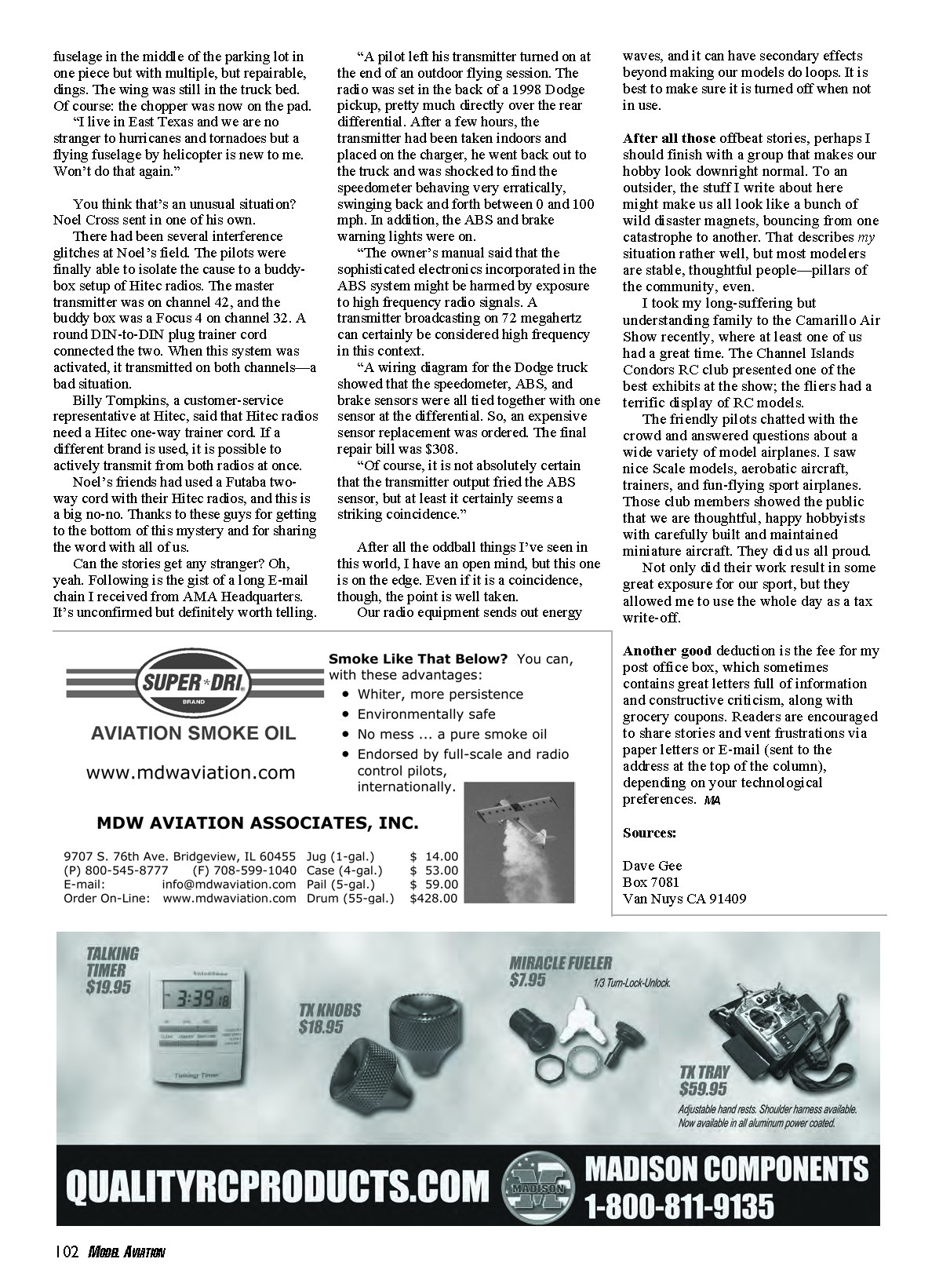
I took my long-suffering but understanding family to the Camarillo Air Show recently, where at least one of us had a great time. The Channel Islands Condors RC club presented one of the best exhibits at the show; the fliers had a terrific display of RC models.
The friendly pilots chatted with the crowd and answered questions about a wide variety of model airplanes. I saw nice scale models, aerobatic aircraft, trainers, and fun-flying sport airplanes. Those club members showed the public that we are thoughtful, happy hobbyists with carefully built and maintained miniature aircraft. They did us all proud.
Not only did their work result in some great exposure for our sport, but they allowed me to use the whole day as a tax write-off.
Another good deduction is the fee for my post office box, which sometimes contains great letters full of information and constructive criticism, along with grocery coupons. Readers are encouraged to share stories and vent frustrations via paper letters or e-mail (sent to the address at the top of the column), depending on your technological preferences.
Sources:
Dave Gee Box 7081 Van Nuys CA 91409
Transcribed from original scans by AI. Minor OCR errors may remain.

