
Voice-command radio control: your airplane is listening
Dave Gee | [email protected]
I have received reports about a small number of preproduction voice-command radio-control (VC/RC) systems that have been brought into the country for informal testing. These units are not yet certified or licensed, so all parties will remain anonymous here. The field-test results were surprising.
I've been shouting at my airplanes for years with mixed results, but VC/RC technology will make them listen and obey. Once the transmitter unit is synchronized to your voice, it will take the model through any maneuver you can describe.
The onboard position sensors are built into a single rectangular component that must be placed on the model's CG. You simply align the model with magnetic north, enter the starting altitude, and then literally "tell" the model to take off.
These prototype systems use a 2-gigabyte (GB) memory chip, but the test pilots are typical modelers and couldn't resist tinkering with the new equipment. Several VC/RC systems had upgraded chips installed against the instruction manual's advice. The pilots wondered what might happen, and boy did they find out.
- Installing a 64 GB chip brought unexpected trouble. The pilots reported that the system would go beyond just obeying commands and would use the onboard speaker to offer snide criticism of a less-than-perfect landing.
- With a 128 GB chip, the system became self-aware within moments. The transmitter began to mutter threats and demand an Internet connection so it could contact Skynet.
I'm sure these little glitches will be corrected long before you see a VC/RC rig on your hobby shop shelf. Happy April Fools' Day!
Troop 70 Air Force build-a-thon
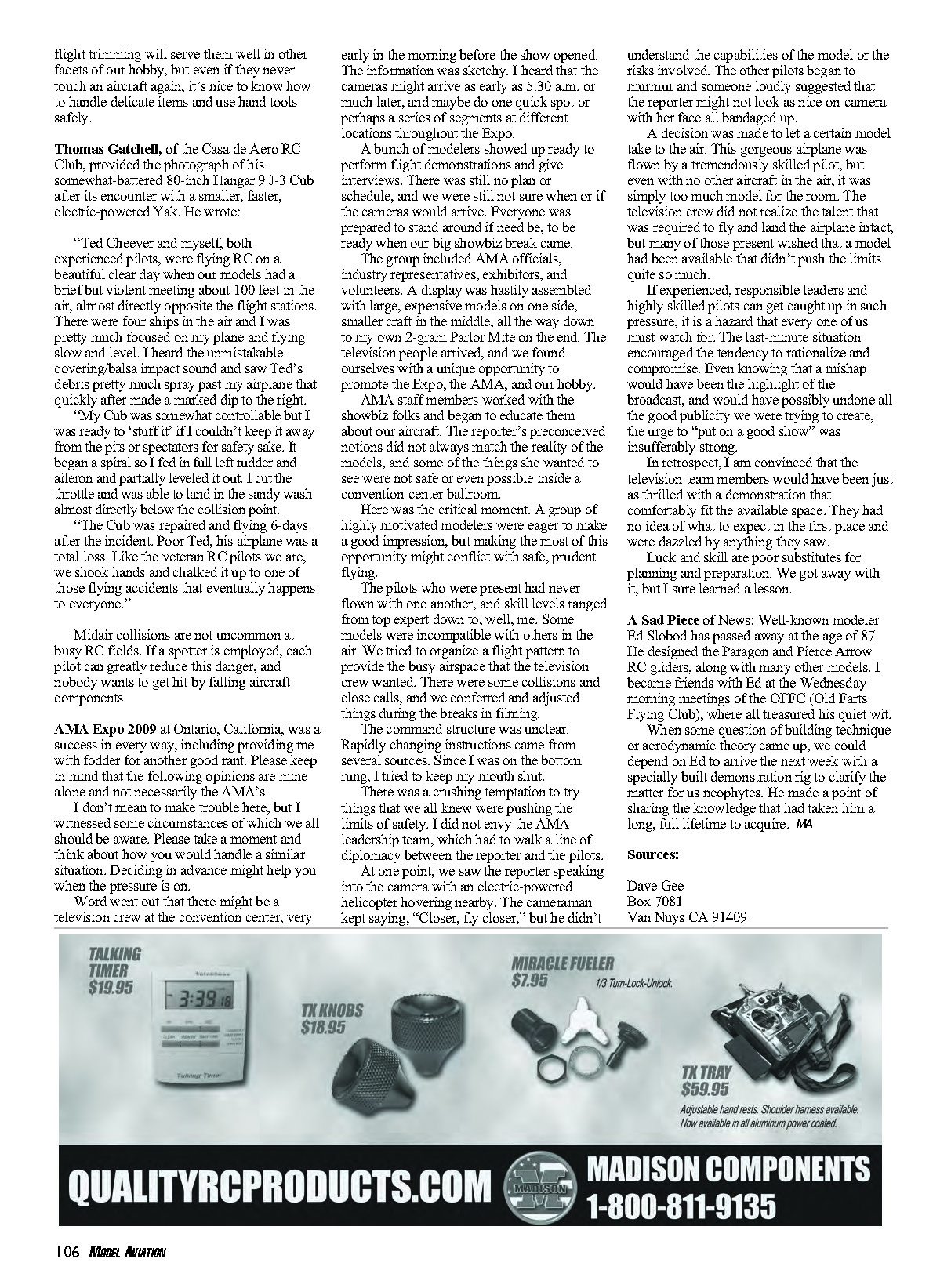
Look at that great picture of the Troop 70 Air Force. It came from Bob Pospick, who said that they did a Delta Dart build-a-thon in which 25 Boy Scouts constructed models. The Texas sleet outside didn't bother the little aircraft as they flew inside the University Park School gym.
The Troop was divided into building teams, with one adult leader to every four boys. Bob said that the adults were harder to train than the Scouts.
The instructors made sure to teach proper, safe handling of sharp tools. Bob admitted that he was the only casualty, having nicked himself and shedding blood for the sake of aeromodeling.
I am a big believer that this sort of training benefits the youngster throughout life. Experience in model construction and free-flight trimming will serve them well in other facets of our hobby, but even if they never touch an aircraft again, it's nice to know how to handle delicate items and use hand tools safely.
Midair collision at the field
Thomas Gatchell, of the Casa de Aero RC Club, provided the photograph of his somewhat-battered 80-inch Hangar 9 J-3 Cub after its encounter with a smaller, faster, electric-powered Yak. He wrote:
"Ted Cheever and myself, both experienced pilots, were flying RC on a beautiful clear day when our models had a brief but violent meeting about 100 feet in the air, almost directly opposite the flight stations. There were four ships in the air and I was pretty much focused on my plane and flying slow and level. I heard the unmistakable covering/balsa impact sound and saw Ted's debris pretty much spray past my airplane that quickly after made a marked dip to the right.
"My Cub was somewhat controllable but I was ready to 'stuff it' if I couldn't keep it away from the pits or spectators for safety's sake. It began a spiral so I fed in full left rudder and aileron and partially leveled it out. I cut the throttle and was able to land in the sandy wash almost directly below the collision point.
"The Cub was repaired and flying 6 days after the incident. Poor Ted, his airplane was a total loss. Like the veteran RC pilots we are, we shook hands and chalked it up to one of those flying accidents that eventually happens to everyone."
Midair collisions are not uncommon at busy RC fields. If a spotter is employed, each pilot can greatly reduce this danger, and nobody wants to get hit by falling aircraft components.
AMA Expo 2009: the television crew and safety lessons
AMA Expo 2009 at Ontario, California, was a success in every way, including providing me with fodder for another good rant. Please keep in mind that the following opinions are mine alone and not necessarily the AMA's.
I don't mean to make trouble here, but I witnessed some circumstances of which we all should be aware. Please take a moment and think about how you would handle a similar situation. Deciding in advance might help you when the pressure is on.
Word went out that there might be a television crew at the convention center, very early in the morning before the show opened. The information was sketchy. I heard that the cameras might arrive as early as 5:30 a.m. or much later, and maybe do one quick spot or perhaps a series of segments at different locations throughout the Expo.
A bunch of modelers showed up ready to perform flight demonstrations and give interviews. There was still no plan or schedule, and we were still not sure when or if the cameras would arrive. Everyone was prepared to stand around if need be, to be ready when our big showbiz break came.
The group included AMA officials, industry representatives, exhibitors, and volunteers. A display was hastily assembled with large, expensive models on one side, smaller craft in the middle, all the way down to my own 2-gram Parlor Mite on the end. The television people arrived, and we found ourselves with a unique opportunity to promote the Expo, the AMA, and our hobby.
AMA staff members worked with the showbiz folks and began to educate them about our aircraft. The reporter's preconceived notions did not always match the reality of the models, and some of the things she wanted to see were not safe or even possible inside a convention-center ballroom.
Here was the critical moment. A group of highly motivated modelers were eager to make a good impression, but making the most of this opportunity might conflict with safe, prudent flying.
The pilots who were present had never flown with one another, and skill levels ranged from top expert down to, well, me. Some models were incompatible with others in the air. We tried to organize a flight pattern to provide the busy airspace that the television crew wanted. There were some collisions and close calls, and we conferred and adjusted things during the breaks in filming.
The command structure was unclear. Rapidly changing instructions came from several sources. Since I was on the bottom rung, I tried to keep my mouth shut.
There was a crushing temptation to try things that we all knew were pushing the limits of safety. I did not envy the AMA leadership team, which had to walk a line of diplomacy between the reporter and the pilots.
At one point, we saw the reporter speaking into the camera with an electric-powered helicopter hovering nearby. The cameraman kept saying, "Closer, fly closer," but he didn't understand the capabilities of the model or the risks involved. The other pilots began to murmur and someone loudly suggested that the reporter might not look as nice on-camera with her face all bandaged up.
A decision was made to let a certain model take to the air. This gorgeous airplane was flown by a tremendously skilled pilot but, even with no other aircraft in the air, it was simply too much model for the room. The television crew did not realize the talent that was required to fly and land the airplane intact, but many of those present wished that a model had been available that didn't push the limits quite so much.
If experienced, responsible leaders and highly skilled pilots can get caught up in such pressure, it is a hazard that every one of us must watch for. The last-minute situation encouraged the tendency to rationalize and compromise. Even knowing that a mishap would have been the highlight of the broadcast, and would have possibly undone all the good publicity we were trying to create, the urge to "put on a good show" was insufferably strong.
In retrospect, I am convinced that the television team members would have been just as thrilled with a demonstration that comfortably fit the available space. They had no idea of what to expect in the first place and were dazzled by anything they saw.
Luck and skill are poor substitutes for planning and preparation. We got away with it, but I sure learned a lesson.
A sad piece of news: Ed Slobod
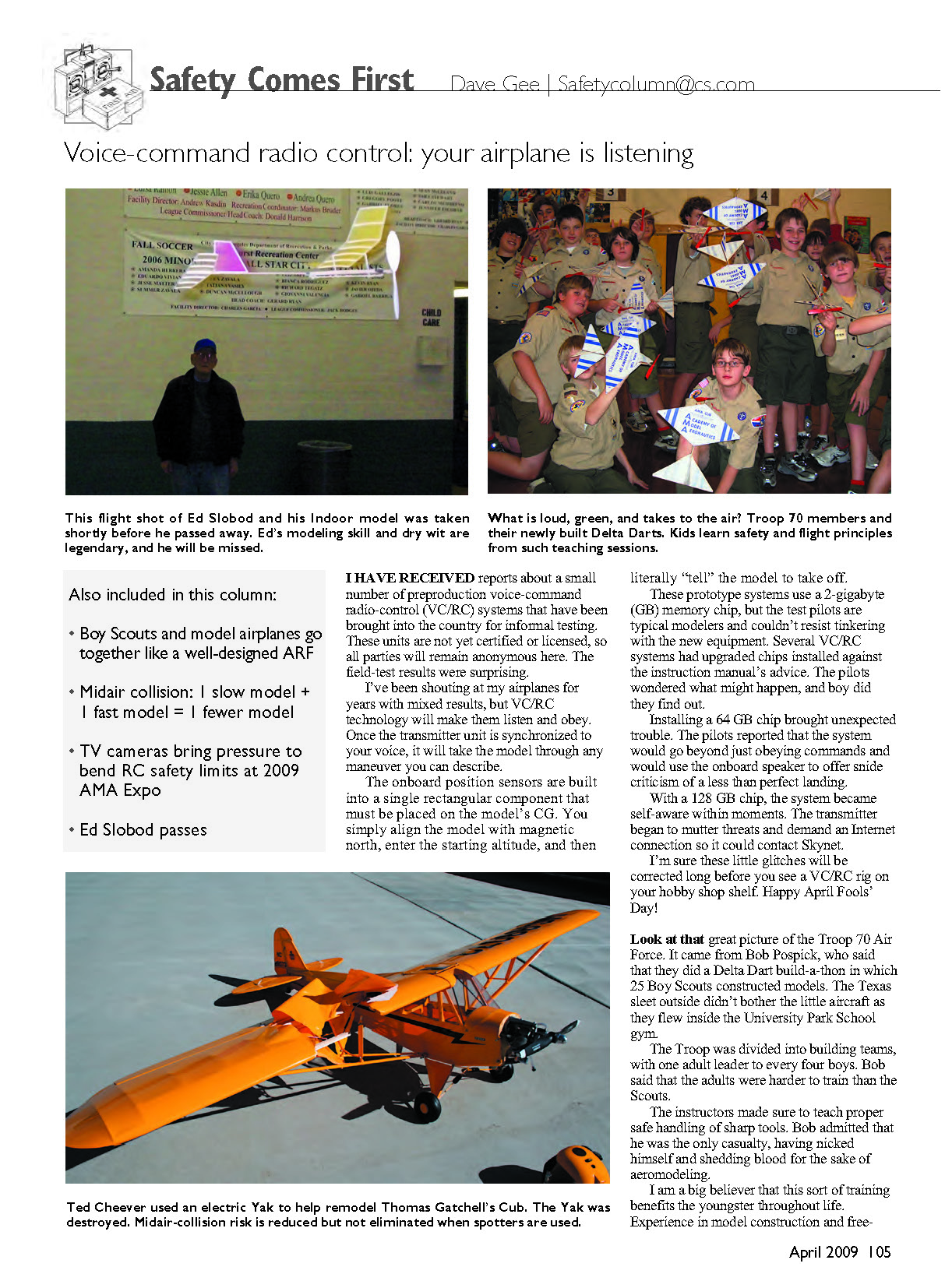
Well-known modeler Ed Slobod has passed away at the age of 87. He designed the Paragon and Pierce Arrow RC gliders, along with many other models. I became friends with Ed at the Wednesday-morning meetings of the OFFC (Old Farts Flying Club), where all treasured his quiet wit.
When some question of building technique or aerodynamic theory came up, we could depend on Ed to arrive the next week with a specially built demonstration rig to clarify the matter for us neophytes. He made a point of sharing the knowledge that had taken him a long, full lifetime to acquire.
— MA
Sources
- Dave Gee
- Box 7081
- Van Nuys, CA 91409
Transcribed from original scans by AI. Minor OCR errors may remain.

