

Safety Comes First
Dave Gee | [email protected]
The sharpness of unfamiliar propellers
Yet another propeller-injury story? Yeah, and it's a doozie.
A good friend called me to report his own serious injury at the field. He is one of the most experienced, knowledgeable modelers in the nation, so anonymity would be best here. I'll call him Tony, which happens to be his real name.
"Dave, I was having a ball helping out at the field with that college aeronautics contest," he said.
This is one of those events for which students design and build an aircraft from scratch. Then they all gather to see which airplane can lift the most payload. It's good to have some "real" modelers around on flight day, to help the neophyte pilots stay out of trouble.
"I had just warned the kids about propeller safety, and then I cut my hand to the bone on the propeller blade, and the engine wasn't even running!" Tony said.
Dedicated instructor that he is, he added a graphic depiction to his advice about avoiding the propeller. It is as follows.
"We were out on the flightline and time was short when I noticed a loose nut. There wasn't time to return to the pit so I tightened it right there. My hand slipped and the sharp rear edge of the propeller sliced me up good. I should have worn gloves or at least covered the propeller with a rag before exerting force on the nut. It slipped and that was that!"
Also included in this column:
- ESC throttle direction awareness
- Dave gets tied up in a soldering job
- Linkage reactions
I want to repeat that this guy is extremely familiar with model aircraft and has served in every possible capacity from safety officer to contest director. He really knows what he is doing and has probably tightened thousands of engine nuts through the years without incident. But a moment of haste caught up with him.
And what's worse, Tony compounded his error by phoning me on column-deadline day.
My skill level is far below Tony's, so how much more cautious must I be to avoid wearing the Order of the Red Gauze? Perfection is a tough goal and I don't think I will get there.
Still, we can see the factors that led to this particular first-aid incident. Tony wanted very much to do his best to help his team. He saw that there was a problem that would drop it out of the contest, and he knew that quick action was required. The students would not be able to recognize and repair the problem in time.
The engine was not running, which can make us relax our vigilance. Tony is in the habit of dulling the sharp propeller blades on his models, but this airplane was unfamiliar to him and had razorlike edges on the propeller. Still, he decided that a calculated risk was worth it.
When Tony's concentration became focused only on the loose nut, his rendezvous with the medical kit was a done deal. A slipping tool let all of his strength transfer to the looming propeller blade.
It never would have happened in his workshop or with his own tools in the pits, but if it happened to Tony, the least we can do is learn his lesson the easy way and recall it when we are faced with a similar situation.
Mark Bim-Merle e-mailed me with another spin on propeller hazards.
"This might be good fodder for your column. Like so many others, I've enjoyed playing with electric foamies for the past few years. I've been using Castle Creations ESCs, and they have a safety feature that won't arm the ESC unless the throttle is at minimum (off). It's a good feature.
"Well, I figured out a way to accidentally overcome this perfectly good piece of software. While setting up a new model to my Futaba programmable transmitter, I was using a preexisting model's memory because it was similar to what this airplane needed. Got the ailerons wiggling, rudder 'ruddering,' and things looked okay.
"But I figured, hey, I want to start from scratch. So I beeped my way to the reset menu and told the transmitter to reset. As a little aside here, I've found that all my electrics need the throttle channel on the transmitter reversed to operate correctly. Resetting cancels this reversal.
"Lo and behold! The thing went to full throttle and started accelerating quickly. It was headed off the bench toward sure doom.
"Luckily, I was standing behind it and was able to grab it by the tail before it got away. Not so luckily, I got a little excited and kinda crunched it when I grabbed it.
"Luckily, it was easily repairable and luckily, no one was hurt. Well, if not brains, I'll take luck."
I can identify with Mark on this one, because I have not been satisfied with reading numerous accounts of short but exciting flights across a basement or workshop. I perpetrated my own goof-up by soldering an electric system with the batteries installed.
Relax; it was a small indoor system. What could go wrong? When the propeller came alive, the wires instantly wrapped around my hand and tangled with the hot soldering iron.
It can be inconvenient when you want to let go of something hot but find yourself lashed to it. Only pure luck prevented contact between flesh and glowing metal.
My wife, Sweet Diedra, heard the commotion and called from the other room with wifely concern in her voice. "No problem, dear, I'm fine," I lied. If she had seen me in action like that, she would make me build my models from Legos.
I do my best, but my misadventures are not as good as the stories I receive from loyal readers. Please contact me via e-mail or posted letter with your close calls, advice, suggestions, and criticism.
John Bromley knew that he had a good topic, and I was glad to receive a copy of his e-mail exchange with AMA Headquarters. His .60-size RC gas-powered airplane met an untimely end, and he wanted to know why. He carted all the debris home and laid it out for inspection.
John wrote:
"The engine was old but reliable. No problems with the radio or battery, but then I noticed that the molded nylon clevis had disconnected from the elevator horn, with the rubber retainer still in place but undone and open. Oddly, the rudder was still connected and intact.
"I then reassembled the clevis, and after giving it a good yank, it released. For some unknown reason the rudder connection did not give or separate even with a very forceful push/pull. This clevis did not break, it just opened."
John wrote that the manufacturer is a well-respected company and that its clevises are stress-tested to a quadruple load, but, he wrote, "As of now, I am replacing all molded nylon clevises on all my airplanes, .46 size and up, with the good old solid-metal type."
I'm not sure that I agree with him on this. A large number of models have flown successfully with plastic clevises. If they were inherently bad, the metal ones would be in universal use by now. It is more important to inspect the control system you have and make sure that it is in good condition, regardless of the material and style of the connections.
Here is where the plot thickens. Dave Mathewson is the one who forwarded this story to me, and in addition to being AMA president, he is an experienced modeler. He wisely advised John to carefully check the threads if he planned to replace all of his clevises, since imported model aircraft probably have metric fittings. John found that although the rods looked to be a similar diameter, the threads on the end were not the same.
Mismatching these thread sizes could have serious results. John's local hobby shop carried all of the proper parts, and now he is back to flying his models.
An examination of control linkages should be part of a good preflight inspection. If you decide to change from one type to another, please make sure that everything matches properly.
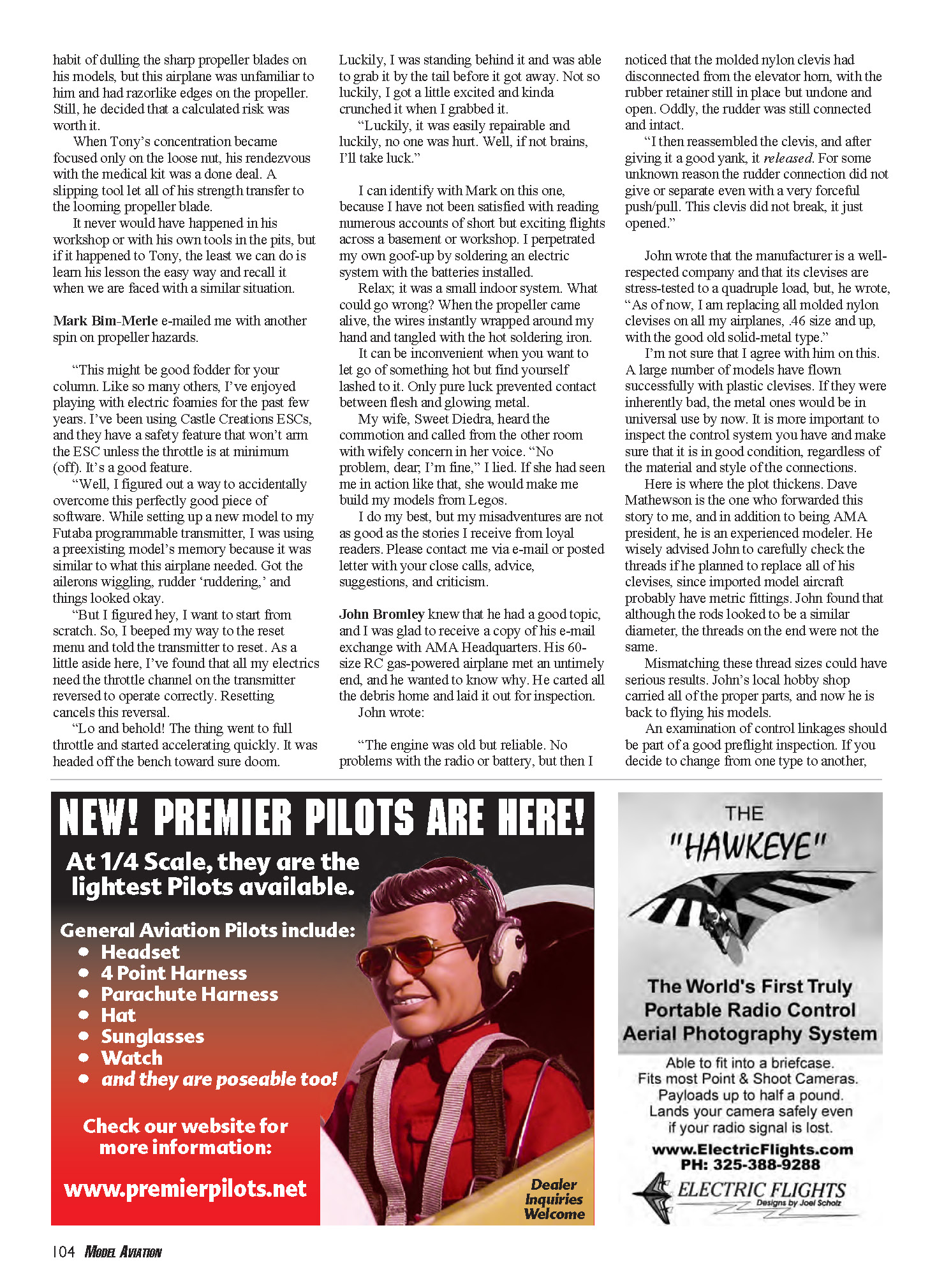
Don Smith was kind enough to assemble a collection of clevises for me to photograph. Notice the wide variety of styles and materials. All of these parts have performed properly, but they will fail if overloaded or abused, as will any mechanical device.
Don's philosophy of model building differs from mine. I grow bored with a model once it has flown, and I can only think of the next project. I store my airplanes until I have to thin the herd to make room for more. He tends to work with a given model until it is tuned to perfection, and he flies it for many years. I have often found myself competing with a new airplane against one of his old, familiar models and losing.
Don has ample occasion to check clevises and other parts for wear, and he keeps replacements on hand. I build another airplane and move on.
Frank Murray is the helicopter pilot in a photograph. He keeps a small, identical emergency backup helicopter handy in case his main one breaks down.
Frank knows about replacing parts before they fail, and his field setup was so complete and tidy that I had to snap a picture. Rotary-wing fliers have to be good mechanics to keep their complicated models in the air.
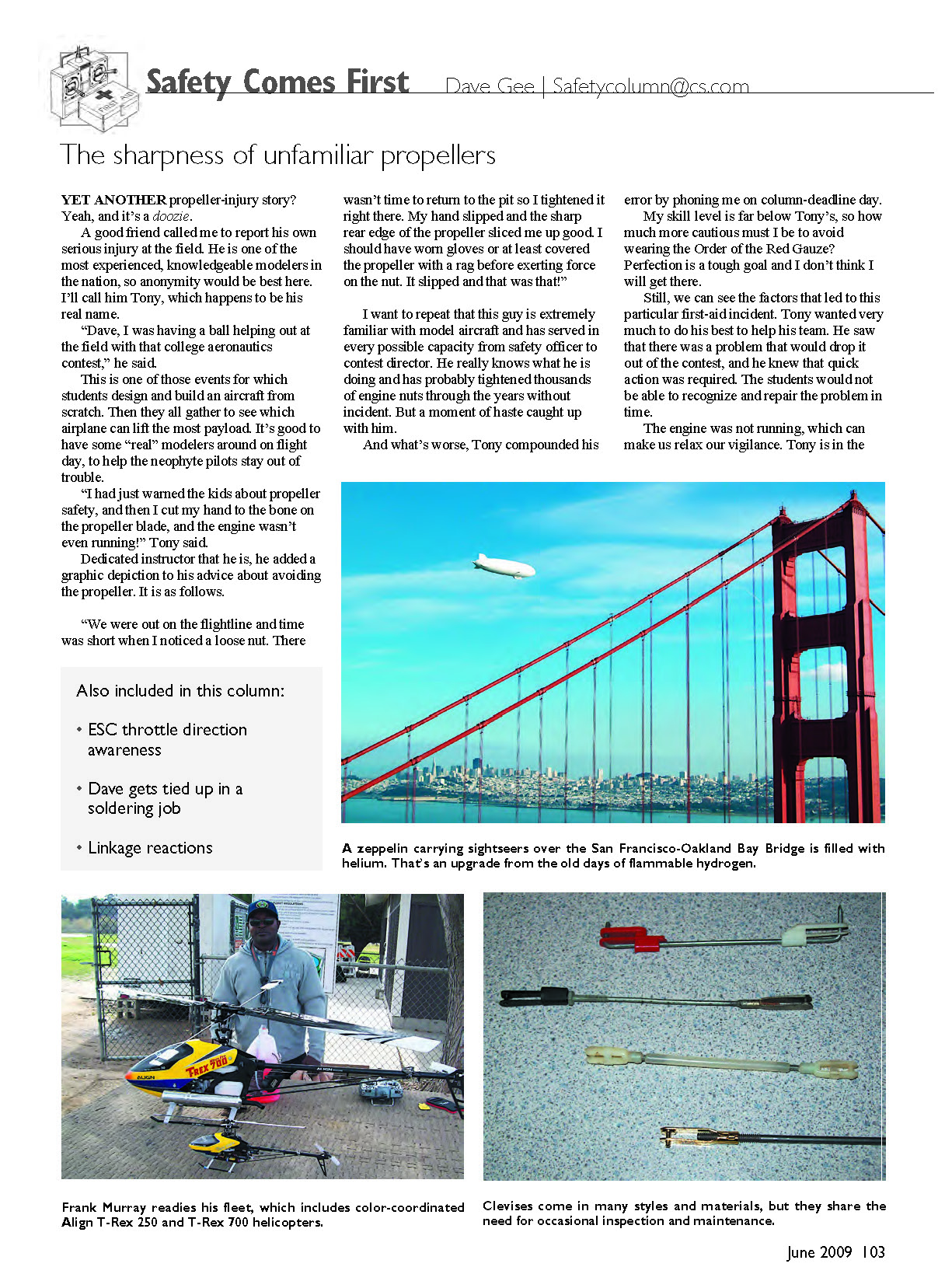
The remaining picture has little to do with safety, but it was too good not to print. I visited San Francisco, California, and while taking snapshots at the Bay Bridge, a genuine passenger zeppelin flew overhead.
Not a blimp, this craft had a rigid frame inside and was built by Zeppelin Luftschifftechnik. Family reactions were standard when I told them about the new sight-seeing flights. My wife asked "Why?" and my son wondered "When do we leave?"
MA
Sources:
- Dave Gee
Box 7081 Van Nuys, CA 91409
- Zeppelin rides: www.airshipventures.com
Transcribed from original scans by AI. Minor OCR errors may remain.

