
Hello hands-free RC
I love seeing new gadgets and technological advances in our hobby, but sometimes things go the wrong direction.
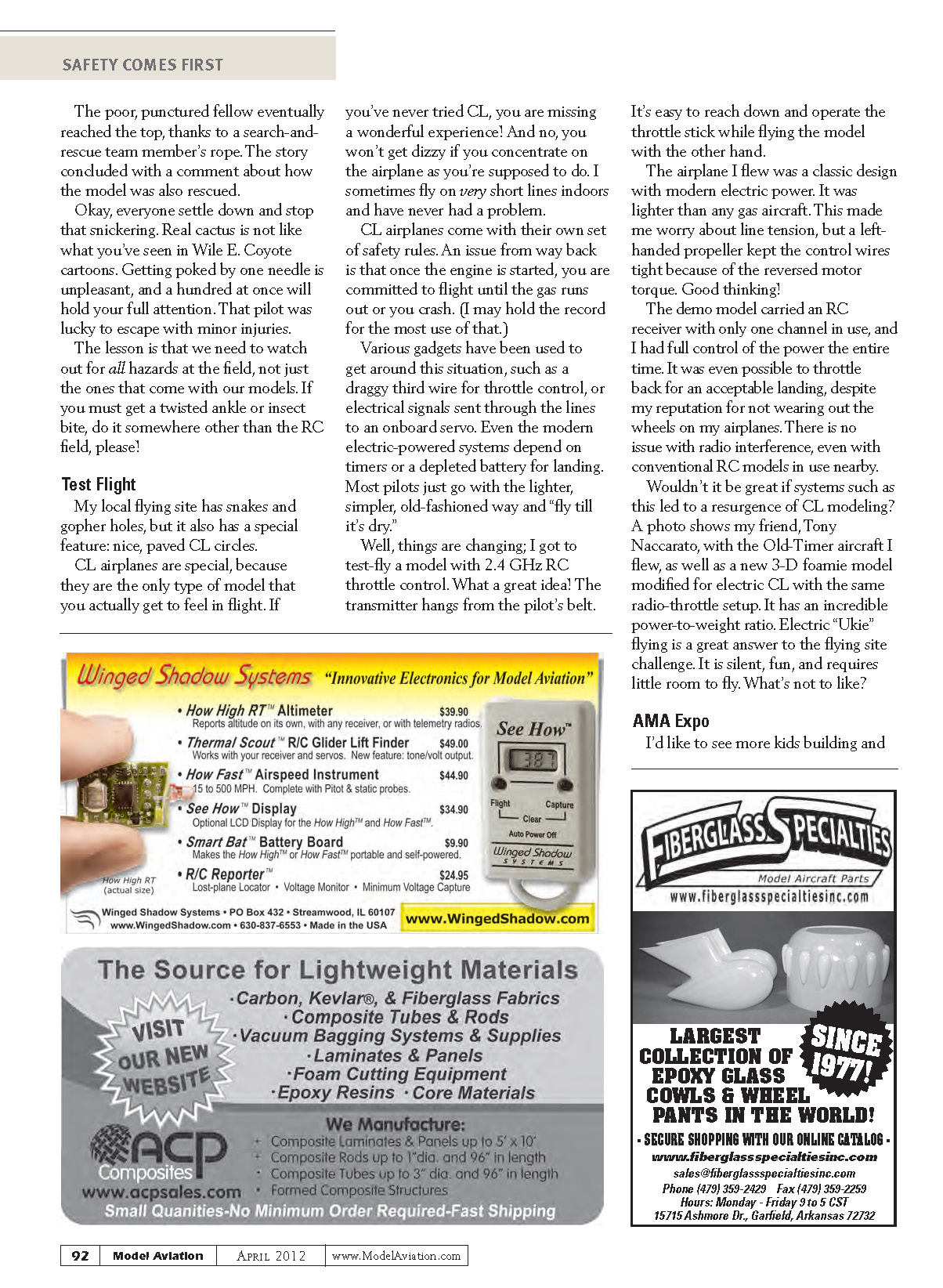
For example, some engineers got too smart and designed a hands-free RC control system interface. Stick a Bluetooth-enabled device in your shirt pocket and it senses the movement of your body, translating the data into control inputs for a model aircraft. If you've seen those video games where you have to move around in front of the television screen, then you know what this is.
The problem is that the model also reacts to any false movement. As long as you keep your arms outstretched, things are okay, but if you try to scratch your nose, the airplane spins out of control. And how long can you balance on your "hovering" foot? The microphone senses any engine noises you make and sends matching throttle inputs. A sudden cough could mean big trouble.
Pilots would look ridiculous on the flightline—making "vroom vroom" noises while spinning and zooming with arms outstretched. What will spectators think of our hobby? Besides making modelers look undignified, this contraption is risky, and in my opinion it should not be allowed. If you see someone flying such a system, I recommend walking up and offering the pilot a congratulatory handshake. Problem solved!
The danger of "hands-free RC" is no joke. Oh, wait—actually it is a joke. Happy April Fools' Day.
Test Flight
My local flying site has snakes and gopher holes, but it also has a special feature: nice, paved control-line (CL) circles. CL airplanes are special because they are the only type of model that you actually get to feel in flight. If you've never tried CL, you are missing a wonderful experience! And no, you won't get dizzy if you concentrate on the airplane as you're supposed to do. I sometimes fly on very short lines indoors and have never had a problem.
CL airplanes come with their own set of safety rules. An issue from way back is that once the engine is started, you are committed to flight until the gas runs out or you crash. (I may hold the record for the most use of that.)
Various gadgets have been used to get around this situation, such as a draggy third wire for throttle control or electrical signals sent through the lines to an onboard servo. Even the modern electric-powered systems depend on timers or a depleted battery for landing. Most pilots just go with the lighter, simpler, old-fashioned way and "fly till it's dry."
Well, things are changing; I got to test-fly a model with 2.4 GHz RC throttle control. What a great idea! The transmitter hangs from the pilot's belt. It's easy to reach down and operate the throttle stick while flying the model with the other hand.
The airplane I flew was a classic design with modern electric power. It was lighter than any gas aircraft. This made me worry about line tension, but a left-handed propeller kept the control wires tight because of the reversed motor torque. Good thinking!
The demo model carried an RC receiver with only one channel in use, and I had full control of the power the entire time. It was even possible to throttle back for an acceptable landing, despite my reputation for not wearing out the wheels on my airplanes. There was no issue with radio interference, even with conventional RC models in use nearby.
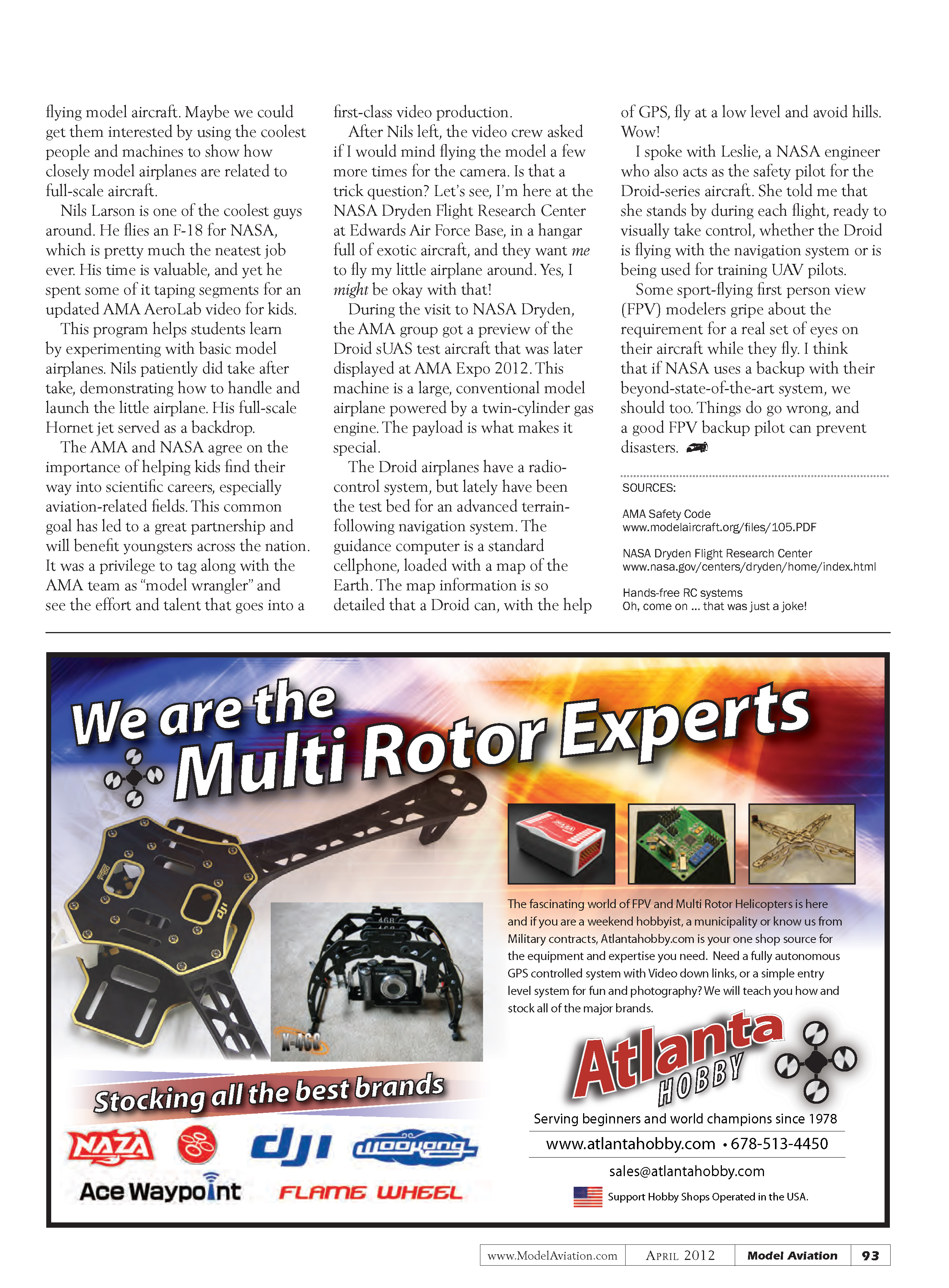
Wouldn't it be great if systems such as this led to a resurgence of CL modeling? A photo shows my friend Tony Naccarato with the Old-Timer aircraft I flew, as well as a new 3-D foamie model modified for electric CL with the same radio-throttle setup. It has an incredible power-to-weight ratio. Electric "Ukie" flying is a great answer to the flying site challenge. It is silent, fun, and requires little room to fly. What's not to like?
Cactus Catastrophe
Several readers sent me a more believable story that is full of sharp points for all of us. We know that many aeromodeling injuries do not involve aircraft. Being outdoors has its own hazards, and sometimes a modeler finds them while concentrating on an airplane or helicopter.
The news story was about a man flying his model outdoors in a park area. The airplane might have been a slope glider, because it landed below the edge of a cliff. While trying to retrieve it, the pilot slid 120 feet down the steep cliff and into a cactus patch. He was trapped and used his cellular phone to call some fellow fliers. They were unable to get him out, so the fire department was contacted.
AMA Expo
I'd like to see more kids building and flying model aircraft. Maybe we could get them interested by using the coolest people and machines to show how closely model airplanes are related to full-scale aircraft.
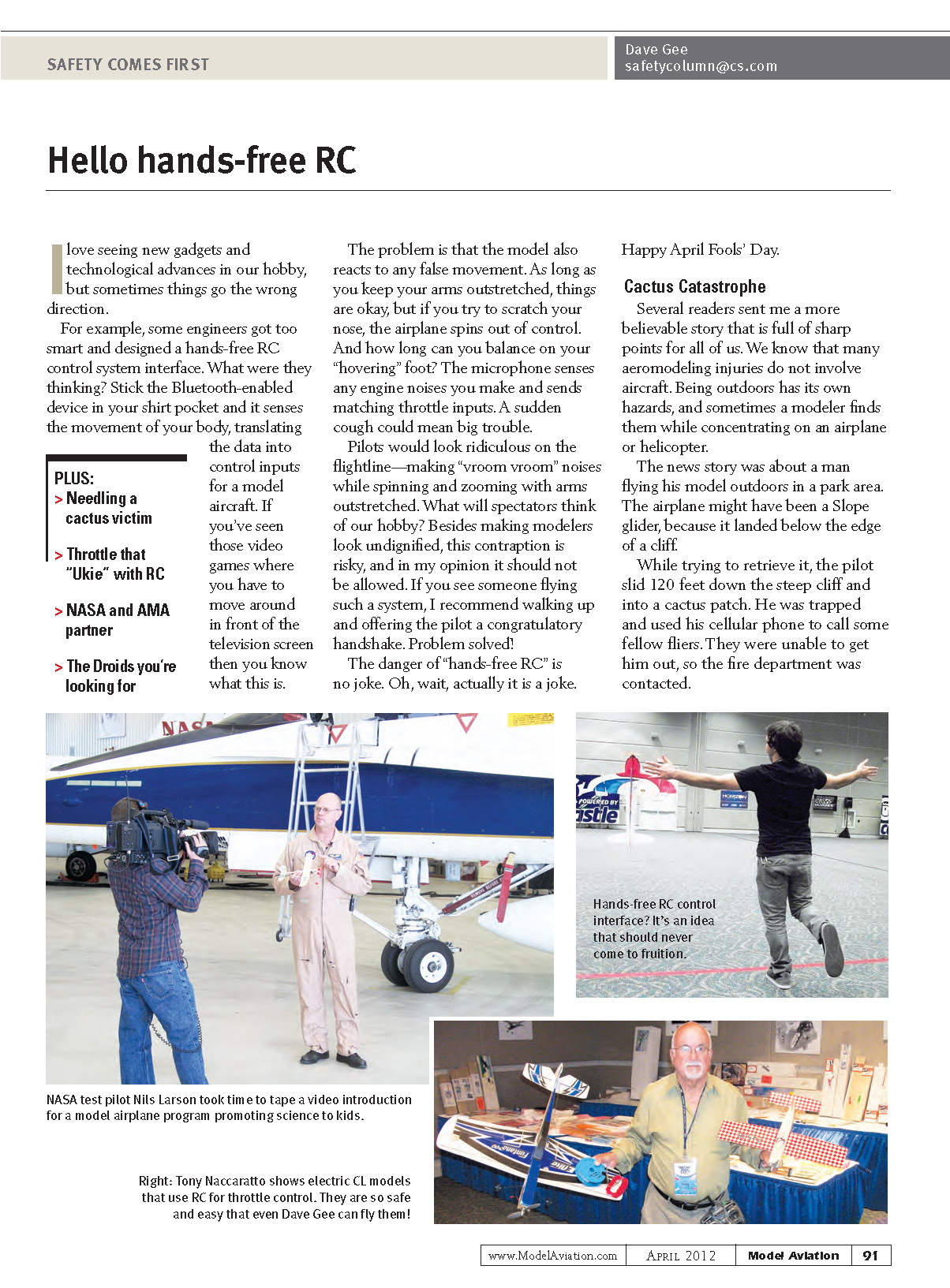
Nils Larson is one of the coolest guys around. He flies an F-18 for NASA, which is pretty much the neatest job ever. His time is valuable, and yet he spent some of it taping segments for an updated AMA AeroLab video for kids.
This program helps students learn by experimenting with basic model airplanes. Nils patiently did take after take, demonstrating how to handle and launch the little airplane. His full-scale Hornet jet served as a backdrop.
The AMA and NASA agree on the importance of helping kids find their way into scientific careers, especially aviation-related fields. This common goal has led to a great partnership and will benefit youngsters across the nation. It was a privilege to tag along with the AMA team as "model wrangler" and see the effort and talent that goes into a first-class video production.
After Nils left, the video crew asked if I would mind flying the model a few more times for the camera. Is that a trick question? Let's see, I'm here at the NASA Dryden Flight Research Center at Edwards Air Force Base, in a hangar full of exotic aircraft, and they want me to fly my little airplane around. Yes, I might be okay with that!
During the visit to NASA Dryden, the AMA group got a preview of the Droid sUAS test aircraft that was later displayed at AMA Expo 2012. This machine is a large, conventional model airplane powered by a twin-cylinder gas engine. The payload is what makes it special.
The Droid airplanes have a radio-control system, but lately have been the test bed for an advanced terrain-following navigation system. The guidance computer is a standard cellphone, loaded with a map of the Earth. The map information is so detailed that a Droid can, with the help of GPS, fly at a low level and avoid hills. Wow!
I spoke with Leslie, a NASA engineer who also acts as the safety pilot for the Droid-series aircraft. She told me that she stands by during each flight, ready to visually take control, whether the Droid is flying with the navigation system or is being used for training UAV pilots.
Some sport-flying first-person-view (FPV) modelers gripe about the requirement for a real set of eyes on their aircraft while they fly. I think that if NASA uses a backup with their beyond-state-of-the-art system, we should too. Things do go wrong, and a good FPV backup pilot can prevent disasters.
SOURCES:
- AMA Safety Code
www.modelaircraft.org/files/105.PDF
- NASA Dryden Flight Research Center
www.nasa.gov/centers/dryden/home/index.html
- Hands-free RC systems
Oh, come on ... that was just a joke!
Transcribed from original scans by AI. Minor OCR errors may remain.

