
Safety Comes First
Dave Gee | [email protected]
News and views from AMA Convention 2007
I love attending the AMA Convention at Ontario, California! Besides seeing old friends and new and all that modeling stuff, I can gather enough column material to last me several months. First, the photos.
Edjer booth and cutting tools
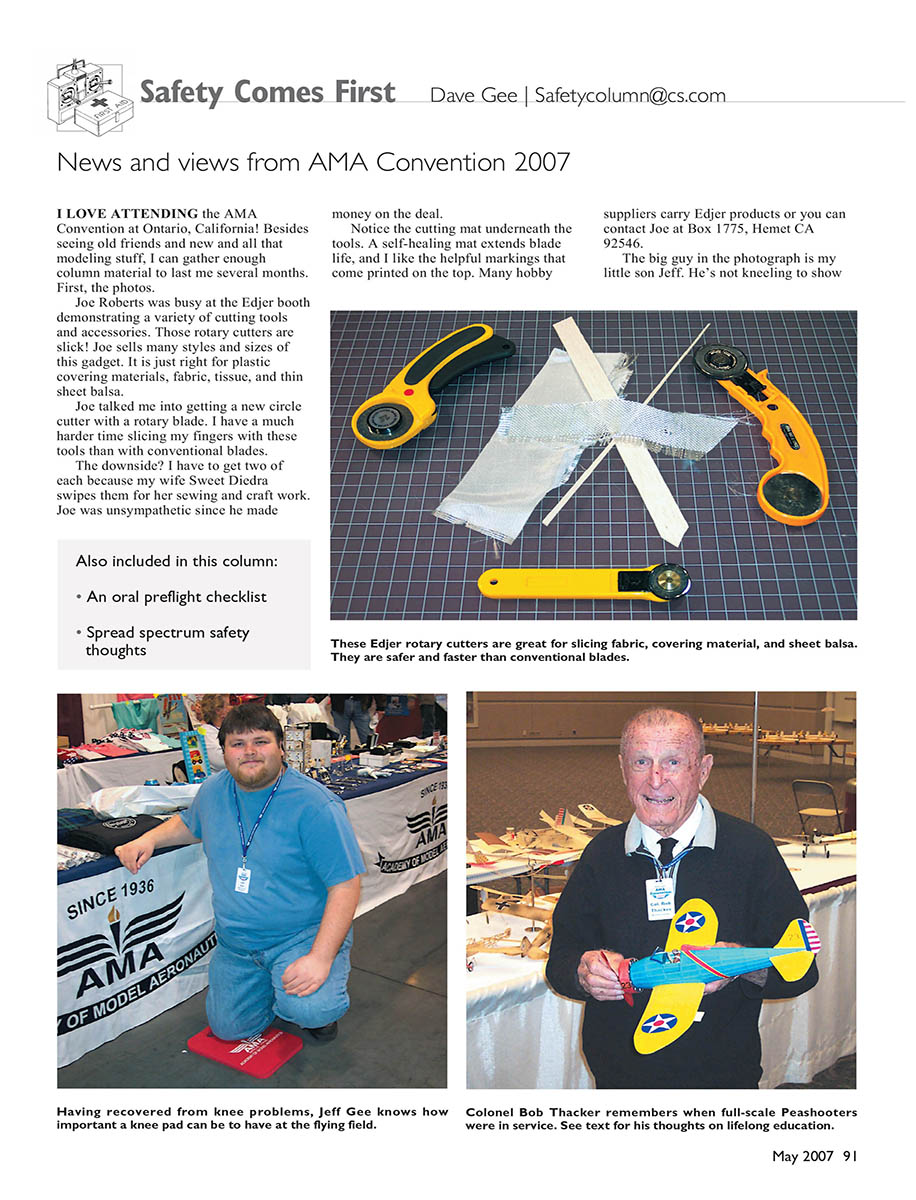
Joe Roberts was busy at the Edjer booth demonstrating a variety of cutting tools and accessories. Those rotary cutters are slick! Joe sells many styles and sizes of this gadget. It is just right for plastic covering materials, fabric, tissue, and thin sheet balsa.
Joe talked me into getting a new circle cutter with a rotary blade. I have a much harder time slicing my fingers with these tools than with conventional blades.
The downside? I have to get two of each because my wife, Sweet Diedra, swipes them for her sewing and craft work. Joe was unsympathetic since he made money on the deal.
Notice the cutting mat underneath the tools. A self-healing mat extends blade life, and I like the helpful markings that come printed on the top. Many hobby suppliers carry Edjer products, or you can contact Joe at Box 1775, Hemet, CA 92546.
Also included in this column:
- An oral preflight checklist
- Spread spectrum safety thoughts
Knee protection at the field
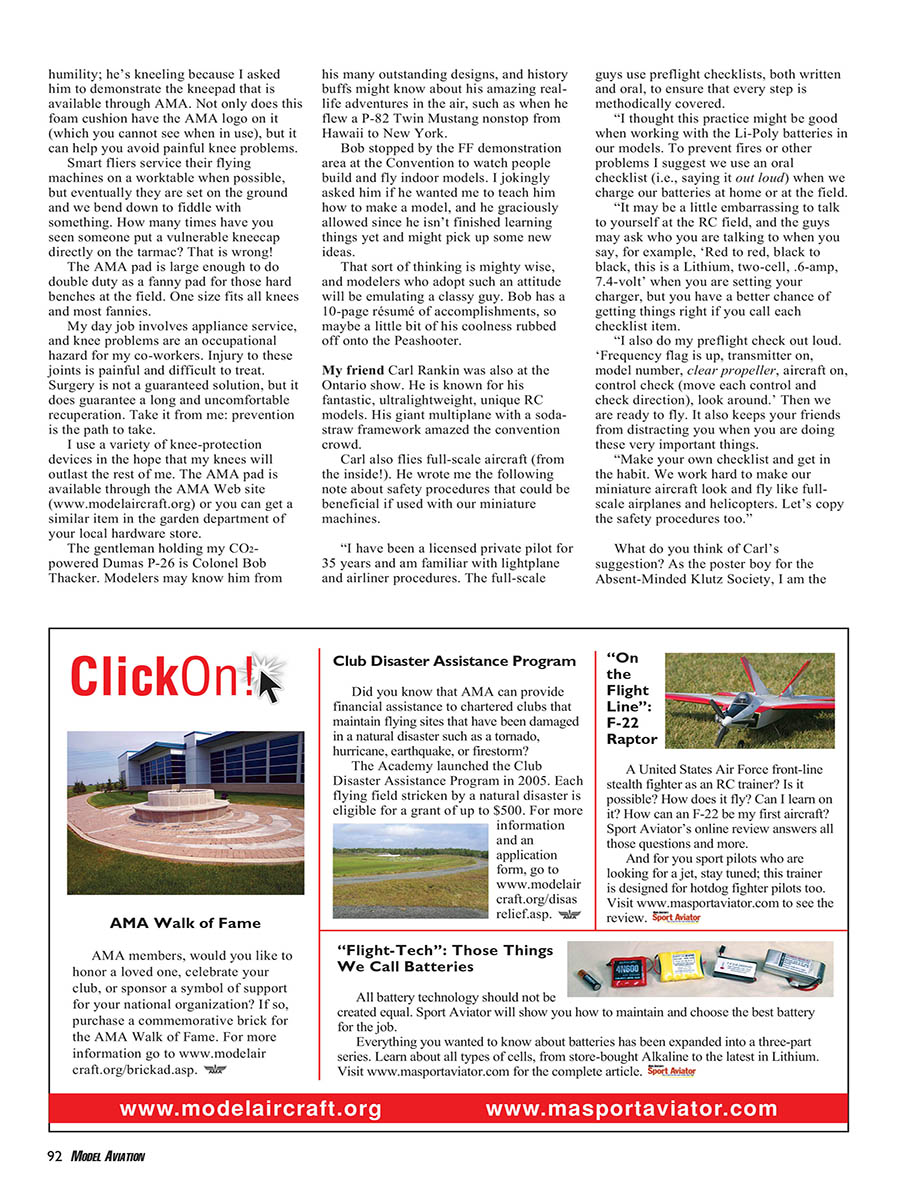
The big guy in the photograph is my little son Jeff. He's not kneeling to show humility; he's kneeling because I asked him to demonstrate the kneepad that is available through AMA. Not only does this foam cushion have the AMA logo on it (which you cannot see when in use), but it can help you avoid painful knee problems.
Smart fliers service their flying machines on a worktable when possible, but eventually they are set on the ground and we bend down to fiddle with something. How many times have you seen someone put a vulnerable kneecap directly on the tarmac? That is wrong! The AMA pad is large enough to do double duty as a fanny pad for those hard benches at the field. One size fits all knees and most fannies.
My day job involves appliance service, and knee problems are an occupational hazard for my co-workers. Injury to these joints is painful and difficult to treat. Surgery is not a guaranteed solution, but it does guarantee a long and uncomfortable recuperation. Take it from me: prevention is the path to take. I use a variety of knee-protection devices in the hope that my knees will outlast the rest of me. The AMA pad is available through the AMA web site (www.modelaircraft.org) or you can get a similar item in the garden department of your local hardware store.
Colonel Bob Thacker and the Peashooter
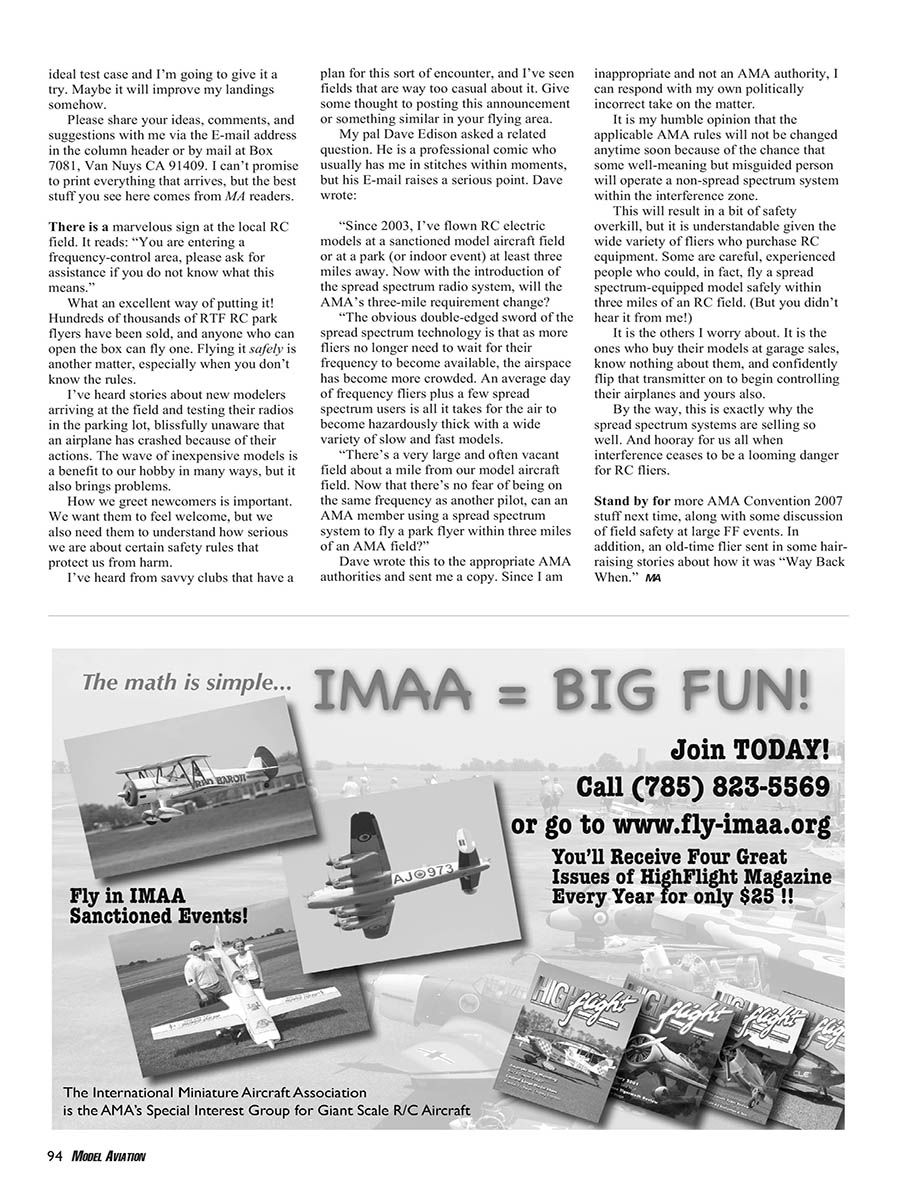
The gentleman holding my CO2-powered Dumas P-26 is Colonel Bob Thacker. Modelers may know him from his many outstanding designs, and history buffs might know about his amazing real-life adventures in the air, such as when he flew a P-82 Twin Mustang nonstop from Hawaii to New York. Bob stopped by the FF demonstration area at the convention to watch people build and fly indoor models.
I jokingly asked him if he wanted me to teach him how to make a model, and he graciously allowed it since he isn't finished learning things yet and might pick up some new ideas. That sort of thinking is mighty wise, and modelers who adopt such an attitude will be emulating a classy guy. Bob has a 10-page résumé of accomplishments, so maybe a little bit of his coolness rubbed off onto the Peashooter.
Carl Rankin and oral checklists
My friend Carl Rankin was also at the Ontario show. He is known for his fantastic, ultralightweight, unique RC models. His giant multiplane with a soda-straw framework amazed the convention crowd. Carl also flies full-scale aircraft (from the inside!). He wrote me the following note about safety procedures that could be beneficial if used with our miniature machines.
"I have been a licensed private pilot for 35 years and am familiar with lightplane and airliner procedures. The full-scale guys use preflight checklists, both written and oral, to ensure that every step is methodically covered.
"I thought this practice might be good when working with the Li-Poly batteries in our models. To prevent fires or other problems I suggest we use an oral checklist (i.e., saying it out loud) when we charge our batteries at home or at the field.
"It may be a little embarrassing to talk to yourself at the RC field, and the guys may ask where you are talking to when you say, for example, 'Red to red, black to black; this is a Lithium, two-cell, .6-amp, 7.4-volt' when you are setting your charger, but you have a better chance of getting things right if you call each checklist item.
"I also do my preflight check out loud. 'Frequency flag is up, transmitter on, model number, clear propeller, aircraft on, control check (move each control and check direction), look around.' Then we are ready to fly. It also keeps your friends from distracting you when you are doing these very important things.
"Make your own checklist and get in the habit. We work hard to make our miniature aircraft look and fly like full-scale airplanes and helicopters. Let's copy the safety procedures too."
What do you think of Carl's suggestion? As the poster boy for the Absent-Minded Klutz Society, I am the ideal test case and I'm going to give it a try. Maybe it will improve my landings somehow.
Please share your ideas, comments, and suggestions with me via the e-mail address in the column header or by mail at Box 7081, Van Nuys, CA 91409. I can't promise to print everything that arrives, but the best stuff you see here comes from MA readers.
Frequency control and welcoming newcomers
There is a marvelous sign at the local RC field. It reads: "You are entering a frequency-control area, please ask for assistance if you do not know what this means."
What an excellent way of putting it! Hundreds of thousands of RTF RC park flyers have been sold, and anyone who can open the box can fly one. Flying it safely is another matter, especially when you don't know the rules.
I've heard stories about new modelers arriving at the field and testing their radios in the parking lot, blissfully unaware that an airplane has crashed because of their actions. The wave of inexpensive models is a benefit to our hobby in many ways, but it also brings problems.
How we greet newcomers is important. We want them to feel welcome, but we also need them to understand how serious we are about certain safety rules that protect us from harm.
I've heard from savvy clubs that have a plan for this sort of encounter, and I've seen fields that are way too casual about it. Give some thought to posting this announcement or something similar in your flying area.
Spread spectrum safety thoughts
My pal Dave Edison asked a related question. He is a professional comic who usually has me in stitches within moments, but his e-mail raises a serious point. Dave wrote:
"Since 2003, I've flown RC electric models at a sanctioned model aircraft field or at a park (or indoor event) at least three miles away. Now with the introduction of the spread spectrum radio system, will the AMA's three-mile requirement change?
"The obvious double-edged sword of the spread spectrum technology is that as more fliers no longer need to wait for their frequency to become available, the airspace has become more crowded. An average day of frequency fliers plus a few spread spectrum users is all it takes for the air to become hazardously thick with a wide variety of slow and fast models.
"There's a very large and often vacant field about a mile from our model aircraft field. Now that there's no fear of being on the same frequency as another pilot, can an AMA member using a spread spectrum system to fly a park flyer within three miles of an AMA field?"
Dave wrote this to the appropriate AMA authorities and sent me a copy. Since I am inappropriate and not an AMA authority, I can respond with my own politically incorrect take on the matter.
It is my humble opinion that the applicable AMA rules will not be changed anytime soon because of the chance that some well-meaning but misguided person will operate a non-spread spectrum system within the interference zone.
This will result in a bit of safety overkill, but it is understandable given the wide variety of fliers who purchase RC equipment. Some are careful, experienced people who could, in fact, fly a spread spectrum-equipped model safely within three miles of an RC field. (But you didn't hear it from me!)
It is the others I worry about. It is the ones who buy their models at garage sales, know nothing about them, and confidently flip that transmitter on to begin controlling their airplanes and yours also.
By the way, this is exactly why the spread spectrum systems are selling so well. And hooray for us all when interference ceases to be a looming danger for RC fliers.
Stand by for more AMA Convention 2007 stuff next time, along with some discussion of field safety at large FF events. In addition, an old-time flier sent in some hair-raising stories about how it was "Way Back When." MA
Transcribed from original scans by AI. Minor OCR errors may remain.

