
Safety Comes First
Just getting to the field can be dangerous
IT'S A BEAUTIFUL day, with the kind of sunshine that makes you want to head for the field and commit some aviation. Rick Zondlo thought so, and he loaded up his models and got rolling. You know that if his story is here, something didn't work out as planned.
Rick had a harrowing experience and says he's lucky to be alive, but his caution and wisdom gave his good luck a big advantage. Following is how he tells it.
"This is a true story. I'm the guy in the accident. On my way to the field yesterday to test hop a new airplane, I decided to take a shortcut off the main highway.
"Just as I started a right turn into the exit my truck exploded. Well, it felt like an explosion ... I was hit from behind by a full-size pickup going about 70 mph. Taking that turn, I was going maybe 15. Wound up in the ditch backwards. Luckily my truck didn't overturn.
"I never saw the guy behind me and didn't know what happened. I woke up to EMS flashing lights and a Sheriff's Deputy. The guy who hit me left his truck and took off on foot. I don't yet know if they found him.
"I was fortunate to have no broken bones or large cuts. Bruised, battered, and hurting like hell from my ears to my toes. ER says I'll most likely be sore and bedridden for a couple of days. The accident screwed up my airplanes and equipment pretty good.
"I mention all of this because there are some lessons to be learned. Pack your vehicle carefully and tie stuff down.
"My two 12V starter batteries broke loose and crumpled the two fuel cans like empty cigarette packs. The fuel cans, in spite of the damage, did not leak. Both were metal and well sealed. The batteries had plastic caps over both terminals which would have prevented sparks even if the fuel had leaked. The models were pretty well protected by the PVC racks and with towels for wheel chocks; only minor damage there.
"I usually transport my 3-cell 2100 mAh Li-poly in the original cardboard box along with the charger. Fortunately again, I didn't this time. The Li-poly was wrapped separately. The original cardboard box with charger was ripped open by flying debris. A punctured Li-poly or shorted starter battery plus two cans of 20% nitro fuel could have been a problem."
Rick was lucky for sure, but luck might not have been enough if he had not packed his gear in such a secure way. It is human nature to downplay the risk of a collision on a short trip, a minor errand, or a relaxing jaunt to the RC field. Rick didn't play those odds; he loaded his stuff as if he might get hit, and it paid off.
An indoor flier might not have many worries about shifting cargo on a model-airplane outing, but most of us carry model equipment that can be hazardous in a vehicle collision. How many modelers put plastic caps over their battery terminals for transport? Ask Rick if it is worth the extra effort.
The statistics show that a majority of aeromodeling accidents have nothing to do with our flying machines. Falls, cuts, scrapes, and dumb moments of inattention could happen anywhere but did happen at the flying field. I have been negligent in not discussing motor-vehicle accidents but will try to do better.
Propeller Strikes and Restraints
One of the most common airplane-related injuries is the old-fashioned propeller strike. This all-too-popular accident is something many of us know about, yet people still stick their fingers in the propeller arc.
I'm a rubber-power flier from way back, and I have never gotten used to powerful gas or electric airscrews, or to seeing experienced fliers working close to those spinning blades.
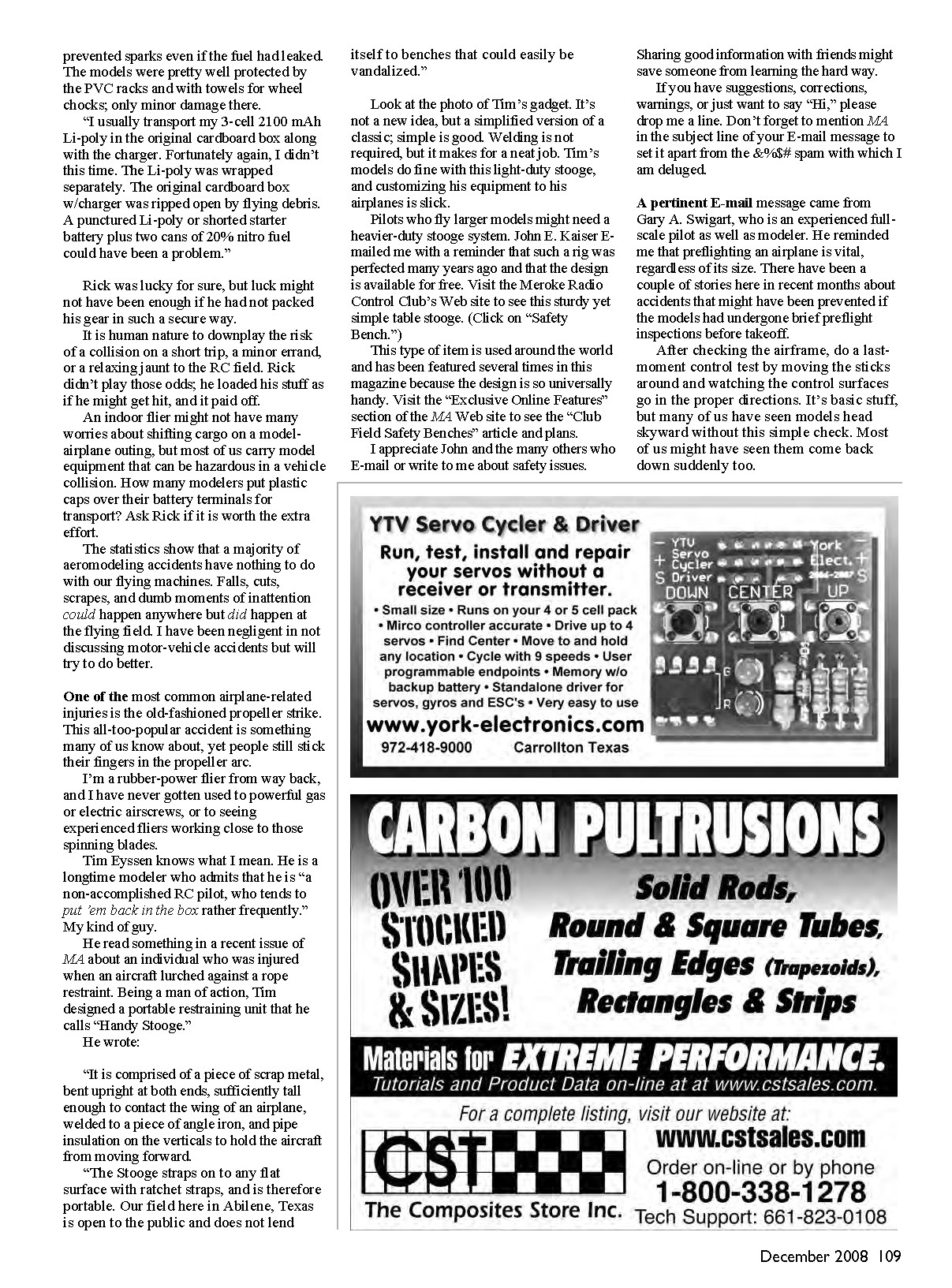
Tim Eyssen knows what I mean. He is a longtime modeler who admits that he is "a non-accomplished RC pilot, who tends to put 'em back in the box rather frequently." My kind of guy. He read something in a recent issue of MA about an incident in which someone was injured when an aircraft lurched against a rope restraint. Being a man of action, Tim designed a portable restraining unit that he calls "Handy Stooge."
He wrote: "It is comprised of a piece of scrap metal, bent upright at both ends, sufficiently tall enough to contact the wing of an airplane, welded to a piece of angle iron, and pipe insulation on the verticals to hold the aircraft from moving forward.
"The Stooge straps on to any flat surface with ratchet straps, and is therefore portable. Our field here in Abilene, Texas is open to the public and does not lend itself to benches that could easily be vandalized."
Look at the photo of Tim's gadget. It's not a new idea, but a simplified version of a classic; simple is good. Welding is not required, but it makes for a neat job. Tim's models do fine with this light-duty stooge, and customizing his equipment to his airplanes is slick. Pilots who fly larger models might need a heavier-duty stooge system.
John E. Kaiser e-mailed me with a reminder that such a rig was perfected many years ago and that the design is available for free. Visit the Meroke Radio Control Club's Web site to see this sturdy yet simple table stooge (click on "Safety Bench").
This type of item is used around the world and has been featured several times in this magazine because the design is so universally handy. Visit the "Exclusive Online Features" section of the MA Web site to see the "Club Field Safety Benches" article and plans.
I appreciate John and the many others who e-mail or write to me about safety issues. Sharing good information with friends might save someone from learning the hard way. If you have suggestions, corrections, warnings, or just want to say "Hi," please drop me a line. Don't forget to mention MA in the subject line of your e-mail message to set it apart from the spam with which I am deluged.
A pertinent e-mail message came from Gary A. Swigart, who is an experienced full-scale pilot as well as modeler. He reminded me that preflighting an airplane is vital, regardless of its size. There have been a couple of stories here in recent months about accidents that might have been prevented if the models had undergone brief preflight inspections before takeoff.
After checking the airframe, do a last-moment control test by moving the sticks around and watching the control surfaces go in the proper directions. It's basic stuff, but many of us have seen models head skyward without this simple check. Most of us might have seen them come back down suddenly too.
Good things come in threes, and I received three e-mails about the same old—but useful—trick. I'll bet that plenty of MA readers weren't even born when someone first thought of putting a rubber band around the transmitter's throttle stick to prevent accidental movement.
Bumping that lever can be exciting, in a bad way. The pit is no place for sudden full speed ahead, and it is even more of an issue these days, when so many models have electric power that starts without warning.
Helicopter pilots, you have the throttle hold function engaged on your transmitter before you're ready to fly, right? You can spend a lot of money on switches, guards, and gadgets, but a simple rubber band will hold that stick back just fine.
When you are ready to taxi or hover, unhook the band and go. Tan II rubber is not required.
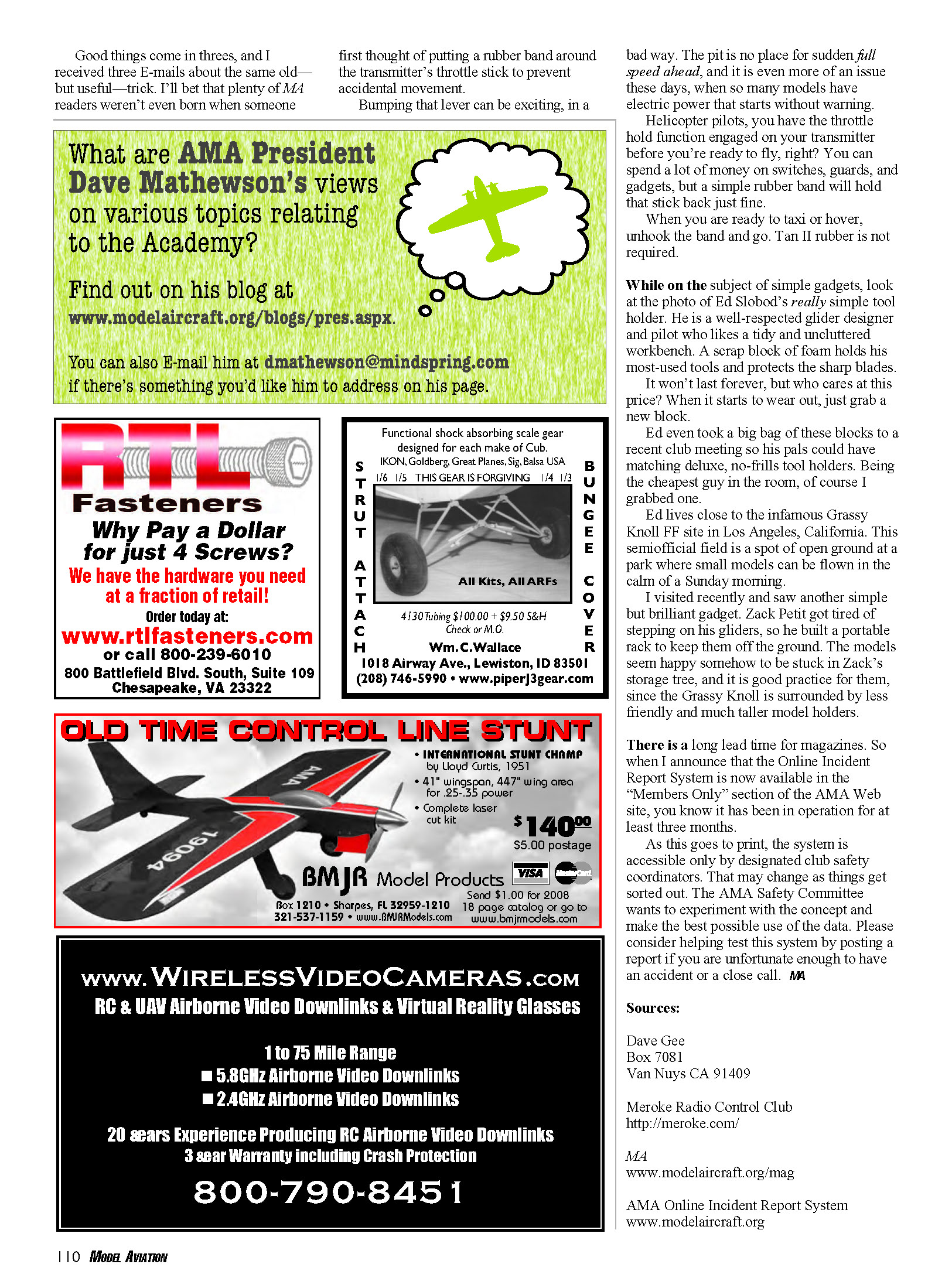
While on the subject of simple gadgets, look at the photo of Ed Slobod's really simple tool holder. He is a well-respected glider designer and pilot who likes a tidy and uncluttered workbench. A scrap block of foam holds his most-used tools and protects the sharp blades.
It won't last forever, but who cares at this price? When it starts to wear out, just grab a new block.
Ed even took a big bag of these blocks to a recent club meeting so his pals could have matching deluxe, no-frills tool holders. Being the cheapest guy in the room, of course I grabbed one.
Ed lives close to the infamous Grassy Knoll FF site in Los Angeles, California. This semiofficial field is a spot of open ground at a park where small models can be flown in the calm of a Sunday morning.
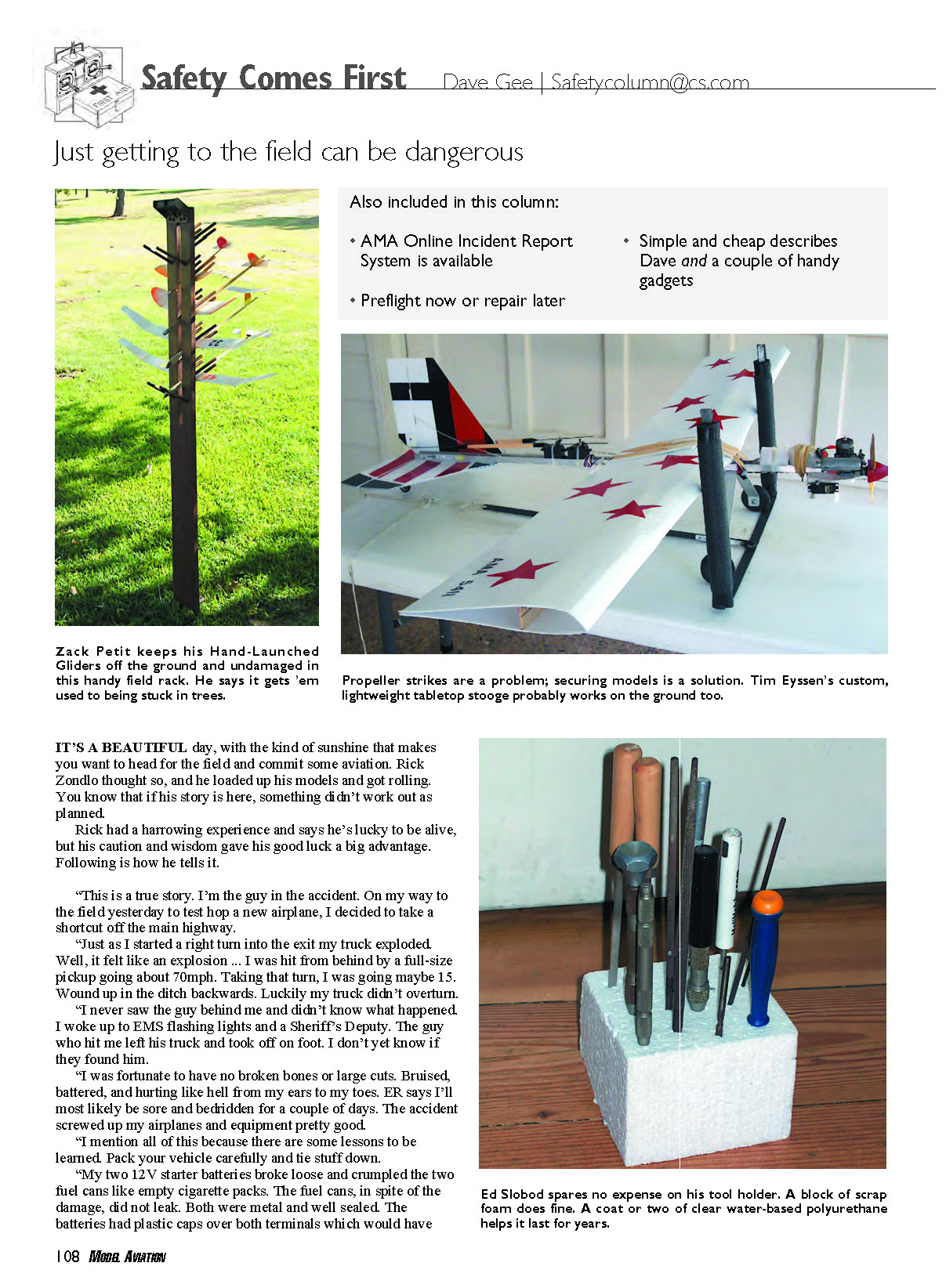
I visited recently and saw another simple but brilliant gadget. Zack Petit got tired of stepping on his gliders, so he built a portable rack to keep them off the ground. The models seem happy somehow to be stuck in Zack's storage tree, and it is good practice for them, since the Grassy Knoll is surrounded by less friendly and much taller model holders.
There is a long lead time for magazines. So when I announce that the Online Incident Report System is now available in the "Members Only" section of the AMA Web site, you know it has been in operation for at least three months.
As this goes to print, the system is accessible only by designated club safety coordinators. That may change as things get sorted out. The AMA Safety Committee wants to experiment with the concept and make the best possible use of the data. Please consider helping test this system by posting a report if you are unfortunate enough to have an accident or a close call.
MA
Sources:
- Dave Gee, Box 7081, Van Nuys CA 91409
- Meroke Radio Control Club — http://meroke.com/
- MA — www.modelaircraft.org/mag
- AMA Online Incident Report System — www.modelaircraft.org
Transcribed from original scans by AI. Minor OCR errors may remain.

