
Safety Comes First
Gary A. Shaw Box 4520, Milton FL 32572; E-mail: [email protected]
My friends had a good laugh at my expense while we were flying last weekend. The aircraft I was refueling decided to regurgitate most of the fuel I thought I was pumping into the tank—all over my legs. As the fuel sprayed, it took a few seconds for me to react and a few more to realize why I had gotten soaked.
As I stood there dripping, I realized I had connected the pump onto the wrong fuel line. Simple mistake, although I was thankful that I hadn't kept a stogie in my mouth while refueling (as I frequently see many modelers do)!
No harm was done, but what made me laugh was the discussion we had later regarding dangerous and stupid things we've all either seen or can remember doing.
By the time you read this column, we should be within a few weeks of the "New Millennium." I thought you might enjoy a review of some of the more unsafe (albeit humorous) things done "this century."
The point to be conveyed while reading the stories is that if just a little thought had been brought to bear before going to the field, some of these accidents might have prevented personal injury and/or loss of equipment.
Many of the accounts I provide are from personal experience or from stories that have been passed to me, so I won't be able to give credit to those who originated the thought. I'll just provide the details as they were passed on to me and include a closing comment to illustrate the value of the story.
Hope you enjoy the reading:
True Passion
- A man and his wife were flying separate airplanes at the same time. His wife's model went dead-stick and he began taxiing her in for a landing. He totally forgot he was flying his own airplane until he heard an engine stop abruptly.
Cold Thought
- A modeler put his transmitter down beside his feet while placing a running float-airplane into a lake. The modeler then proceeded to knock the radio into the lake in about three feet of water (early spring). The model idled out onto the lake. The modeler decided to wade out to get the model in 45° water, and nearly died from exposure. Moral: use common sense, a boat, and a net.
Hungry Cubs
- A modeler starts his scale airplane and steps over the tail to straddle it during runup. Instead, the modeler steps on the tail. Startled, the modeler excitedly gets off the model and unknowingly advances the throttle abruptly. The model spins and hits the pilot in the shin—lots of blood and several stitches. Moral: use a buddy to hold the airplane or secure the tail when starting an airplane.
Road Rage
- A modeler takes the model off from a road with a telephone line next to it. The model hits the telephone line (of course) and the model crashes into a cow pasture. Several "mad cows" destroy what remains of the model. Moral: join a club and follow the Safety Code.
Animal Rage
- A helicopter pilot was trying to "scare away" a donkey using a helicopter. He hovered "aggressively" toward the donkey, and the donkey in turn charged the helicopter! The modeler punched the throttle and missed the donkey by inches. The donkey then chased the modeler through a barbed-wire fence. The helicopter had gone skyward and the modeler successfully got it down—after calming down. Moral: never use anything Radio Control (RC) in a reckless manner.
Light Bulb
- A bright guy liked to work on models in his workshop with bare feet. One day, he spilled a puddle of cyanoacrylate (CyA) on the floor without knowing it and stepped in it. Do I need to say more?
Dive Bomber
- Have you ever tried to program a transmitter while flying a model toward yourself? In this instance, a modeler was doing just that when he adjusted the elevator-throw direction as the airplane was on a low flyby. The airplane went into the deck just outside the pits and showered the people with debris. Moral: never fly the airplane directly toward you if the pits are right behind you. Always fly in the direction of the established field pattern.
Charged Up
- For those of you who think a normal wall-charger supplied with a radio will charge large-capacity batteries in short order, one pilot discovered that after a 16-hour charge of his 1,200 milliampere-hour (mAh) pack, he was able to fly only 30 minutes before picking up the pieces.
Prop Arc
- One of my favorites is about a modeler who started an engine on a test stand and began pointing out features to a friend. While he was pointing, he stuck his finger through the prop arc—ouch! Trying to stop the engine by disconnecting the fuel line, he put his finger through the arc again. 'Nuff said!
Bad Taste
- A man discovered that the fuel pump on his flight box would not prime itself, so he sucked fuel into the pump to get it to feed into the airplane. Normally, this was not a problem; he would watch the fuel come up to the pump, stop sucking, and then turn on the pump. What corrected this behavior was that one day he switched the pump on first and then sucked! Yum, yum!
Wrong Throw
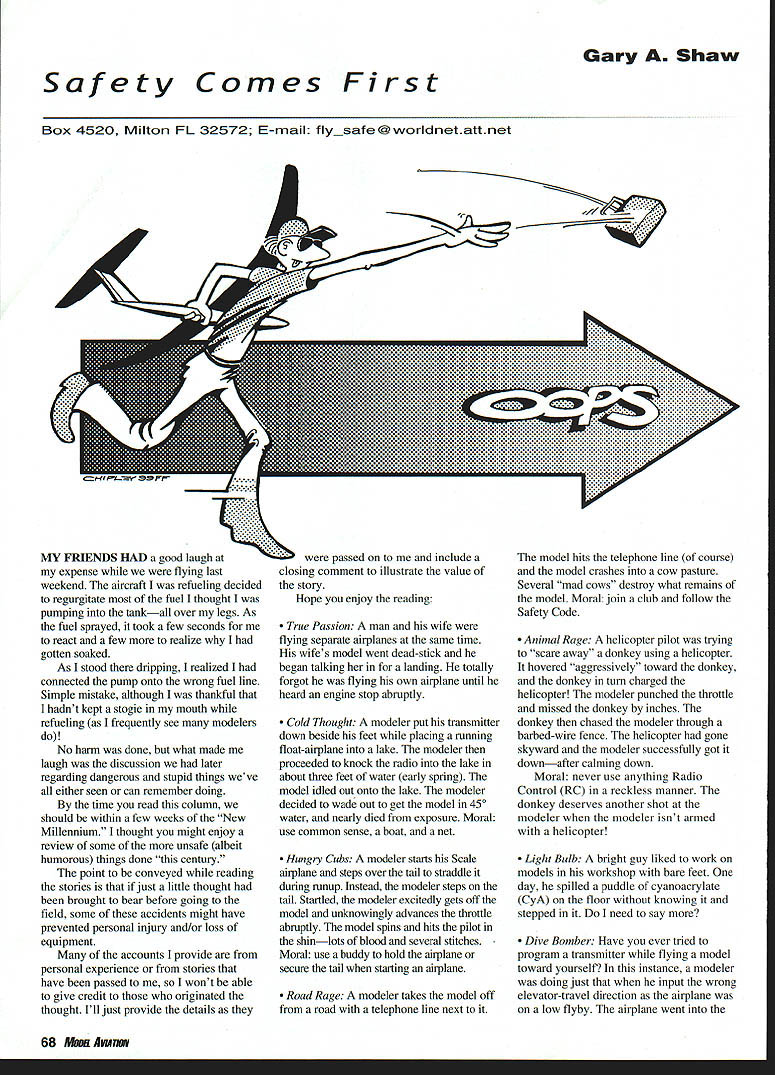
- Question: Have you ever gone to hand-launch an airplane but thrown the transmitter instead? Trust me, I'm told it happens. On a similar note, the same guy continually launches powered gliders into the antenna of the transmitter held in his left hand. Moral: Maybe the guy should switch to model trains.
- Never set up electronic directional throws on the transmitters while facing a model that utilizes elevator and rudder; the rudder will work in reverse. Suggestion: stand behind the airplane and set all the servo throws in the correct directions. You won't be disappointed, or surprised by what happens when you fly.
Electric Moment
- A modeler with a pristine, four-stroke World War II scale model noted that his right pants pocket was "really" hot shortly after takeoff. Realizing that he had dropped his glow driver in a pocket that contained change, he quickly pulled the device out and dropped it into his other pocket—the one that contained paper clips and a metal lighter. That's when the other pocket started on fire. After pulling off his shorts, landing the airplane, and walking back through the pits to loud applause, the modeler received treatment for second-degree burns.
Floater
- A man and his friend planned to fly a well-used trainer. Since the model didn't track well on the ground, he decided to fire it up and let it go. Upon release, his thumb slid forward over the switch, turning the receiver off. The engine pulled the little model up into a gradual left-climbing turn, which circled it up slowly, higher and higher until he and his friend could no longer see it. He could hear the sound of the engine at least five minutes after it disappeared.
- It was then time to go home and break the news to his wife, who had expressed extreme displeasure when he bought the radio for it. The next day, the same friend rented a full-scale airplane and conducted an aerial search with no results. They did it again the next day; still nothing.
- Their search was getting to be a little expensive, so on the third day they decided to borrow a friend's small boat and head out on the lake to find the airplane. They cruised the shoreline for a couple of hours and then decided to go out about a mile toward a long jetty to see if the model had washed up against the rocks.
- They were about a half-mile out when a very unwelcome storm blew in and the little motor on the boat decided to die. As the waves pounded them, one of the men started rowing, while the other baled water out of the boat. When one of the oars broke they decided to row canoe-style to a nearby jetty. Reaching the safety of the jetty, the men hung onto the boat by the rope, which was pounded against the rocks while they sat out the storm.
- Storm gone and the water calm, the men set out for their starting point. Upon arriving at shore, they were greeted by their wives and state troopers. After being gone for six hours, they determined that they had not had a good day—so did the troopers. They never saw the airplane again and never installed a switch like that again, either. Moral: fly with a club and/or take a boat safety course.
Hope you enjoyed the short overview of things that could have been done better in this century. Think safely whenever doing anything RC, and remember, if you have to wonder if it's okay to do it, you've already answered your own question. Be safe and enjoy the hobby!
Wishing you a happy holiday season! See you next year. MA
Transcribed from original scans by AI. Minor OCR errors may remain.

