
Safety Comes First
Gary A. Shaw
Box 4520, Milton FL 32572; E-mail: [email protected]
You Could Learn a Lot From a Dummy
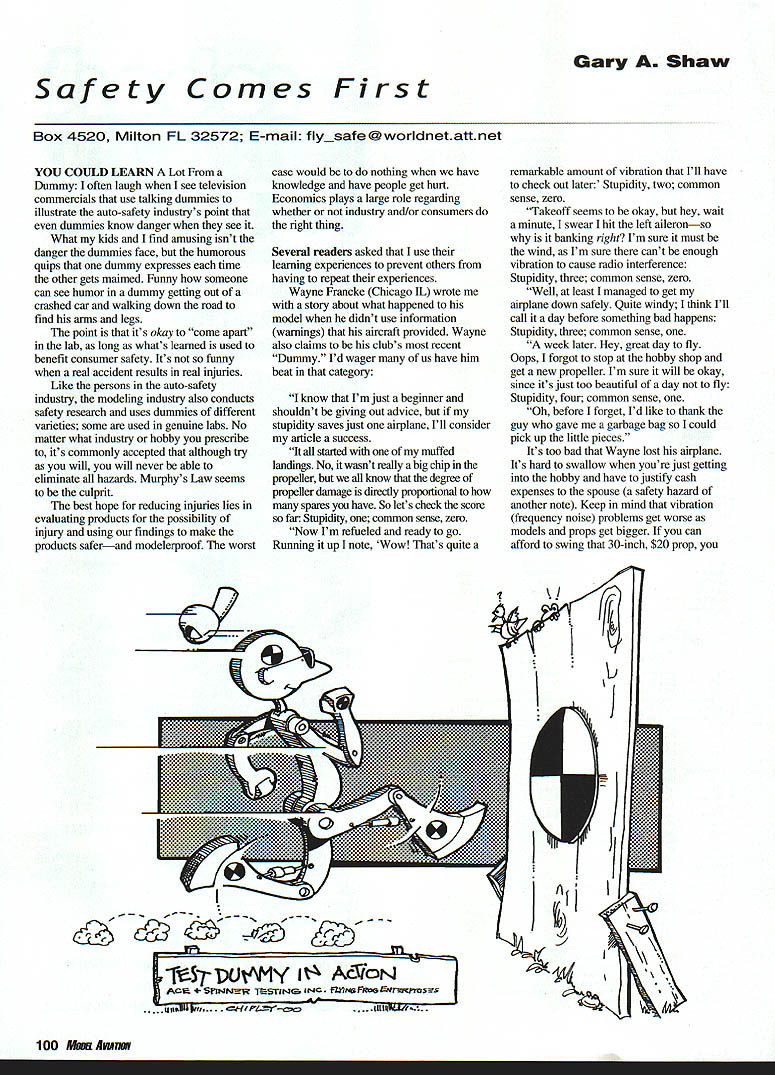
I often laugh when I see television commercials that use talking dummies to illustrate the auto-safety industry's point that even dummies know danger when they see it. What my kids and I find amusing isn't the danger the dummies face, but the humorous quips that one dummy expresses each time the other gets maimed. Funny how someone can see humor in a dummy getting out of a crashed car and walking down the road to find his arms and legs.
The point is that it's okay to "come apart" in the lab, as long as what's learned is used to benefit consumer safety. It's not so funny when a real accident results in real injuries.
Like the persons in the auto-safety industry, the modeling industry also conducts safety research and uses dummies of different varieties; some are used in genuine labs. No matter what industry or hobby you prescribe to, it's commonly accepted that although try as you will, you will never be able to eliminate all hazards. Murphy's Law seems to be the culprit.
The best hope for reducing injuries lies in evaluating products for the possibility of injury and using our findings to make the products safer—and modeler-proof. The worst case would be to do nothing when we have knowledge and have people get hurt. Economics plays a large role regarding whether or not industry and/or consumers do the right thing.
Several readers asked that I use their learning experiences to prevent others from having to repeat their mistakes.
Wayne Francke — A Cautionary Tale
Wayne Francke (Chicago, IL) wrote with a story about what happened to his model when he didn't heed information (warnings) that his aircraft provided. Wayne also claims to be his club's most recent "Dummy." I'd wager many of us have him beat in that category.
"I know that I'm just a beginner and shouldn't be giving out advice, but if my stupidity saves just one airplane, I'll consider my article a success.
"It all started with one of my muffed landings. No, it wasn't really a big chip in the propeller, but we all know that the degree of propeller damage is directly proportional to how many spares you have. So let's check the score so far: Stupidity, one; common sense, zero.
"Now I'm refueled and ready to go. Running it up I note, 'Wow! That's quite a remarkable amount of vibration that I'll have to check out later.' Stupidity, two; common sense, zero.
"Takeoff seems to be okay, but, hey, wait a minute, I swear I hit the left aileron—so why is it banking right? I'm sure it must be wind, as I'm sure there can't be enough vibration to cause radio interference: Stupidity, three; common sense, zero.
"Well, at least I managed to get my airplane down safely. Quite windy; I think I'll call it a day before something bad happens." Stupidity, three; common sense, one.
"A week later. Hey, great day to fly. Oops, I forgot to stop at the hobby shop and get a new propeller. It will be okay, since it's just too beautiful of a day not to fly. Stupidity, four; common sense, one.
"Oh, before I forget, I'd like to thank the guy who gave me a garbage bag so I could pick up the little pieces."
It's too bad that Wayne lost his airplane. It's hard to swallow when you're just getting into the hobby and have to justify cash expenses to the spouse (a safety hazard of another note). Keep in mind that vibration (frequency noise) problems get worse as models and props get bigger. If you can afford to swing that 30‑inch, $20 prop, you can obviously afford to replace it when it gets damaged. Right?
If not, vibration may get the best of your equipment, as it apparently did in this case. Keep in mind that vibration not only causes radio interference, but structural fatigue as well. Fatigue and the constant stresses associated with vibration often lead to component failure. When you use damaged props, there is always a gamble.
If your prop is damaged and is spinning at high RPM, can you tell if (or when) it's going to break? The prop certainly wasn't designed to function properly with that big chunk missing from the tip, was it? Some sound advice: when in doubt, throw it out. It's simply not worth the risk of injury.
Throughout the years, I've been led to believe that flying small-to-medium airplanes has one distinct advantage: the kits and associated equipment are cheaper, easier to replace, easier to repair, store, transport, etc. The next time you're in the hobby shop or paging through that catalog, give smaller models versus larger models some thought!
Comments From the Mailbag
I have received letters in response to recent columns that discussed the use of cyanoacrylate (CyA) glues, the visual perception of flying, and setting servo throws via transmitters while flying.
To illustrate my point about adjustments, a modeler from the Southwest wrote that at a recent event, the best pilot and builder in the club experienced an embarrassing boo-boo. The pilot (a former Pattern expert) was flying his Extra 300 for the 100th-plus time with two of his friends. He decided to make a change to the servo controls via his computer transmitter.
In the course of trying to watch the airplane and make an adjustment, the pilot somehow reversed all of the controls! The airplane headed down big-time, thereby turning itself into itty-bitty pieces. The lesson I learned here: don't make any adjustments to a computer transmitter (or any transmitter, for that matter) while the airplane is in the air. It's confusing enough when you're making adjustments on the ground.
A letter from Martin O'Neill (CA) provided a few tips about how persons who wear prescription eyewear can enhance visual perception while flying.
- Purchase prescription sunglasses for use on bright days instead of placing plastic add-ons over the front of eyeglasses. Non-prescription sunglasses can distort visual perception.
- Bifocals should never be used when you're flying because the mind wants to process what it sees from all angles and the brain has a hard time sorting it all out. The result is a smaller usable field-of-view and a harder time concentrating on (and seeing) the airplane.
- For contact-lens wearers: do not use lenses that correct one eye for distance and the other for close objects, as this can eliminate depth perception when flying. Martin recommends optically true, ground airplane sunglasses that complement the contacts.
I'm going on Martin's word here, but I hope any opticians who are reading this will provide additional input if anything has been left out.
Mail about CyA has noted respiratory passage and eye irritation as chief complaints. In a few letters there has been discussion of symptoms ranging from severe allergic reactions to chest pain, but many of the symptoms have been attributed in part to not using a respirator.
Keep one thing in mind when you're using glues and chemicals:
- You can always use less-hazardous substitutes.
- Or buy a respirator and use cartridges appropriate for the type of chemical you use.
- If a respirator is recommended or you just feel better using it, wear it religiously when using the chemicals that concern you.
For future columns I'll attempt to answer a few of the questions brought up about CyA. Until then, if you would like more information about respirators, e-mail me at [email protected], or write to me at the address listed at the top of the column. I'll get an answer to your question, if it's possible, and get back to you.
Until next month, keep your eye to the sky and the wheels on the bottom.
Transcribed from original scans by AI. Minor OCR errors may remain.

