
Safety Comes First
Box 4520, Milton FL 32572; E-mail: [email protected]
Air Compressor Bang
In the February 2000 column, I passed on a reader's concern about air compressors and internal tank corrosion.
An individual reported an incident related to catastrophic tank failure that was attributed to internal corrosion (rust) from water.
Moisture condenses in the bottom of the tank when air is compressed, and causes corrosion if not drained. No tank is immune, and all tanks need to be emptied through installed bottom drains if rust is to be avoided.
To assist in the retardation of rust, it was suggested that the tank be disassembled and a product called Corrosion Block be sprayed inside and sloshed around for good coverage.
Expanding on the original recommendation with more-specific insight (and experience with pressure vessels) is a letter from Ron Roudon, Garden Grove CA:
"I just reread your February column with particular interest on the air compressor segment. While your reader's suggestion about coating the inside of the tank to prevent corrosion is a good one, a couple of extra steps are necessary to minimize the risk of a catastrophic tank failure.
"I should first explain that I worked with pressure vessels, up to and including high-pressure boilers, for most of my 25-year career in the oil-refining industry until I retired three years ago, so I am well-versed in pressure-vessel safety and maintenance.
"Again, coating the inside of the compressor tank is an excellent first step. What should follow is a yearly inspection by a qualified professional in the compressor field. Then every five years the compressor tank should be pressure-tested by that same professional. Neither of these things should be done by the owner of the compressor. Just a note that wasn't touched on in your article.
"Most people might think that a compressor tank with, say, 50 pounds per-square-inch (psi) of pressure couldn't do much damage if it did explode. Well, think again. There are 144 square inches in a square foot. That 50 psi translates to 7,200 pounds for every square foot of surface of the compressor tank.
"That's more than enough to kill."
Mailbag Responses to Radio Control (RC) Training Devices
In the March 2000 column, I provided a few comments about the use of flight-training devices—buddy boxes, flight simulators, and autopilots.
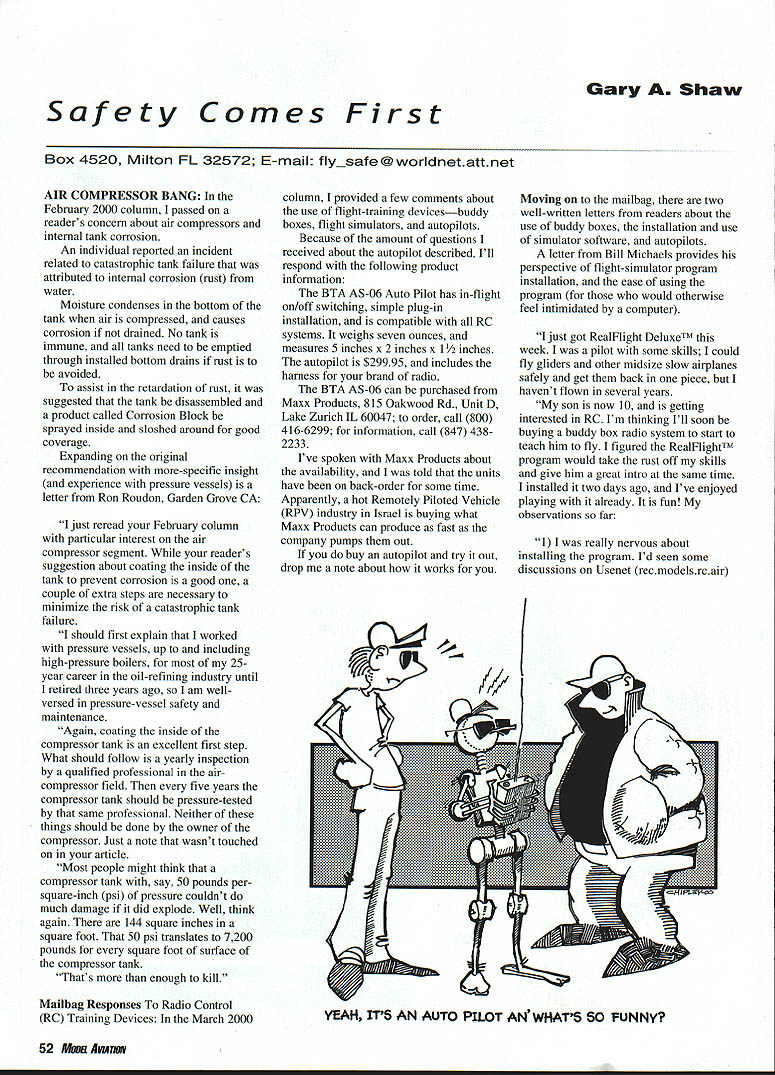
Because of the amount of questions I received about the autopilot described, I'll respond with the following product information:
The BTA AS-06 Auto Pilot has in-flight on/off switching, simple plug-in installation, and is compatible with all RC systems. It weighs seven ounces, and measures 5 inches x 2 inches x 1 1/4 inches. The autopilot is $299.95, and includes the harness for your brand of radio.
The BTA AS-06 can be purchased from Maxx Products, 815 Oakwood Rd., Unit D, Lake Zurich IL 60047; to order, call (800) 416-6299; for information, call (847) 438-2233.
I've spoken with Maxx Products about the availability, and I was told that the units have been on back-order for some time. Apparently, a hot Remotely Piloted Vehicle (RPV) industry in Israel is buying what Maxx Products can produce as fast as the company pumps them out.
If you do buy an autopilot and try it out, drop me a note about how it works for you.
Moving on to the mailbag, there are two well-written letters from readers about the use of buddy boxes, the installation and use of simulator software, and autopilots.
#### Letter from Bill Michaels
A letter from Bill Michaels provides his perspective of flight-simulator program installation, and the ease of using the program (for those who would otherwise feel intimidated by a computer).
"I just got RealFlight Deluxe™ this week. I was a pilot with some skills; I could fly gliders and other midsize slow airplanes safely and get them back in one piece, but I haven't flown in several years.
"My son is now 10, and is getting interested in RC. I'm thinking I'll soon be buying a buddy box radio system to start to teach him to fly. I figured the RealFlight™ program would take the rust off my skills and give him a great intro at the same time. I installed it two days ago, and I've enjoyed playing with it already. It is fun! My observations so far:
"1. I was really nervous about installing the program. I'd seen some discussions on Usenet (rec.models.rc.air) that sounded like the program was buggy and hard to install and run. I only have a Pentium 233 with an older 3-D graphics card, but it installed and runs fine. I've flown with the simple computer-generated graphics and the photolike backgrounds, and both work fine.
"2. I find that the simple background doesn't really take much away from the flight experience (my computer can barely handle the high-resolution graphics, so I don't usually use them). I'd like to see them for a faster system, though.
"3. The Futaba-style transmitter that arrived with the program feels just like a real transmitter, except it is lighter.
"4. My son and daughter (age 13) were intrigued by the program and wanted to use it. In addition to regular mode, my son likes to use it as a full-scale flight simulator using the 'view from the cockpit' option. This makes it two programs in one, as far as he is concerned!
"5. The only complaint I have is that it is hard to tell how high you are when flying. This makes it hard to tell what altitude the airplane is in sometimes. I find myself doing most of my flying close to the ground so I have the horizon as a visual cue.
"6. I thought the program seemed extravagant. My wife bought the deluxe version with both add-ons for $300. I almost returned it; it seemed awfully expensive, and I wasn't even sure it would run. I almost traded in the software for a new radio, kit, and engine! I'm glad now that I kept it; it is more fun than I thought it would be.
"My advice to people considering the software—buy it! I am sure that when I go out to the field for the first time in years I'll be glad I brushed up with RealFlight™ first.
—Bill Michaels"
#### Letter from a Retired Instructor (unnamed)
I spent many Sunday mornings "holding hands" with an instructor as we passed the transmitter back and forth. With slow-flying airplanes (and my slow reaction time), this worked okay.
Now that I am retired I spend more time at the flying field, and throughout the past three years I can't recall a single student who did not use a buddy box. They are taken for granted as a training device in my club.
I agree with you about the usefulness of simulators. A decent one costs only one-third the cost of a trainer. I am one of those people who does not learn physical maneuvers very easily (like dance steps) so the simulator is something I depend upon to keep up my skills in the winter months. A side benefit is that when I return to the flying field after a long absence, my pulse rate will be much lower because of the time on the simulator.
I know that others in my club have simulators, but I cannot give you any idea of the number. I have seen many messages in modeling forums where experienced pilots get very grumpy when the subject of simulators comes up.
I am not sure where this negative attitude originates. I have a feeling that it is from those who have forgotten how difficult it is for a beginner. They complain that the simulators lack a sense of depth and field-of-view on the computer, and the screen is too narrow. This is true, but it does not negate the positive utility of time spent on a simulator.
As for the sense of depth, the image of the model diminishes with distance, and that is a clear indicator of how far out it is. The narrow field-of-view is in contrast to the wide peripheral vision we have.
On the field, our feet tell us where the ground is, and our peripheral vision knows where the runway is. On the simulator it is very hard to locate the runway, so I would recommend to a beginner to just try landing the model out in front in a smooth fashion and recognize that they will have a better idea of where to land when actually standing on the flightline.
I have no experience of the autopilots, and have not heard any reference to them in my club. So the following comment is made in considerable ignorance.
For the new student who is not physically limited, I do not imagine that an autopilot will speed up the learning process. It will no doubt save some models, but if the student has enough sense to avoid flying in crosswinds, I feel that the autopilot mechanism is only going to delay the student's achieving a level of confidence that will lead to qualification.
Now for some contradictory observations to the above paragraph.
I have twice crashed models when I let them fly too far out, they lost their orientation, and they went down hard. I suppose an autopilot might have given me a better chance of getting them back within decent range (I now concentrate very hard to prevent that from happening again).
As I am not a youngster, I have seen that the difficulty of learning to fly RC goes up with the age of the student. I am amazed at the teenagers who, with good support, qualify quickly, while those beyond age 60 suffer crash after crash. For older students, perhaps the autopilots might minimize the discouragement of repeatedly rebuilding bashed models.
Closing Thoughts
It's great to receive mail that offers such interesting points of view; it allows me the opportunity to pass "real world perspectives" along to you. (I know you get tired of my opinions.)
I feel that more emphasis should be placed on the use of any device that assists with learning, while decreasing overall risk. Buddy boxes, simulator software programs, and autopilots add competence, safety, and value to the learning experience.
Try one of these devices the next time you fly. If you feel that the time you spend getting brushed up has been the least bit helpful, you've paid yourself dividends. Enjoy!
That's all for this month. Keep the skids on the bottom, and think about cleaning out the flight box for spring!
MA
Transcribed from original scans by AI. Minor OCR errors may remain.

