
Safety Comes First
Gary A. Shaw
Box 4520, Milton FL 32572; E-mail: [email protected]
Chemical Hazards
One subject that has generated significant discussion among modelers is the use of chemicals, and protecting yourself from chemicals.
I am qualified to say this because the majority of mail I've received has been focused on chemical uses; conversations I have with modelers at the field also often swing in this direction — and for good reason.
Chemicals play an important role in model-building, and most of us realize (usually after the fact) that we do a poor job of protecting ourselves from the hazards of chemicals.
In today's modeling environment, the list of chemicals we're exposed to seems endless. Glues, paints, resins, solvents, plasticizers, fibers, and fuels represent only a few.
To make matters more complex, each time we build a new type of model, we develop new substances or adapt existing substances to make creations stronger, lighter, and/or more flexible.
Most of the time we succeed in our efforts, and we pass this knowledge on to others.
Since many of us are also trying to make a buck, ideas and techniques are often quickly marketed. If the ideas and techniques are popular, the hobby grabs on fast and begins moving in a new direction.
Why is this an issue in this month's column?
I received an E-mail describing a glue that is currently favored for sheeting wings. I feel that the glue could be very hazardous if it is inappropriately used.
Elmer's® ProBond Polyurethane Glue is unique because it contains a product called Diphenylmethane 4,4'-Diisocyanate, which was previously used in polyurethane paint.
Why would I be concerned? Modeler Jim Zabel raises a few questions that warrant a response:
"Just how much of a health hazard does Elmer's® ProBond Polyurethane Glue really pose when used indoors in the average basement workshop?
"I just finished sheeting some cores with it for the first time and, though it doesn't have much of an odor, I did notice that it irritated my eyes and nose (a bit like CyA does) as I spread it onto the sheeting.
"The label does indicate that it is an eye irritant, and I tried to keep my face as far from the bench as possible to avoid breathing it as well, but it is impossible to avoid all vapors in an indoor shop. (One doesn't just open windows for ventilation in Minnesota this time of year either!)
"My concern is that the same label that accurately warns of eye irritation also warns of long damage, both immediate and delayed!
"Frankly, I am a bit concerned about this. Any Material Safety/Occupational Health experts that can shed some light on this?
"I'd rather not find out a few years down the road that I caused myself permanent lung damage by using this stuff."
Jim asks some good questions, which can be answered through review of the appropriate Material Safety Data Sheet (MSDS).
The MSDS is a document that the federal government requires be provided by manufacturers of chemicals on request, to anyone who uses the product, so that he or she is made aware of what hazards may be encountered. The MSDS lists the hazards of the chemical and information about how to protect yourself.
Having read the precautions on the product label and becoming concerned, Jim did the right thing: he contacted the manufacturer for specific information, to help minimize his overall risk.
Jim followed up with a second letter, defining the hazard that concerned him and providing recommendations for exposure control:
"I did a little more research for those of you that might be interested.
"I spoke to two very cordial and knowledgeable individuals in the technical department at Elmer's® and they told me:
- Elmer's® claims that the product contains no 'pure' isocyanate and that the extreme warnings on the label are mostly legal 'boilerplating' aimed at hazards resulting from 'misuse' of the product, such as heating it or spraying it (thus creating an aerosol mist that could be inhaled).
I was told that Elmer's® 'pre-reacts' the isocyanate in the manufacturing process, changing it into what was described as a 'longer chain molecule' that does not pose the same risk of crystallization in the lungs as pure isocyanate does. It does not make it harmless, but it does reduce the hazard potential some.
- Elmer's® says that the vapor pressure of the product is sufficiently high to prevent any of the 'pre-reacted' isocyanate from becoming liberated into the air. They also stated that it is not carried in the fumes you may notice when using the product.
The only way isocyanate can be liberated into the air is if it is heated, which we don't do when sheeting wings. The other possibility of injury from the isocyanate used is inhaling mist, resulting from spraying the product.
- I was told that the main risk from the product is actually 'sensitization,' resulting in allergic reactions in persons susceptible to chemical sensitization.
These symptoms would be like that of a cold or respiratory flu. Vapors from the product can also aggravate existing asthmatic conditions in some individuals, just as CyA or other chemicals can.
- Elmer's® claims that the product is as safe to use as any other household chemical, as long as adequate ventilation is used.
- The fumes that are noticed are classified as simple 'organic vapors.'
For those worried about possible as-of-yet-unknown effects of breathing the fumes while using the product, Elmer's® states that a respirator with 'organic vapors' rated cartridges provides ample protection."
Diphenylmethane 4,4'-Diisocyanate has been known to cause severe allergic reactions in individuals exposed to it over time.
Because of its ability to cause sensitization, if a product you use contains diisocyanate, follow MSDS precautions to the letter—unless you desire becoming the next person allergic to it.
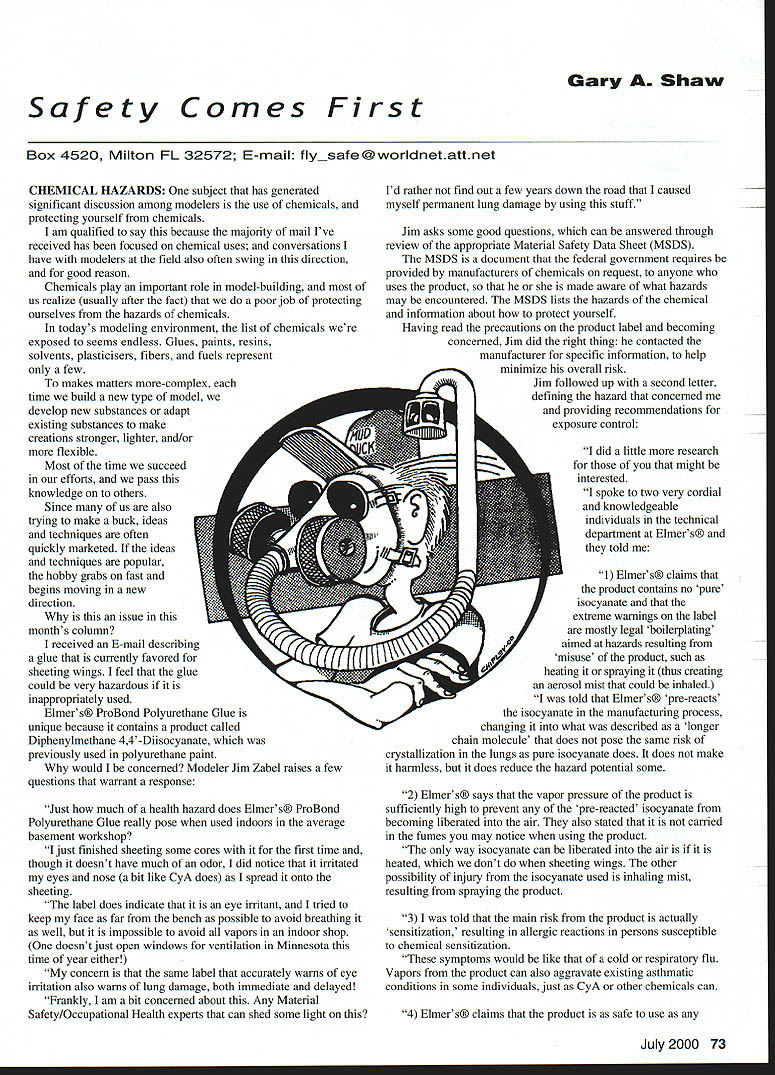
Don't use this glue without personal protective equipment — such as gloves, an organic-vapor respirator, and goggles — and never heat, spray, or use the glue without ventilation.
I'm sure the glue's bonding properties and durability are excellent, but you should be extremely careful with it.
From the Mailbag
In past columns, I've written about the virtues of using a buddy box, computer simulator, or autopilot while learning to fly, and I've asked readers to let me know if using such equipment helped them learn.
Christine L. Demmons wrote to tell of her experiences and successes:
"The article you wrote in the March 2000 issue: I would like to give you my input.
"I am a student and have learned with the buddy box and the computer simulator. The autopilot I have never heard of. My club, the Salem Barnstormers, uses only the buddy box system, and I think it is the only way to learn.
"With the buddy system, you get into trouble, and the instructor can rescue the airplane instead of getting out a trash bag. I have seen the method of passing off the controller, and it makes me cringe when I see it. You have a split-second to make a decision, and you are passing a controller in that second.
"I saw an airplane go out of control once because of a controller passing, and I knew then my club was right using the buddy box system.
"The simulators are an incredible tool. After about my third flight, I was ready to throw the towel in. I am a quick learner, and not catching on made me just a little frustrated. My husband bought the Radio Control (RC) Great Planes® simulator, and for a week I practiced.
"Next time I flew, my instructor knew something had changed. I explained the simulator and he started me with homework on it. This winter he has me practicing my landings, and maybe in the spring I will be soloing.
"We live in New Hampshire and it can be a long winter. My husband and I will watch the snow fall as we fly our simulator. Worse does come to worse in New England, and the simulator is the closest tool you will find off the field.
"Thanks for listening to my input.
"Yes, I am a girl and I love to fly!"
Congratulations Christine, and thanks for the input. Enjoy the skies! You'll be sharp as a tack this spring, and you'll enjoy the learning experience that much more.
That's all for this month. Happy skies! MA
Transcribed from original scans by AI. Minor OCR errors may remain.

