
Safety Comes First
Box 4520, Milton FL 32572; E-mail: [email protected]
From the Mailbag
Earlier this month (April), a letter arrived that described the possibility of radio interference being generated when using power panels.
When the writer started his model from his deluxe power panel, he noticed frequent radio "glitching" that seemed to occur only when his glow starter was connected to the power panel and the model.
"I had started the engine and was having my daughter Robin operate the controls, when I noticed a flutter in the ailerons and then the throttle advanced to a very high idle.
"I looked at my daughter and asked if she had done that, and she said 'no.' I then disconnected the glow connector from the glow plug and set the airplane down on the ground away from the power panel and its glow plug driver circuitry.
"With the radio still switched on, we observed the airplane for a few minutes and saw no more 'glitching.' It then occurred to me that the switching circuitry in the power panel was probably the cause, so I decided to go ahead with the first flight.
"All went 'okay,' and I was able to bring the Easy-Sport 40 back in for a safe landing.
"I have no real way to be absolutely sure that the power panel is the cause of the glitching, but am relying on 'gut instinct.'
"I remember having similar problems when I first started out in Radio Control (RC), in that when using a power panel and a connected glow plug driver, my models seemed to glitch every now and then.
"Since radio interference was more of a norm back then, I just attributed jumpy servos to any number of potential interference issues and never connected the possibility that the panel or glow driver might be the culprit.
"What made me a believer one day was watching my model glitch while starting it with the panel, but no glitching occurred when I used my 'new' pocket glow starter. Apparently, the wire connection to the panel or the circuitry in the panel caused feedback, which translated to radio interference.
"Not knowing there might be a connection between the interference and the panel, I can't tell you how many times I sent equipment back to the manufacturer over the years to get checked.
"To make a long story short, once I routinely started using pocket glow drivers to start my models, the glitches went away, and so did my awareness to the problem.
"Obviously, many still use the old glow driver/power panel method when starting airplanes, and need to be aware that glitches might occur. Although I never had an engine go nuts as described above, I did have everything start buzzing and jump around.
"If you currently use a glow driver connected to a power panel, take heed, and be careful."
'Nuff said!
Which is safer: wood, plastic, or metal propellers?
Throughout the years, I've written many columns that contained hand-in-the-prop stories, for the purpose of demonstrating the destructive potential of a whirling blade.
I'd like to think that a few modelers have heeded warnings to keep body parts out of the prop arc, but with today's high-performance propellers, the need to heed these warnings and be even more diligent has never been greater.
John T. Deden wrote to highlight the concern, and to ask several questions about current AMA rules.
"Tonight I read the May 2000 issue of Model Aviation, and got into your column on page 72. For some reason, it triggered a question and a quandary I've had for years about AMA legal and illegal props.
"As I recall, without looking it up in the Safety Code, metal propellers have long been outlawed because of their extreme hazards to body parts when in use on our models. I assume this is still the criteria.
"That safety rule was promulgated and established in the era when the choices of props was either metal (aluminum) or a good, hard wood. Then along came, eventually, today's almost indestructible plastics, which immediately went into props all over the world.
"Today, almost all, or at least a huge percentage of, model props are one form of semirigid, virtually nonbreakable plastic of various fiber and plastic molded materials.
"Today's plastic props, to me, as an old modeler of some 50-plus years experience with metal, wood, and today's plastics, are as deadly as the metal props were considered to be 20-plus years ago when the ruling was established. (I think it was about 20 years.)
"I have had the experience of getting fingers caught in a whirling wood prop (minor cuts and broken prop), and later my wrist caught into a whirling metal prop (quite bad cut, just misses a major vein).
"I hope I never encounter the cutting edge of a plastic prop, as from my observations of prop/hand, etc. accidents, I would expect the whirling plastic prop to slice into my flesh or remove a finger or portion of a hand just as easily as would the outlawed metal props.
"Saw one of our club members a few years back get one of his hands almost sliced in two by a couple of passes by a plastic prop.
"I have had a couple of very close encounters when a well-known plastic prop, after a smooth and successful flight and landing, shattered, burying a four-inch piece three inches into rather hard soil at the edge of my kneecap and my field box, while the rest of the prop was discovered some 40-plus paces straight out from the airplane, partly buried into the semihard earth.
"I've never had a wood prop do that. Yes, I've had wood props shatter on botched landings, aborted takeoffs, and backfires, and even had wood pieces whack my pant leg, but I assure you that if that shattering plastic prop's piece had been about four inches aft, it would have 100% skewered into my left leg!
"Okay, question of the year: Since modern plastic props possess almost identical hazardous materials characteristics as metal props (i.e., the ability to cut like metal and be as indestructible as metal in the penetration or slicing mode), why are they allowed and metal is not?
"Frankly, from my engineering background, I cannot see any significant difference between the two. Why the okay for hard as steel, yet 'flexible and crash resistant' plastic, with its sharp and deadly cutting abilities, versus the not flexible, not crash resistant, but no-stay for equivalent hard steel/aluminum blade?
"Both have fine cutting edges and appear to have equivalent cut and slice capabilities. In the long past, some 'Survival Knives' were of sharp, hard plastic.
"Will appreciate hearing how past and present AMA officers have permitted this anomaly to persist. Note: I'm not an advocate for metal props, but would like to see/hear what was and is the reasoning on this obviously out-of-date and possibly biased rule."
John, I don't have an answer to give as of this writing, but I will forward your question on and see if I can get a response.
I agree that today's materials offer great potential for harm in the external propeller and internal jet-turbine category; external for hand-in-the-prop issues, and jet turbine for high-speed spin failures and flying debris.
I'll formulate a response to your question and get back to you as soon as I can. Any reader opinions? Drop me an E-mail.
Battery Pack Replacement Basics
In recent columns, I've written about charging batteries, Black Wire Disease and batteries, and replacing old battery packs.
Although I'm no expert in electronics, I take the position of "when in doubt, throw them out." It's better to spend $30 for a new pack than $300 for a new airplane, or maybe more for hospital bills if your aircraft goes into the crowd and gets you.
Bob Pinkus provides a few tips that might keep you from losing an airplane, or getting hurt from an airplane that goes astray:
"I've been in RC for about 25 years, and as vice president of the on-base club for 23 of them. I'm also an Extra Class Amateur Radio Operator of 38 years.
"All these electronics use lots of Ni-Cds, and I've learned a great deal about them through reading, trial and error, and in my job with the Air Force at Wright-Patterson Air Force Base. Worked in RPV's (Remotely Piloted Vehicles) a number of years back. Recently been in the B-2, X-30 National Aerospace Airplane, Gunship, U-2R, LANTIRN (Low Altitude Navigation and Targeting Infrared For Night), Propulsion, etc.—you get the idea.
"You had some words regarding finding dead cells in packs.
"I think it would be good to point out a bad practice I've seen people do that is an invitation to failure. That is, removing dead cells from an old pack and replacing just those dead cells with new ones. Save a buck now. Lose an airplane later (and not much later at that).
"The different internal resistances will always cause overcharging in some cells, insufficient charging in others, and either complete shorts or even polarity reversal, which is worse than a dead short.
"Series circuits try very hard to equalize the current draw across all the elements in that string. Most people know this, but all don't and newcomers certainly don't.
"Also, people need to know the signs of cells about to die. Voltages and current draws (cycling) can mislead. White powdery substance at the positive end means the cell has opened its vent and is leaking electrolyte. Brown coffee-stain appearance means it's hemorrhaging and will die very soon.
"Just wanted to point that out."
Thanks for the tips, Bob.
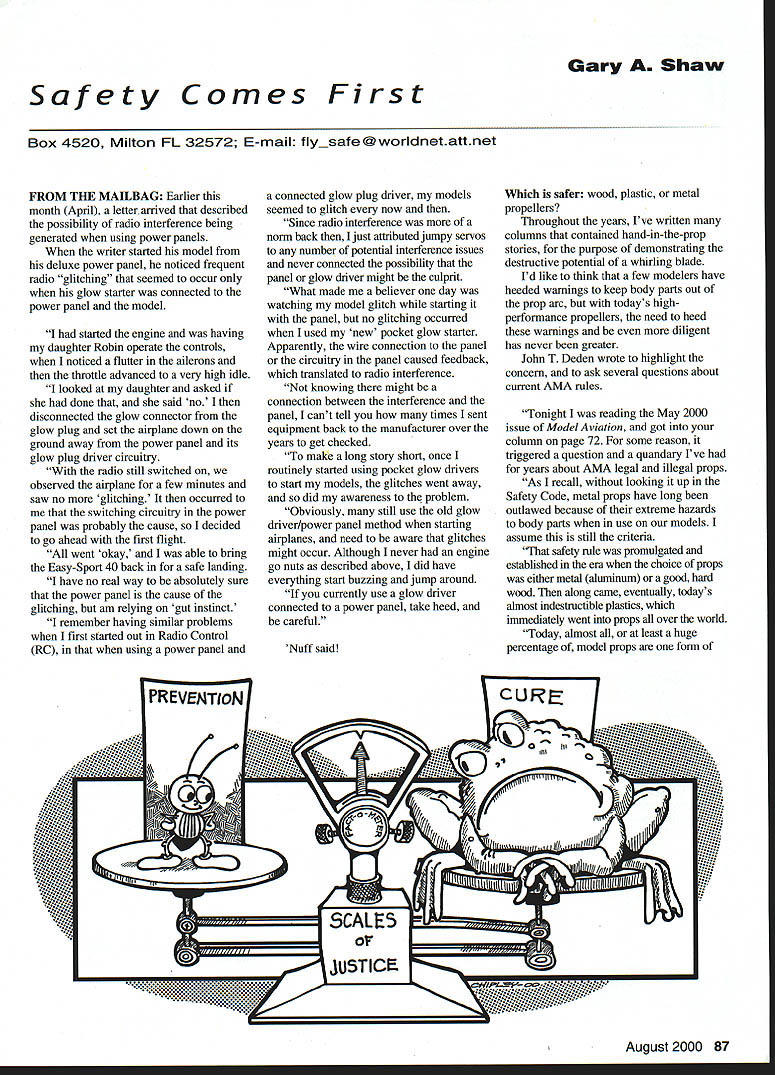
Remember, an ounce of prevention is worth a pound of cure when suspecting batteries. Take the high road and replace the pack!
Until next month, keep the skids on the bottom, and the wings in the sky! MA
Transcribed from original scans by AI. Minor OCR errors may remain.

