
Safety Comes First
Gary A. Shaw
Box 4520, Milton FL 32572; E-mail: [email protected]
TIME TO WINTERIZE: The flying season is coming to a close, which means it's time to think about what needs to be done to get ready for next season.
This time of year, pilots need to toss cracked or chipped propellers, discard used rubber bands, toss the collection of burned-out plugs, and put some after-run oil in engines to prevent rust. If the covering is cracked, fix it. If the wheel mounts are loose, find the cause and fix that (helps keep the wheels on the bottom).
If you think you have a short flying season, consider pilots in Alaska. While I was fishing there in July, I couldn't help but wonder what they do different from the "lower 48" when they prepare their airplanes for the next season.
I returned home, did a quick Internet search, and learned of an excellent Web site through the AMA and AMA District XI Web pages: the Alaska Radio Control Society at www.alaskarcc.org.
Within it, I found an excellent article titled "Facts about Fuel," about preserving fuel for long periods of time (winter).
If you're curious about what makes fuel go bad, go to www.alaskarcc.org and click on "Hints/How To's." Or review the following, from a five-part presentation by Don Nix ([email protected]), former president of GBG Industries (maker of PowerMaster model fuel).
Facts About Fuel
During the Question and Answer part of countless "Dog and Pony Shows" at hobby clubs all over the US, one of the frequently asked questions is, "What's the shelf life of fuel?" The answer is both simple and easy. Properly stored, model engine fuel will last almost indefinitely.
So what constitutes "properly stored?" Let's take a look.
Contrary to many things you might have read or heard, just about the only thing that adversely affects model fuel is the absorption of moisture from the air. Keep the air away from it, and your fuel will likely be potent.
Methanol—the major ingredient in model fuel—is hygroscopic. This means it's virtually 100% soluble in water, and absorbs moisture from the air like a vacuum cleaner sucking up dirt. Most modelers have no idea how rapidly this can—and does—happen, and tend to be rather skeptical about the idea.
Let me paint a picture for you: Almost everyone has spilled a little fuel on the top of their fuel can in their flight box. If so, you've no doubt noticed that the shallow film of raw fuel takes on a cloudy, milky look. What you are seeing is the methanol sucking moisture right out of the air.
Since the quantity of fuel is thin with a lot of surface area, the absorption is rapid—the water won't mix with the oil and the fuel turns cloudy. Just remember how quickly this happens—almost immediately—and it might give you an idea of just how quickly your fuel can be ruined if you leave the cap off, allow a vent tube to remain open, etc.
The wide surface area, relative to the quantity of the fuel exposed, is disproportionate, of course, to leaving the cap off the fuel jug, but I think you get the idea. In a humid condition such as exists in parts of the US, it doesn't take very long at all to adversely affect your fuel. And it doesn't take a large opening—a cross-threaded cap, a small vent line, etc.—is all that's needed to do the damage.
The solution is simple, of course—just keep it tightly sealed.
And yet, sometimes that's not enough. Most of us have seen small droplets of condensed water inside our fuel jug after it's become partially empty. This is the result of condensation of moisture as the air trapped inside the jug cools.
While some claim exposure to sunlight (or lights, for that matter) will cause pure nitromethane to deteriorate over time, it's our experience that once the nitromethane is in a solution and substantially diluted, the deteriorative effect is relatively minor.
To test this, some years ago we put a gallon of 10% fuel out in direct sunlight (in sunny Southern California) for a month. At the end of that time, we tested that fuel in an engine versus the fresh product and could see no difference.
While it certainly won't hurt anything to store fuel away from direct sunlight, etc., it's our personal opinion that the adverse effect of sunlight on fuel under normal operating conditions is too little to worry about.
From the Mailbag
In the August 2000 column, I included a letter that asked why AMA allows the use of carbon-fiber propellers. In the writer's opinion, carbon-fiber propellers have cutting abilities similar to metal propellers.
The letter received strong responses, focused on what caused AMA to outlaw metal propellers.
I've been told that metal propellers were banned because of metal's ability to flex, crack, and break at high rpm, causing dangerous missile-firings at the field.
Metal could take a finger off, but so could wood, plastic, and carbon-fiber propellers. However, projectiles from the latter are less effective at greater ranges.
The following letter did a nice job of summing up the real issue: not putting your hand in the propeller to begin with.
"I strongly agree with John Deden's opinions about the relative danger from propellers made of different materials.
"My flying experience began in the mid-1950s, and we had the choice of wood or nylon propellers. The nylon propellers were nearly indestructible, while [wood props] were more fragile. They had a thick airfoil cross-section, and thus, no sharp leading edges. Wood propellers broke much more easily, but the broken pieces were fairly innocuous, as were the spinning intact propellers. Nylon propellers rarely broke, but when they did, the pieces posed a greater danger.
"The most-dangerous propellers then were the razor-sharp 1/2A nylon versions. They wouldn't take a finger off, but they would make a dozen or so paper-like cuts in an instant. Wounds from these stung badly, and for a long time.
"Those who flew in Racing and Speed events faced a higher danger potential from engines, which spun the propeller at a higher rpm, and with greater torque. Back then, the average engine was much less a threat than the hopped-up power plants.
"Today, even an average engine can match the danger potential of yesterday's hopped-up engines. These high-torque, high-rpm engines coupled with today's thin-bladed propellers (as opposed to earlier thick airfoils) make the propeller much more dangerous. In my opinion, the culprit is not material but blade shape and speed. The logical solution is safe handling and adherence to AMA safety rules."
Cross-sectioned, razor-edged carbon-fiber or fiberglass-filled composite propellers can slice off body parts without any hesitation. Today's high-performance engines are all the more dangerous with their extreme rpm. Propeller-accepted prevention is the same today as 50 years ago:
- Never allow objects or body parts to enter the plane of the spinning propeller.
- Never reach over the propeller to adjust the engine.
- Never hurry while adjusting the engine for a flight.
- Follow your starting/adjusting procedure meticulously each time.
"I always connected my airplanes to a storage during the starting/adjusting period. That way if my helper or I screwed up, the airplane couldn't go anywhere. We kept rags in our pockets to toss into the propeller, stopping the engine if disaster struck, but I'm now sure this would work safely with today's engines. When I fly presently, I still use my older engines."
Mystery Interference Identified and Solved
Each one of us has probably had a radio glitch while at the field, or has perhaps even lost an airplane to an unknown "hit."
You may have read this on the AMA National Newsletter Web site from May 2000, but it was of such safety importance, I've included it here.
Submitted via E-mail by Jim Busk:
"Just a note to relay an experience I went through last summer at our flying field concerning interference. The problem we were having was that we had intermittent interference that was bad on some days, and nonexistent on other days.
"Our airplanes would get hit with short—and sometimes not-so-short—glitches, the PCM (Pulse Code Modulation) receivers would go into hold for one to two seconds (seemed longer when it was happening!), and we had several crashes because of this unidentified phenomenon.
"The problem was not on just one RC (Radio Control) channel, but it seemed to skip around from channel to channel. Since I am a ham-radio operator, I tried to identify the problem, and spent many hours with a radio-frequency spectrum analyzer, monitoring the RC frequencies at the field. I did this during the weekdays (I'm retired) when no one was flying, which made it easier, as there were no strong local signals to cover up the potential source of the interference.
"I could not find any significant interference in the immediate area where we were flying, and to say the least, this had me talking to myself. After spending a fair amount of money to find the problem, all I had was a thinner wallet!
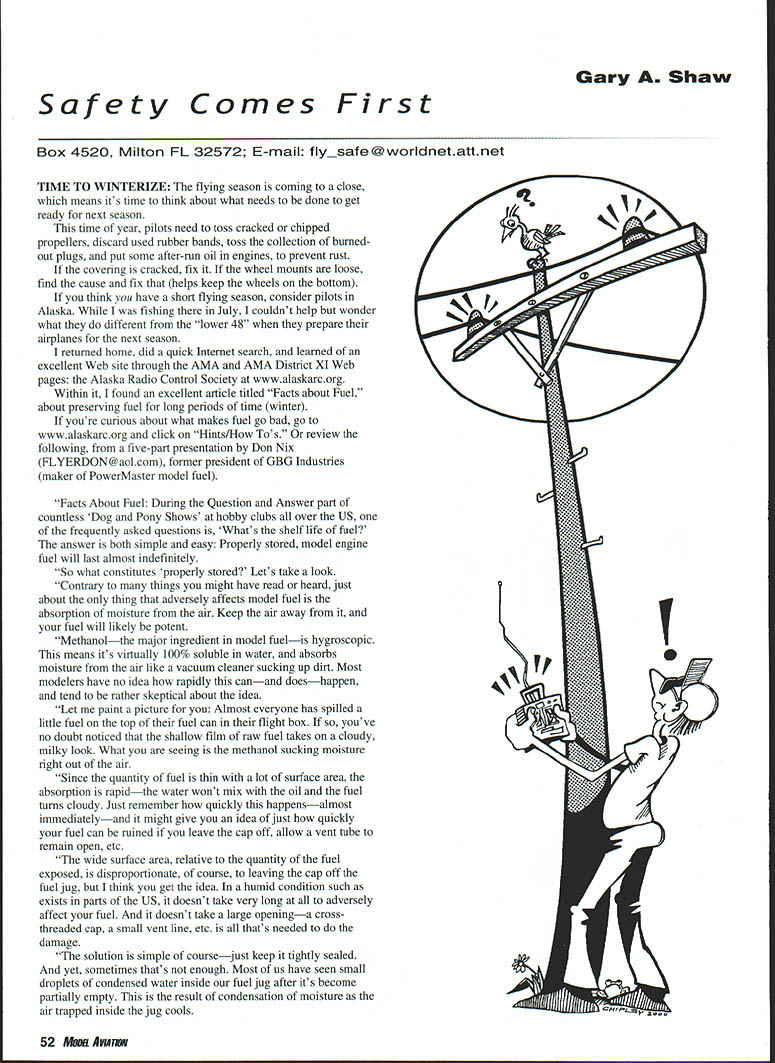
"One day, while wandering around with a hand-held portable analyzer, I noticed a small amount of noise in the vicinity of some electric-company lines running along the road that leads to our field. The noise was not very strong at all, and at first I did not think it was the problem. More checking revealed that on windy days, the interference was quite a bit stronger, particularly if I stood near a pole (wood, about 50 feet high) that had a ground wire running down it to a metal stake driven into the dirt.
"When I compared the signal strength of the noise to the strength of the RC transmitters that were approximately 600–800 feet away, I found that the RC signals were quite a bit stronger. Again, this made me wonder if this was indeed the problem.
"Since the wind seemed to make a difference in the noise, I took a heavy hammer and hit the pole a few times to get it vibrating. The result was an even stronger broadband interference showing on the analyzer. I tried this with the line of poles that ran alongside the field, and found two poles that were really noisy when I hit them.
"I then contacted the electric company, and after asking a few times, they came out with their noise crew and found the same thing I did using their own analyzer. They sent linemen out to replace insulators on the two poles. This fixed the problem completely! We have had no crashes or glitches from interference since the insulators were fixed.
"The explanation as to why the signals did not seem to be strong enough to cause the problem is that the noise was coming from the insulators leaking (the primary line-voltage in that area being about eight kilovolts), and the noise source was high in the air. At ground level, the noise signal was not as strong as above the ground where the airplanes flew.
"Also, the noise was very sporadic, and the average level was fairly low, but once in a while there were fairly good spikes of noise being radiated.
"The electric crew told me that noise from old insulators is not that uncommon. But it turns out it was enough to cause us problems for quite a while until it was found and fixed. The reason the noise was stronger on the pole with a ground wire running to earth is that the wire was conducting the noise and radiating it at the lower elevation where I was standing with my spectrum analyzer." MA
Transcribed from original scans by AI. Minor OCR errors may remain.

