
Safety Comes First
Box 4520, Milton FL 32572; E-mail: [email protected]
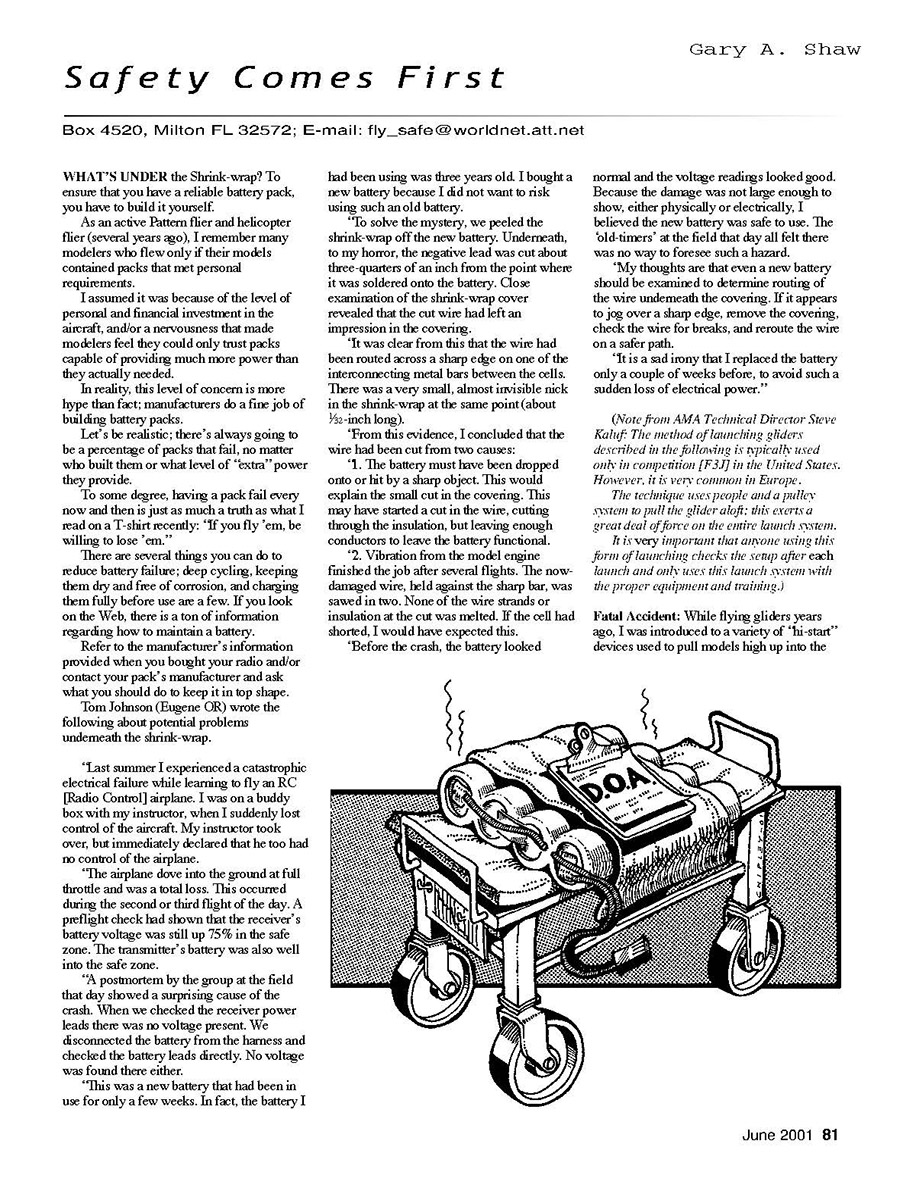
WHAT'S UNDER the Shrink-wrap?
To ensure that you have a reliable battery pack, you have to build it yourself.
As an active Pattern flier and helicopter flier (several years ago), I remember many modelers who flew only if their models contained packs that met personal requirements. I assumed it was because of the level of personal and financial investment in the aircraft, and/or a nervousness that made modelers feel they could only trust packs capable of providing much more power than they actually needed.
In reality, this level of concern is more hype than fact; manufacturers do a fine job of building battery packs. Let's be realistic; there's always going to be a percentage of packs that fail, no matter who built them or what level of "extra" power they provide. To some degree, having a pack fail every now and then is just as much a truth as what I read on a T-shirt recently: "If you fly 'em, be willing to lose 'em."
There are several things you can do to reduce battery failure: deep cycling, keeping them dry and free of corrosion, and charging them fully before use are a few. If you look on the Web, there is a ton of information regarding how to maintain a battery. Refer to the manufacturer's information provided when you bought your radio and/or contact your pack's manufacturer and ask what you should do to keep it in top shape.
Tom Johnson (Eugene OR) — Potential Problems Underneath the Shrink-wrap
Last summer I experienced a catastrophic electrical failure while learning to fly an RC (Radio Control) airplane. I was on a buddy box with my instructor, when I suddenly lost control of the aircraft. My instructor took over, but immediately declared that he too had no control of the airplane.
The airplane dove into the ground at full throttle and was a total loss. This occurred during the second or third flight of the day. A preflight check had shown that the receiver's battery voltage was still up 75% in the safe zone. The transmitter's battery was also well into the safe zone.
A postmortem by the group at the field that day showed a surprising cause of the crash. When we checked the receiver power leads there was no voltage present. We disconnected the battery from the harness and checked the battery leads directly. No voltage was found there either.
This was a new battery that had been in use for only a few weeks. In fact, the battery I had been using was three years old. I bought a new battery because I did not want to risk using such an old battery.
To solve the mystery, we peeled the shrink-wrap off the new battery. Underneath, to my horror, the negative lead was cut about three-quarters of an inch from the point where it was soldered onto the battery. Close examination of the shrink-wrap cover revealed that the cut wire had left an impression in the covering.
It was clear from this that the wire had been routed across a sharp edge on one of the interconnecting metal bars between the cells. There was a very small, almost invisible nick in the shrink-wrap at the same point (about 1/32-inch long).
From this evidence, I concluded that the wire had been cut from two causes:
- The battery must have been dropped onto or hit by a sharp object. This would explain the small cut in the covering. This may have started a cut in the wire, cutting through the insulation, but leaving enough conductors to leave the battery functional.
- Vibration from the model engine finished the job after several flights. The now-damaged wire, held against the sharp bar, was sawed in two. None of the wire strands or insulation at the cut was melted. If the cell had shorted, I would have expected this.
Before the crash, the battery looked normal and the voltage readings looked good. Because the damage was not large enough to show, either physically or electrically, I believed the new battery was safe to use. The "old-timers" at the field that day all felt there was no way to foresee such a hazard.
My thoughts are that even a new battery should be examined to determine routing of the wire underneath the covering. If it appears to jog over a sharp edge, remove the covering, check the wire for breaks, and reroute the wire on a safer path.
It is a sad irony that I replaced the battery only a couple of weeks before, to avoid such a sudden loss of electrical power.
Note from AMA Technical Director Steve Kaluhi
The method of launching gliders described in the following is typically used only in competitions (F3J) in the United States. However, it is very common in Europe.
The technique uses people and a pulley system to pull the glider aloft; this exerts a great deal of force on the plane, which can be dangerous. It is very important that anyone who attempts this form of launching checks the setup after each launch and only uses this launch system with the proper equipment and training.
Fatal Accident
While flying gliders years ago, I was introduced to a variety of "hi-start" devices used to pull models high up into the sky. The results were so spectacular that until electric motors offered similar performance, I would never consider using anything else.
Because of the weight of the models towed and the heights people try to achieve, equipment can be quite powerful. The tragic story that follows was provided by E-mail (source unknown), and reveals precautions that should be taken whenever modelers employ the use of powerful equipment.
"Recently, rumors from Europe reached the BMFA (British Model Flying Association) to the effect that a person had been killed during the towing of a model glider. Remarkably, very little information was available from official sources, so BMFA members used various contacts throughout the continent and have managed to piece together what appears to have happened.
"The accident happened while a rocket SE-8 competition was taking place, but the person concerned was not flying in this event; he was relatively inexperienced and was using the site to practice glider flying.
"A pulley launch system was being used, whereby the towline was anchored to the ground by stakes, being passed around a handled pulley and back to the glider. On the signal to start, the two towers ran away from the fixed stake to pull in the line and launch the model. Much the same system is used competitively all over the world to launch model gliders.
"On the day in question, after 'about 30 launches,' the stake anchoring the pulley to the ground was pulled out by the force of the towline and struck one of the towers — a 16-year-old — in the back of the head, which tragically killed him.
"Understanding the cause of the accident, however, is of equal — if not more — importance to sport glider fliers using the 'pulley-tow' technique than for competition fliers. It appears that the holding stake had been fixed at the start of the day's flying and had probably not been checked for security, subsequently.
"Repeated towing had caused it to loosen until it reached the point when it was pulled from the ground by the towline at high tension. The only direction it could then take was toward the towers, which it did with tragic and fatal consequences.
"In competition flying in the United Kingdom, holding stakes are required to be a minimum of 450 mm long and 15 mm diameter, of which 350 mm must be driven into the ground. Stakes are often moved or lines reattached during competition and are therefore regularly checked by default; this is not usually done in the case of sport or practice flying.
"The lesson is very clear that any staked pulley must be regularly checked to verify its security; failing to do so could be your last mistake ever!"
That's all for this month. Keep the wings level and the wheels on the bottom. MA
Transcribed from original scans by AI. Minor OCR errors may remain.

