
Safety Comes First
Box 4520, Milton FL 32572; E-mail: [email protected]
Chemical hazards in the workshop
I'll start this month with a word of caution about the use of chemicals in the workshop.
You can buy almost anything to use when building or repairing things that fly. I've seen a few homegrown mixtures of "stuff" for different applications that were touted as being "real good."
It could be said that many of the chemical successes used in the industry today had a portion of their roots in modeling, but that doesn't mean you should be any less careful exposing yourself to them than to something bought off the shelf.
On numerous occasions, I've seen friends try to adjust the hardening rate of cyanoacrylate glue (CyA) by mixing different kinds of chemicals together, then misting the mixture onto various surfaces with CyA applied. The concoctions were tested in the garage to see if they could help improve the foam-wing building process.
I'm not sure what was being sprayed, but it smelled like acetone; there was no local ventilation, and the modeler wasn't wearing gloves or eye and respiratory protection. I'm not aware of any "breakthroughs," but the person doing the spraying inhaled quite a bit of the mixture.
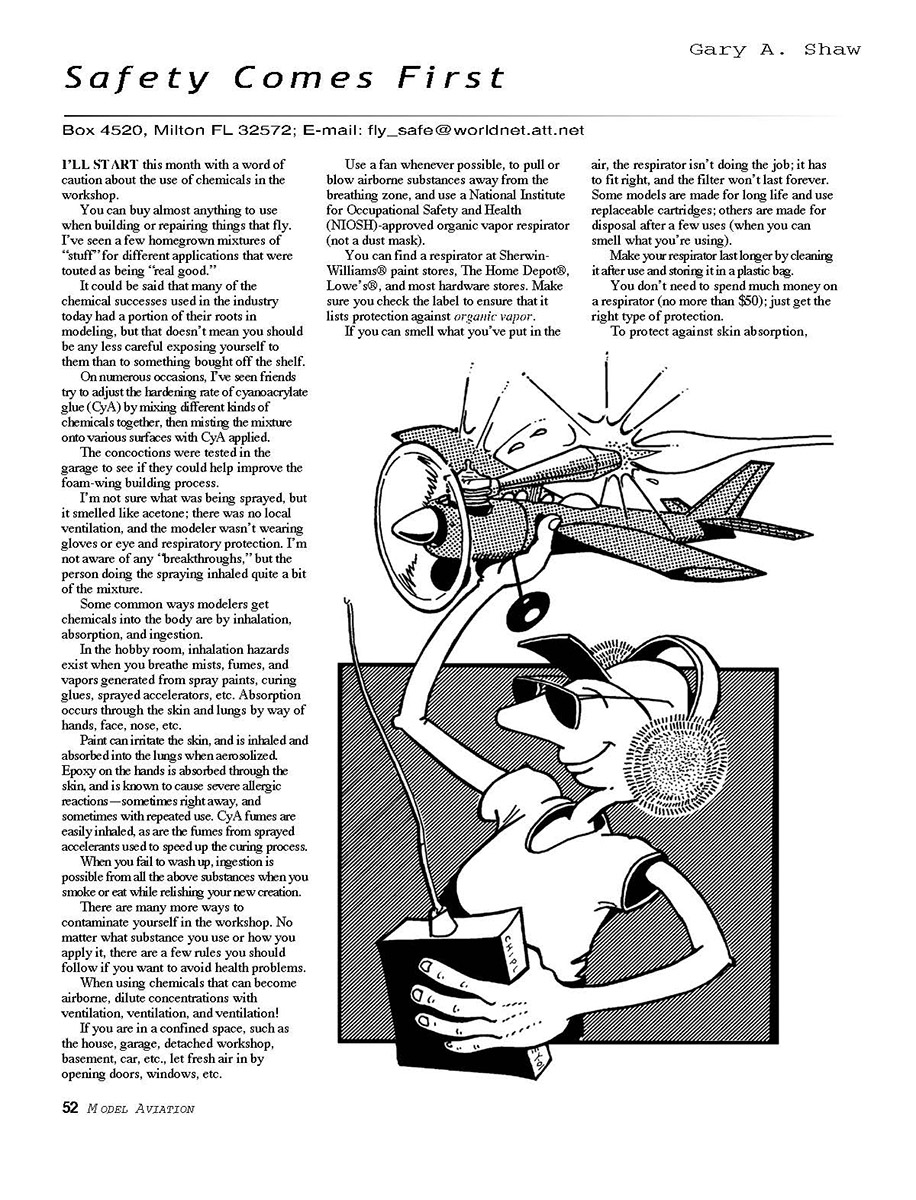
Some common ways modelers get chemicals into the body are by inhalation, absorption, and ingestion.
- Inhalation hazards exist when you breathe mists, fumes, and vapors generated from spray paints, curing glues, sprayed accelerators, etc.
- Absorption occurs through the skin and lungs by way of hands, face, nose, etc.
- Ingestion becomes possible when you fail to wash up and then smoke or eat while rehandling your new creation.
Paint can irritate the skin, and is inhaled and absorbed into the lungs when aerosolized. Epoxy on the hands is absorbed through the skin, and is known to cause severe allergic reactions—sometimes right away, and sometimes with repeated use. CyA fumes are easily inhaled, as are the fumes from sprayed accelerants used to speed up the curing process.
There are many more ways to contaminate yourself in the workshop. No matter what substance you use or how you apply it, there are a few rules you should follow if you want to avoid health problems.
Ventilation and respirators
When using chemicals that can become airborne, dilute concentrations with ventilation, ventilation, and ventilation!
If you are in a confined space, such as the house, garage, detached workshop, basement, car, etc., let fresh air in by opening doors, windows, etc.
Use a fan whenever possible to pull or blow airborne substances away from the breathing zone, and use a National Institute for Occupational Safety and Health (NIOSH)-approved organic vapor respirator (not a dust mask).
You can find a respirator at Sherwin-Williams® paint stores, The Home Depot®, Lowe's®, and most hardware stores. Make sure you check the label to ensure that it lists protection against organic vapor.
If you can smell what you've put in the air, the respirator isn't doing the job; it has to fit right, and the filter won't last forever. Some models are made for long life and use replaceable cartridges; others are made for disposal after a few uses (when you can smell what you're using).
Make your respirator last longer by cleaning it after use and storing it in a plastic bag.
You don't need to spend much money on a respirator (no more than $50); just get the right type of protection.
Skin protection
To protect against skin absorption, wear chemical-resistant gloves and protective clothing, and follow the product label instructions for different types of applications.
Local paint and hardware stores normally carry the equipment needed. If you can't find it there, try commercial pesticide and herbicide suppliers—Lesco® is one. It's your body, and only you control what goes on it or into it. Keep yourself healthy by reducing what you expose yourself to, and you'll ensure a much happier life in the process.
Hearing protection
How many of you enjoy target shooting? Do you use hearing protection when you're shooting?
Most people who shoot get regular doses of gun-safety courses about what will happen to their hearing if they fail to protect it from high-impact noise. If you protect your hearing from exposure to gun noise, wouldn't you protect it from exposure to model-engine noise?
What fascinates me when I go to a field is that few people protect their ears. I know many people who model and shoot, and they only protect their hearing when they shoot. It seems there's a paradigm about noise that has to be broken—do you just get better education about hearing protection when you engage in other activities?
Let me know your thoughts about ways to educate modelers. If you're a club safety officer, you can help by talking about the effects of noise at club meetings.
Modelers have enough rules to follow when flying, but protecting their hearing should become a personal standard they choose to follow, rather than being told they have to.
In a later column I'll define what noise is, when it becomes destructive, and what you can do to minimize its effects. Until then, wear ear muffs or plugs to protect your hearing whenever you start an engine. Your ears will be glad you did!
Transcribed from original scans by AI. Minor OCR errors may remain.

