
Safety Comes First
Box 4520, Milton FL 32572; E-mail: [email protected]
A VALID POINT: AMA recently forwarded a letter to me from Todd Thomasson (Danville VA) that contained a very good question: Should flying fields have first-aid kits?
"I am only 17 years old, but I felt compelled to bring up an important, yet very simple, safety factor: a first-aid kit. I have seen numerous accidents at the club field and fly-ins and something occurred to me when dealing with the aid of injuries.
"Many times after someone is unfortunately struck by a prop, there is some bleeding of some sort. I myself have been struck several times and I am lucky to still have use of my thumb. I have read in magazine articles how people would use an old greasy and dirty rag of some sort to wrap the wound with, which may work but is not sanitary and can lead to infection.
"With a first-aid kit, there are immediate supplies there at your convenience that you could use to tend to yourself. First-aid kits are inexpensive, and with the materials they contain an injury could quickly be tended to.
"Many rules and guidelines have been set to help keep such things from happening, but I haven't seen much on the subject as to what to do when an accident does occur.
"I think that before we have another column telling us how to improve our habits to a higher standard of safety, we should have a column or brief discussion of what someone should do in case of an injury.
"We all are human and make our fair share of mistakes, but something like a first-aid kit can quickly take care of a bad situation until any more necessary care is needed. I feel that all fields should have first-aid kits and that AMA should do something to help influence them into doing so.
"I am hoping that you will mention this to some extent in the newest issue as possible, seeing as the flying season is starting back up. Injuries are going to occur, but they don't have to be as bad if there was simply a first-aid kit at hand to help better the situation."
Todd is correct when he states that first-aid kits can be essential for improving a bad situation, and I agree that flying fields should have one on hand. The contents come in handy when you're in need!
In the past I've written plenty about the benefits of having a first-aid kit on hand, and I have provided reader input regarding suggested contents such as essential ingredients, maps to the nearest emergency room (ER), emergency medical service (EMS) in rural areas, etc.
The bottom line is to try to prevent the injury in the first place.
As Todd wrote, say you've gotten your fingers whacked in the propeller, there's someone there to help you, and you need attention for a basic—not life-threatening—injury.
There are many types of kits on the market to help with situations such as this, but with so many choices which one do you pick?
Look for a kit that is weatherproof and has:
- Band-Aids™ (2 x 2-inch and 4 x 4-inch strips)
- Medium-sized dressings
- Adhesive tape
- Scissors
- An arm sling
- Pain relievers such as Tylenol™
- An antihistamine for allergic reactions
- Sunscreen
- Tweezers
If you can't find a kit that meets your needs, get recommendations from the local EMS personnel and make one yourself!
Once you've put a kit together, consider adding telephone numbers for the EMS, and maps to and telephone numbers for the nearest ER. Some clubs post EMS and ER numbers on club bulletin boards, field signs, and posts.
Consider placing the kit in an area that is sheltered from weather, and establish a monthly routine to replace items that have been used, soiled, or have expired.
A few clubs put clear shrink-wrap around first-aid kits to protect them from water, and as a visual clue that an inventory check is needed if the shrink-wrap is missing.
Take care to ensure that items affected by freezing (lotions, medicines, creams, etc.) in the winter are removed and replaced in the spring.
These are suggestions to help get you started; there is no set standard that covers all contingencies. Perhaps you have medical personnel in your club who are willing to help point you in the right direction, or contact a local EMS or ER for suggestions.
After a little thought, I'm sure you'll come up with something that works.
Thanks for the input, Todd. I hope my response addresses your concern.
Can You Hear It?
In the August 2001 column, I mentioned that in a future column I'd provide some information about noise and its effect on hearing.
I'm still gathering information, but the National Institute for Occupational Safety and Health (NIOSH) revealed that hearing loss is one of the most pervasive problems in today's environment.
At present exposure limits, NIOSH indicates that one out of 30 million people will develop permanent hearing loss as a result of exposure to noise hazards (at or more than 85 decibels [dB]).
How does this information apply to you?
Although gradual hearing loss from exposure to hobby noises may be less dramatic than injury at the field, any hearing loss is significant and results in a permanent handicap for the individual affected.
Loss of hearing denies you sensory experiences that contribute to the quality of your life, and, for some, poor hearing may impede the ability to be gainfully employed. Many people ignore the fact that some hearing loss is preventable.
How do you prevent hearing loss? Simply put, reduce your exposure to harmful noise (at or exceeding 85 dB) whenever possible. One way to do this is through the use of personal protective devices.
I'll write more about recommended types of protection in a future column, but until then you might find the following information interesting. Keep in mind that the goal is to keep exposure below 85 dB.
Hobby-related Noises:
- Weakest sound heard by the human ear: 0 dB
- Whisper: 30 dB
- Normal conversation: 60 dB
- Ringing telephone: 80 dB
- Belt sander: 93 dB
- Hand drill: 98 dB
- Spraypaint gun: 105 dB
- Chain saw/model engine: 110 dB
- Jet engine at takeoff: 140 dB
From the Mailbag
In the May 2001 issue I wrote about different methods modelers have used to get models out of trees. Although many tactics were mentioned, two stood out as very dangerous.
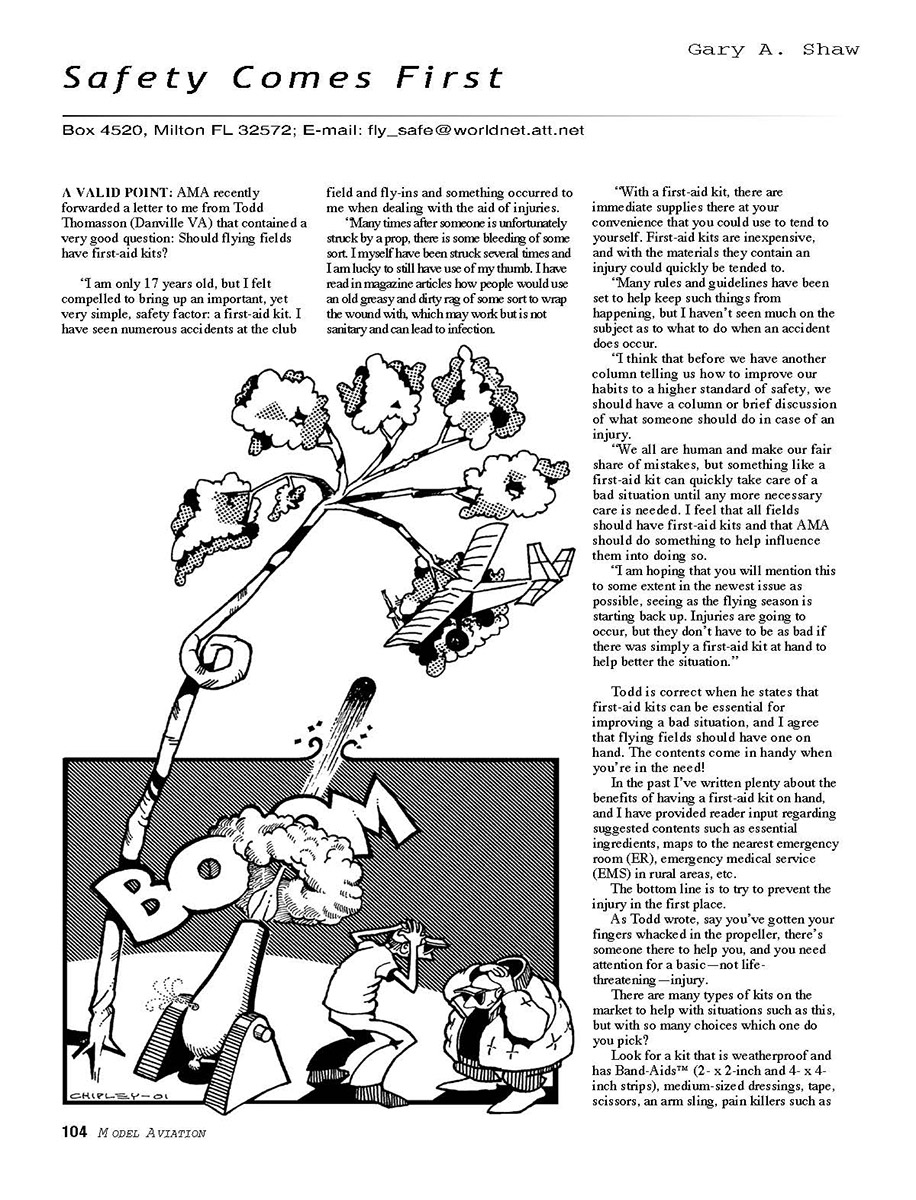
The first was climbing trees to get a model down. Don't do it! I'm told a modeler was killed when a branch he was jumping on to free a model broke.
The second was using a firearm to shoot the branch off a tree. This ended with a retrieved model, but not everyone is going to be so lucky.
As fate would have it, a letter arrived after I wrote that column and described the use of a high-powered rifle. You be the judge as to whether or not the following actions are wise.
"I just wanted to mail you to let you know that I enjoyed your story about retrieving models. It hit really close to home. I, too, had a unique experience with a Telemaster and a tree.
"I was flying the Telemaster when the aircraft became uncontrollable; I quickly realized that the tail was coming off. Needless to say it ended up in the tallest tree in the forest behind our flying site on the end of the deadest branches on the tree.
"No ladder was tall enough, and if it was, the limb was too weak to lean anything on it. I was stumped. The wing fell off the airplane as well as the engine. The servo tray and the receiver were hanging down, still attached by the antenna. The only thing holding the airplane was an elevator control rod.
"Then a light suddenly appeared. Me being the shot that I am, I decided to venture home to get the old trusty 12-gauge shotgun. The first shot was nearly disaster.
"The gun had a scope on it, and because I was shooting nearly straight up, it slipped off my shoulder and the scope hit me in the eye, leaving a nasty bruise.
"I was not giving up, so I shot several more times before it fell. Everything was still intact but the battery was never found, and of course the fuselage looked as if it had been in a war.
"Well, that's my story!"
Until next month, put the weapons away!
MA
Transcribed from original scans by AI. Minor OCR errors may remain.

