
Safety Comes First
Box 4520, Milton FL 32572; E-mail: [email protected]
It feels good to meet modelers who say they've received something of value from reading about various topics in this column.
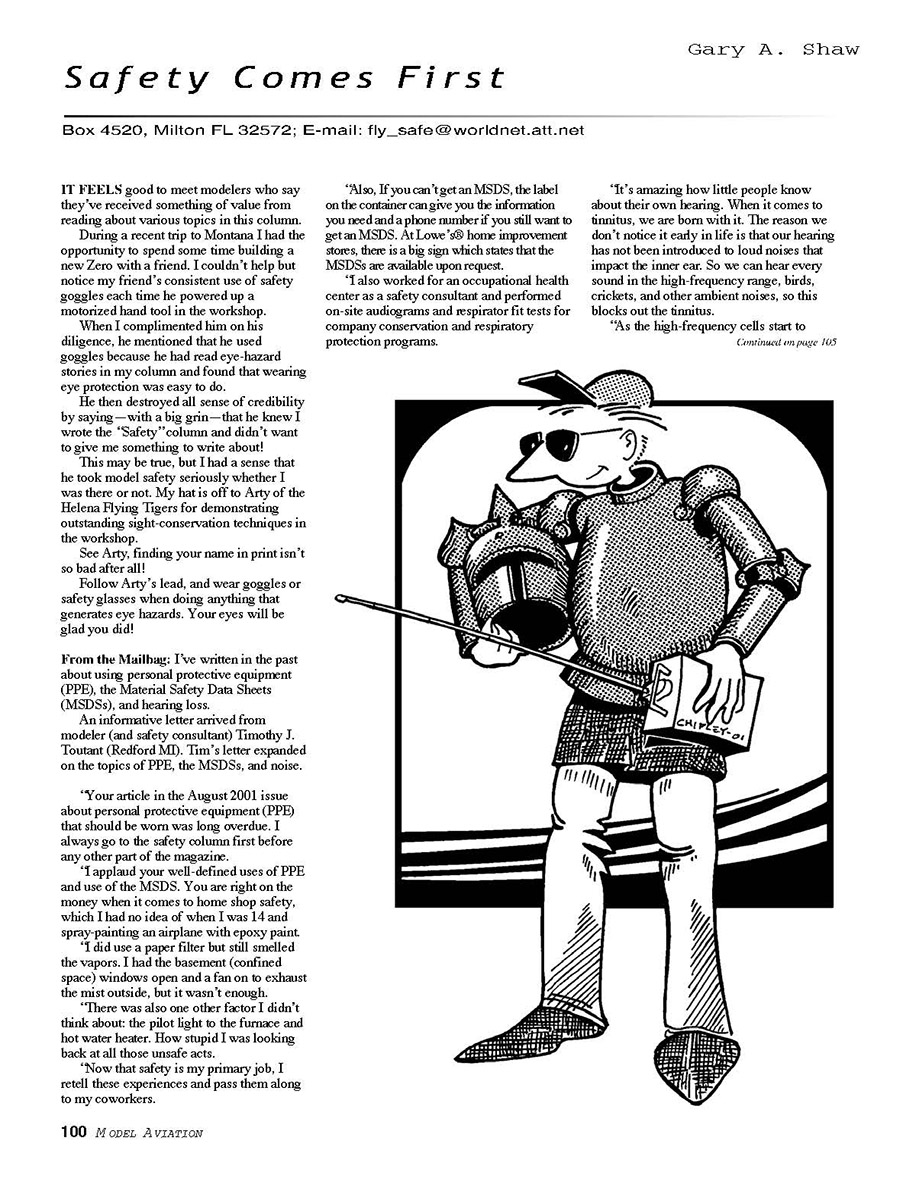
During a recent trip to Montana I had the opportunity to spend some time building a new Zero with a friend. I couldn't help but notice my friend's consistent use of safety goggles each time he powered up a motorized hand tool in the workshop.
When I complimented him on his diligence, he mentioned that he used goggles because he had read eye-hazard stories in my column and found that wearing eye protection was easy to do.
He then destroyed all sense of credibility by saying—with a big grin—that he knew I wrote the "Safety" column and didn't want to give me something to write about!
This may be true, but I had a sense that he took model safety seriously whether I was there or not. My hat is off to Arty of the Helena Flying Tigers for demonstrating outstanding sight-conservation techniques in the workshop.
See Arty, finding your name in print isn't so bad after all!
Follow Arty's lead, and wear goggles or safety glasses when doing anything that generates eye hazards. Your eyes will be glad you did!
From the Mailbag:
I've written in the past about using personal protective equipment (PPE), the Material Safety Data Sheets (MSDSs), and hearing loss.
An informative letter arrived from modeler (and safety consultant) Timothy J. Toutant (Redford MI). Tim's letter expanded on the topics of PPE, the MSDSs, and noise.
"Your article in the August 2001 issue about personal protective equipment (PPE) that should be worn was long overdue. I always go to the safety column first before any other part of the magazine.
"I applaud your well-defined uses of PPE and use of the MSDSs. You are right on the money when it comes to home shop safety, which I had no idea of when I was 14 and spray-painting an airplane with epoxy paint. I did use a paper filter but still smelled the vapors. I had the basement (confined space) windows open and a fan on to exhaust the mist outside, but it wasn't enough.
"There was also one other factor I didn't think about: the pilot light to the furnace and hot water heater. How stupid I was looking back at all those unsafe acts.
"Now that safety is my primary job, I retell these experiences and pass them along to my coworkers.
"Also, if you can't get an MSDS the label on the container can give you the information you need and a phone number if you still want to get an MSDS. At Lowe's® home improvement stores, there is a big sign which states that the MSDSs are available upon request.
"I also worked for an occupational health center as a safety consultant and performed on-site audiograms and respirator fit tests for company conservation and respiratory protection programs.
"It's amazing how little people know about their own hearing. When it comes to tinnitus, we are born with it. The reason we don't notice it early in life is that our hearing has not been introduced to loud noises that impact the inner ear. So we can hear every sound in the high-frequency range, birds, crickets, and other ambient noises, so this blocks out the tinnitus.
"As the high-frequency cells start to degrade first due to loud noises, tinnitus becomes more noticeable, especially when it is very quiet. It could be a constant low hum, to a whistling or swooshing sound.
"Noise is measured in decibels (dBA), and the higher the decibels, the more damage that can be done. More so in high-pitched noises as associated with our model engines, with ducted-fan and turbine units being the worst.
"When giving a hearing test, the frequencies introduced are pure tones ranging from 500 Hz (hertz), [to] 1,000 Hz, 2,000 Hz, 4,000 Hz, 6,000 Hz, and 8,000 Hz, and the loudness [ranges] from zero dBA until the person starts hearing the tone.
"The 2,000 Hz to 4,000 Hz [range] is where our speech is, and is at about 65 dBA. Here is a dBA list that might get attention.
- Pneumatic chipper (at five feet): 115 dBA without hearing protection; 15 minutes maximum exposure before damage starts.
- Chain saw (at ear level): 110 dBA; 30 minutes [before damage].
- Power lawn mower (at one foot): 95 dBA; four hours [before damage].
- Model airplane engine: 90 dBA; six hours [before damage].
- Normal voice is at 1/2 foot, raised voice at one foot, shout at two feet."
Check the Position of the Carburetor:
I received a letter from Glen Todd of the South Fork Airforce. He told a story of what can happen if your engine needle valve is cranked over at an angle that allows your fingers to get too close to the propeller.
"Referring to your discussion about props, I would like to relate an accident that happened to me while adjusting an MDS engine.
"The engine was new, and was being run at the flying field for the first time. When I mounted the engine in an Fw 190 (round cowl), I failed to notice the carburetor was offset to the right, which angled the needle valve into the back of the prop.
"While adjusting the prop, I fed the back of my second finger into the back of a Master Airscrew 11 x 6 carbon-fiber prop.
"An hour and half and nine stitches later, I was informed by some of our members about the problem with the carburetor. Please ask your readers to check the position of the carburetor on any new engine."
Couldn't Dress Any Better?
Have you ever come home from the flying field and had a hard time explaining what happened to your clothes?
My old-time friend Tom Griffin (of Remote Control Association of Central Florida [RCACF] fame) had a lot of explaining to do after spending a day at the field. It seems he tried to get up-close-and-personal with an idling model that had another agenda.
You never can tell when one wants to reach out and bite you, so be careful!
"Just thought I would relate my most recent encounter with a prop. No damage, but a near miss.
"I had a 25 Astro in one of my models. I had it on one of the tables at the field, checking everything out for a flight. I was facing the model and it me.
"I made certain the motor was in the off position, and went through the rudder and elevator controls, and then all of a sudden the motor roared to life—not because of something I did, but probably because I was too close to the airplane with the transmitter—who knows.
"Anyhow, the airplane naturally came right at me. I was fortunately leaning just a little toward the airplane. When it hit, it absolutely shredded my shirt but barely touched my stomach before I came to my senses and grabbed it. I went on and flew the airplane.
"The guys out there said they weren't going to let me fly there anymore if I couldn't dress any better."
That's all for this month. Keep a window open while building, the glue where you want it, and the wheels on the bottom! MA
Transcribed from original scans by AI. Minor OCR errors may remain.

