
Safety Comes First
Gary A. Shaw
Box 461, Lovell WY 82431; E-mail: [email protected]
FLY WITH A SPOTTER: The sound of a midair collision is so unique, modelers never forget it once they hear it. Fortunately, with the exception of Combat fliers, the frequency of midair collisions is rare, and personal injury as a result is even rarer.
When the thud of a collision is heard, it's a given that all eyes will turn to see what's happened. In some cases, even modelers flying airplanes will look to see what's happened and lose track of — and sometimes crash — their own models! Tragic, but true!
Midair collisions can be prevented through the use of good field-pattern techniques and a good spotter. The pattern techniques consist of modelers agreeing to a direction of flight around a field and calling out for landings, takeoffs, people on the runway, and dead-sticks.
Spotters reduce the risk of midair collisions or injuries by watching for other airplanes and people, and they provide warnings if you get too close to objects (lines, towers, buildings, or boundaries).
I recently received a telephone call regarding a midair that occurred in Florida.
Two airplanes were flying in opposite directions over the runway, approximately midfield in the pattern, when the wing of the high-wing model clipped the fuselage of the low-wing model. Pieces flew from the airplanes, and both went out of control in opposite directions.
The pilot of the high-wing model stabilized the airplane inverted, and the other pilot stabilized his airplane in a sharp descending knife-edge turn toward the pits.
Not knowing what the other pilot was doing, and struggling to maintain inverted control, the high-wing airplane's pilot turned sharply toward the pits and descended rapidly to attempt a tail-first landing on the runway.
While he struggled to get back to the field, the knife-edged airplane crashed midfield on the runway, and the pilot sprinted out to check the wreckage.
(Why is it that we sometimes run to the wreckage of a model? Do we think there's someone inside, or is it excitement, a desire to turn off the batteries, or grief? Who knows?)
While this pilot was surveying the wreckage, the inverted high-wing airplane swooped down the opposite end of the runway, and a warning was shouted from the pits.
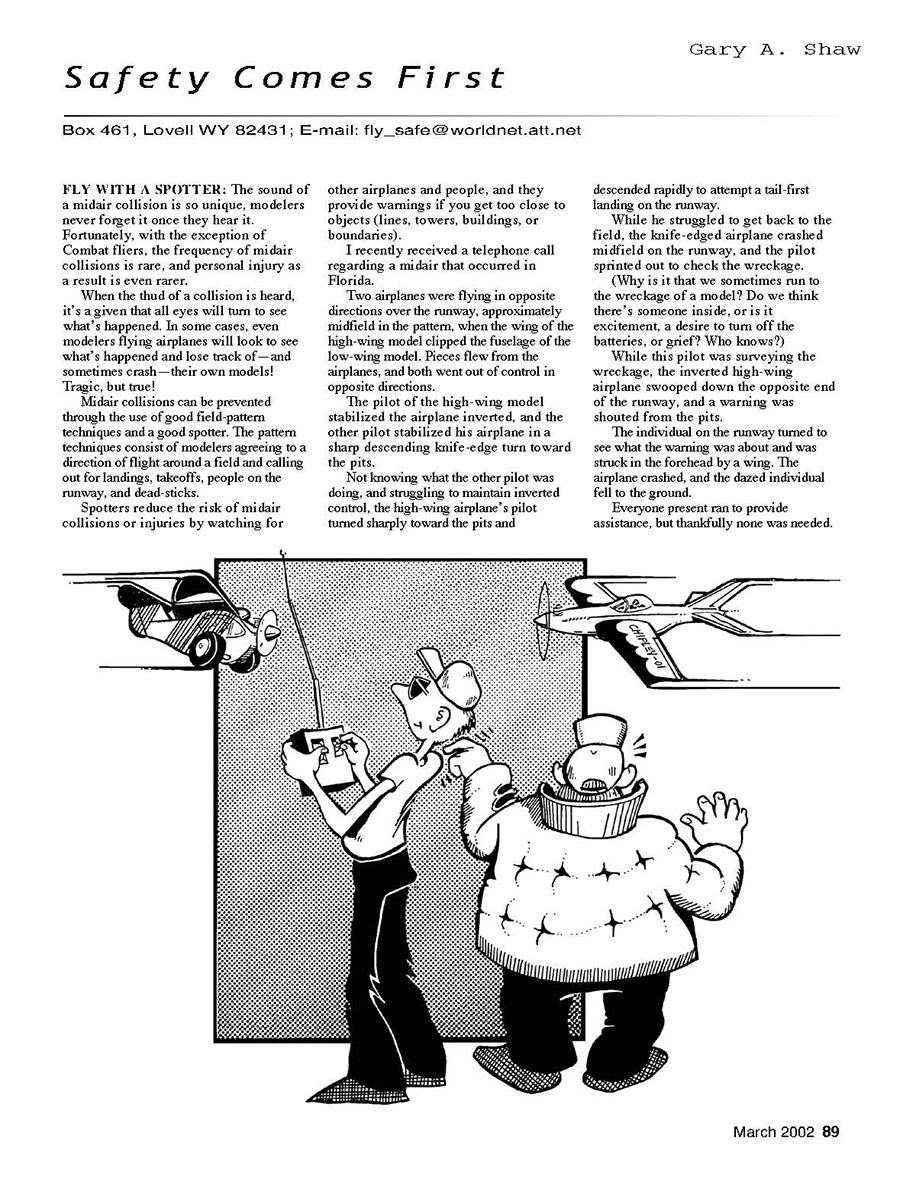
The individual on the runway turned to see what the warning was about and was struck in the forehead by a wing. The airplane crashed, and the dazed individual fell to the ground.
Everyone present ran to provide assistance, but thankfully none was needed.
Battery Maintenance
I'm always searching for good information about appropriate winter battery-maintenance techniques and tips.
I'll quickly admit that I know little about electronics and how most of it works. I know how to use electronics, but building or maintaining that kind of stuff has never been a strength of mine.
I found an interesting Web article by C.L. "Red" Schoefield describing with great clarity the issues surrounding winter battery maintenance and black wire disease.
"How should I store my batteries at the end of the season? What should I do to them when I put them back in operation?
"The batteries should be removed from the transmitter and airplane for longer-term storage. Here in the South, where a lot of us work out of our garage workshops, I recommend putting them in the refrigerator (not the freezer) during the off-season.
"While not so important where your workshop rarely gets above 23° Celsius (74° Fahrenheit), the refrigerator is still a good bet.
"Why? The failure mode of Ni-Cds is separator failure; this is the material that keeps the plates from touching each other. When it fails, the cell shorts. At higher temperatures it oxidizes faster. In fact, the rate doubles for every 10° Celsius increase.
"Should I store my batteries charged or discharged? It doesn't really matter, they will self-discharge in a few months stored at room temperature. If you are going to store them in the refrigerator, the charge will remain for a lot longer. So I would discharge them first to 4.4 volts and then put them away.
"Good cells will just sit there in the discharged condition (the voltage can vary considerably but is usually above one volt). In a battery with a damaged, 'worn-out' separator in the cells, the cells are apt to short if left in a discharged condition. This is actually good since it is the first indication of a cell that's going bad and it is best to replace the pack.
"A battery left on trickle charge will seldom short out since it is in the charged condition, and any short that tries to develop will be zapped by the charge in the cell.
"Partial shorts (those having fairly high resistance) can be developing that can cause the cells to self-discharge at a higher rate than normal, and possibly leave you short in the middle of a flight after you just measured the cell when it came off charge with your ESV (Expanded Scale Voltmeter) and everything looked OK.
"The reason I recommend removing the batteries from the transmitter and airplane is to protect against 'black wire' disease. Should a cell short while in storage, there is a high probability that there will be some leakage that can lead ultimately to the 'black wire' problem.
"Now when your batteries are coming out of storage, before charging check the voltage without a load on the battery. It should read well over four volts, even if it has not been charged all winter. They should be essentially fully discharged, flat as we say in the business.
"In this condition, if the battery is going bad it will probably have shorted and you will read zero volts on that cell. It may be a soft short, one that could be blown away merely by the simple action of slow charging. Don't do it! It is just lying there waiting to bite you.
"Replace the pack. Cut out the 'good' cells if you want and use them in something less critical than your model. If you have access to a cycler, running through a couple of charge/discharge cycles is a good idea just to make sure you are getting the capacity you are supposed to. Anything less than 80% of rated is suspect.
"Once at the field, pre-flight battery checks are in order, particularly at the beginning of the season. Since those that religiously check their flight packs with an ESV seem to crash less (due to battery failure), one must assume that the ritual is smiled upon by the RC (Radio Control) gods.
"The black-wire syndrome is an occurrence in battery packs (Ni-Cds) where the negative wire becomes corroded (turns from shiny copper to blue-black). This is the result of either a shorted cell in the pack, the normal weaker failure mode of Ni-Cds, or cell reversal when a pack is left under load for an extended period.
"The sealing mechanism of an Ni-Cd cell depends to some degree on maintaining a potential across the seal interface. Once this potential goes to zero, the cell undergoes what is called 'creep leakage.'
"With other cells in a pack, at some potential above zero the leakage (electrolyte) is 'driven' along the negative lead. It can travel for some distance making the wire impossible to solder, and at the same time greatly reducing its ability to carry current and even worse, makes the wire somewhat brittle.
"A switch left on in an airplane or transmitter for several months can cause this creepage to go all the way to the switch itself, destroying the battery lead as well as the switch harness. There is no cure. The affected lead, connector, and switch harness must be replaced.
"This creep leakage takes time, so be periodic inspection of the packs and making sure that there are no shorted cells insures against the problem.
"The cells should also be inspected for any evidence of white powder (electrolyte mixed with carbon dioxide in the air to form potassium carbonate). In humid conditions this can revert back to mobile electrolyte, free to creep along the negative lead.
"Some 'salting,' as this white powder is referred to, does not necessarily mean the cell has leaked.
"There may have been some slight amount of residual electrolyte left on the cell during the manufacturing process. This can be removed with simple household vinegar and then washed with water, after which it is dried by applying a little warmth from your heat gun."
That's all for this month.
If you'd like to ask Red a question, he can be reached via E-mail at [email protected].
Stay warm and keep the packs charged! MA
Transcribed from original scans by AI. Minor OCR errors may remain.

