
Safety Comes First
Gary A. Shaw
Box 461, Lovell WY 82431; E-mail: [email protected]
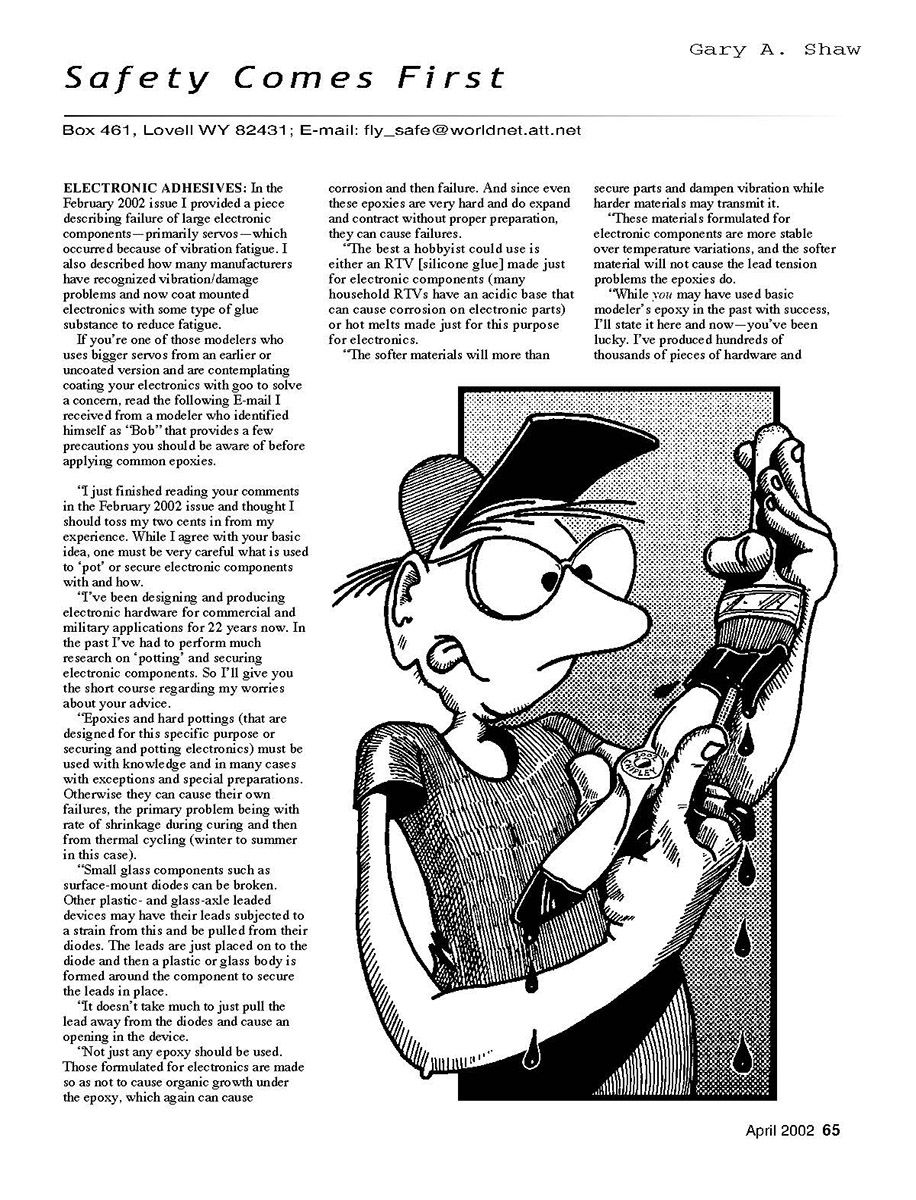
ELECTRONIC ADHESIVES: In the February 2002 issue I provided a piece describing failure of large electronic components — primarily servos — which occurred because of vibration fatigue. I also described how many manufacturers have recognized vibration/damage problems and now coat mounted electronics with some type of glue substance to reduce fatigue.
If you're one of those modelers who uses bigger servos from an earlier or uncoated version and are contemplating coating your electronics with goo to solve a concern, read the following E-mail I received from a modeler who identified himself as "Bob" that provides a few precautions you should be aware of before applying common epoxies.
"I just finished reading your comments in the February 2002 issue and thought I should toss my two cents in from my experience. While I agree with your basic idea, one must be very careful what is used to 'pot' or secure electronic components with and how.
"I've been designing and producing electronic hardware for commercial and military applications for 22 years now. In the past I've had to perform much research on 'potting' and securing electronic components. So I'll give you the short course regarding my worries about your advice.
"Epoxies and hard pottings (that are designed for this specific purpose or securing and potting electronics) must be used with knowledge and in many cases with exceptions and special preparations. Otherwise they can cause their own failures, the primary problem being with rate of shrinkage during curing and then from thermal cycling (winter to summer in this case).
"Small glass components such as surface-mount diodes can be broken. Other plastic- and glass-axis leaded devices may have their leads subjected to a strain from this and be pulled from their diodes. The leads are just placed on to the diode and then a plastic or glass body is formed around the component to secure the leads in place.
"It doesn't take much to just pull the lead away from the diodes and cause an opening in the device.
"Not just any epoxy should be used. Those formulated for electronics are made so as not to cause organic growth under the epoxy, which again can cause corrosion and then failure. And since even these epoxies are very hard and do expand and contract without proper preparation, they can cause failures.
"The best a hobbyist could use is either an RTV (silicone glue) made just for electronic components (many household RTVs have an acidic base that can cause corrosion on electronic parts) or hot melts made just for this purpose for electronics.
"The softer materials will more than secure parts and dampen vibration while harder materials may transmit it.
"These materials formulated for electronic components are more stable over temperature variations, and the softer material will not cause the lead tension problems the epoxies do.
"While you may have used basic modeler's epoxy in the past with success, I'll state it here and now — you've been lucky. I've produced hundreds of thousands of pieces of hardware and demonstrated millions of hours of MTBF [Mean Time Between Failures] when things are done correctly. But when procedures aren't followed, and/or the correct material isn't used, it shows.
"I've had the luxury of being able to track 13 years of hundreds of different models of hardware while working for one company as their engineering manager, and of doing the failure analysis and learning from it so the same mistake isn't made again. So please do not take my two cents lightly.
"I've seen the failures from trying to use the wrong material the wrong way or even the correct materials the wrong way. Your idea at its basic level is not wrong and all of your intentions are correct, but if the wrong material is used, or materials requiring preparation and the preparations are not done, more harm may be done than good."
I've asked Bob to let me know what types of materials are available and from what sources. I'll provide any feedback I receive in my next column.
Thanks, Bob, for the clarification.
Can You See It? In the January 2002 column I asked readers to respond if they had an opinion about the value of painting propeller tips for visibility and whether they thought manufacturers or consumers should apply the colors.
I received more than 20 E-mails from readers; all but one supported applying colors. The dissenting vote applied the logic that although painting tips provides a visible arc, it also provides the sense of security that the modeler would expect an arc to be visible on all spinning propellers; therefore, injury might occur to those trained to see an arc when it isn't present.
The remaining readers apparently use paint for two reasons: to balance the propeller and to provide a visible arc.
I'm a proponent of painting the tips. I use the logic that if you can see it, you're more likely to avoid it. If we all used that logic and were trained to follow it religiously, I believe our hobby would be a little safer.
Let's look to the full-scale world for an example. Go to a general aviation airfield and try to find a mounted, unpainted propeller. I've never seen one on a certificated airplane. Why? Safety and liability — the same two reasons that drive me to say we should all strive to paint the propellers when they are attached to model-aircraft engines.
Regarding the modeler's opinion that painting them may cause injury in the long run, we should all stay aware of the fact that whether painted or not, caution should be used when you're around a running engine!
The following letter from Lee Tait supports this opinion.
"I am responding to your request for input about the subject of painting prop tips for visibility. I have been involved with RC [Radio Control] airplanes for about 14 years, and our club safety chairman for about the last 10 years.
"Maybe about that time, 10 years ago, I began painting my prop tips for visibility. I don't recall the exact reason why I started, but it certainly was to prevent myself from getting hurt. I have shown by example how doing this simple thing can help pilots and helpers see the prop circle so they can keep clear.
"When we have new members at the field, I usually point out a couple of field safety items, this always being one of them. One of the others is retaining the airplane when starting with a helper or some mechanical means.
"I paint about 3/4 to one inch of the prop tip using a craft-store-bought paint. I have found that Q-tips™ work well to apply the paint, and usually two thin coats do the job fine.
"If a person is going Scale, then a color that is correct for that airplane would naturally be chosen and applied as appropriate for that model. I had started with red, then white, and now for the last five to six years [I have used] Day-Glo™ orange. I find this color shows up the best from near dark to bright sunlight.
"Once the props are dry, I check the imbalance and if heavy at one blade of two-, three-, or four-blade props, and I mark with a marker which blade is heavy on the prop hub with an 'H' or 'OK.' When I mount the prop that has a marked heavy blade, I set that blade opposite the piston to help improve the balance. As most people run a single-cylinder engine in our club, that works; for multicylinder, then of course the prop should be balanced by the individual's preferred method.
"I think the manufacturer should not be required to paint the tips, as that adds cost to the product.
"I also sand the leading and trailing edges of all my props before I paint the tips, especially the molded props, to remove the sharp edges remaining from the manufacturing process.
"Last, I never use my fingers to flip the prop. I have a Kavan electric starter that I use on my up-to-.91-size engines that I own. I have used it to start some balky gas engines of fellow club members also. I have had several other starters but prefer the Kavan, as I find it easier to grip and trigger safely."
(Editor's note: In the preceding letter, Mr. Tait states that he sets the heavy blade of an unbalanced propeller opposite the piston to offset the difference. Although this can work to a degree, using a balanced propeller is always recommended.)
Until next month! MA
Transcribed from original scans by AI. Minor OCR errors may remain.

