
Safety Comes First
Box 461, Lovell WY 82431; E-mail: [email protected]
STICKY SITUATION:
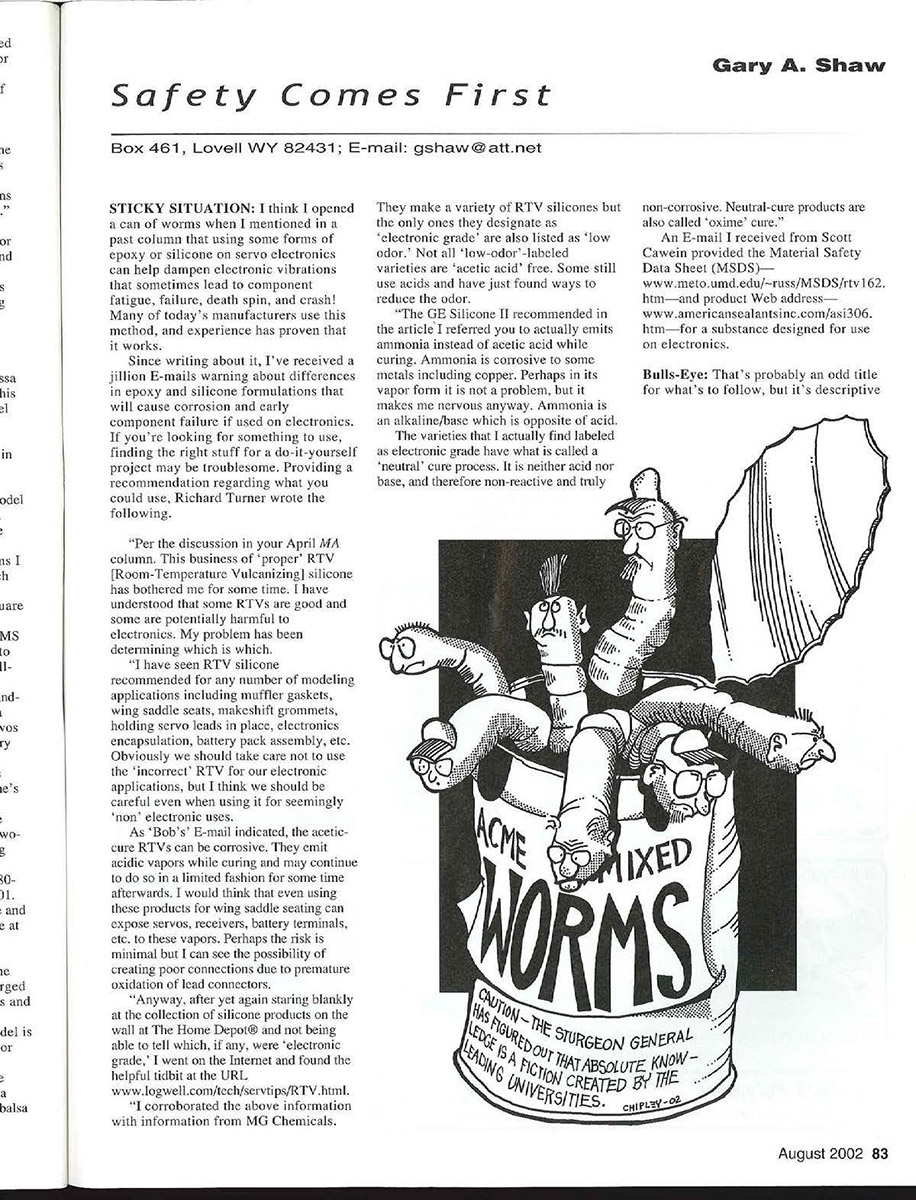
I think I opened a can of worms when I mentioned in a past column that using some forms of epoxy or silicone on servo electronics can help dampen electronic vibrations that sometimes lead to component fatigue, failure, death spin, and crash! Many of today's manufacturers use this method, and experience has proven that it works.
Since writing about it, I've received a gillion E-mails warning about differences in epoxy and silicone formulations that will cause corrosion and early component failure if used on electronics. If you're looking for something to use, finding the right stuff for a do-it-yourself project may be troublesome. Providing a recommendation regarding what you could use, Richard Turner wrote the following.
"Per the discussion in your April MA column. This business of 'proper' RTV [Room-Temperature Vulcanizing] silicone has bothered me for some time. I have understood that some RTVs are good and some are potentially harmful to electronics. My problem has been determining which is which.
"I have seen RTV silicone recommended for any number of modeling applications including muffler gaskets, wing saddle seats, makeshift grommets, holding servo leads in place, electronics encapsulation, battery pack assembly, etc. Obviously we should take care not to use the 'incorrect' RTV for our electronic applications, but I think we should be careful even when using it for seemingly 'non' electronic uses.
"As 'Bob's' E-mail indicated, the acetate RTVs can be corrosive. They emit acidic vapors while curing and may continue to do so in a limited fashion for some time afterwards. I would think that even using these products for wing saddle seating can expose servos, receivers, battery terminals, etc. to these vapors. Perhaps the risk is minimal but I can see the possibility of creating poor connections due to premature oxidation of lead connectors.
"Anyway, after yet again staring blankly at the collection of silicone products on the wall at The Home Depot® and not being able to tell which, if any, were 'electronic grade,' I went on the Internet and found the helpful tidbit at the URL www.logwell.com/tech/servtips/RTV.html.
"I corroborated the above information with information from MG Chemicals.
They make a variety of RTV silicones but the only ones they designate as 'electronic grade' are also listed as 'low odor.' Not all 'low-odor'-labeled varieties are 'acetic acid' free. Some still use acids and have just found ways to reduce the odor.
"The GE Silicone II recommended in the article I referred you to actually emits ammonia instead of acetic acid while curing. Ammonia is corrosive to some metals including copper. Perhaps in its vapor form it is not a problem, but it makes me nervous anyway. Ammonia is an alkaline/base which is opposite of acid.
"The varieties that I actually find labeled as electronic grade have what is called a 'neutral' cure process. It is neither acid nor base, and therefore non-reactive and truly non-corrosive. Neutral-cure products are also called 'oxime' cure."
An E-mail I received from Scott Cawien provided the Material Safety Data Sheet (MSDS)—www.meto.umd.edu/~russ/MSDS/rtv162.htm—and product Web address—www.americansilcantsinc.com/asi306.htm—for a substance designed for use on electronics.
Bulls-Eye:
That's probably an odd title for what's to follow, but it's descriptive of what happened to a modeler whose child was allowed to stand next to dad on the flightline.
Although this story is the result of unfortunate circumstances, I've never seen an accident or injury that couldn't be prevented. All it takes is common sense, attention to detail, or preparation to break a chain of unpleasant events. In this case, overconfidence ruled and Murphy won. Fortunately, the child will recover.
"One of our fellow modelers, who I will not mention by name because he already feels bad enough, accidentally hit his three-year-old child in the head while landing. The child is okay and at home after a night in the hospital. The child suffered a fracture in the orbital area (around the eye) and wound up with some stitches in its head. No apparent permanent damage other than some scarring.
"How did this happen? It was late in the afternoon and most everybody had gone home. He was the only person in the air at the time. There were only four other adults at the field; two were flying that day and the other two were doing maintenance. He was standing on the side of the runway instead of away and off the runway. His child was next to him and milling around on and off the runway.
"The two club members doing maintenance advised the father that there was potential danger to his toddler and to get him away from the flightline. His spotter volunteered to help by taking over the airplane so he could tend to his child, but he refused, thinking he could handle the situation. The spotter attempted to remove the child, but you know how that goes with strangers and small kids.
"When he came in for a landing he was standing right up against the runway on the dirt, and was not aware that his child was right next to him. The crosswind pushed the airplane toward him so he naturally stepped back; this left his child in the path of the airplane. Imagine his horror as he turned to see the airplane go by and hit his child right in the forehead.
"Now folks, understand that this is not an effort to offend anyone; this is a wake-up call. All of us are responsible for safety. If you asked or told a fellow club member to follow a certain safety rule, please do; we do not need any more accidents. Now here is how quickly a day can turn to you know what. All of what I explained above happened in less than five minutes from the time that the pilot was first asked to have the child removed from the runway area due to safety.
"Fortunately there were two cell phones at the field at the time. A call to 911 had the local fire department and EMS unit respond to the scene in less than 10 minutes. (Imagine if the main road was not open.) The spotter administered first aid and helped calm the father. One club member stayed on the phone with 911 while another drove down to the main gate to open it for the emergency vehicles. The last members stood by with the spotter and father in case any assistance was needed.
"I need to thank the club members who responded to this situation and handled it, for without their help things could have gone from bad to worse real quickly. The spotter gave up his good Sunday shirt to help stop the bleeding from an open head wound caused by a aluminum prop nut and wooden prop that splintered upon impact. The whole engine and firewall was knocked off of the fuselage when it impacted.
"We are very lucky that this did not turn into a major tragedy it very well could have been. The airplane was a 40-size low-wing sport ARF [Almost Ready to Fly]. Not a slow or light model at all. This whole situation was preventable. Use common sense when you are at the field, and help each other out so that we can all be safe."
It seems odd that I'm writing this column (in March) for August, and it's currently snowing to beat the band here in Wyoming. It's hard to think about summer when many in this area (80 miles from Yellowstone National Park) are flying with snow skis, and ice fishing is the hot topic when people get together. Spring is just around the corner, and it's about time. MAA
Transcribed from original scans by AI. Minor OCR errors may remain.

