

Safety Comes First
Dave Gee
Box 7081, Van Nuys CA 91409; E-mail: [email protected]
"DON'T FLY ALONE, and make sure there's a retired EMT and plenty of cell phones at your field," said my friend Mike Myers after a horrible day.
Mike is a well-known Southern California modeler and leader of the Society of Antique Modelers. He was testing a large Old-Timer aircraft that was newly converted from ignition to diesel. Pleased to get the engine running smoothly, he launched the model and saw that it was greatly overpowered. It climbed too steep, performed a neat stall turn, and dove back at Mike.
Despite his enthusiastic attempts to get out of the way, the model struck him. He threw an arm up for protection and received hand and head injuries. Friends at the field rendered first aid and summoned help.
Thirty-nine stitches later he was on the phone to me, not realizing that such conversations tend to be published here. When Mike immediately launched into anecdotes about flying at Old Warden (in England), I rejoiced that his skills as a raconteur had remained intact.
For those who want the details, his model was a 6-foot Cloud Cruiser with a .35 PAW swinging an 11 x 5 propeller. The original power plant was a .60 ignition engine. I assured Mike that dueling scars can be quite sexy, but he said that propeller strikes and prop-nut divots do not qualify.
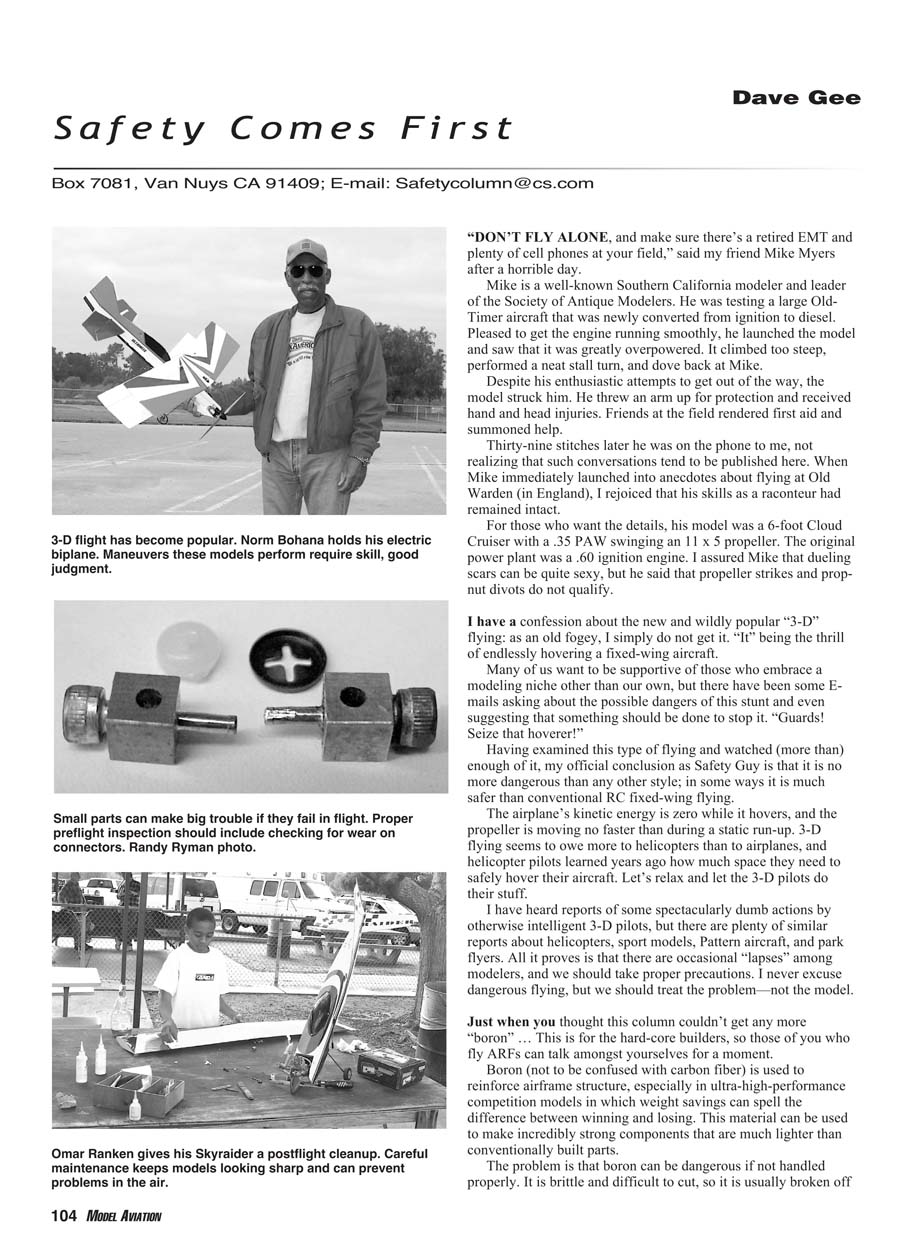
I have a confession about the new and wildly popular "3-D" flying: as an old fogey, I simply do not get it. "It" being the thrill of endlessly hovering a fixed-wing aircraft.
Many of us want to be supportive of those who embrace a modeling niche other than our own, but there have been some E-mails asking about the possible dangers of this stunt and even suggesting that something should be done to stop it. "Guards! Seize that hover!"
Having examined this type of flying and watched (more than) enough of it, my official conclusion as Safety Guy is that it is no more dangerous than any other style; in some ways it is much safer than conventional RC fixed-wing flying.
The airplane's kinetic energy is zero while it hovers, and the propeller is moving no faster than during a static run-up. 3-D flying seems to owe more to helicopters than to airplanes, and helicopter pilots learned years ago how much space they need to safely hover their aircraft. Let's relax and let the 3-D pilots do their stuff.
I have heard reports of some spectacularly dumb actions by otherwise intelligent 3-D pilots, but there are plenty of similar reports about helicopters, sport models, Pattern aircraft, and park flyers. All it proves is that there are occasional "lapses" among modelers, and we should take proper precautions. I never excuse dangerous flying, but we should treat the problem—not the model.
Just when you thought this column couldn't get any more "boron" ... This is for the hard-core builders, so those of you who fly ARFs can talk amongst yourselves for a moment.
Boron (not to be confused with carbon fiber) is used to reinforce airframe structure, especially in ultra-high-performance competition models in which weight savings can spell the difference between winning and losing. This material can be used to make incredibly strong components that are much lighter than conventionally built parts.
The problem is that boron can be dangerous if not handled properly. It is brittle and difficult to cut, so it is usually broken off with pliers. This sometimes results in splinters which must be carefully accounted for and properly disposed of. I have strong opinions regarding the relative benefits and hazards of boron use, and long ago I decided to get along without this material.
Modelers who employ boron must exercise extreme care, and most users seem to have a story or two about how they learned the hard way. Carlo Godel, who is extremely well informed, posted an Internet message on the subject. It reads:
“Boron is pretty much inert; it does not break down in the body but remains in the same state that it went in over long periods of time. The biggest problem is with getting a piece in your finger or toe; it is difficult to see and remove and will hurt for a really long time if you don’t remove it. It is also very sharp and will travel through skin and tissue and could conceivably enter a blood vessel and cause damage to organs; not very likely though.
“One fellow had a piece in his finger, and it passed right through and poked out the other side where it was removed a few months later, but the pain involved was a real bother for those few months.
“Careful is as careful does. Just be careful when you break it into pieces, as the stuff does not break uniformly and will occasionally throw a very small shard into the air where it can be picked up by an eyelash, etc. Wear eye protection.”
I responded with something like “Yikes!” Then Don DeLoach posted a reassuring message.
“I wouldn’t overreact on the subject of boron danger. When I use boron I work over a clean workbench and am very careful with splinters. Carlo’s safety suggestion about getting it in your eyes is very good. In the future I am going to be even more aware and careful of this.”
Granted, Don is smarter and more experienced than I am, but boron is still not worth the extra trouble and risks. For one thing, I seldom work over a clean workbench, and I am not careful enough with splinters or anything else. If you use this material, be methodical and cautious, and protect yourself!
While lurking at the local hobby emporium I heard an upsetting tale. A young RC pilot was ready to fly, so he went to the frequency board, removed a pin, and placed his own frequency pin in the newly open spot. When he switched his radio on, he caused someone else’s already airborne model to crash. The other pilot (who had obeyed all of the rules) was able to guide his airplane’s trajectory so that it crashed in an open area away from humans.
The storyteller said that it looked like a case of ignorance and impatience rather than evil intent on the pin switcher’s part. Word has it that the pilot of the crashed model explained the field safety procedures to him in great detail, at a high decibel level.
This brings me to a subject that has caused much excitement and discussion: transmitters with programmable frequencies. I’ve gotten numerous E-mail messages from modelers who are concerned that the availability of these radios will wipe our models from the skies. Some clubs are considering banning the so-called “Dial-a-Crash” radios, or at least discouraging their sale and use.
May I make an appeal for reason and prudence? Of course there is a possibility of abuse of this frequency-dialing capability, but if the pilot is a dummy, the brand and type of radio are irrelevant. Please refer to the preceding story. The radio is an inanimate object; it is the person twisting the controls who matters.
It is handy to be able to switch to an unused channel. Let’s concentrate on proper safety procedures rather than try to limit technological progress.
On the subject of frequency issues, Marshall Stanton has performed some interesting tests which have since been reproduced elsewhere. He checked his new HiTec Eclipse 7 transmitter and found that a scanner showed activity on adjacent channels. Then he walked his radio through some models in the pit area (after taking proper precautions!) and found no interference or glitches.
The conclusion is that although there is detectable output beyond the selected channel, it is not a signal that can cause problems for other models. I talked with Tony Ohm from Hitec, and he confirmed these findings. Yes he is a real guy, knowledgeable and friendly, not a made-up name.
I'll close this month with an informative E-mail from Randy Ryman.
"I was flying my Senior Telemaster around at about half throttle, when I lost all throttle control. After about two minutes of flying in a large orbit, and determining that there was no way I could land at half throttle, I finally heard the engine rpm coming down. I lined up for a landing and the engine came to idle and I promptly landed.
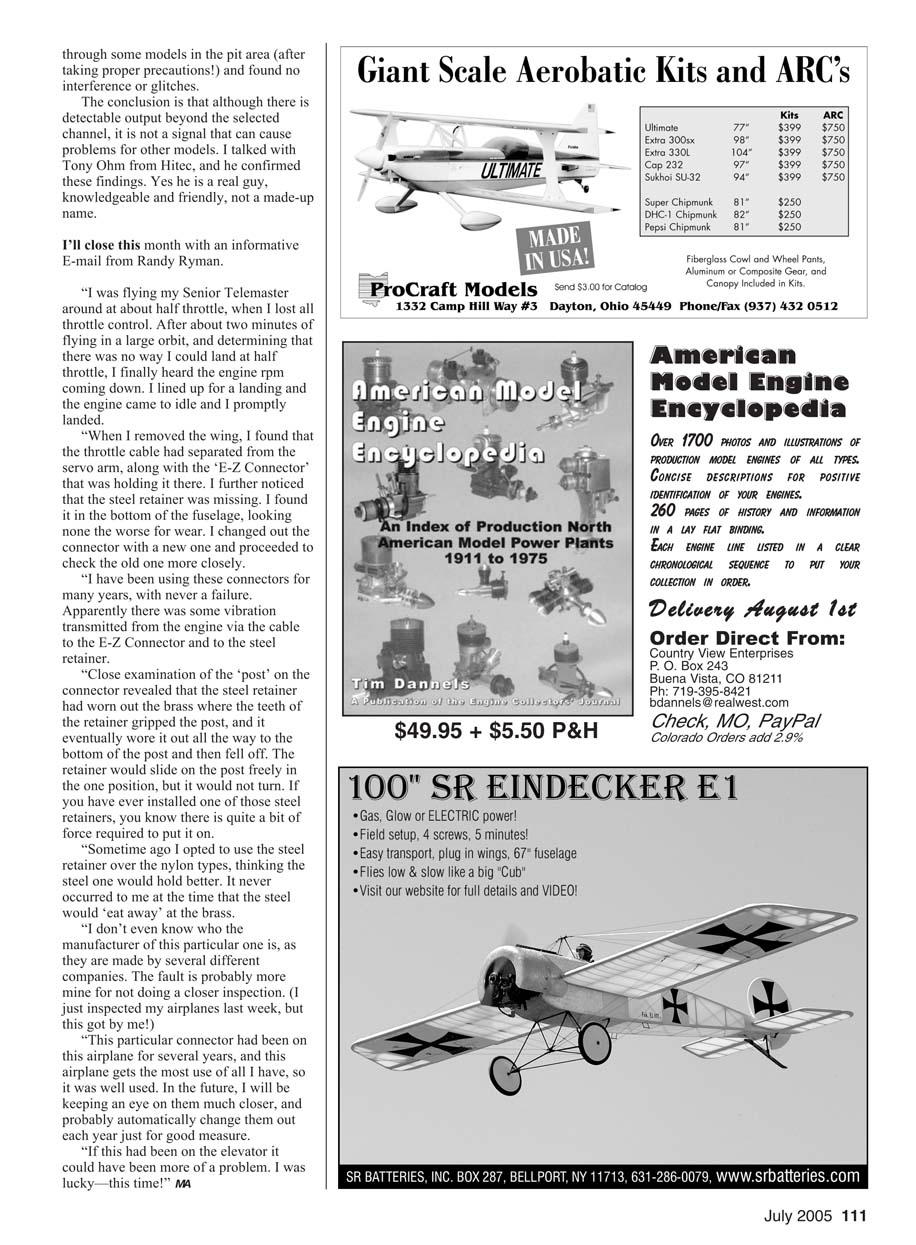
"When I removed the wing, I found that the throttle cable had separated from the servo arm, along with the 'E-Z Connector' that was holding it there. I further noticed that the steel retainer washer was missing. I found it in the bottom of the fuselage, looking none the worse for wear. I changed out the connector with a new one and proceeded to check the old one more closely.
"I have been using these connectors for many years, with never a failure. Apparently there was some vibration transmitted from the engine via the cable to the E-Z Connector and to the steel retainer.
"Close examination of the 'post' on the connector revealed that the steel retainer had worn out the brass where the teeth of the retainer gripped the post, and it eventually wore it out all the way to the bottom of the post and then fell off. The retainer would slide on the post freely in the one position, but it would not turn. If you have ever installed one of those steel retainers, you know there is quite a bit of force required to put it on.
"Sometime ago I opted to use the steel retainer over the nylon types, thinking the steel one would hold better. It never occurred to me at the time that the steel would 'eat away' at the brass.
"I don't even know who the manufacturer of this particular one is, as they are made by several different companies. The fault is probably more mine for not doing a closer inspection. (I just inspected my airplanes last week, but this got by me!)
"This particular connector had been on this airplane for several years, and this airplane gets the most use of all I have, so it was well used. In the future, I will be keeping an eye on them much closer, and probably automatically change them out each year just for good measure.
"If this had been on the elevator it could have been more of a problem. I was lucky—this time!" MA
Transcribed from original scans by AI. Minor OCR errors may remain.

