
Safety Comes First
Dave Gee
Box 7081, Van Nuys CA 91409; E-mail: [email protected]
I GET SUCH a kick out of writing this column! It's great fun to read the E-mails and letters that arrive filled with stories and useful info. Thanks so very much to all of the readers who pass along their wisdom and experience about model airplanes. Please keep 'em coming!
Sharing these messages with you is almost as satisfying as launching a good flight (a rare phenomenon the way I build models). It would be a shame to have such a golden moment ruined by some mishap, as in this message from Hank Sperzel of Omaha, Nebraska.
"Well, it was such a nice day Saturday that I decided to test run my 1/2A Stels. The engine is installed in a rather light Satellite 320, so rather than remove the engine and mount it on the test stand, I planned on running it as is.
"I was plagued with problems right from the get-go. The darn glow plug leads kept coming off and I was afraid they would become entangled in the prop. Sure enough the leads came off again, and as I reached to grasp them, the prop (an APC 5.5 x 2) 'barked' a 1/4-inch x 3/8-inch flap on the top of my middle finger on my left hand. It was the back of the prop that got me. Yes, it did smart a little, but a quick fix with a Band-Aid and it was back to testing.
"The very next run the leads came off again, and in the process of grabbing them that little APC prop whacked the tip off my left index finger. Sure does slow down your typing. Have a nice day and be careful out there."
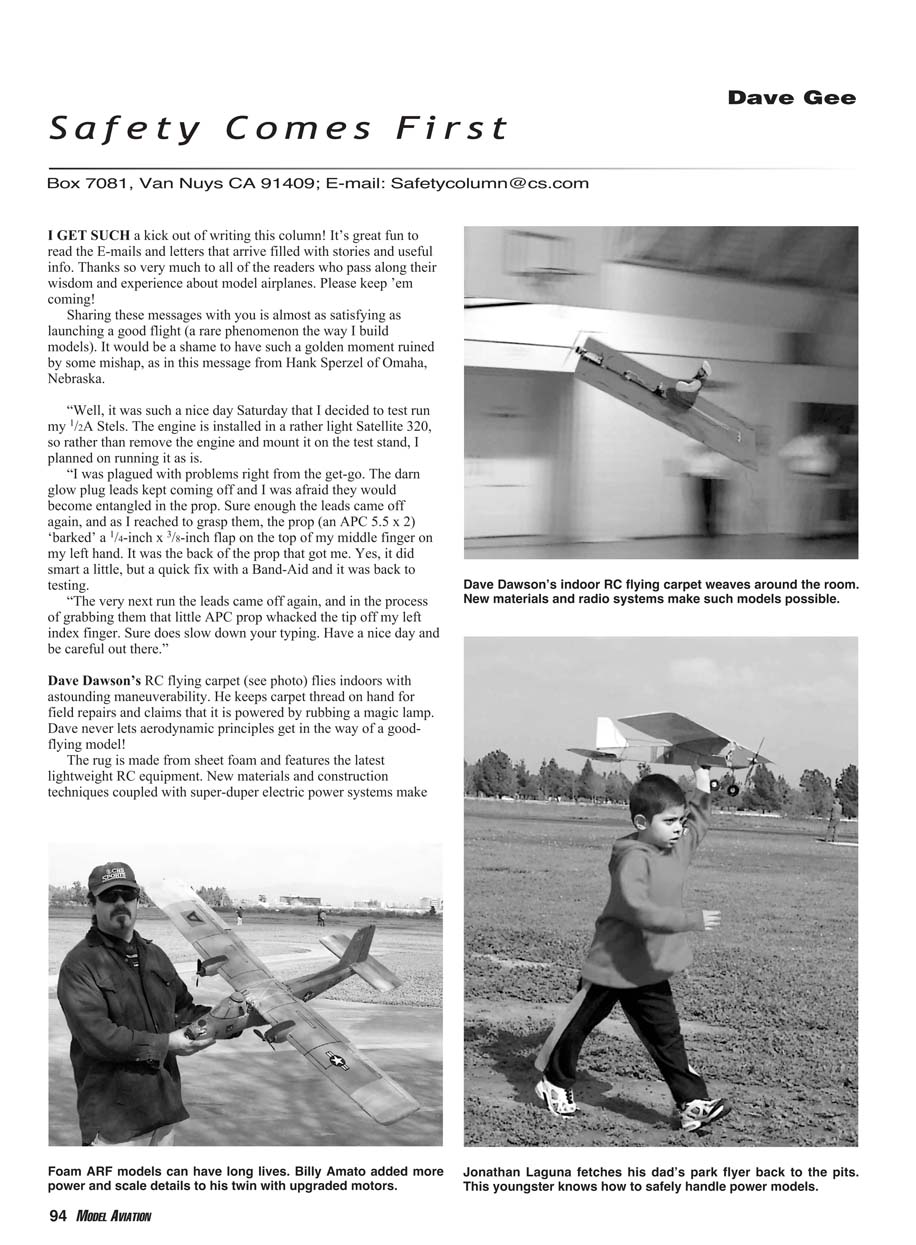
Dave Dawson's RC flying carpet (see photo) flies indoors with astounding maneuverability. He keeps carpet thread on hand for field repairs and claims that it is powered by rubbing a magic lamp. Dave never lets aerodynamic principles get in the way of a good-flying model!
The rug is made from sheet foam and features the latest lightweight RC equipment. New materials and construction techniques coupled with super-duper electric power systems make
Safety Comes First
Dave Gee
this type of model possible.
Good designers can keep the wing loading low, which makes an airplane slower and safer. Compared to outdoor models, indoor RC aircraft tend to fly much closer to walls and people, so a sharp pilot will minimize risk in every way possible.
John Gospodarek asked me to mention glider tow systems, and he says it's worth rehashing once in awhile since a winch accident can result in serious injury. He has actually seen fliers try to correct tangles or broken lines without turning the winch switch off first! Smart gliderers make sure the winch power is cut so their hands aren't.
Yes, I meant to write "gliderers." What would you call them?
I've had an interesting E-mail discussion with Tom Johnson. He has some good ideas about propeller safety, and his "left-handed" theory is worth discussing.
"Some time ago while teaching a student how to start his engine I had explained to him how it is safer to stand on the side opposite of the rotating propeller. I have seen props fly off to the right at such times and warned him of the danger. He went on to solo and gain experience on his own.
"After several months he thanked me for teaching him to start his engine 'left-handed.' I asked him what he meant. He said that when I taught him to start his engine with his left hand that it was awkward at first, but he later realized it placed his body out of harm's way more than when he and others used their right hand.
"I had never given the technique any thought at all. I am left-handed and it just seemed 'right' that I stand to the left of the model and start the engine using my left hand. I had inadvertently passed this on to the student, but he thought it was a deliberate point of safety.
"I agree with his interpretation of the lesson and make a point of including it with new students. Sometimes safety can be an 'accident.'"
In response to my questions, Tom continued:
"I have no scientific data on this, but in every case that I have seen the prop will fly to the right. I presume that no matter at what point the nut lets go, the prop is still rotating and moving forward when it leaves the end of the engine shaft. Being that the prop is turning left to right (at a few thousand rpm), the momentum naturally moves it in that direction. Probably also has something to do with the axis of rotation moving from the center of the prop to one end.
"I have seen them stick in the ground (or a Styrofoam cooler) like a knife thrown by a circus performer. Always in the same direction.
"Of course, if the prop shatters while still on the shaft, the pieces no longer behave that way. In addition, a backfire situation will loosen the nut, but the prop usually stays on because it pushes toward the engine. Perhaps some 'right-minded' person would argue otherwise."
Several readers have asked for some discussion of procedures at informal, uncrowded RC fields. These fliers can use a less formal etiquette than those at a busy airstrip, and the advantages of space and time let them use a more casual approach to frequency control and pit safety.
Not that they are less careful, but since there are fewer pilots and models, they can be more generous with time and space allocations. This can become automatic with experienced modelers, and new pilots might not notice the subtle differences.
If I'm flying with just a few friends, we will simply shout out a frequency and nobody would consider turning a transmitter on unless all of those present had verified that it was safe. Sometimes we know each other's frequencies by heart, and the result would be confusing to an outsider.
"Why don't these guys make sure they are clear? How come they don't shoot each other down?"
Don't be fooled by the casual appearance; sharp fliers always take proper precautions and will fill a stranger in right away. It's easy to envy modelers at such fields when you're waiting for a frequency pin at some bustling model airport!
Safety Comes First
Dave Gee
Charles Robinson E-mailed an interesting question, and I don't know the answer. Can a smart reader give us the straight dope?
"Maybe you or some of the readers can help me. A friend of mine is having a lot of trouble with corrosion on the negative black wire on the battery-switch wire and the connector of battery and switch leads. This will attack the connector and even go down the black negative wire to the battery on connectors that are not gold plated. What causes it and how do you prevent it?"
In my exhaustive research for this column (which involves shooting the breeze at various flying sites), I have occasionally witnessed someone doing something dumb. Sometimes the action is so dangerous that much must be taken to prevent an accident.
How do you talk to someone who is taking a safety risk? Have you ever seen someone doing something foolish or just wrong at the field, where an injury was so likely that you just had to step in? What is the proper course of action when in the presence of a dummy? Specifically, should you intervene in the dangerous actions of another pilot, and if so, what is the best way?
These are serious questions and the answers are complicated. It helps to keep in mind that we all take turns being the dummy, and sometimes it's my turn to be corrected.
Some modelers advise taking a macho stance by mouthing off loudly: "I won't let some idiot take chances with my safety, and I let 'em know loud and clear!" I'm not the blustery type, and a quieter initial approach lets you keep your options open.
My usual method involves a bit of humor and a lighthearted discussion of what may happen unless more care is taken. Making it sound like we're facing a problem together allows the dummy to save face. Speaking softly is often more effective than shouting; loud ultimatum is a personal challenge that changes the subject away from flightline safety.
Solve the problem. Don't create new ones. Keep in mind that the dummy may have social skills that match their bad flying habits.
What if the dummy in question continues taking risks with other people's safety in the pits and reacts angrily when his or her judgment is challenged? Some dummies feel that any mention of their casual treatment of your safety deserves a punch in the nose, as if beating someone up validates their dangerous actions in the pits.
At 6 foot, 4 inches, and 240 pounds (for you indoor modelers, that's 108,862.1688 grams), I view such situations differently from normal-sized people, but hand-to-hand combat with some intoxicated boor is what happens when you make poor choices.
Is there a club procedure for dealing with safety violators? Does local law enforcement have jurisdiction? Sometimes your best choice is to pack up and leave for the day. Sure, you don't get to fly, but you also missed a chance to test your first-aid skills, which is good.
Do you remember the Great Safety Column Sweepstakes? The results are in. Jon Abney won the Roc-It-Up glue holder, and hobby knives with antitroll upgrades went to Marshall Stanton, John Gospodarek, and Jeremy Mohl (assisted by Danielle, Izzy, Lizzy, and Little Jay).
What other safety columnist mails sharp instruments to readers? Thanks to all those who entered by sending in a topic suggestion. MA
Transcribed from original scans by AI. Minor OCR errors may remain.

