
Safety Comes First
Dave Gee | [email protected]
Aeromodeling is a safe activity—really!
Also included in this column:
- Fuel hazards
- Tom Viechor’s “Fuse-Hold”
- Preventing back strain
- Cordless starters
- The two stages of pilot belligerence
DON’T GET THE wrong idea! This column often includes scary stories about mayhem and disaster, but that is not typical of aeromodeling. Ours is a peaceful, pleasant hobby, and injuries are the exception—not the rule. The first-aid kit I take to Indoor meets consists of a Band-Aid and some Chap Stick. I have to admit that the horror stories are entertaining, though, and they make me think twice before taking a chance.
What brought this to mind was my attendance at several recent contests and fun-fly events. Being the Safety Guy (and needing material every month), I noted the careful steps the participants took to ensure safe flying.
At even the most casual session, there was frequency control and the pilots were serious about maintaining safe channels. This caution did not take away from the lighthearted, fun mood; in fact, it helped to create a relaxed feel because radio security was one less thing to worry about.
The flying was considerate and safe, allowing the spectators to enjoy each model’s performance. There were modelers huddling over a cranky airplane to help a friend get it into the air or repairing a damaged airplane with borrowed tools and materials.
The worst injury I witnessed was a finger caught in a toolbox lid. None of this makes for exciting reading, but it does represent the true spirit of model aviation, and that’s what I’m pushing here.
Following is a note from Lee Campbell (healed for the moment) that was posted on an Internet chat group.
“There are three things in model aviation that are not fun.
- Sticking your hand in the prop of a running engine.
- Having the engine come loose from the model.
- Squirting CA [cyanoacrylate] glue in your eye.
Done all three. Enjoyed none.”
Lee got his wisdom the hard way, but I urge readers to take his word for it and avoid these situations. Propeller safety is a frequent topic here, for obvious reasons. Watch the propeller!
Engine mounts wear out and need occasional inspection. Whether you use gas or electric, the power-plant attachments are one of the most highly stressed areas of a model.
As far as cyanoacrylate glue goes, I’m a bad example. Last weekend I found myself securely glued to my model. This after decades of practice with superglue!
Luckily we now know that most cyanoacrylate-to-skin bonds are not serious. Some time and warm water will solve the problem. (Don't try to fly the model while you are attached to it since the wing loading will be adversely affected.) Even eye splashes are usually recoverable, but I do not recommend testing it.
I'll bet that Lee learned another lesson: watch what you post online because you never know where it will show up!
Last month I wrote about electric fuel pumps and how they have an excellent safety record. As soon as the column was mailed off, alert readers sent me an Internet discussion "thread" about MadManMike and his Fiery Refueling Adventure.
Mike (who is actually a nice guy and not mad at all) told me about how he was using the electric fuel pump in his field box to gas up an airplane, when the tubing slipped off and gas squirted out. It ignited instantly and burned until the pump had emptied the can.
He was working outdoors, so the damage was comparatively minor. The power panel was homemade and had been used many times without incident. Neither of us is a qualified fire investigator, but Mike said the only possible source of ignition was the electrical system in the field box.
Do you know of a similar incident or do you have some information about this subject? Please drop me a line. We need to get to the bottom of this matter.
Mike says he's going to stick to hand-cranked pumps from now on.
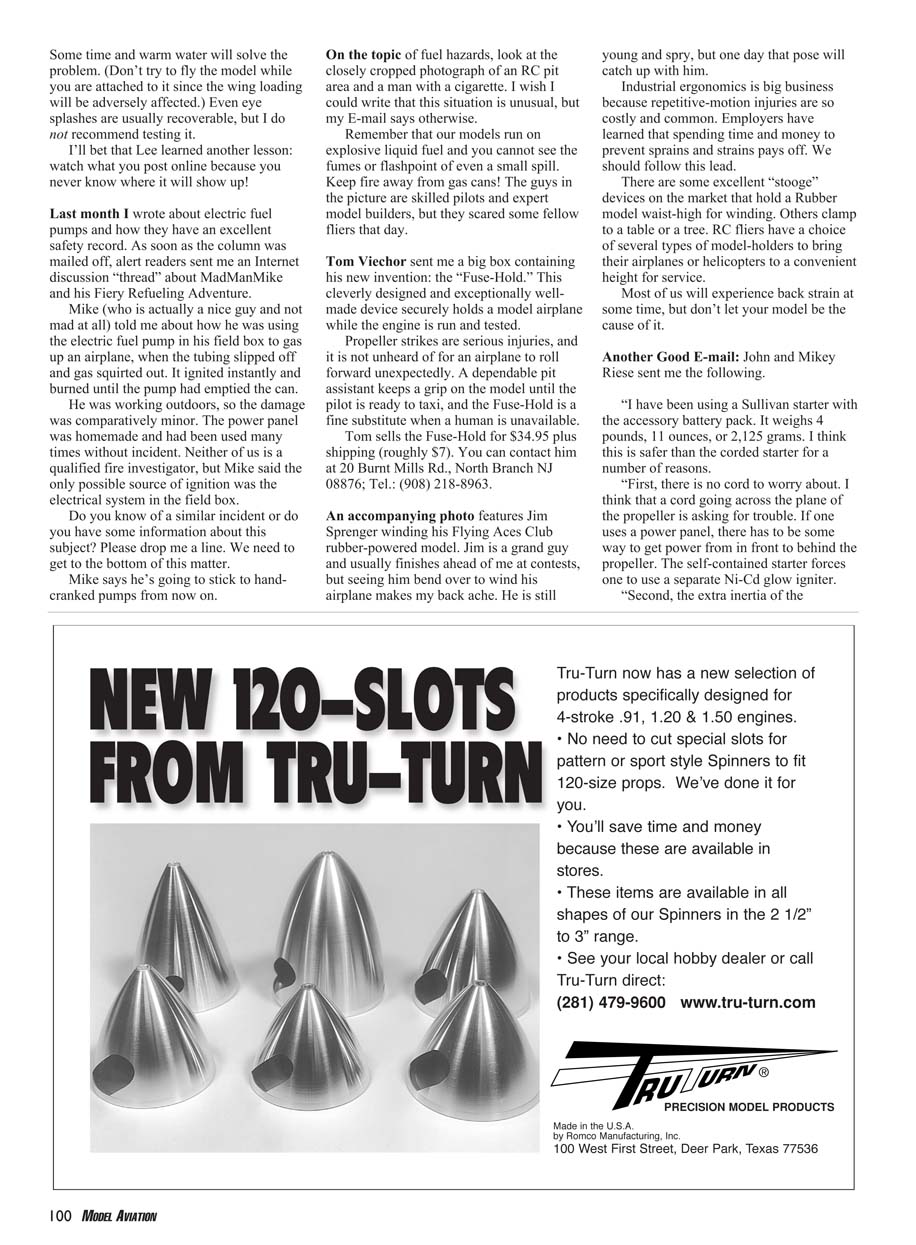
On the topic of fuel hazards, look at the closely cropped photograph of an RC pit area and a man with a cigarette. I wish I could write that this situation is unusual, but my E-mail says otherwise.
Remember that our models run on explosive liquid fuel and you cannot see the fumes or flashpoint of even a small spill. Keep fire away from gas cans! The guys in the picture are skilled pilots and expert model builders, but they scared some fellow fliers that day.
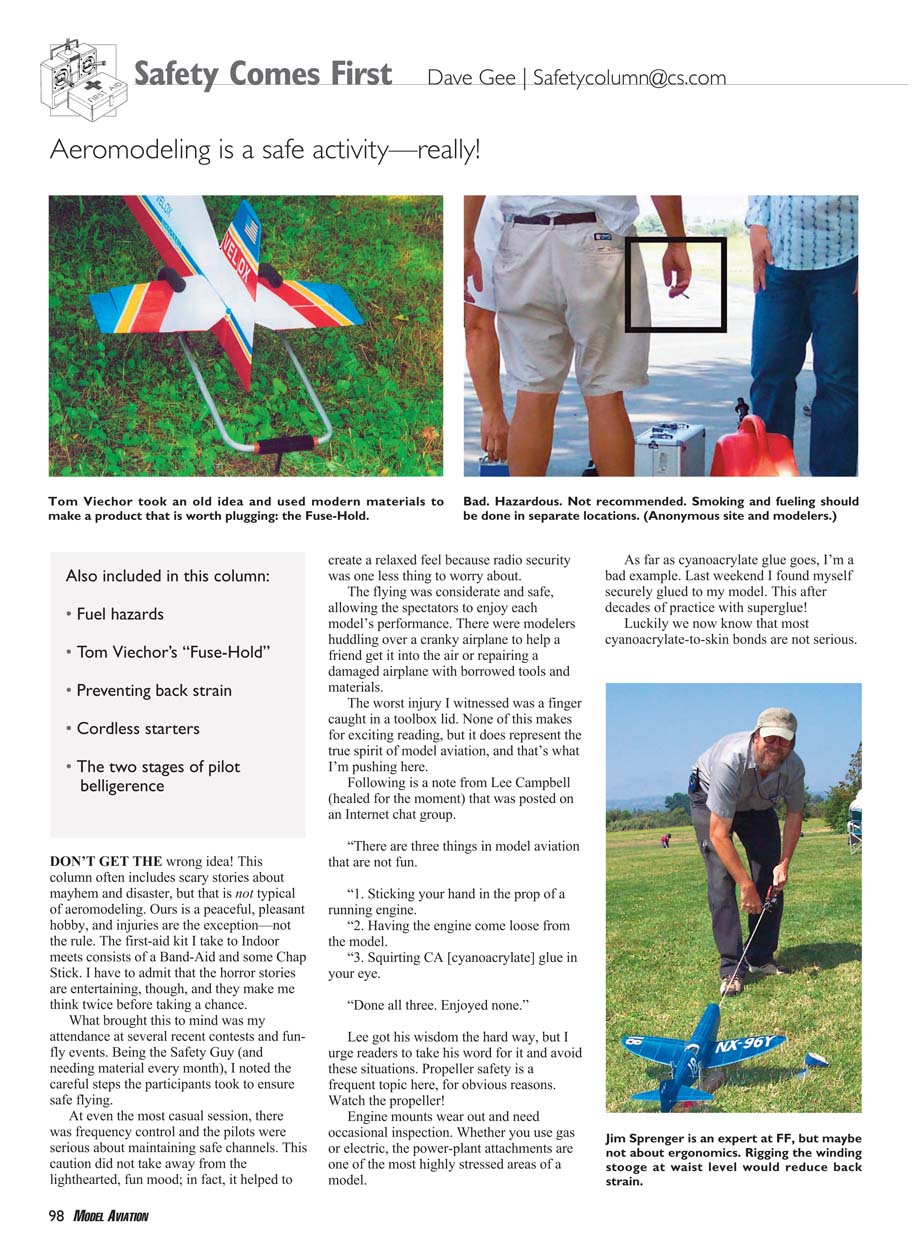
Tom Viechor sent me a big box containing his new invention: the "Fuse-Hold." This cleverly designed and exceptionally well-made device securely holds a model airplane while the engine is run and tested.
Propeller strikes are serious injuries, and it is not unheard of for an airplane to roll forward unexpectedly. A dependable pit assistant keeps a grip on the model until the pilot is ready to taxi, and the Fuse-Hold is a fine substitute when a human is unavailable.
Tom sells the Fuse-Hold for $34.95 plus shipping (roughly $7). You can contact him at 20 Burnt Mills Rd., North Branch NJ 08876; Tel.: (908) 218-8963.
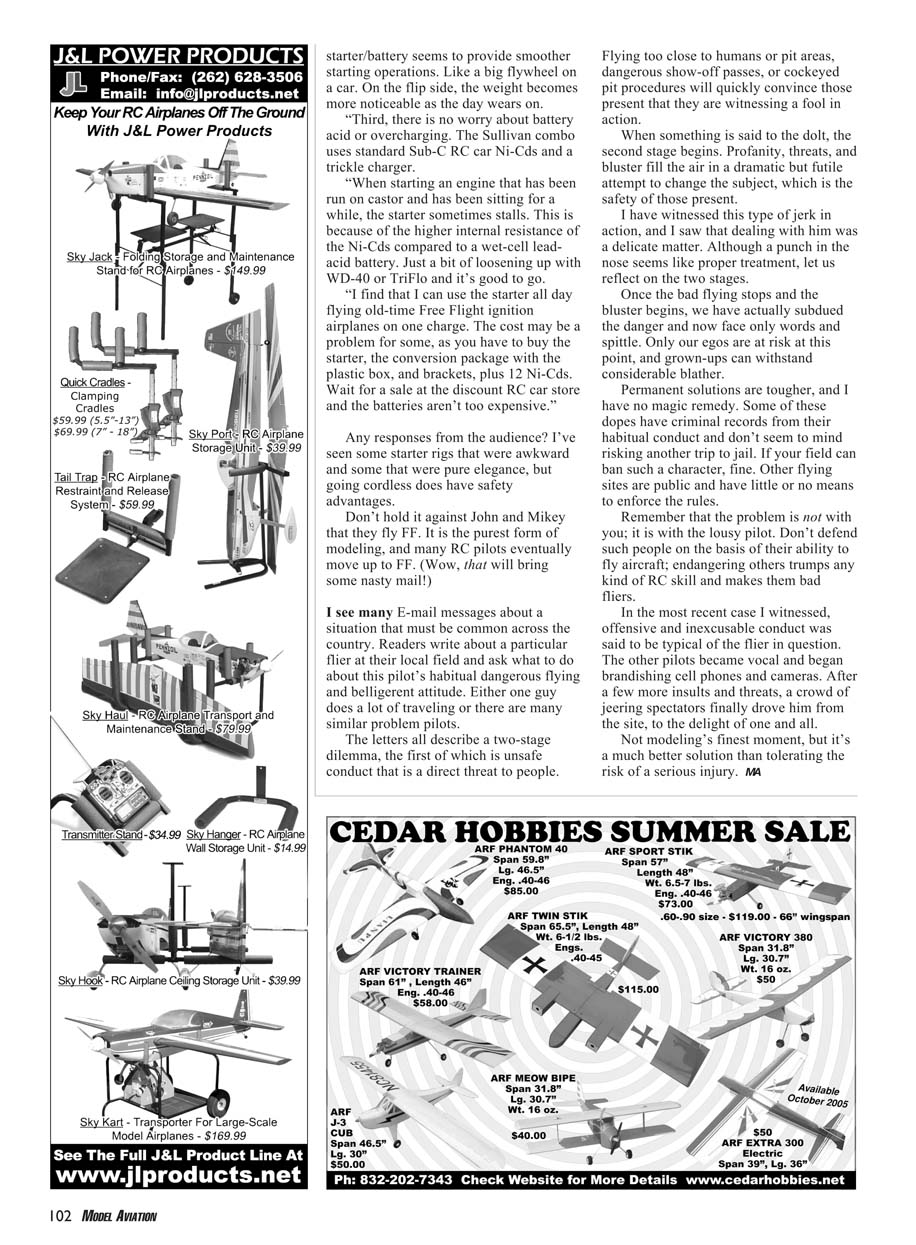
An accompanying photo features Jim Sprenger winding his Flying Aces Club rubber-powered model. Jim is a grand guy and usually finishes ahead of me at contests, but seeing him bend over to wind his airplane makes my back ache. He is still young and spry, but one day that pose will catch up with him.
Industrial ergonomics is big business because repetitive-motion injuries are so costly and common. Employers have learned that spending time and money to prevent sprains and strains pays off. We should follow this lead.
There are some excellent "stooge" devices on the market that hold a Rubber model waist-high for winding. Others clamp to a table or a tree. RC fliers have a choice of several types of model-holders to bring their airplanes or helicopters to a convenient height for service.
Most of us will experience back strain at some time, but don't let your model be the cause of it.
Another Good E-mail: John and Mikey Riese sent me the following.
"I have been using a Sullivan starter with the accessory battery pack. It weighs 4 pounds, 11 ounces, or 2,125 grams. I think this is safer than the corded starter for a number of reasons.
First, there is no cord to worry about. I think that a cord going across the plane of the propeller is asking for trouble. If one uses a power panel, there has to be some way to get power from in front to behind the propeller. The self-contained starter forces one to use a separate Ni-Cd glow igniter.
Second, the extra inertia of the starter/battery seems to provide smoother starting operations. Like a big flywheel on a car. On the flip side, the weight becomes more noticeable as the day wears on.
Third, there is no worry about battery acid or overcharging. The Sullivan combo uses standard Sub-C RC car Ni-Cds and a trickle charger.
When starting an engine that has been run on castor and has been sitting for a while, the starter sometimes stalls. This is because of the higher internal resistance of the Ni-Cds compared to a wet-cell lead-acid battery. Just a bit of loosening up with WD-40 or TriFlo and it's good to go.
I find that I can use the starter all day flying old-time Free Flight ignition airplanes on one charge. The cost may be a problem for some, as you have to buy the starter, the conversion package with the plastic box, and brackets, plus 12 Ni-Cds. Wait for a sale at the discount RC car store and the batteries aren't too expensive.
Any responses from the audience? I've seen some starter rigs that were awkward and some that were pure elegance, but going cordless does have safety advantages.
Don't hold it against John and Mikey that they fly FF. It is the purest form of modeling, and many RC pilots eventually move up to FF. (Wow, that will bring some nasty mail!)
I see many E-mail messages about a situation that must be common across the country. Readers write about a particular flier at their local field and ask what to do about this pilot's habitual dangerous flying and belligerent attitude. Either one guy does a lot of traveling or there are many similar problem pilots.
The letters all describe a two-stage dilemma, the first of which is unsafe conduct that is a direct threat to people.
Flying too close to humans or pit areas, dangerous show-off passes, or cockeyed pit procedures will quickly convince those present that they are witnessing a fool in action.
When something is said to the dolt, the second stage begins. Profanity, threats, and bluster fill the air in a dramatic but futile attempt to change the subject, which is the safety of those present.
I have witnessed this type of jerk in action, and I saw that dealing with him was a delicate matter. Although a punch in the nose seems like proper treatment, let us reflect on the two stages.
Once the bad flying stops and the bluster begins, we have actually subdued the danger and now face only words and spittle. Only our egos are at risk at this point, and grown-ups can withstand considerable blather.
Permanent solutions are tougher, and I have no magic remedy. Some of these dopes have criminal records from their habitual conduct and don't seem to mind risking another trip to jail. If your field can ban such a character, fine. Other flying sites are public and have little or no means to enforce the rules.
Remember that the problem is not with you; it is with the lousy pilot. Don't defend such people on the basis of their ability to fly aircraft; endangering others trumps any kind of RC skill and makes them bad fliers.
In the most recent case I witnessed, offensive and inexcusable conduct was said to be typical of the flier in question. The other pilots became vocal and began brandishing cell phones and cameras. After a few more insults and threats, a crowd of jeering spectators finally drove him from the site, to the delight of one and all.
Not modeling's finest moment, but it's a much better solution than tolerating the risk of a serious injury. MA
Transcribed from original scans by AI. Minor OCR errors may remain.

