
Safety Comes First
Dave Gee | [email protected]
An expert's definition of "flash point"
"THE AVERAGE PERSON has no idea how dangerous gasoline really is," wrote District VIII Safety Coordinator Don Nix. He was kind enough to E-mail me with further information about this commonly used model fuel.
Don read my recent story about electric fuel pumps and was concerned about the definition of "flash point." It was used there to mean a place where gasoline fumes and oxygen are present in the proper proportions to form a flammable (or explosive) mixture, which can be ignited by a spark.
Don has plenty of professional knowledge and experience with flammable liquids, and he wanted to make sure MA readers understood what to watch out for when using gas-powered models. He wrote:
"Here is a definition of flash point, from a chemical manual. 'The flash point of a fuel is the lowest temperature at which it can form an ignitable mix with air.' To expand on that a bit: 'Flash point is the temperature to which a flammable or combustible liquid must be raised before it will emit sufficient vapors to be ignited by some source of ignition—spark, flame, etc.'
"When you see a flash point stated for a particular liquid, around 55–70 degrees Fahrenheit for most model fuels, that means that if it is cooler than the stated temp, it will not emit enough vapors to be ignited. As the temp of the liquid rises above the stated flash point, it emits more and more vapors, thus increasing the possibility of ignition from some source of ignition.
"The greater the difference between the flash point and the temperature of the liquid, the more vapors that are emitted and the greater the danger of ignition. Consider this: the flash point of methanol is about 55 degrees Fahrenheit and, surprisingly, nitromethane is 96 degrees Fahrenheit. In other words, the methanol is much more flammable than the nitro.
"The flash point of gasoline is 40 degrees Celsius—below zero! Even on a very cool day, a container of gasoline is going to be hugely higher than the flash point, and therefore, extremely dangerous."
Don was concerned that my use of the term "flash point" might be misleading to readers because it referred only to the exact location where fumes could be ignited. I appreciate his willingness to help out and his well-written explanation.
If you find erroneous, incomplete, or confusing information in this column (and you probably won't have to look too hard), please contact me and let all readers have the benefit of your knowledge. I freely admit to ignorance on many subjects, in addition to making lousy landings. Expert help is always welcome!
Safety Comes First
Dave Gee
Darrell W. Honey sent a great story from his home base of Pittsburg, Illinois.
"You always say to please drop a line if we have had a close call. Well, let me tell you about mine!
"When I was being trained, my instructor plainly told me to turn on the transmitter first and then the receiver switch. He also told me to turn off the receiver switch first and turn off the transmitter last. Problem is I don't remember his telling me why.
"I had a really great instructor and don't want to put the blame on him because it could be that I wasn't paying attention. Naw, couldn't be that!
"I have flown hundreds of successful 'missions' with few problems, but then one of my engines would not stop running even with the carburetor barrel completely closed. I checked for leaks and found none. There were no bubbles in the line and the engine ran just fine but would not stop without jerking the fuel line off.
"While approaching the safety fence and closing the throttle trim the engine just would not stop idling. I then (not thinking) turned off my transmitter switch while the engine was still running. Nothing happened for a few seconds but then the engine suddenly went to wide-open throttle and the airplane made a 90° turn and headed straight for me as if possessed.
"The prop lacerated my leather shoe and finally choked down when the prop got into the leg of my jeans. Evidently the vibrations of the engine opened the throttle and at that point I had absolutely no control over my airplane.
"There was no blood this time, but I shudder to think what could have happened if I had been wearing shorts or any shoes less than leather. This was a .75 two-stroke and could have done some major damage to my toes and tender skin.
"Please tell your readers to follow instructions to the letter in turning the transmitter on and off. (Note: I later replaced the front ball bearing and this seemed to solve my problem, although I am not 100% sure this was the cure because maybe I fixed something else in the process.)"
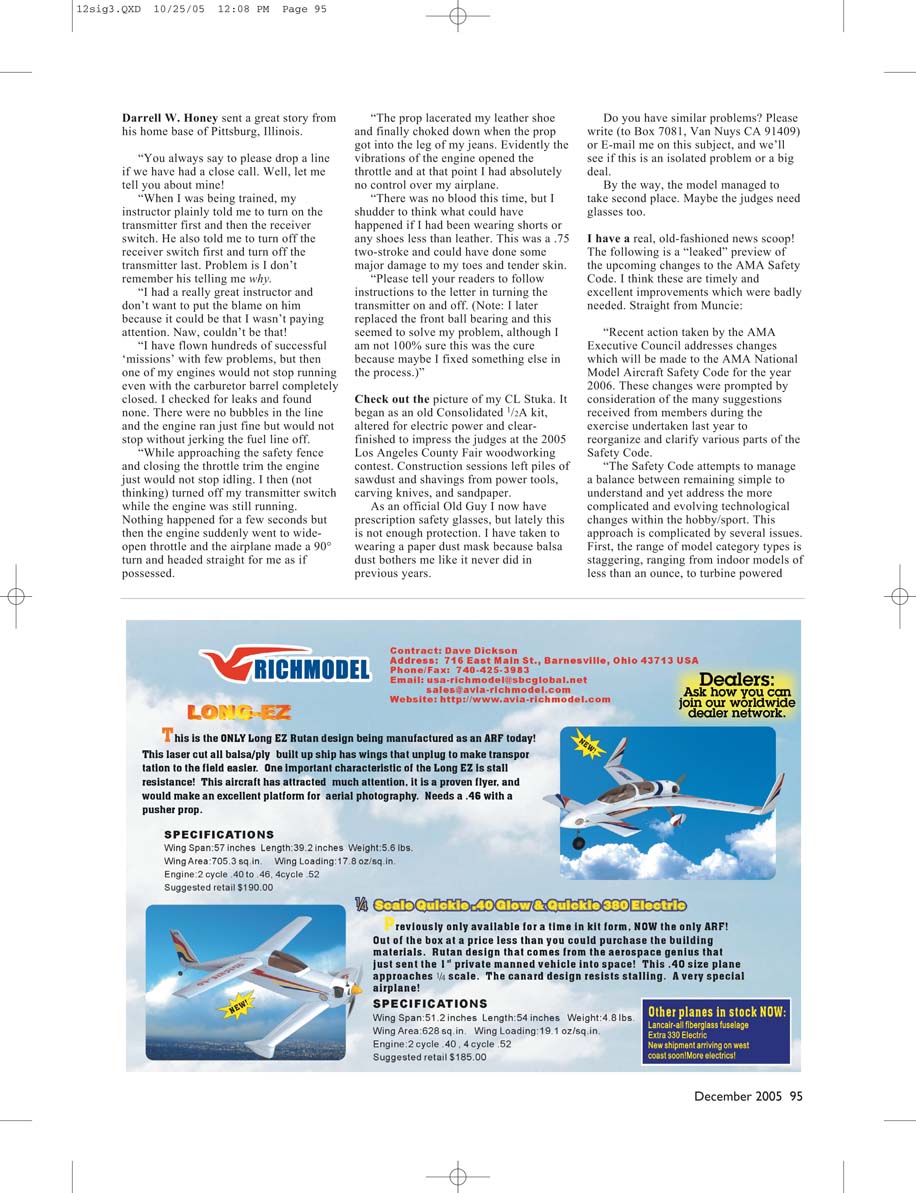
Check out the picture of my CL Stuka. It began as an old Consolidated 1/2A kit, altered for electric power and clear-finished to impress the judges at the 2005 Los Angeles County Fair woodworking contest. Construction sessions left piles of sawdust and shavings from power tools, carving knives, and sandpaper.
As an official Old Guy I now have prescription safety glasses, but lately this is not enough protection. I have taken to wearing a paper dust mask because balsa dust bothers me like it never did in previous years.
Do you have similar problems? Please write (to Box 7081, Van Nuys CA 91409) or E-mail me on this subject, and we'll see if this is an isolated problem or a big deal.
By the way, the model managed to take second place. Maybe the judges need new glasses too.
I have a real, old-fashioned news scoop! The following is a "leaked" preview of the upcoming changes to the AMA Safety Code. I think these are timely and excellent improvements which were badly needed. Straight from Muncie:
"Recent action taken by the AMA Executive Council addresses changes which will be made to the AMA National Model Aircraft Safety Code for the year 2006. These changes were prompted by consideration of many suggestions received from members during the review and commented last year to reorganize and clarify various parts of the Safety Code.
"The Safety Code attempts to manage a balance between remaining simple to understand and yet address the more complicated and evolving technological changes within the hobby/sport. This is complicated by several issues. First, the range of model category types is staggering, ranging from indoor models of less than an ounce, to turbine powered models reaching speeds of almost two hundred miles per hour.
"A second issue centers on attempting to meet the needs of a wide range of flying site specifications and conditions. We have outdoor sites which have virtually limitless over fly areas, free of obstructions, as well as crowded urban sites which require strict control of the flying areas. Within the last few years the advent of 'park flyers' and other small electric models has turned backyards and school gymnasiums into flying sites.
"Because of these issues, the Safety Code should be thought of as an extension of common sense, addressing the more basic issues, and forming a starting point for local site and safety considerations. In the end, it is the responsibility of those individuals within the local flying site group to develop and maintain safety rules for their specific needs.
"The following provides the detail changes to the AMA National Model Aircraft Safety Code for the year 2006.
"General
"The first sentence of item number 1 will be changed to read:
"8. I will not operate model aircraft carrying pyrotechnic devices which explode or burn, or any device which propels a projectile of any kind.
"Rationale: Devices, other than those which fired a projectile by pyrotechnic means, were being carried and discharged aboard model aircraft. This is deemed unsafe and could result in personal injury through an accidental discharge or result in damage to other aircraft causing them to lose control.
"Radio Control
"New item number 1 and changes to item 3 (number 4 in the new 2006 Safety Code)
"1. All model flying shall be conducted in a manner to avoid over flight of unprotected people.
"Move the current Radio Control item to a position after the current item 2 as item 3 and renumber all subsequent items accordingly.
"Reword the present 3 to read:
"4. At all flying sites a safety line or lines must be established, in front of which all flying takes place. Only personnel associated with flying the model aircraft are allowed at or in front of the safety line. In the case of air shows or demonstrations a straight safety line must be established. An area away from the safety flight line must be maintained for spectators. Intentional flying behind the safety line is prohibited.
"Rationale: Items 1 and 4 are to help clarify that flying sites may contain multiple flight areas for varied types of model aircraft, such as standard sport flying, park flyers, helicopters, etc. These may be placed parallel to one another or in intersecting positions. The proposals are also intended to maintain the ability to allow a single curved line without the confusing ambiguity of the word 'curved.' This will allow models to be flown virtually 360 degrees around a site when conditions permit without over flight of unprotected people.
"Reword item 6 to read:
"6. With the exception of events flown under official AMA Competition Regulations rules, excluding takeoff and landing, no powered model may be flown outdoors closer than 25 feet to any individual, except for the pilots and the pilot's helper(s) located at the flight line.
"Rationale: The intent is to clarify the rules as presently stated. While a model may be flown closer than 25 feet to an individual pilot and helper(s), a distance of 25 feet must be maintained from all other individuals, including other pilots and their helpers. Note that this rule continues to retain the word 'outdoors.'"
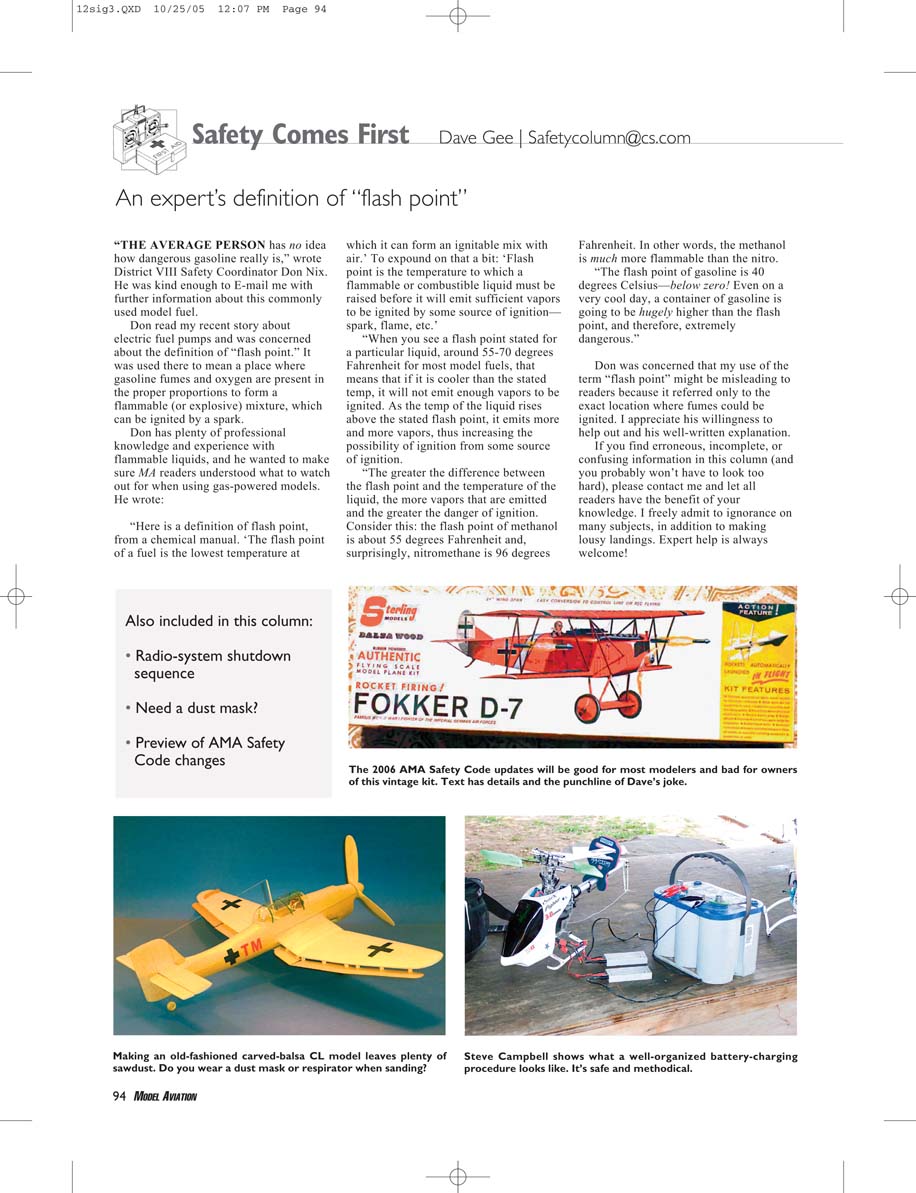
Did you catch item 8? Now look at the picture of a Fokker-model boxtop. The spring-loaded dummy rocket feature in that old Sterling kit is now officially prohibited as "any device which propels a projectile of any kind."
Maybe this will finally drive the price of these valuable collector's items low enough for a cheapskate columnist such as myself to buy one. Or will they just be built without the rockets? M.G.
Transcribed from original scans by AI. Minor OCR errors may remain.

