

Safety Comes First
Dave Gee
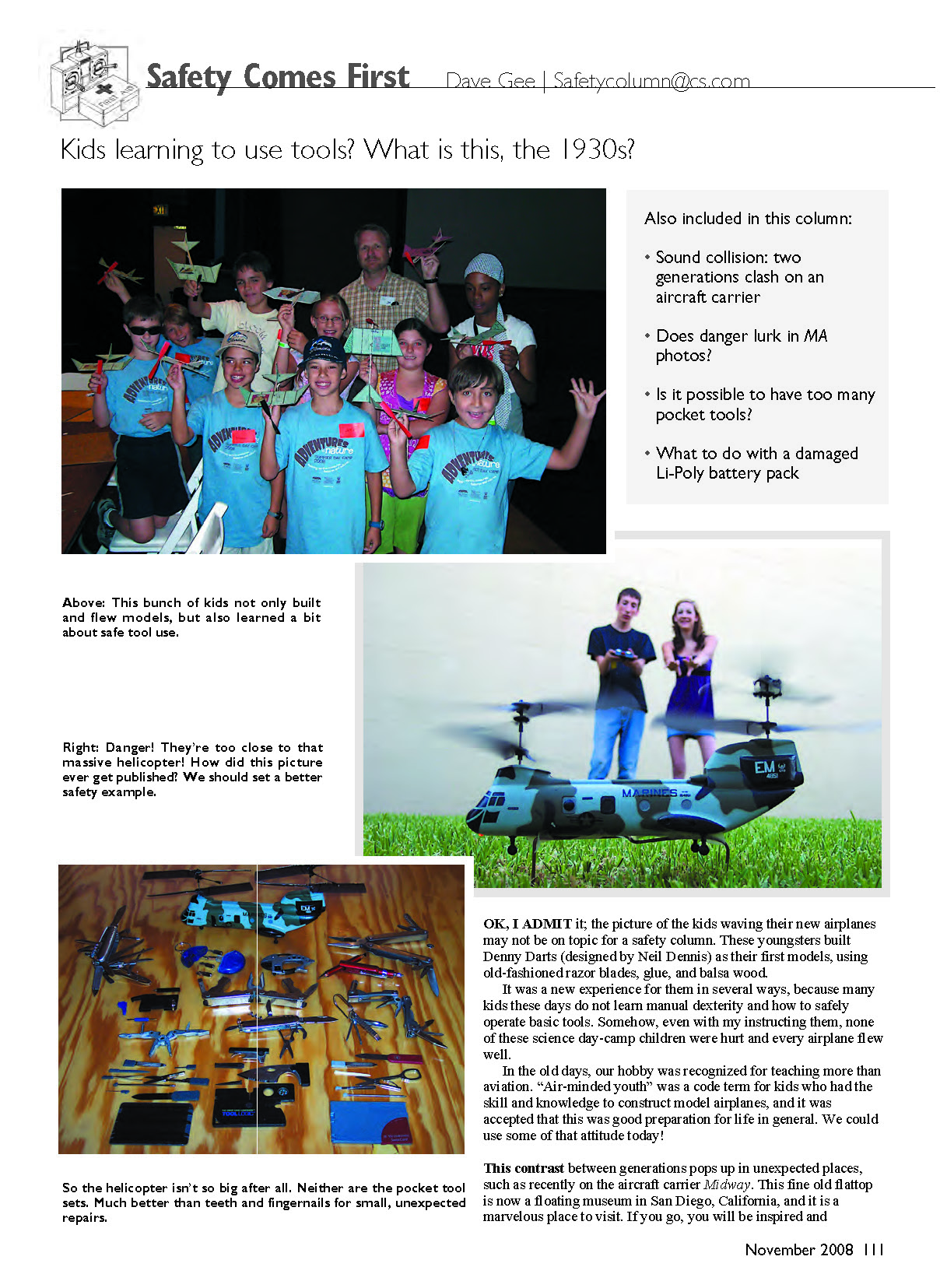
OK, I ADMIT it; the picture of the kids waving their new airplanes may not be on topic for a safety column. These youngsters built Denny Darts (designed by Neil Dennis) as their first models, using old-fashioned razor blades, glue, and balsa wood.
It was a new experience for them in several ways, because many kids these days do not learn manual dexterity and how to safely operate basic tools. Somehow, even with my instructing them, none of these science day-camp children were hurt and every airplane flew well.
In the old days, our hobby was recognized for teaching more than aviation. "Air-minded youth" was a code term for kids who had the skill and knowledge to construct model airplanes, and it was accepted that this was good preparation for life in general. We could use some of that attitude today!
This contrast between generations pops up in unexpected places, such as recently on the aircraft carrier Midway. This fine old flattop is now a floating museum in San Diego, California, and it is a marvelous place to visit. If you go, you will be inspired and awestruck by the ship, the aircraft, and the crew's stories.
I was on the bridge with a tour group, listening to the docent explain how a giant, complex vessel was controlled from this single room, when a young girl interrupted to ask a question. She pointed out the captain's old-fashioned rotary telephone and asked how he dialed it since it had no buttons. All the older people burst into laughter as the younger generation waited for the answer to what it thought was a good question.
This generational difference in mind-set is related to the kids who used a razor blade to cut balsa for the first time. These days there seems to be an expectation that everything has been made harmless and that if we are hurt in any way by anything, it is time to sue the guilty party.
All manner of things are designed to minimize danger more than ever, and the skillful, clever ways in which we are automatically protected can be amazing. Perfection is a nice goal but is impossible. The mind-set that some people acquire in a world of total and automatic protection can be more dangerous than ever.
Many young people have never seen a power tool without a blade guard and are baffled by the concept of having to take special care for one's own safety while using an inherently dangerous artifact. This includes a spinning propeller driven by a powerful engine or motor.
If your hair is gray and/or missing (such as mine is), you might have a bit of wisdom to pass across the generation gap to an eager young modeler who is emerging from an overly protected life to take part in our exciting sport. Try not to sound too crotchety.
On the topic of crotchetiness, I have received a large crop of E-mail messages from loyal MA readers who closely examine the photographs in each issue for safety violations and then triumphantly report any possible pictorial perversity (try saying that three times fast). I am the first to admit that the official publication of the Academy of Model Aeronautics should set an example, but I do not always agree with those who write in with their "gotcha" moments.
These reports seem to fall into certain categories, one of which is the obvious goof that should have been spotted before publication. Try as we might, these still slip through sometimes.
Another type has to do with the limitations of two-dimensional pictures; the eye can be fooled by a photograph. A model might look dangerously close to a person, while a side view might show the true proper distance.
Yet another typical "problem" photo is a posed shot that does not depict reality but would be improper if it did. The classic example is a model zooming past the camera, with the wingtips outside the shot. Two off-camera helpers are holding the aircraft for the cameraman.
A recent shot of a guy driving a convertible with his model sticking out of the backseat brought several E-mails. He wasn't wearing his seatbelt because the car wasn't in motion. And, yes, if he were really driving, the airplane would have ended up in pieces on the road. Few modelers would, as a result of that ad, get into an open car and zoom around with an aircraft loose on the seat while risking a seatbelt citation.
Think of nonmodeling ads that show some sexy woman on a mountaintop, next to a sports car, sipping vodka. Nobody really thinks she hiked up there in her evening gown or that she might accidentally drive off the cliff after she finishes her drink. It's just a picturesque ad.
The last type of complaint is the most baffling one. Readers will find something in a picture that I simply do not see. Maybe a rule technicality is being broken, but the danger is only in the reader's mind.
Sometimes a modeler writes in who is unfamiliar with the type of model in the photo. What is a normal operation for a Pylon racer might look dangerous to a glider pilot. Operating a gas-powered model involves putting one's hands close to the propeller, and a photograph will show this. CL Racers grab their models and make the fastest pit stops possible. Jet pilots stand near fuel cans and deal with hot exhaust streams.
Sharp fliers can do all those things safely. A photograph can show how close they are to trouble, while their skill and alertness keep them safe.
Look at the kids flying a twin-rotor helicopter. (This picture shows the extreme tolerance that my stepkids have for my wacky requests.) Pilot Justin Sorenson is not as close to the "giant" model as he appears. His sister, Jaclyn, is not really reaching into the rotors. The aircraft is safely anchored to the ground, because I couldn't keep it in frame otherwise.
This is to illustrate that a photo can be deceiving and that we should enjoy the artwork in MA without worrying that someone met a violent fate moments after the shutter snapped.
Another picture shows the true size of that little quadruple-rotor helicopter. It can literally fly out of your hand and is happy in a living room. And infrared control means never having to worry about frequencies.
In addition, it is so stable and well designed that even a columnist such as I can fly it. I hover it close to my head and other furniture, but the flexible rotors are incapable of causing harm.
Along with the helicopter, you see a part of my obsessive collection of pocket tools; I am a sucker for these things. I like being able to fix or adjust things even when my real toolbox is at home. People don't expect me to reach into my suit jacket and pull out pliers or tweezers to save the day.
I have more of these devices than I can carry—a point that Sweet Diedra has made clear to me while giving me her long-suffering-wife look.
Tool gadgets are great because they put a proper implement in your hands when you need it, rather than your having to fetch a toolbox or use makeshift methods such as turning a screw with a coin or cutting a box open with fingernails.
Modelers tend to be tinkerers—the type who try improvised repairs on an item. A pocket tool lets you tighten a screw or free a stuck hinge on the spot without damaging the threads or screw head.
Am I alone in this obsession with pocket tool sets? If you have your own drawer full of these things, please tell me about it.
I'd also like to hear about your close-call stories and any topics you think should be included here in the coming months. Drop me an E-mail or send a letter to the address in the source list.
A reader recently asked about a damaged, puffed-out Li-Poly battery pack. Where should it be taken? How does one dispose of a pack that has signs of trouble?
I didn't have a great answer. Driving it somewhere for disposal doesn't sound too good. Who wants to be in a moving car with a bad Li-Poly pack in his or her lap?
Dunking it in saltwater is not good advice for a charged pack. It must have the power drained first, preferably slowly, and only then can saltwater safely neutralize the pack.
An informal online survey showed that a few other pilots are also stuck. Some admit to burying the pack in the back yard for a few months, and others have punctured it deliberately "to see the fireworks." Yikes!
Your town might have a hazardous-chemical-disposal department that is willing to process such a pack, but be tactful; we could produce bad publicity if an emergency hazmat truck races over to someone's house with sirens blaring because of a 2-ounce battery.
I found sound advice on the FMA Direct Web site. It read:
"Dispose of cells or battery packs as follows: discharge—with the cell or battery pack in a safe area, connect a moderate resistance across the terminals until the cell or battery pack is discharged. Caution: the cell or battery pack may be hot. Discard Li-Poly Battery—puncture plastic envelope, immerse in salt water for several hours and place in regular trash."
An open-shaft 180 or 250 brushed motor works as a safe load. The motor can be attached with alligator clips. I'd do one cell at a time till the motor quits. The saltwater renders the cell contents' internal chemistry inert.
I recommend a nonconductive puncture tool, such as a sharpened wood dowel, to pierce the cell envelope. Vampire slayers have these handy in their pockets, I'm told.
I will now brace for the impact of better information that is bound to follow. MA
Sources:
Dave Gee Box 7081 Van Nuys CA 91409
Transcribed from original scans by AI. Minor OCR errors may remain.

